Materials
Titanium materials for additive manufacturing
Start with the required function, risk class, and evidence level. Then choose TC4 / Ti-6Al-4V Grade 5, Ti-6Al-4V ELI Grade 23, Grade 2 / TA2 / TA2G commercially pure titanium, or a special material route as needed.
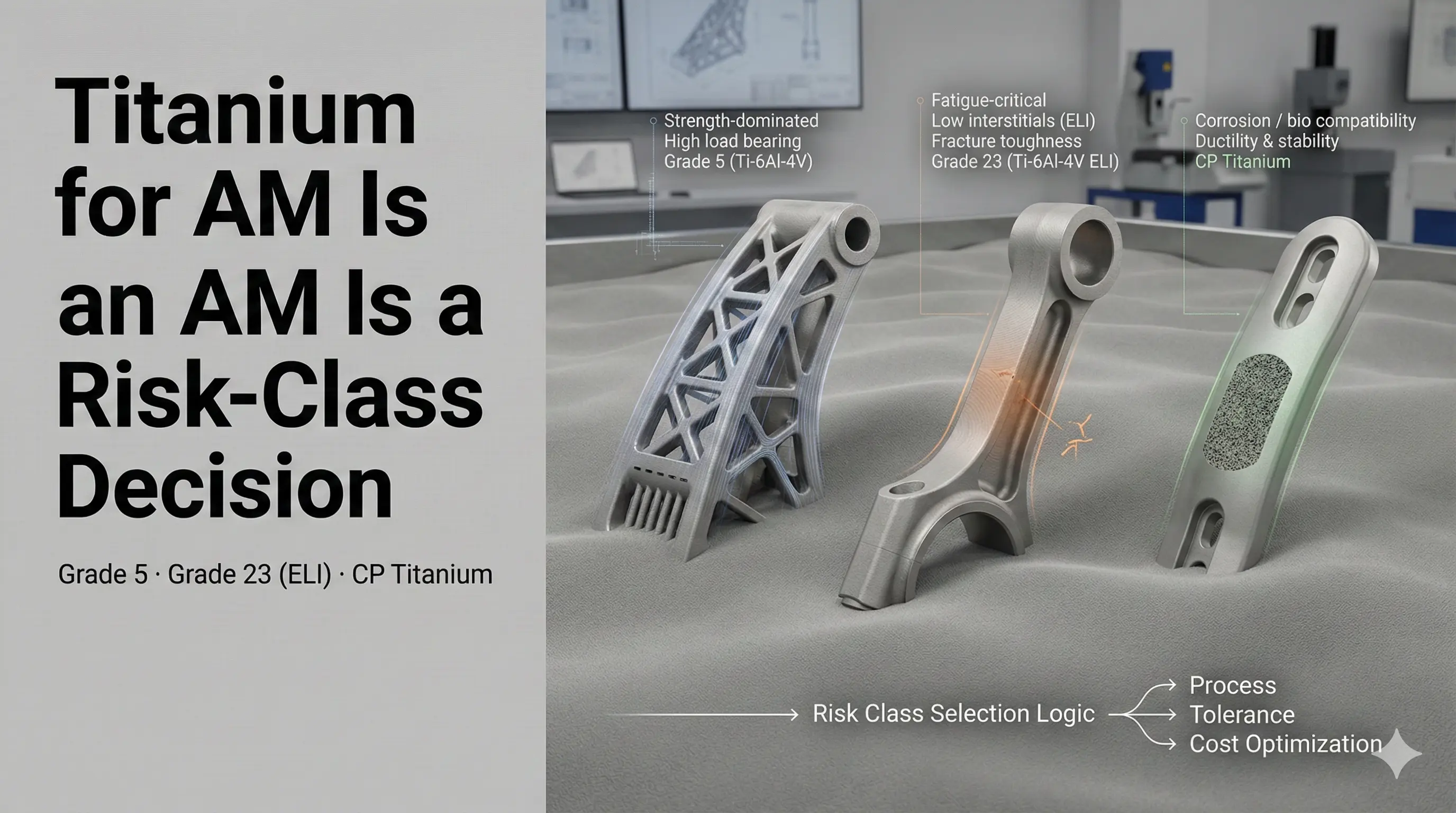
Common titanium AM material paths
The right grade is selected against fatigue risk, ductility, oxygen control, corrosion exposure, documentation expectations, and the actual material name used in the RFQ.
Common for strength-to-weight structural parts, brackets, housings, mounts, and performance hardware. TC4, Ti-6Al-4V, Grade 5, and Ti64 should be normalized before quote comparison.
ASTM F3001 powder bed fusion route for extra-low-interstitial Ti-6Al-4V when tighter chemistry and application-specific evidence matter.
Reviewed where corrosion behavior, ductility, or a controlled commercially pure titanium requirement matters more than maximum strength. Confirm the exact standard and supplier AM route.
Material selection should follow the risk class
Titanium AM material choice depends on fatigue sensitivity, ductility, temperature, corrosion, oxygen control, evidence level, and whether the part is a prototype or a production-intent component.
Define the standard
State the alloy grade and any ASTM, AMS, ISO, or customer specification instead of relying on an informal material name.
Match post-processing
Stress relief, anneal, solution/aging, HIP, machining, and surface finishing can materially change acceptance assumptions.
Tie evidence to risk
Material COA, build records, coupons, CMM, CT, and traceability should scale with the part consequence.
Not sure which titanium grade fits the part?
Send CAD, drawings, operating environment, load spectrum, temperature, corrosion or biocompatibility constraints, quantity, and required evidence package.