Applications

Use TC4 titanium AM where geometry changes the outcome

Titanium additive manufacturing earns its cost when TC4 / Ti-6Al-4V lightweighting, TA1 / TA2 corrosion-oriented hardware, part consolidation, internal geometry, or patient-specific form changes system performance enough to justify qualification and evidence.

TC4 and Ti-6Al-4V titanium 3D printing application parts

Application families

Start from the part function, failure mode, and material name before choosing TC4 / Ti-6Al-4V LPBF, EBM, machining, casting, or forging.

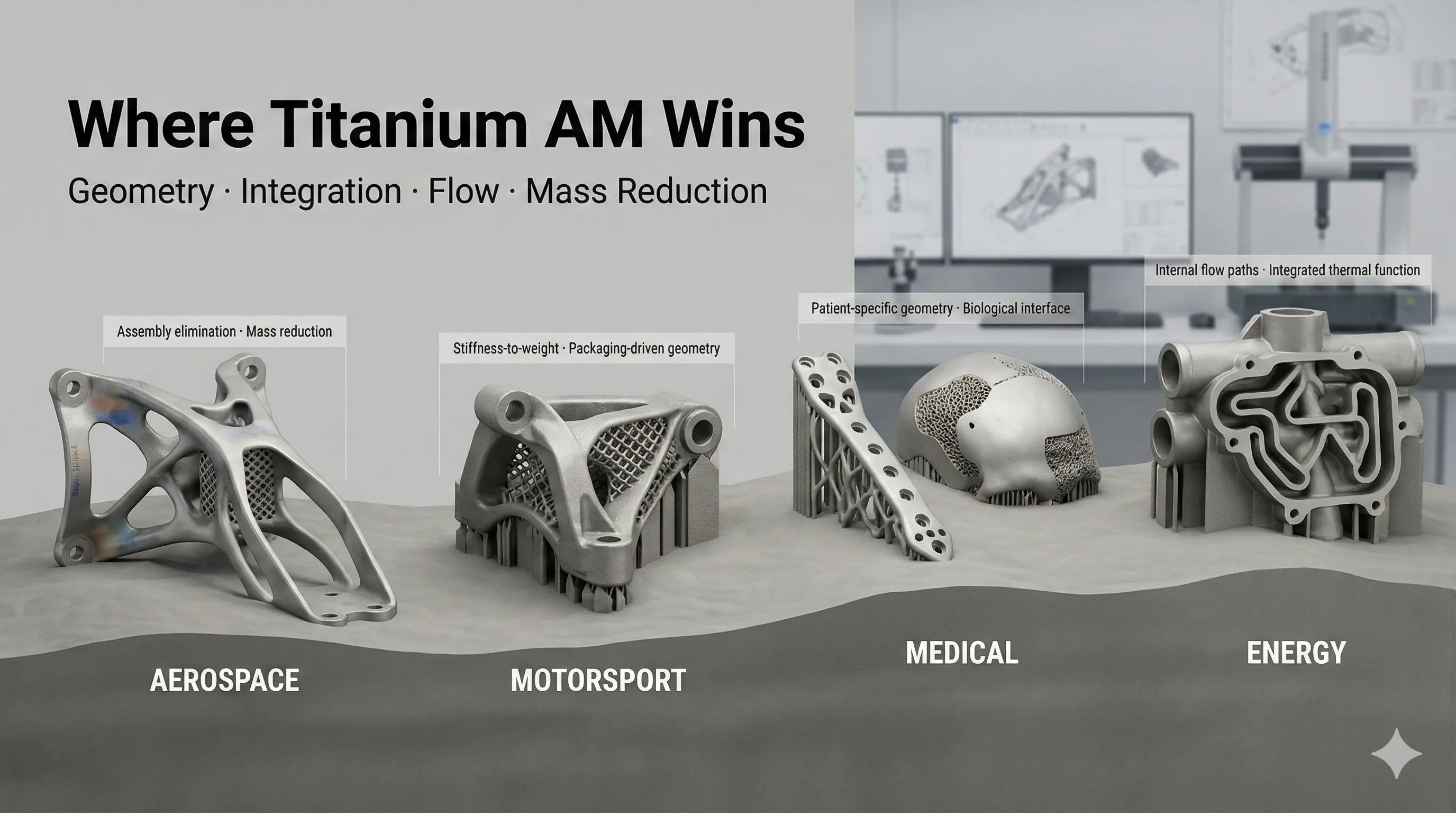
Aerospace lightweighting

TC4 / Ti-6Al-4V brackets, mounts, ducts, housings, and secondary structures where load-path geometry and evidence packages can justify AM.

Motorsport and robotics

End effectors, arms, mounts, and powertrain-adjacent structures where dynamic response improves when mass is removed.

Medical structures

ELI material routes, porous surfaces, patient-specific geometry, and validation scope for medical-adjacent use cases.

Energy and flow components

High-strength TC4 housings, TA1 / TA2 corrosion-oriented hardware, internal channels, thermal/flow structures, and compact titanium assemblies.

Part consolidation

Fewer fasteners, lower assembly mass, integrated interfaces, and reduced alignment stack-ups when qualification burden is acceptable.

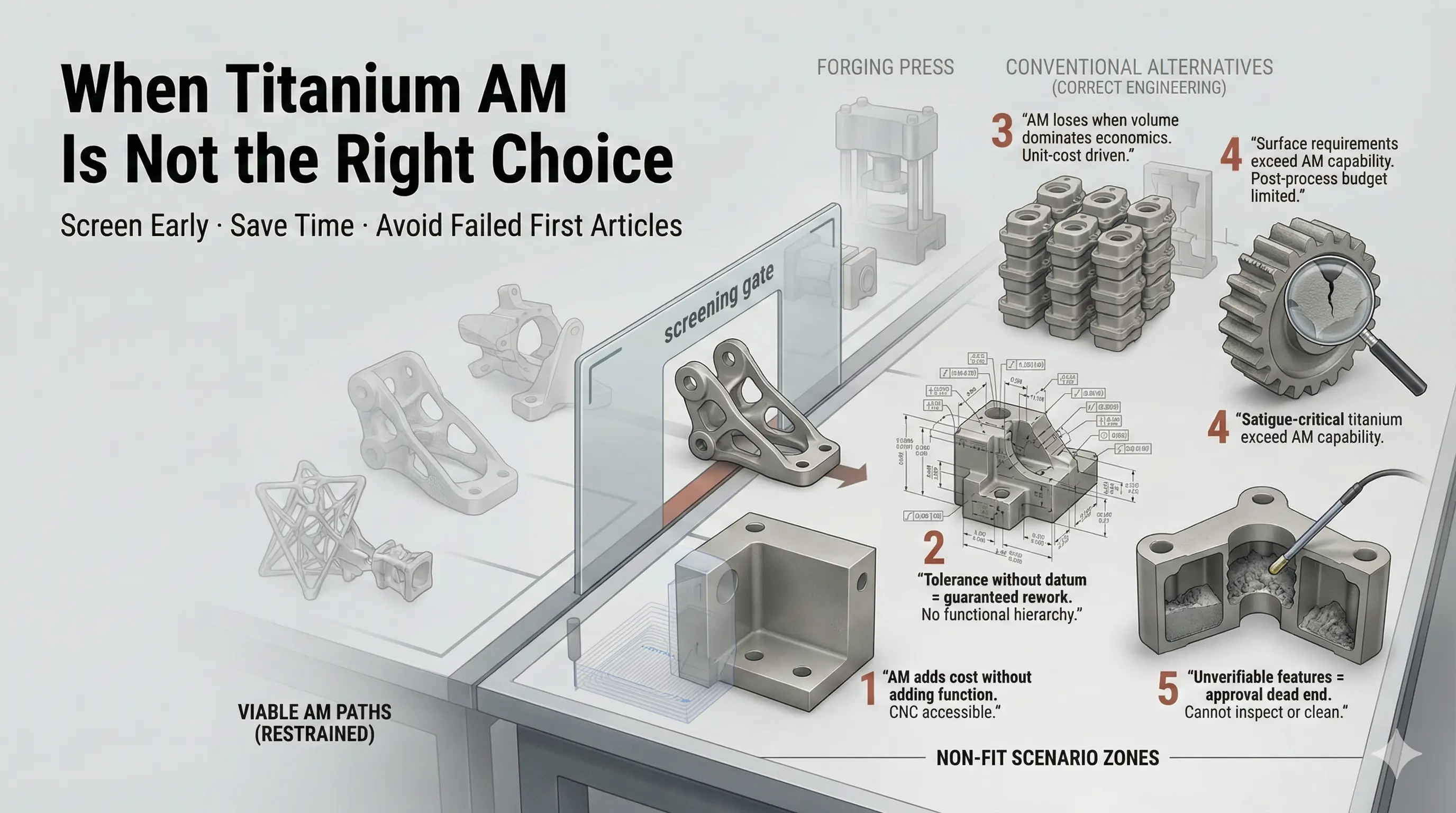
When to avoid AM

Simple geometry, all-over tight tolerances, no evidence budget, or high-volume cost sensitivity may favor conventional routes.

Where AM can help

Application-specific review

Use the actual system benefit to decide whether titanium AM is worth quoting.

TC4 and Ti-6Al-4V weight reduction that changes system behavior

TC4, Ti-6Al-4V, Grade 5, and Ti64 AM are strongest when mass reduction improves flight, vehicle, robot, or rotating-system behavior and the fatigue/evidence burden is planned from the start.

Topology-optimized structures

Organic load paths, variable sections, hollow structures, and stiffness-to-weight optimization.

Part consolidation

Eliminate fasteners, overlaps, joints, and assembly interfaces when repairability and qualification burden are acceptable.

Qualification boundary

The cost and schedule only work when inspection, surface finish, and fatigue evidence are aligned with risk.

TC4 and Ti-6Al-4V titanium 3D printed aerospace, motorsport, medical, and energy applications

Application screening before quotation

Not every titanium part belongs in AM. Screen the application around geometry value, load case, machining access, evidence budget, and procurement approval path.

Good fit

Complex load paths, internal channels, compact assemblies, patient-specific forms, and high value per kilogram saved.

Weak fit

Simple stock-like geometry, high-volume cost pressure, high fatigue claims with low evidence budget, or inaccessible supports.

RFQ decision

A useful quote connects application outcome to process route, finishing, inspection, documentation, and lead time.

TC4 titanium additive manufacturing application screening and RFQ rules

Application deep dives

Use these guides to connect an application idea to the manufacturing route, evidence burden, and purchasing path.

Drone and UAV parts

Review TC4 / Ti-6Al-4V AM for payload mounts, sensor brackets, motor junctions, thermal-adjacent hardware, vibration risk, and RFQ evidence.

Aerospace and defense supply chains

Evaluate titanium AM as an alternate supply route for lightweight structures, near-net blanks, bridge production, and qualified sourcing.

Application fit map

Compare aerospace, motorsport, medical-adjacent, energy, flow, and consolidation cases before committing to TC4, ELI, TA1, TA2, or CP titanium AM.

Internal channels and manifolds

Plan powder removal, CT inspection, pressure testing, cleaning access, and acceptance criteria for enclosed flow paths.

Fatigue-sensitive lightweight parts

Connect weight reduction to surface finish, support scars, HIP decisions, coupons, CT, and route-specific acceptance evidence.

Application library

Find the engineering decision, not another application slogan

These existing guides are grouped by the requirement that drives the quote. Use them to define the operating environment, failure mode, evidence burden, and RFQ inputs before deciding whether titanium AM is justified.

Flight, space, and lightweight mobility

Start with mass value, load path, fatigue exposure, interfaces, and the evidence required by the design authority.

Robotics and high-technology equipment

Translate equipment-level goals into stiffness, moving mass, heat, cleanliness, vacuum, and maintainability requirements.

Energy and critical infrastructure

Define the actual fluid, atmosphere, temperature, pressure, lifetime, code boundary, and inspection owner before selecting titanium AM.

Corrosion, water, thermal, and flow hardware

Do not select titanium from an industry label alone: specify the chemistry, pressure, temperature, erosion, galvanic interfaces, and acceptance test.

Critical-minerals and process-development hardware

Use titanium only after the process stream and failure mode are defined; experimental fixtures and production pressure hardware require different evidence.

Need a TC4 titanium AM application review?

Send CAD, target alloy name such as TC4, Ti-6Al-4V, Grade 5, Ti64, ELI, TA1, TA2, or CP Ti, plus quantity, lead time, load case, operating environment, critical dimensions, post-processing needs, and inspection requirements.