TC4 / Grade 5 material route
Ti-6Al-4V Grade 5 3D printing for custom TC4 parts
Review custom Ti-6Al-4V parts for LPBF or EBM with the required machining, finishing, and inspection scope. Grade 5, TC4, and Ti64 are useful sourcing names, but a comparable quote also needs a controlled material specification, delivered condition, CAD, drawing, and quantity.
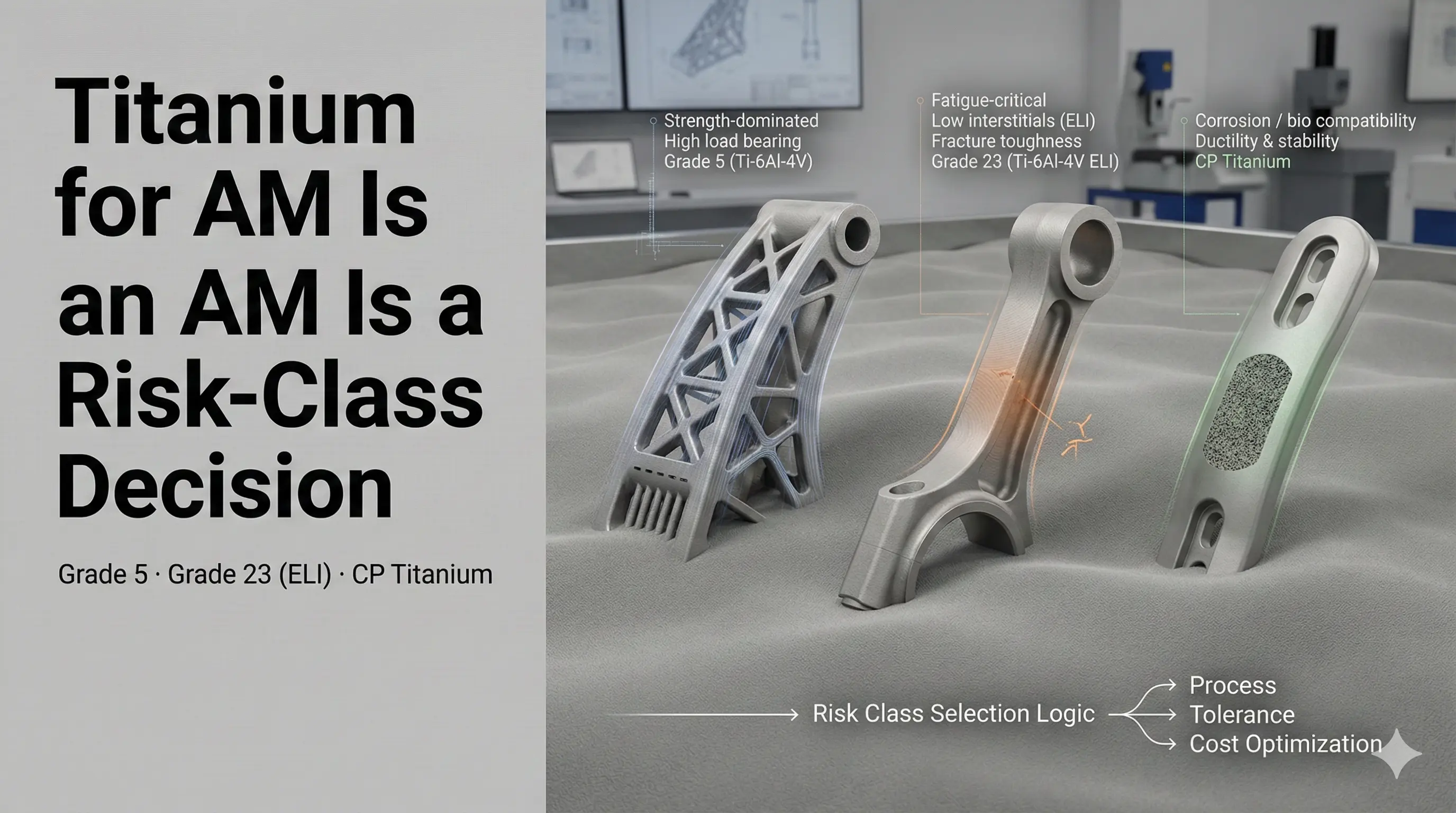
Quick TC4 additive manufacturing screen
The alloy name opens the discussion. Geometry value, process control, finishing access, and acceptance evidence decide whether the part is quote-ready.
High-value low-to-medium volume parts with lightweight load paths, consolidated interfaces, internal flow geometry, lattices, or machining reduction.
Governing material basis, LPBF or EBM route, build orientation, heat treatment, machining stock, surface condition, inspection, and traceability.
Simple prismatic geometry, high annual volume, all-over tight tolerances, inaccessible supports, or no budget for required qualification evidence.
Choose the quote scope
What should a Ti-6Al-4V 3D printing quote deliver?
State the project stage before comparing suppliers. These are RFQ scope choices, not fixed service packages; the actual material, process, inspection route, and availability require project-specific confirmation.
- Feasibility prototype
- Identify what the prototype must demonstrate and where as-built surfaces are acceptable. Ask the quote to name support removal, thermal condition, dimensional checks, and exclusions; do not use a geometry-only prototype to approve production performance.
- Machined functional part
- Mark datums, bores, threads, seal faces, machining stock, and surface-specific acceptance. Confirm the post-processing sequence rather than assuming “finished” means every surface is machined.
- Controlled production
- Add the approved specification revisions, powder/build genealogy, thermal records, inspection coverage, sampling, change control, and release authority. Use the qualification and inspection guide to define what the evidence must prove, not simply which reports to request.
Have CAD but an incomplete drawing? List the unresolved requirements in the Ti-6Al-4V RFQ and identify whether you need a budgetary review or a production-intent quotation.
Material name map
TC4, Ti-6Al-4V, Grade 5, and Ti64 in an RFQ
Alloy names help identify a material family. Purchase requirements need a controlled definition. This distinction prevents suppliers from quoting different material, post-processing, and evidence assumptions under one part number.
| Search or drawing term | How it is commonly used | What the quote must control |
|---|---|---|
| TC4 | Chinese engineering and sourcing designation commonly associated with the Ti-6Al-4V alloy family. | State the governing material or customer specification, AM process, chemistry limits, condition, and acceptance evidence. |
| Ti-6Al-4V | International composition-based alloy name used across aerospace, industrial, and AM supply chains. | Identify whether the requirement applies to powder, the printed component, a wrought comparison, or a customer-controlled material definition. |
| Grade 5 titanium | Common ASTM-oriented grade wording used by global engineering and purchasing teams. | Do not use a wrought Grade 5 callout alone to control an AM part; add the applicable AM and application requirements. |
| Ti64 / Ti 6-4 | Short sourcing and engineering shorthand for Ti-6Al-4V. | Replace shorthand with a controlled material line before purchase order release. |
| Grade 23 / Ti-6Al-4V ELI | Extra-low-interstitial variant used where tighter chemistry and selected fracture, fatigue, or medical requirements matter. | Do not substitute it automatically for Grade 5; define interstitial limits, application standard, and evidence expectations. |
Production route
The printed alloy is only one part of the delivered condition
Two quotes can both say “TC4” and still describe different parts. Compare the complete route, not only the powder name or machine hours.
- 1. Process basis LPBF/PBF-LB/M or EBM/PBF-EB/M, qualified machine and parameter route, build orientation, and lot definition.
- 2. Feedstock Powder specification, chemistry, particle-size basis, supplier lot, handling, storage, and reuse controls where required.
- 3. Build strategy Orientation, support contacts, distortion control, powder evacuation, witness features, coupons, and protected functional surfaces.
- 4. Thermal route Stress relief, anneal, or HIP selected against material condition, microstructure, fatigue risk, defect acceptance, and application rules.
- 5. Finishing Support removal, CNC machining, threads, sealing faces, surface treatment, cleaning, and preservation of datums and wall thickness.
- 6. Acceptance CMM, CT, density, roughness, leak or pressure testing, coupons, certificates, nonconformance handling, and traceability package.
RFQ checklist
Inputs for a comparable TC4 delivered-part quote
A supplier can price a printed shape with only CAD. A production-intent quote needs enough context to price the delivered, inspected, documented part.
- CAD and drawing
- The STEP model supports build review; the drawing controls datums, tolerances, surface finish, threads, sealing faces, and acceptance notes.
- Material basis
- State TC4, Ti-6Al-4V, Grade 5, Ti64, or a governing specification, then identify whether supplier recommendation is allowed.
- Part function and service
- Load direction, fatigue spectrum, temperature, corrosion, pressure, leak, vibration, and consequence of failure shape the route.
- Delivered condition
- Clarify stress relief, anneal, HIP, support removal, machining, surface treatment, cleaning, and any special handling.
- Acceptance evidence
- Define COA/COC, powder and build-lot traceability, coupons, CMM, CT, density, surface roughness, leak testing, and reports.
- Commercial scope
- Quantity, prototype or production intent, repeat demand, delivery date, packaging, and destination prevent incomplete quote comparisons.
Application routes
Where Ti-6Al-4V Grade 5 AM is commonly screened
The right question is not “Can TC4 be printed?” It is whether geometry value and the acceptance route justify AM for this part.
- Aerospace and defense brackets, mounts, housings, and alternate supply routes
- Drone and UAV payload, sensor, motor, and lightweight structural hardware
- Motorsport and racing parts with high value per kilogram removed
- Robotics arms, grippers, joints, end effectors, and compact housings
- Valve, pump, manifold, nozzle, and flow-control hardware
- Heat exchangers, cold plates, internal channels, and thermal hardware
Standards framework
Use standards as the baseline, then add project-specific acceptance
ASTM F2924-14(2021) covers Ti-6Al-4V components made by full-melt powder bed fusion and provides a purchasing and producer framework for feedstock, component classification, chemistry, microstructure, mechanical properties, and supplementary requirements.
F2924-14(2021) is listed as Active by ASTM at this review on September 13, 2026. It is a Ti-6Al-4V PBF component specification, not proof that a particular supplier or part meets your application requirements. If the drawing requires Ti-6Al-4V ELI, review the existing Grade 23 / ASTM F3001 material path instead of treating ELI and Grade 5 as interchangeable.
ISO/ASTM 52904:2024 addresses metal powder bed fusion process operation and production control for critical applications using laser- or electron-beam systems.
ISO/ASTM 52911-1:2019 provides design recommendations for laser-based metal powder bed fusion. The applicable contract, industry rules, customer specifications, and drawing requirements still control the final acceptance path.
For fatigue-critical, pressure-retaining, flight, or medical hardware, define the part-level qualification and acceptance authority separately. This page supplies no universal strength, fatigue life, tolerance, HIP cycle, or product approval. Use the existing titanium AM standards map when several specifications must flow into one purchase order.
TC4 titanium AM FAQ
Questions to resolve before supplier comparison
- Is TC4 the same as Ti-6Al-4V Grade 5?
- TC4, Ti-6Al-4V, Grade 5, and Ti64 are commonly used for the same broad alloy family in different markets. They are not a complete purchase specification. For an AM part, the RFQ should still control the governing standard, powder and component chemistry, process route, heat treatment, mechanical basis, inspection, and documentation.
- Can TC4 titanium parts be produced by LPBF?
- Yes, Ti-6Al-4V is widely processed by laser powder bed fusion. Feasibility still depends on geometry, wall and channel access, orientation, support removal, distortion, machining allowance, surface requirements, and the qualified parameter and evidence route.
- What is the difference between Grade 5 and Grade 23 ELI?
- Grade 23 is the extra-low-interstitial Ti-6Al-4V route. It is selected when its chemistry and resulting performance basis are required, not simply because it sounds like a higher grade. The drawing or RFQ should state the applicable standard and acceptance requirements.
- Does every TC4 LPBF part need HIP?
- No. HIP is a risk-based process decision. Fatigue sensitivity, internal-defect acceptance, section thickness, surface condition, application requirements, and qualification strategy should determine whether HIP belongs in the route.
- What should I send for a TC4 titanium 3D printing quote?
- Send a STEP file, controlled drawing, material or standard target, quantity, operating environment, load and failure concerns, critical surfaces, tolerances, delivered condition, inspection and documentation requirements, and required delivery date.
Send a TC4 or Ti-6Al-4V part for engineering review
Include CAD, drawing, material or standard target, quantity, service conditions, critical features, delivered condition, inspection evidence, and timing.