- TITANIUM 3DP Engineering - Engineering Guides - 8 min read
Ti-6Al-4V 3D Printing Lead Time: Prototype to Production
A buyer-focused guide to Ti-6Al-4V 3D printing lead time, from CAD review and LPBF scheduling through heat treatment, machining, inspection, documentation, and repeat production.
On this page
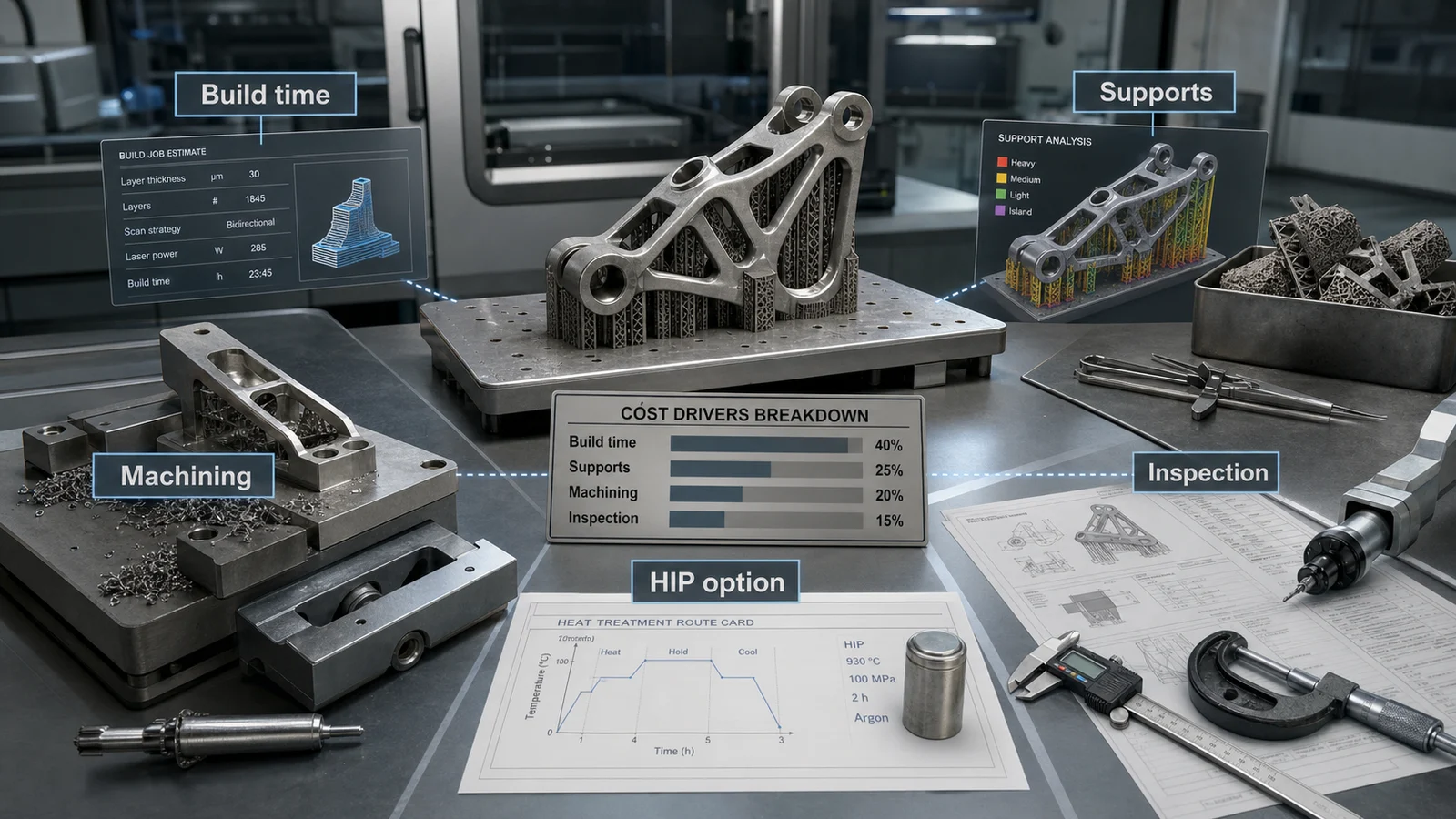
Ti-6Al-4V 3D printing lead time is not just the number of hours a part spends in an LPBF machine. A delivered functional component may pass through manufacturability review, orientation and support design, build scheduling, printing, depowdering, thermal processing, plate separation, support removal, CNC machining, surface finishing, inspection, testing, documentation, and shipping.
The shortest credible schedule is the shortest complete process route that still delivers the required part condition and evidence. Removing an undefined inspection or heat-treatment step from a quote may make the date look earlier without making the part acceptable.
Short Answer
A simple prototype with open geometry, standard material, light finishing, and basic dimensional inspection can move quickly when capacity is available. A production-intent part takes longer when it includes:
- New DfAM work or unresolved drawing requirements.
- Enclosed passages that need cleaning and CT or flow verification.
- HIP, specialized heat treatment, or external processing queues.
- Multiple CNC setups or difficult fixture development.
- CMM, leak, pressure, fatigue, or material testing.
- First-article approval and a controlled documentation package.
- Customer hold points between manufacturing stages.
No universal online lead-time promise is reliable without the model, drawing, quantity, material condition, acceptance scope, and delivery location.
Lead Time by Manufacturing Stage
| Stage | What must happen | Frequent schedule constraint | What the buyer can provide early |
|---|---|---|---|
| Technical review | Confirm process fit, requirements, geometry risks, and quote scope | Missing drawing, conflicting files, undefined acceptance | STEP or native CAD, controlled PDF, quantity, operating conditions |
| Build preparation | Select orientation, create supports, add stock, plan coupons and layout | Protected faces or datum strategy not identified | Critical surfaces, no-support zones, machining permissions |
| Build scheduling | Reserve machine, powder, plate, and build capacity | Machine queue, material campaign, part quantity, shared build policy | Firm demand, delivery priority, acceptable split lots |
| LPBF build | Preheat where applicable, scan layers, monitor process, cool safely | Build height, layer count, interruption or build failure | Approval of the frozen build plan and configuration |
| Primary post-processing | Depowder, stress relieve, separate, remove supports | Thermal-processing batch and support access | Required delivered condition and approved processors |
| CNC and finishing | Establish datums, machine interfaces, finish specified surfaces | Fixture design, tool access, tolerance density, subcontract queue | Functional datum scheme, stock strategy, roughness by surface |
| Inspection and testing | CMM, CT, material tests, leak or pressure tests as required | Undefined thresholds, CT feasibility, report review | Methods, acceptance limits, sampling plan, report format |
| Release and logistics | Compile records, approve deviations, pack, ship | Missing document list, customer hold, export or logistics issue | Required certificates, ship-to details, Incoterms, contact for decisions |
The critical path is the longest connected chain of dependent operations. Adding every stage duration together can overstate lead time when work runs in parallel, but ignoring external queues can understate it.
Prototype Lead Time and Production Lead Time Are Different Problems
Prototype schedule
A prototype may be intended to test fit, flow, assembly, or early structural behavior. It can sometimes use limited documentation and a focused inspection plan. That flexibility should be explicit. “Prototype” does not automatically mean that material traceability, stress relief, dimensional acceptance, or safe pressure testing can be omitted.
The first prototype also carries learning work: orientation, support strategy, distortion prediction, machining access, fixture concepts, and the interpretation of incomplete requirements. A repeat of the same controlled prototype may move faster because these decisions have already been made.
Production-intent schedule
Production begins before the machine starts. Configuration control, approved material and process specifications, lot definition, supplier qualification, inspection planning, first-article requirements, nonconformance handling, and record retention can determine the route.
The initial production lot may therefore take longer than a prototype even when the CAD shape is unchanged. Once the build, post-processing, machining, and inspection route is stable, repeat orders can use established programs, fixtures, travelers, and report templates.
What Usually Controls the Schedule
1. Incomplete or changing requirements
The fastest way to lose time is to request an urgent quote while the alloy, drawing revision, tolerances, heat-treatment condition, or acceptance tests are still changing. Suppliers either pause for clarification or add assumptions that must be reopened later.
Issue a controlled RFQ package and identify which requirements are fixed, which may be optimized, and who can approve a deviation. The titanium AM RFQ guide provides the full input list.
2. Build height and orientation
LPBF creates the part layer by layer. Build height affects machine occupancy, but the lowest orientation is not automatically the fastest complete route. Rotating the part can add supports, worsen down-facing surfaces, change distortion, or make finish machining more difficult.
Approve orientation as part of a complete DfAM review rather than prescribing it from one cost or schedule variable.
3. Thermal processing and HIP
Stress relief, annealing, or HIP may be required by the specification or justified by the material and failure mode. External processing introduces transport, batch, and certificate timing. A request to remove HIP should be an engineering decision tied to requirements, not a scheduling shortcut.
4. Machining and fixtures
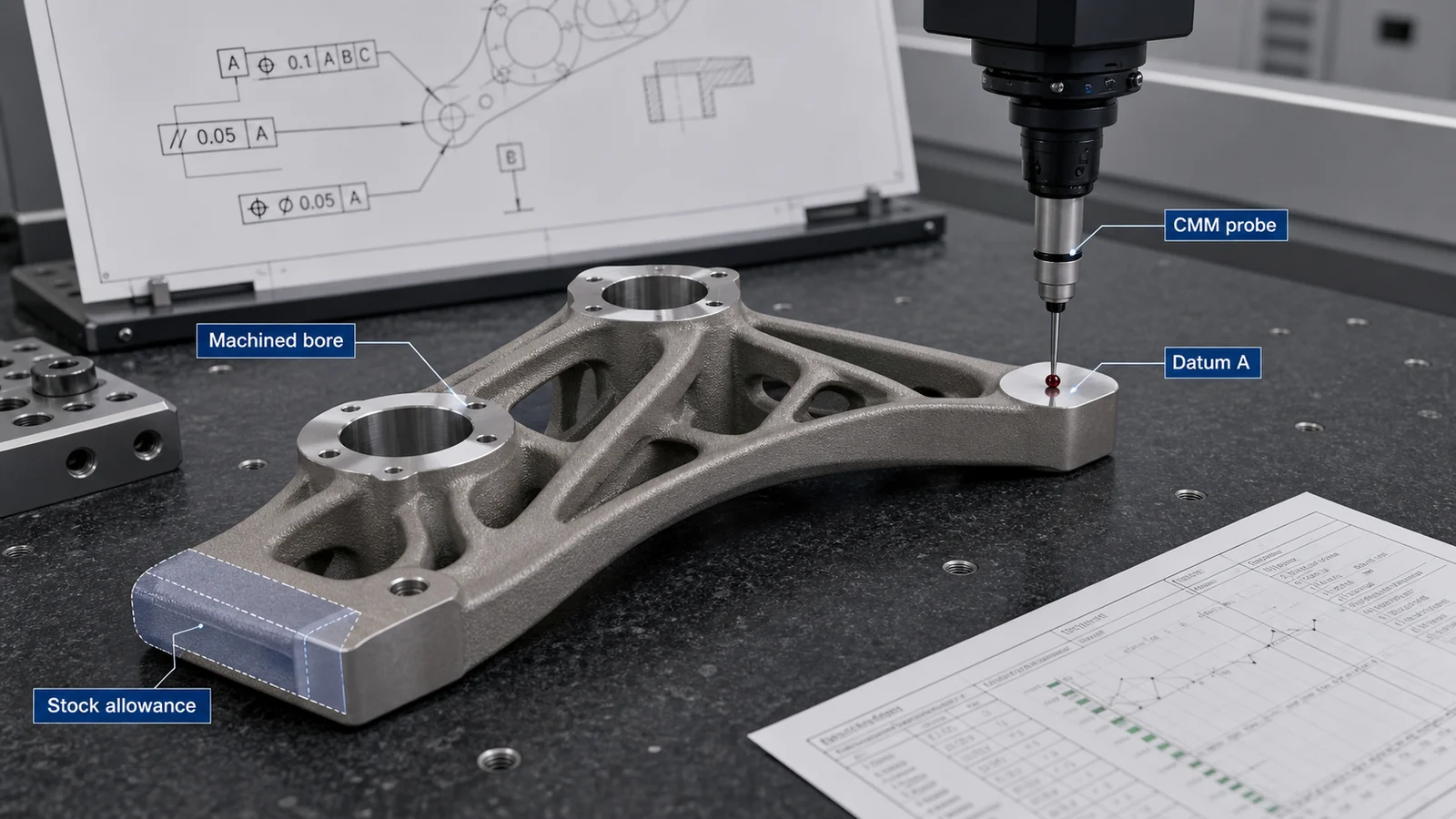
Machining can be the critical path when a printed part has multiple precision interfaces but no stable, accessible datum strategy. Custom soft jaws, sacrificial features, or dedicated fixtures may be needed before production machining begins.
Identify final bores, threads, sealing faces, bearing seats, and located interfaces early. The tolerance, datum, and CMM guide explains how drawing choices affect both schedule and acceptance.
5. Internal-channel acceptance
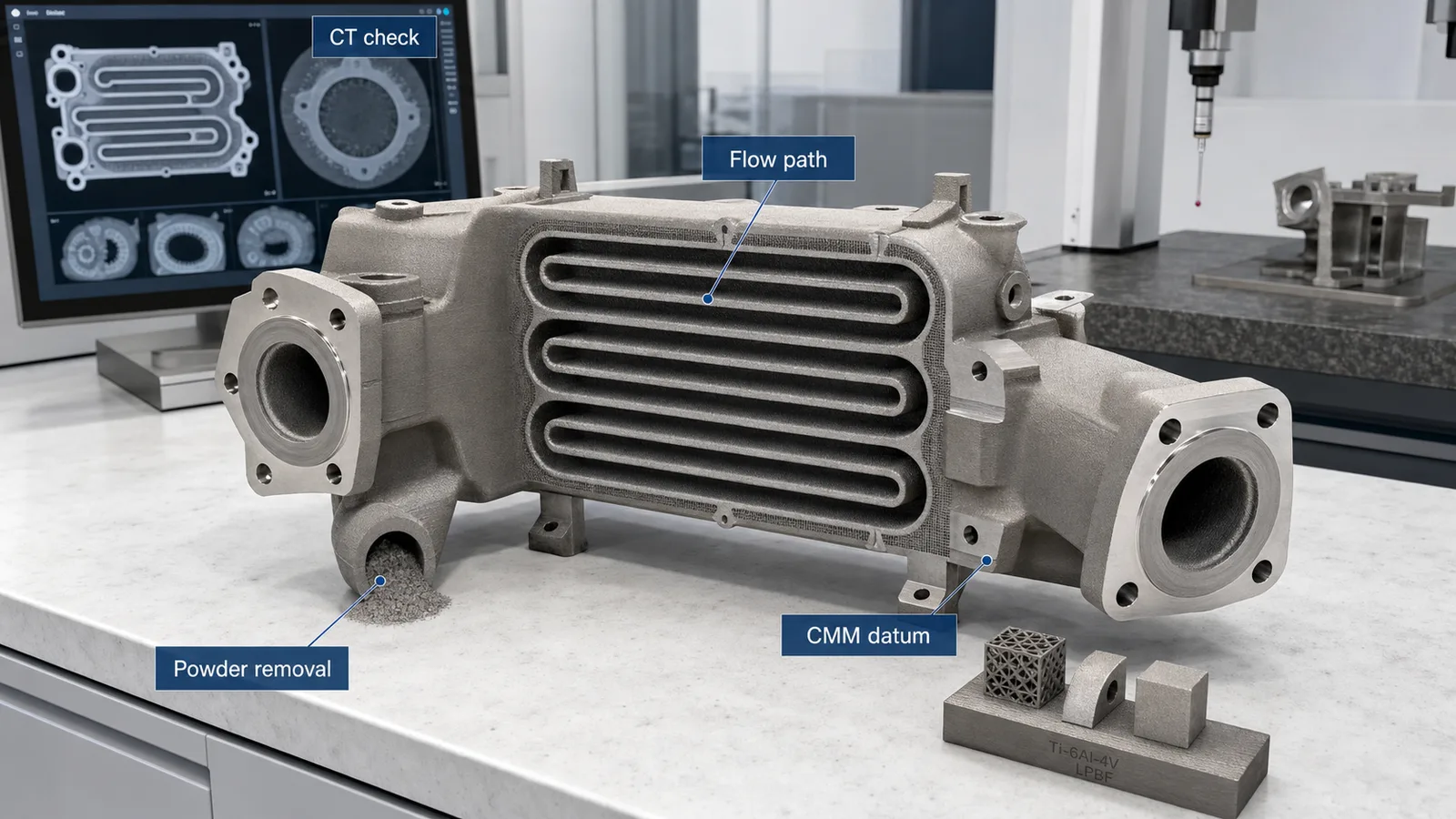
Enclosed geometry may need repeated depowdering, cleaning evidence, CT review, flow testing, or leak testing. CT is not an instant universal answer: part size, material thickness, feature orientation, resolution, artifact risk, and acceptance thresholds affect feasibility.
Use the internal channels, powder removal, and CT guide before setting a delivery date for a manifold or flow component.
Work That Can Often Run in Parallel
Schedule compression should remove waiting and rework, not required controls. Depending on supplier capability and project risk, useful parallel work can include:
- Starting fixture design after orientation and machining stock are frozen.
- Reserving external heat-treatment or HIP capacity while the build is scheduled.
- Preparing CMM programs from the controlled model and drawing before parts arrive.
- Agreeing report templates and document indexes during manufacturing.
- Procuring standard tooling, gauges, and shipping materials before build completion.
- Reviewing a representative coupon or first article while later units remain on hold.
Parallel work creates commercial risk if the design is still changing. State who pays for committed work when a late revision invalidates fixtures, programs, or reservations.
How to Expedite Without Weakening the Part
- Freeze the inputs. Send one controlled model, one drawing revision, and one requirement list.
- Separate must-have evidence from optional investigation. Tie each inspection to a failure mode and acceptance decision.
- Ask for the critical path. The supplier should identify the stage controlling the promised date.
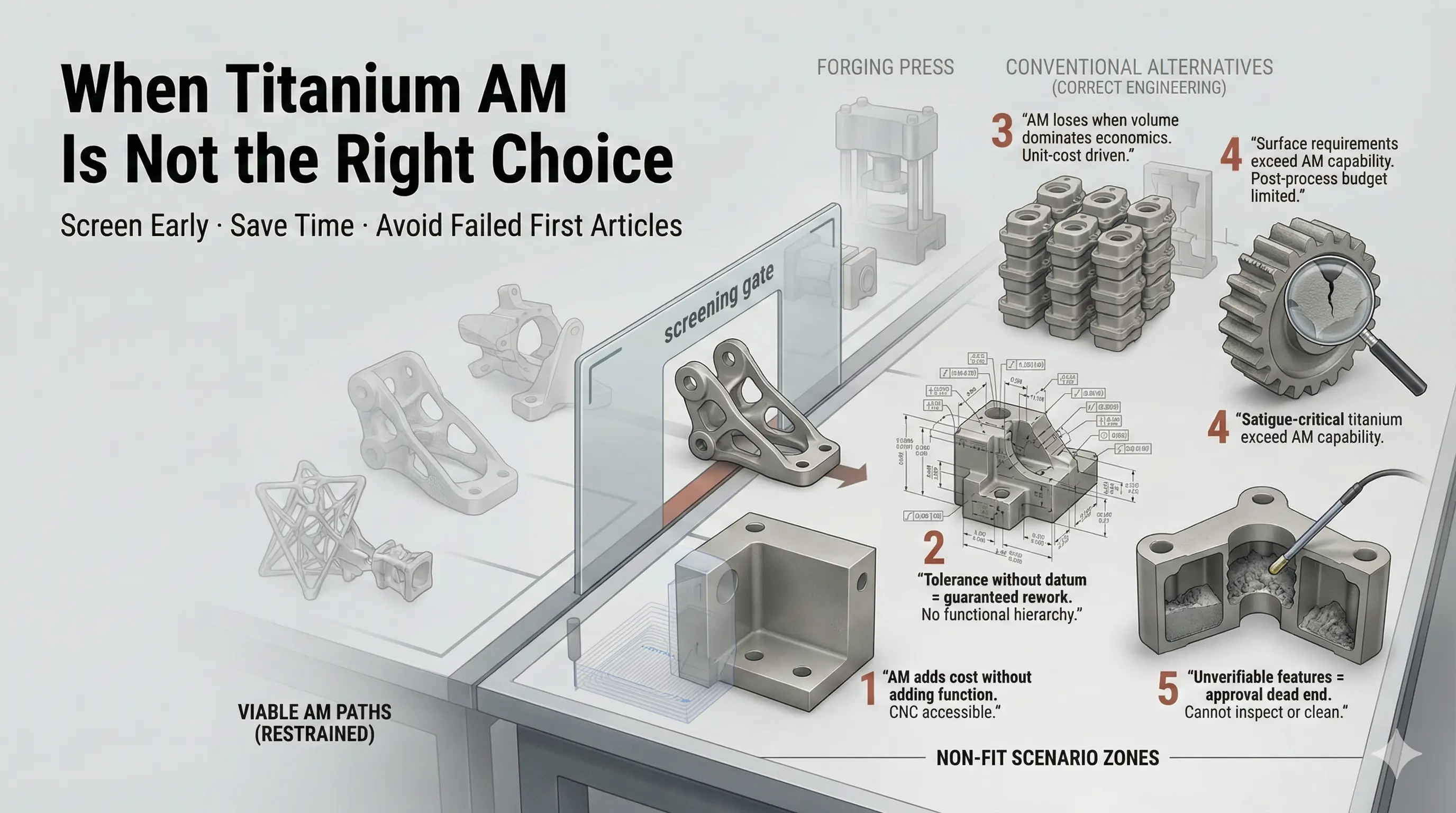
- Allow route alternatives. A hybrid AM-plus-CNC approach or a CNC baseline may meet the need sooner for some parts.
- Approve quickly. Name decision owners for DfAM, deviations, first article, and documentation.
- Use staged delivery when useful. A verified first article may arrive before the balance, provided lot and approval controls remain clear.
- Plan repeat demand. Forecasts can support material campaigns, capacity reservations, fixture readiness, and batch processing.
Avoid “expediting” by silently dropping stress relief, material records, leak testing, or final dimensional inspection. A nonconforming urgent part does not shorten the project.
Lead-Time Questions to Ask a Supplier
- Is the quoted date for an as-built shape or a finished, inspected part?
- Which stages are performed in-house and which are subcontracted?
- What starts the clock: RFQ, purchase order, data approval, material availability, or build-plan approval?
- What is on the critical path?
- Does the schedule include first-article review or customer hold points?
- Are HIP, machining, CT, CMM, leak testing, and documentation included?
- What assumptions would change the delivery date?
- Can quantity be split into controlled lots or staged deliveries?
- What happens to schedule after a build interruption or rejected operation?
- Which work can be reused on a repeat order?
A useful supplier response should expose dependencies and assumptions instead of presenting one unexplained number.
Send This Package for a Reliable Date
- STEP or native CAD plus a controlled PDF drawing.
- Material name and specification, including whether TC4 means Ti-6Al-4V Grade 5 for this project.
- Required delivered heat-treatment and surface condition.
- Prototype quantity, production quantity, annual demand, and requested delivery location.
- Critical dimensions, datums, roughness, internal passages, and protected surfaces.
- Functional loads, temperature, pressure, media, fatigue, cleanliness, and leak requirements.
- Inspection, test, sampling, traceability, and document requirements.
- Whether DfAM changes, alternate processes, split delivery, or equivalent standards may be proposed.
Use the TC4 / Ti-6Al-4V Grade 5 material guide to normalize the alloy terminology. If the route itself is uncertain, compare titanium 3D printing with CNC machining before committing to an AM schedule.
Sources and Scope
The NIST powder bed fusion overview provides process context. ASTM F2924 covers additively manufactured Ti-6Al-4V by powder bed fusion and notes that parts are often post-processed to achieve final surface finish and critical dimensions. ISO/ASTM 52911-1 provides design guidance for laser-based powder bed fusion.
These references do not define a universal commercial lead time. Actual dates depend on the approved process route, supplier capacity, part-specific risk, and release requirements. For a schedule based on real geometry, request a Ti-6Al-4V manufacturability and lead-time review.
- Ti6al4v 3D printing lead time
- Tc4
- Prototype
- Production
- LPBF
- Procurement
- RFQ