· Updated - TITANIUM 3DP Engineering - Engineering Guides - 7 min read
Titanium 3D Printing Cost: How Ti-6Al-4V Parts Are Quoted
A buyer-focused guide to titanium 3D printing cost: how geometry, build height, supports, quantity, HIP, machining, CT/CMM, and documentation shape a Ti-6Al-4V quote.
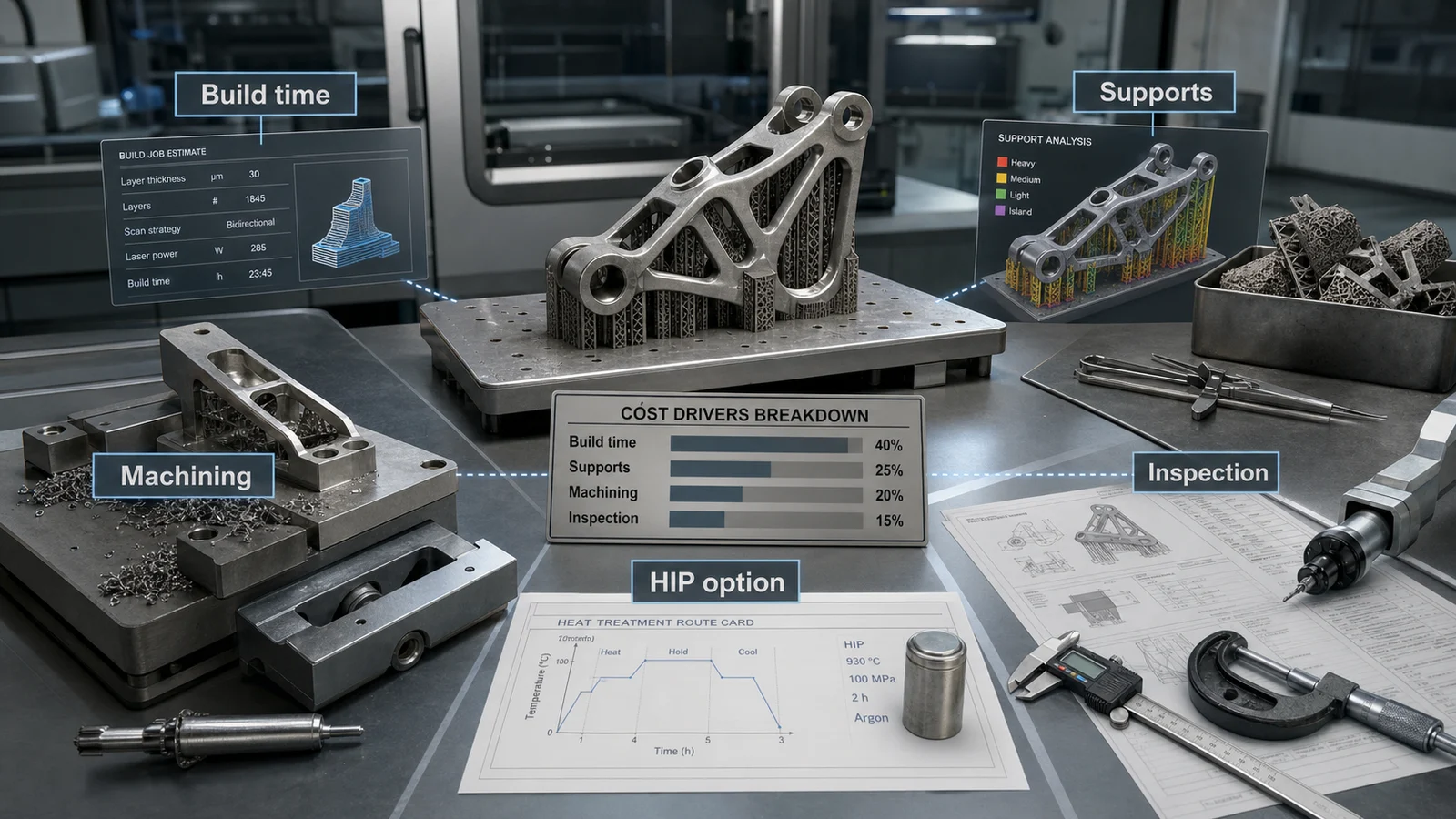
Representative article image; not a customer acceptance record or proof of a qualified manufacturing route. Refer to the cited sources and part-specific inspection records for engineering evidence.
On this page
There is no reliable universal price per gram or price per cubic centimeter for a finished titanium 3D printed part. Those shortcuts ignore the operations that often determine the quote: engineering review, machine occupancy, supports, heat treatment, machining, inspection, documentation, and the risk created by missing requirements.
This guide is for engineers and buyers who want to understand a Ti-6Al-4V, Grade 5, Ti64, or TC4 additive manufacturing quote before sending CAD to suppliers.
Short Answer: What Drives Titanium 3D Printing Cost?
For most production-intent titanium powder bed fusion parts, the delivered cost can be understood as six connected blocks:
- Build preparation and manufacturing engineering.
- Powder bed fusion machine time and build utilization.
- Depowdering, support removal, and thermal processing.
- CNC machining and surface finishing.
- Inspection, testing, and release documentation.
- Commercial risk caused by unclear geometry, acceptance, quantity, or schedule.
Powder matters, but it is not a complete price model. A light part with difficult supports, inaccessible channels, five machined ports, CT inspection, and full traceability can cost more than a heavier part that is low, self-supporting, easy to finish, and simple to inspect.
Why Online Price Ranges Are Often Misleading
Search results commonly present titanium printing as a price per unit volume or mass. That can be useful for a rough print-only comparison, but it is a poor predictor of the delivered part.
The same solid volume can produce different quotes when:
- One orientation doubles build height.
- Supports touch a sealing face or fatigue-sensitive edge.
- Internal powder cannot be removed through the available openings.
- Tight bores and threads require a second CNC setup.
- HIP, CT, CMM, coupons, or certificates are included by only one supplier.
- One quote is for an as-built shape and another is for an accepted, cleaned, machined component.
Before comparing numbers, normalize what each quote actually delivers.
Titanium AM Cost Stack
| Cost block | What creates the work | Information that improves the quote |
|---|---|---|
| Engineering | Orientation, support design, compensation, build layout, risk review | Native CAD or STEP, drawing, critical surfaces, permission for DfAM changes |
| Machine time | Build height, scan area, layer count, recoating, machine utilization | Quantity, annual demand, delivery schedule, acceptable part orientation |
| Support and depowdering | Support volume, removal access, trapped powder, cleaning verification | Protected surfaces, channel access, drain/cleaning openings, residual-powder requirement |
| Thermal processing | Stress relief, anneal, HIP, batch certificates | Required delivered condition and whether supplier recommendation is allowed |
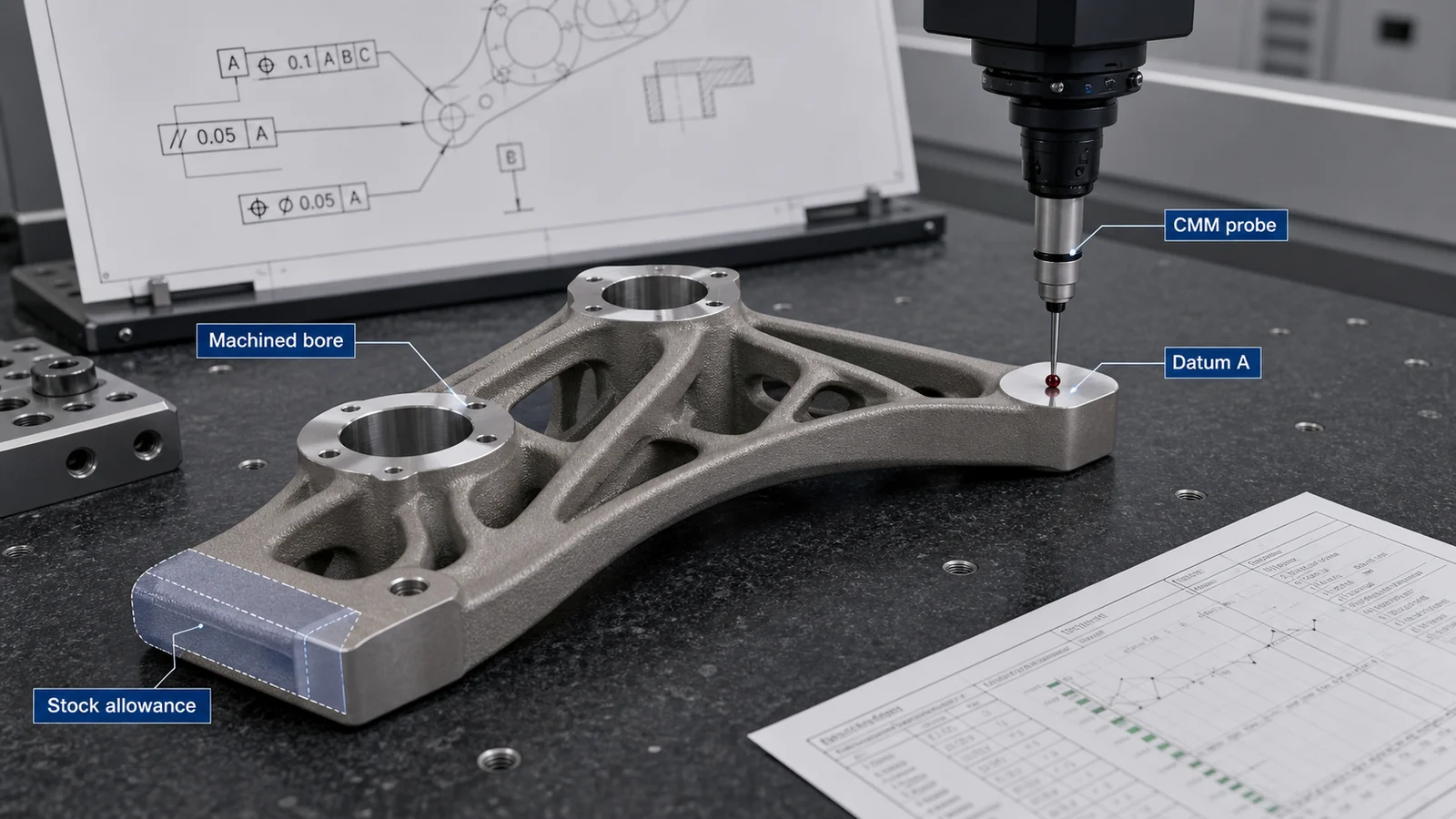
| Machining and finish | Fixtures, datums, stock, tool access, threads, bores, sealing faces | Controlled drawing, machining stock, datum scheme, roughness by surface |
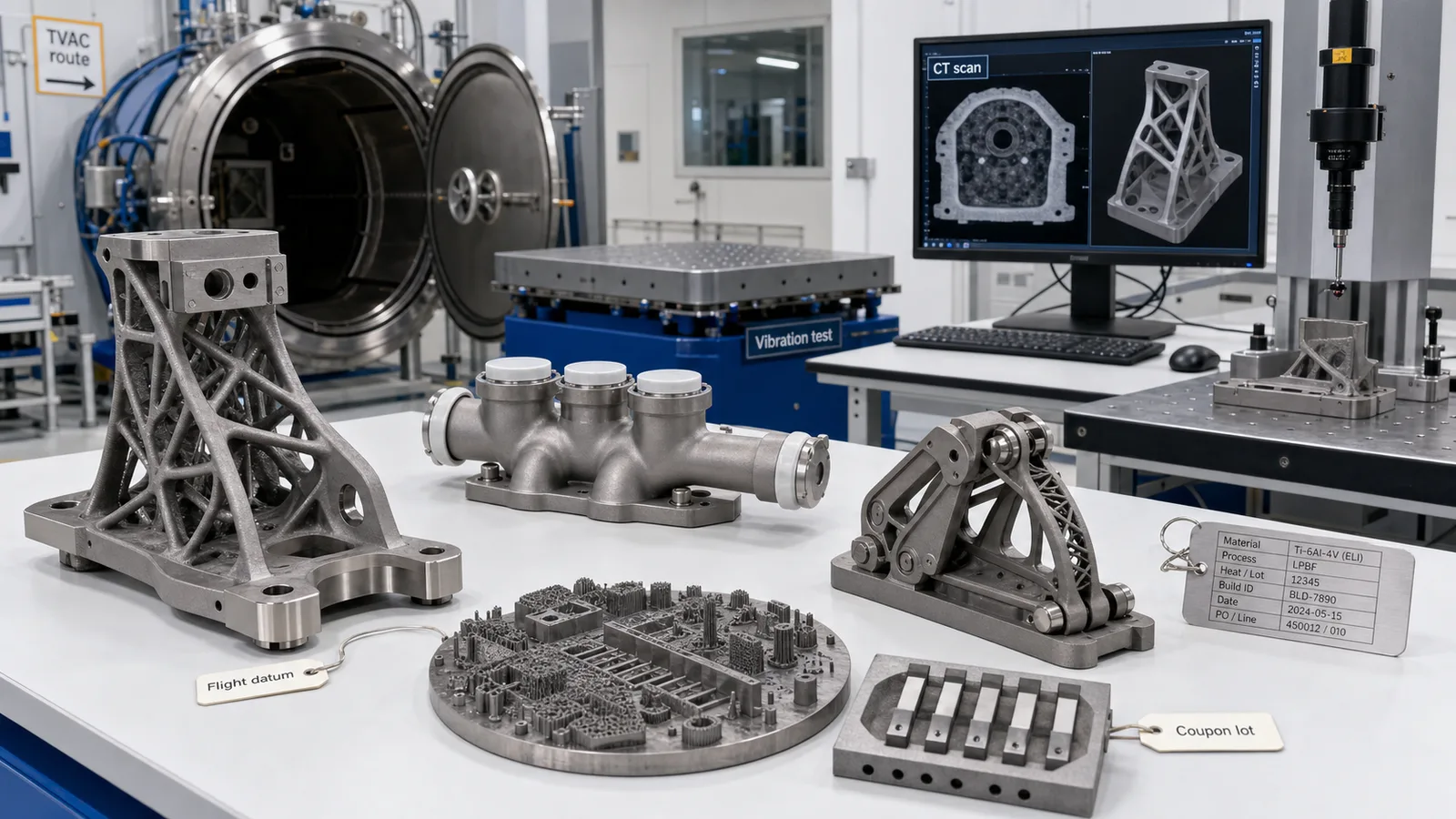
| Inspection and release | CMM, CT, density, coupons, leak test, reports, traceability | Acceptance criteria, decision thresholds, report format, lot definition |
This table is more useful than asking which supplier has the lowest hourly machine rate. A cheaper build can become the more expensive route after support removal, machining, inspection, and rework are added.
The Largest Cost Lever Is Often Geometry
Build height
Powder bed fusion builds the part layer by layer. A taller orientation generally occupies the machine longer. Rotating a part can reduce height, but orientation also changes supports, surface condition, distortion, anisotropy considerations, and machining access. The lowest part in the Z direction is not automatically the lowest delivered cost.
Support contact
Supports are not free temporary geometry. They require design, printing, separation, finishing, and inspection. Cost rises when supports are inside pockets, attached to thin walls, or placed on surfaces that later need sealing, fatigue performance, or cosmetic finish.
Internal passages
Internal channels can justify additive manufacturing, but only when powder can be removed and the feature can be accepted. Blind cavities, long dead legs, abrupt transitions, and hidden lattices add cleaning time and supplier risk. If a channel is functional, include access, flow, cleanliness, and inspection requirements in the RFQ.
Use the internal-channel and powder-removal guide before freezing enclosed geometry.
Quantity Changes the Best Cost Strategy
Quantity affects more than a simple unit-price discount.
For one prototype, engineering setup and minimum external-process charges may dominate. For a batch, the supplier can spread build preparation, fixtures, programming, and documentation across more units. At higher repeat volume, build nesting and stable post-processing can improve economics, but conventional machining, forging, casting, or a hybrid route may become more competitive.
An RFQ should distinguish:
- Immediate prototype quantity.
- Expected validation or pre-production batch.
- Annual demand and order frequency.
- Whether parts may share a build.
- Whether configuration or drawing revisions are likely.
A supplier cannot assess repeat-production economics from “quantity: one” when the real program may need hundreds of parts after approval.
When Titanium AM Can Beat CNC Cost
Titanium AM is most likely to create economic value when it removes cost elsewhere in the system:
- A topology-optimized part replaces a large billet with extensive material removal.
- Several machined or welded pieces become one controlled component.
- Internal passages eliminate drilling, plugging, brazing, or multiple manifolds.
- Low-volume complex geometry avoids dedicated tooling.
- A near-net printed blank reduces machining time while preserving CNC control of functional surfaces.
- Inventory or lead-time reduction is worth more than the unit manufacturing difference.
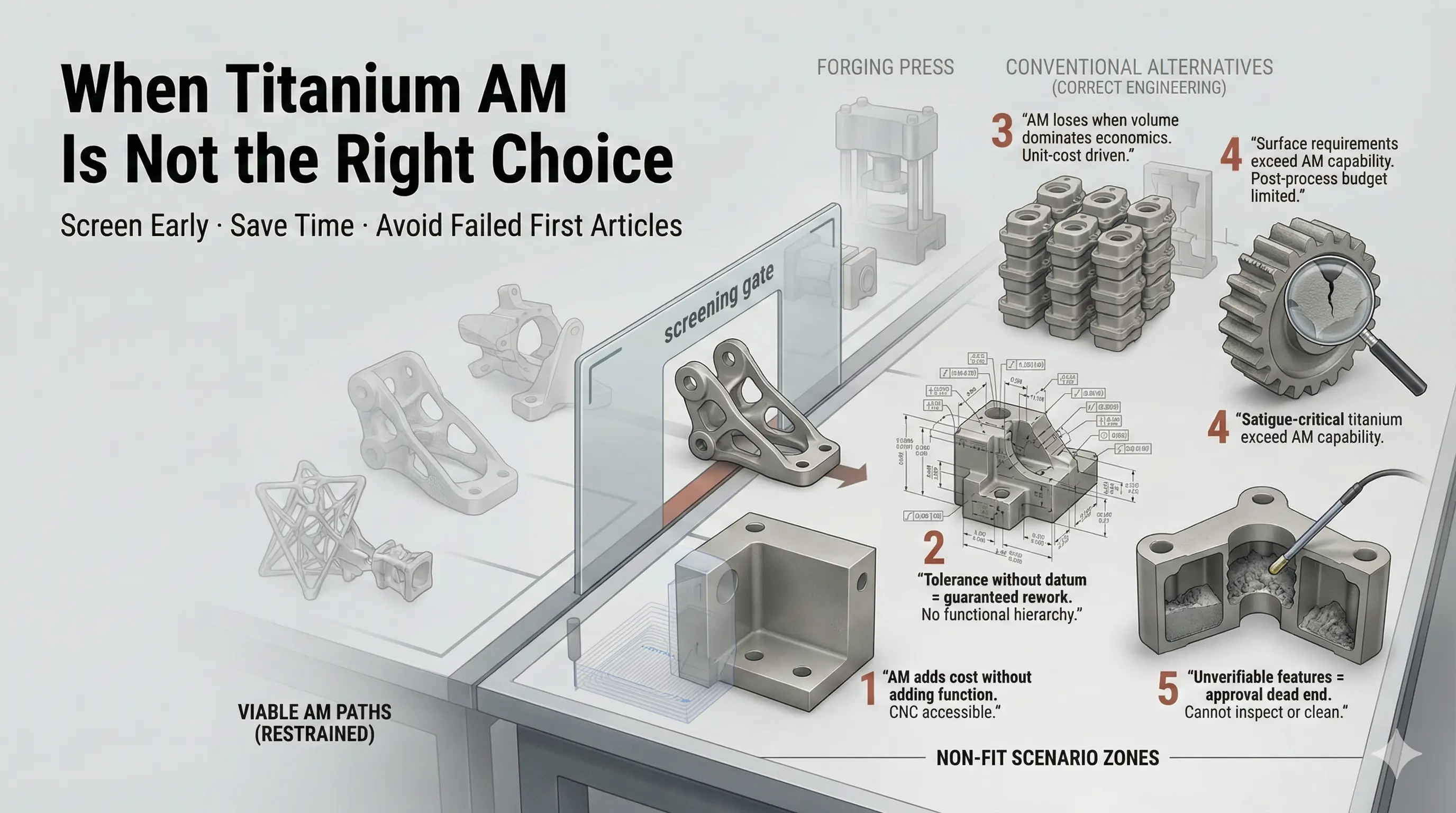
Simple blocks, shafts, plates, and open-access brackets usually favor machining. The route should be selected from the whole delivered part, not from a general belief that printing or CNC is always cheaper.
Use the titanium 3D printing versus CNC machining guide for a direct process comparison.
Post-Processing Can Exceed the Print-Only Difference
ASTM F2924 notes that Ti-6Al-4V powder bed fusion components may be machined, ground, EDM cut, polished, or otherwise post-processed to reach critical dimensions and surface finish. That is an important purchasing point: a production AM part is often a hybrid manufactured part.
Typical downstream decisions include:
- Stress relief before plate separation.
- Anneal or HIP when required by the material and acceptance route.
- Wire EDM or sawing for plate removal.
- Support removal and blend finishing.
- CNC machining of bores, ports, threads, datums, and sealing surfaces.
- Surface treatment and cleaning.
- CMM, CT, density, coupons, leak testing, or other release evidence.
Do not write “all standard post-processing” in an RFQ. Different suppliers will interpret it differently, and the resulting prices will not be comparable.
A Better Way to Request Cost Reduction
Ask for three clearly separated outputs:
- A baseline quote for the delivered part exactly as specified.
- Supplier-recommended changes that reduce cost without changing function or acceptance.
- Optional process or evidence changes with their technical consequence stated.
For example:
Quote the delivered TC4 / Ti-6Al-4V component with stress relief, machined datum A, four finished ports, CMM of drawing-critical dimensions, and material/build traceability. Separately identify savings available from orientation changes, support reduction, relaxed nonfunctional surface finish, batch quantity, HIP scope, or targeted rather than full-volume CT.
This wording allows the supplier to improve the route without quietly removing required work.
Cost-Reduction Actions Ranked by Risk
Usually low risk
- Mark noncritical surfaces as as-built acceptable.
- Provide stable datums and machining access.
- Allow small DfAM changes outside protected interfaces.
- Combine compatible parts or quantities in one release plan.
- Define targeted inspection instead of vague “full inspection.”
Requires engineering review
- Change orientation or split the part.
- Increase channel openings or add cleaning ports.
- Move support contacts.
- Change heat treatment or HIP scope.
- Replace full machining with local finishing.
Do not remove without an acceptance basis
- Material and build-lot traceability required by the purchasing file.
- Machining stock on functional interfaces.
- Inspection tied to safety, fatigue, leak, or assembly risk.
- Powder-removal verification for enclosed flow paths.
- Thermal processing required by the material or qualified route.
RFQ Inputs Needed for a Useful Price
Send the following in the first request:
- STEP or native CAD plus a controlled drawing.
- Material term and governing basis: TC4, Ti-6Al-4V, Grade 5, Ti64, ELI, or another grade.
- Prototype quantity, expected batch size, and annual demand.
- Part function, load direction, temperature, environment, pressure, fatigue, or leak concerns.
- Critical datums, tolerances, bores, ports, threads, sealing faces, and protected surfaces.
- Required thermal processing, machining, finish, cleaning, inspection, and documentation.
- Delivery location and required date.
- Permission for the supplier to recommend another manufacturing route.
The TC4 and Ti-6Al-4V material page helps normalize the alloy wording. The titanium AM RFQ checklist provides a copy-ready request structure.
Sources and Scope
This article intentionally avoids universal price claims because actual cost depends on geometry, supplier capability, quantity, delivered condition, and acceptance requirements.
- NIST: Powder Bed Fusion explains the layer-by-layer PBF process and the importance of feedstock, process, part measurement, qualification, and efficiency.
- NIST: A Reference Activity Model for Powder Bed Fusion maps support design, manufacturing, post-processing, and inspection activities across the PBF workflow.
- ASTM F2924 defines a purchasing and producer framework for additively manufactured Ti-6Al-4V powder bed fusion components.
- OSTI: Machinability comparison of AM and wrought Ti-6Al-4V documents why post-machining remains relevant for dimensional accuracy and surface finish.
Bottom Line
Titanium 3D printing cost is the cost of a route, not just powder and laser time. The most effective savings come from reducing unnecessary build height, inaccessible supports, ambiguous finishing, avoidable machining setups, and undefined inspection scope while preserving the evidence the part actually needs.
A useful quote answers one question clearly: what will it cost to deliver the part in an accepted condition?
- Titanium 3D printing cost
- Cost drivers
- RFQ
- Procurement
- Ti6al4v
- Tc4
- LPBF
- Machining