· Updated - TITANIUM 3DP Engineering - Engineering Guides - 13 min read
Titanium 3D Printed Heat Exchangers: Design, Inspection, and RFQ
Decide when titanium additive manufacturing fits a heat exchanger, then define channels, powder removal, machining, CT, leak testing, and RFQ acceptance evidence.
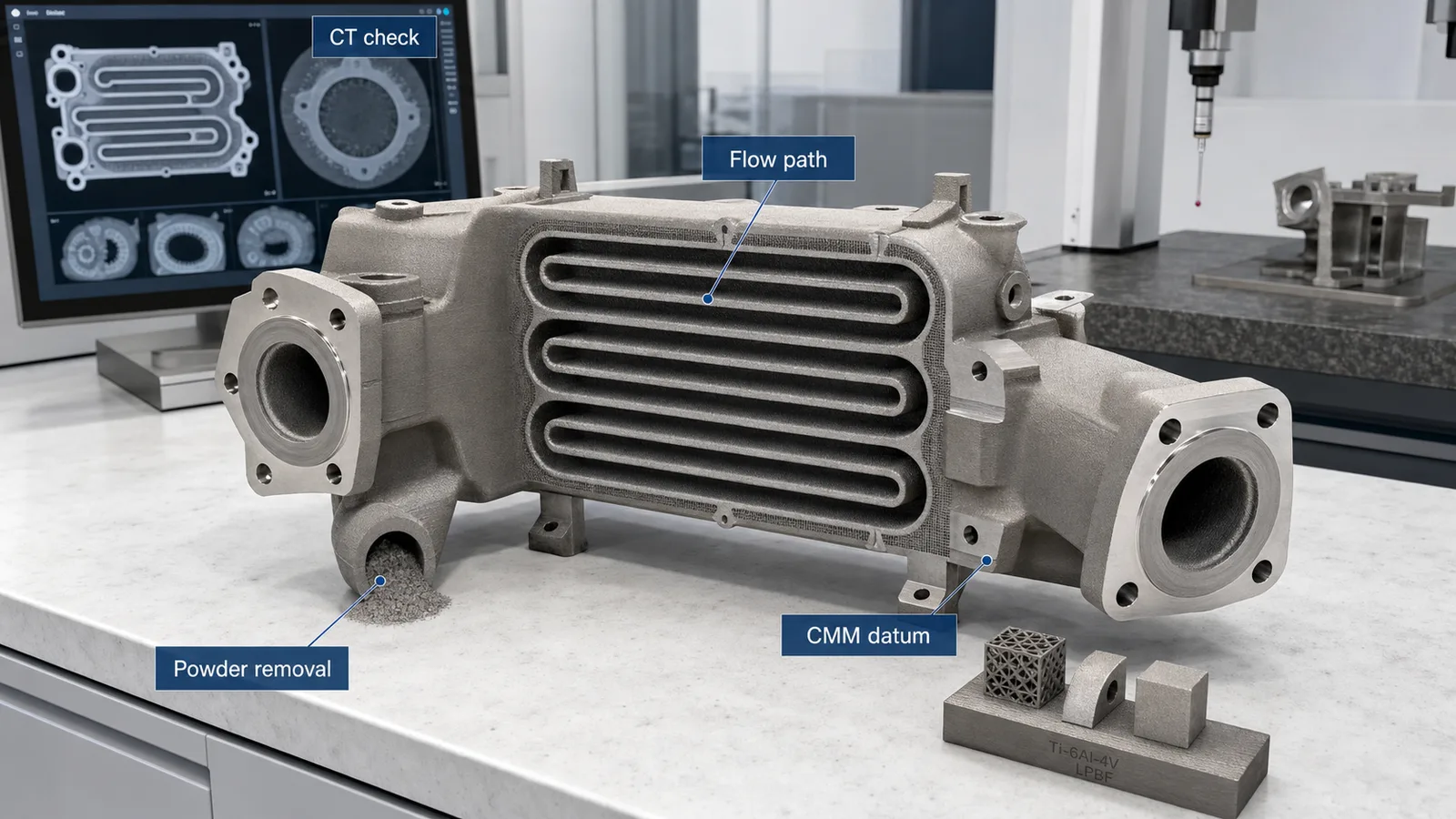
Representative article image; not a customer acceptance record or proof of a qualified manufacturing route. Refer to the cited sources and part-specific inspection records for engineering evidence.
On this page
Titanium 3D printed heat exchangers deserve an AM review when integrated flow paths, fewer joints, corrosion resistance, lower mass, or low-volume packaging create measurable system value. A printed thermal part can combine channels, manifolds, mounting structure, and sealing features, but it can become expensive or unacceptable if cleaning and inspection cannot reach the internal geometry.
The correct question is not whether a compact heat exchanger can be printed. The better question is whether the complete route can deliver the required heat transfer, pressure integrity, cleanliness, inspection evidence, surface condition, and documentation at an acceptable cost.
For a broader application map, start with Titanium 3D Printing Applications and use this article for thermal-management-specific decisions. For chloride-rich desalination, RO concentrate, and MLD/ZLD brine thermal hardware, use Titanium 3D Printing for Seawater Desalination and Brine Concentration Hardware.
For LNG, refinery, petrochemical, produced-water, or oil and gas thermal hardware where pressure, leak, sour-service, or operator documentation requirements shape the RFQ, pair this guide with Titanium 3D Printing for Oil & Gas, LNG, and Petrochemical Hardware.
Should You 3D Print a Titanium Heat Exchanger?
Review titanium additive manufacturing when compact flow routing, fewer joints, lower mass, corrosion resistance, or low-volume packaging improves the complete thermal system. A printed-and-machined hybrid route is usually stronger when the channels benefit from AM but sealing faces, ports, datums, or mounting interfaces need conventional precision. Prefer a conventional plate, tube, drilled, brazed, or welded route when the geometry is simple and it can meet the same thermal, pressure, cleanliness, and evidence requirements with lower delivered risk.
It is usually worth reviewing when the design has:
- Internal channels that reduce external tubes, fittings, plugs, or leak paths.
- A compact manifold, cold plate, radiator, heat pipe, or thermal-control body with difficult conventional machining.
- A combined structural and thermal function, such as a bracket that also routes coolant.
- A corrosive, high-temperature, aerospace, space, marine, chemical, or industrial environment where titanium helps.
- A low-volume or development program where tooling delay is more expensive than additive review.
- A pressure, leak, or flow requirement that can be tested and documented.
It is a weak candidate when the part is only a simple plate, tube bundle, commodity cold plate, or high-volume component that can be made conventionally with lower risk. Run the When Not to Use Titanium Additive Manufacturing screen before sending a price-only RFQ.
Why Thermal Management Is Timely in 2026
Thermal management is not a narrow niche in 2026. Electrified aircraft, small spacecraft, high-power electronics, hydrogen systems, compact propulsion hardware, and faster aerospace development cycles all increase interest in compact, lightweight, documented heat-transfer hardware.
Recent public signals show why engineers are paying attention:
- 3D Systems announced NASA-backed work on additively manufactured titanium and nitinol thermal-control hardware for space missions, including titanium-water heat pipe radiator prototypes reported as lighter than current state-of-the-art radiator assemblies.
- The NASA Technical Reports Server includes work on AM radiator panels with integral branching heat pipes, including titanium alloy strategies for embedded porous wick structures and high-temperature heat rejection.
- Conflux Technology announced work with Airbus ZEROe on an additively manufactured heat exchanger for hydrogen-electric propulsion thermal regulation.
- In March 2026, Velo3D announced Intergalactic heat exchanger headers for an aviation cabin-air heat exchanger program, showing how AM is being used to shorten thermal-hardware development cycles even when the material is not titanium.
These examples do not mean every titanium heat exchanger should be printed. They do show that thermal hardware is moving into the same engineering conversation as weight reduction, supply-chain speed, inspection evidence, and qualification readiness. For aerospace sourcing context, pair this guide with Titanium 3D Printing for Aerospace and Defense Supply Chains.
Where Titanium Heat Exchangers Fit Best
Titanium is not chosen only because it is printable. It is chosen when its material behavior supports the application. Good reasons include corrosion resistance, strength-to-weight ratio, temperature margin, fatigue resistance after the correct finishing route, and compatibility with specific fluids or environments.
Common titanium AM thermal candidates include:
| Part family | Why titanium AM can help | Main RFQ risk | Evidence to define |
|---|---|---|---|
| Compact liquid heat exchanger | Curved channels, fewer joints, smaller envelope | Powder removal and pressure integrity | CT scope, cleaning route, leak or pressure test |
| Cold plate or electronics cooling body | Channel routing near heat sources and mounting features | Internal roughness and flatness | Flow test, machined contact face, CMM |
| Aerospace thermal manifold | Part consolidation and fewer external fittings | Traceability and qualification evidence | COA, COC, build record, CMM, CT if hidden paths matter |
| Space radiator or heat-pipe body | Integrated wick, reduced mass, compact routing | Thermal-vacuum and cleanliness requirements | Thermal test basis, CT, cleaning, material records |
| Corrosion-resistant process component | Titanium flow path in aggressive media | Surface condition and chemical compatibility | Alloy selection, cleaning, passivation, pressure test |
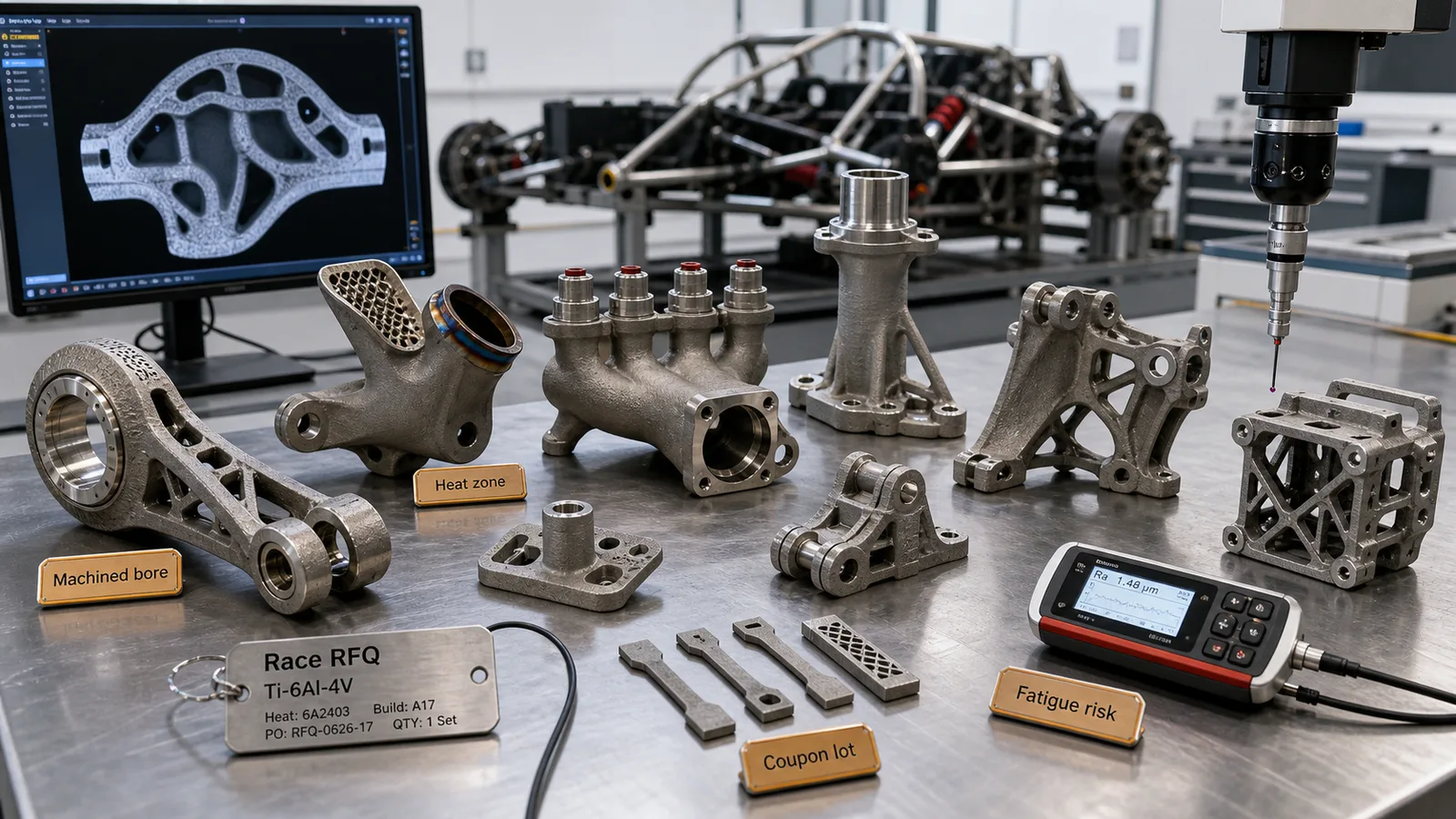
| UAV or robotics thermal structure | Cooling and structure in one compact part | Vibration, fatigue, and support scars | Fatigue review, protected surfaces, CMM datums |
The value is strongest when additive geometry changes the system: shorter fluid path, fewer seals, less assembly, better heat spreading, or a geometry that could not be drilled or brazed cleanly. If additive geometry does not change the system, conventional manufacturing may still be the better route.
For titanium lightweighting logic, see Titanium Additive Manufacturing Applications That Achieved Real Weight Reduction. For compact UAV thermal hardware, the same screening logic appears in Titanium 3D Printing for Drone and UAV Parts.
Thermal Performance Starts With Flow Path, Not CAD Complexity
A printed heat exchanger can look advanced while performing poorly. Thermal performance depends on heat-transfer area, channel geometry, pressure drop, flow distribution, wall thickness, fluid selection, surface condition, and how the part connects to the rest of the system.
Before RFQ, define:
- Heat input, allowable temperature rise, and duty cycle.
- Fluid, flow rate, inlet temperature, pressure, and cleanliness requirement.
- Pressure drop limit and whether flow balance matters across parallel channels.
- Contact surfaces, mounting pressure, thermal interface material, and flatness.
- Hot-side and cold-side separation, wall thickness, and leak consequence.
- Operating temperature, thermal cycling, vibration, and corrosion exposure.
- Prototype, test article, flight hardware, industrial part, or production intent.
A supplier can help improve channel geometry, but they cannot infer the thermal system from a STEP file alone. The RFQ should explain the heat problem, not only the shape.
Internal Channels Are the Make-or-Break Feature
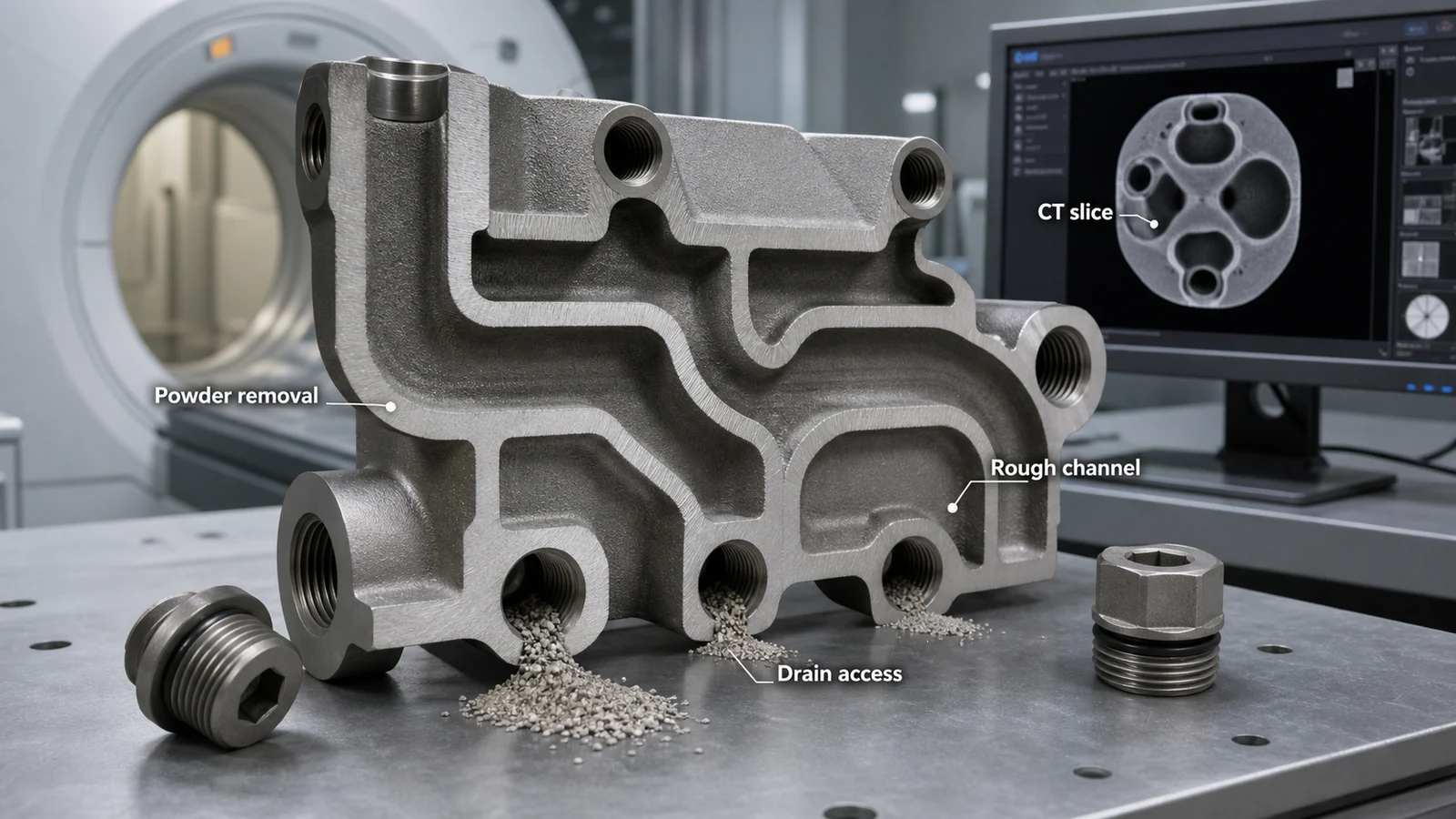
Most titanium AM heat exchanger risk lives inside the part. Internal channels create value, but they also control powder removal, cleaning, roughness, pressure drop, CT feasibility, and leak risk.
High-risk features include:
- Long blind passages with no powder exit.
- Tight serpentine bends that trap powder or cleaning media.
- Thin walls between hot and cold paths without inspection rules.
- Fine lattice or TPMS regions hidden inside sealed cavities.
- Abrupt channel expansions that collect partially sintered powder.
- Down-facing internal surfaces where roughness changes flow.
- Ports and sealing faces without machining stock or datum strategy.
The article on Titanium 3D Printed Internal Channels covers depowdering and CT in detail. For heat exchangers, those rules become even more important because residual powder, partial blockage, and internal roughness can change both performance and acceptance.
Material Selection: Ti-6Al-4V, ELI, or CP Titanium
Ti-6Al-4V is often the starting point for compact structural thermal hardware because it is widely understood in titanium AM, strong, and familiar to many suppliers. Ti-6Al-4V ELI may be reviewed when fracture behavior, ductility, low interstitial control, or a specific acceptance basis matters. CP titanium may be relevant when corrosion resistance and ductility matter more than high strength.
The material decision should not be cosmetic. It should follow:
- Fluid compatibility and corrosion risk.
- Working temperature and thermal cycling.
- Pressure boundary and proof-test requirement.
- Fatigue or vibration exposure.
- Required post-processing route.
- Documentation level required by the buyer.
- Supplier capability for the alloy and process route.
Use Titanium AM Material Selection: Ti-6Al-4V, ELI, and CP Titanium when the alloy is not yet locked. A thermal component can fail commercially if the material line is vague and each supplier quotes a different alloy condition.
Process Choice: LPBF Is Common, but the Route Must Be Defensible
LPBF is often the first review route for compact titanium heat exchangers because it supports fine channels, manifolds, mounting features, and integrated flow bodies. EBM may be considered when the supplier route and geometry fit. DED is usually not the first choice for small sealed channels, but it may fit larger near-net thermal structures, repair, or machining-stock components.
Process choice affects:
- Minimum channel size and powder removal.
- Support contact and internal roof quality.
- Wall thickness, distortion, and stress relief.
- Surface condition and finishing access.
- Datum machining and fixture strategy.
- CT, pressure test, coupons, and traceability scope.
- Cost and lead time.
The correct RFQ posture is to state the thermal requirement and allow the supplier to challenge the route if the geometry conflicts with manufacturability. See Titanium AM Process Selection: LPBF vs EBM vs DED before forcing a process into the drawing.
Design Rules That Reduce Thermal-Hardware Risk
DfAM for heat exchangers should protect both flow and acceptance. The design should not only maximize surface area; it should make cleaning, inspection, machining, and testing practical.
Useful rules include:
- Keep powder escape paths obvious and inspectable.
- Add temporary cleaning ports if they can be plugged or machined later.
- Avoid internal features that cannot be depowdered or CT-resolved.
- Use smooth channel transitions instead of shelves and dead zones.
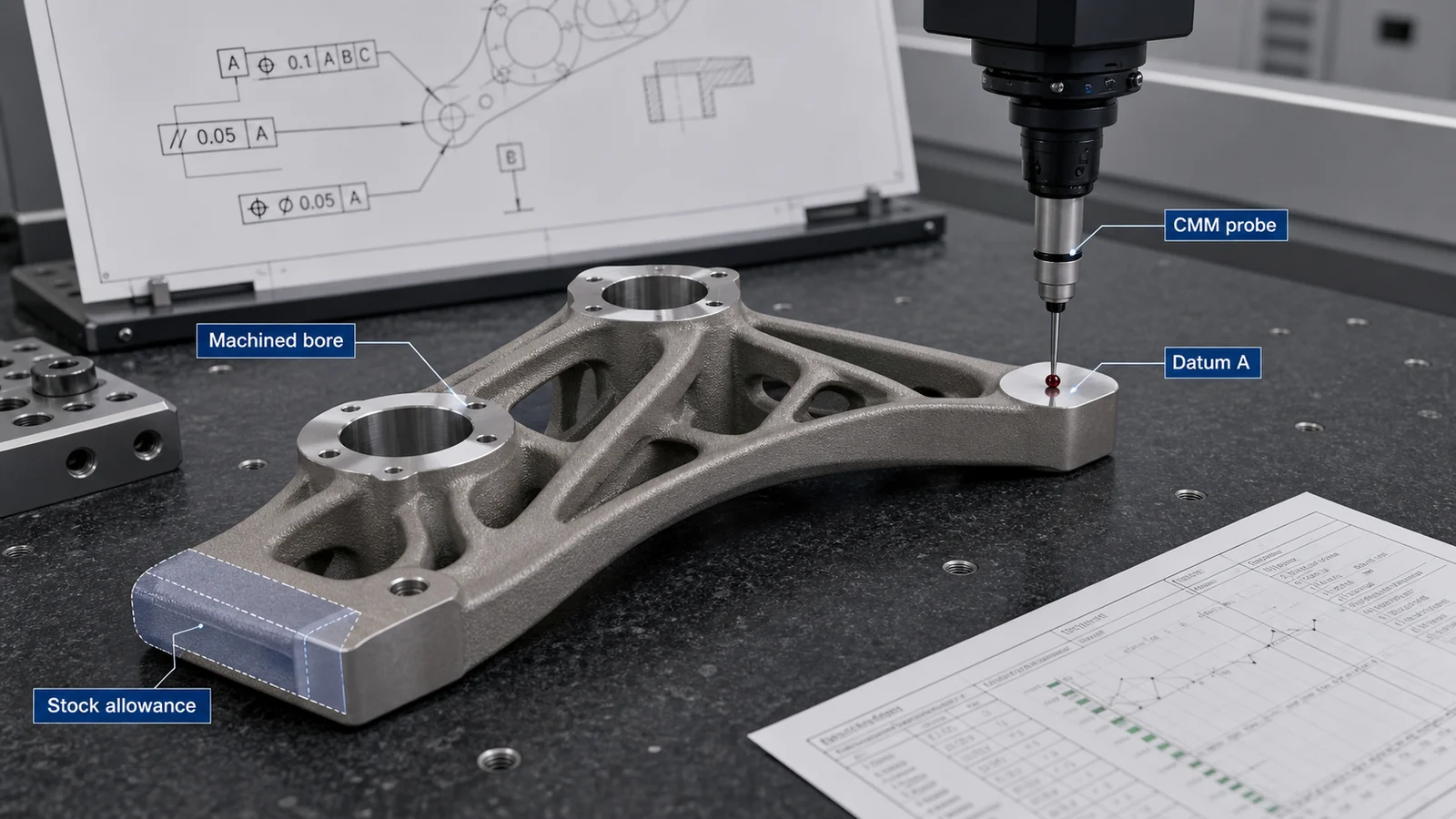
- Add machining stock to sealing faces, O-ring grooves, ports, threads, and mounting pads.
- Protect fatigue or sealing surfaces from support contact.
- Separate structural mounting features from fragile thermal walls.
- Define which surfaces may remain as-built and which need finishing.
- Use datum planning so ports and sealing faces can be measured after machining.
The surrounding DfAM rules are covered in Titanium DfAM Rules for LPBF and EBM. For precision interfaces, also use Titanium 3D Printing Tolerances: Datum Planning and CMM.
Surface Finish Changes Flow, Fatigue, and Cleaning
Internal as-built titanium AM surfaces are not equivalent to drilled or honed passages. Roughness can increase heat-transfer area in some cases, but it can also increase pressure drop, trap contamination, make cleaning harder, or create fatigue concerns in pressure-cycled regions.
Do not specify a blanket surface finish everywhere unless it is necessary. Instead, separate surfaces by function:
- Heat-transfer channels where roughness affects performance.
- Pressure-boundary walls where defects or porosity matter.
- Sealing faces that must be machined or finished.
- Mounting faces that need flatness or thermal contact.
- Internal channels that must meet cleanliness or flow-balance rules.
- Exterior surfaces that can remain as-built without affecting acceptance.
Post-processing can include stress relief, HIP, machining, abrasive flow finishing, chemical finishing, cleaning, passivation, or application-specific verification. The right sequence matters. For example, CT before and after certain operations may answer different questions. Use Post-Processing for Titanium 3D Printing when defining the delivered condition.
Pressure, Leak, and Cleanliness Requirements Must Be Early
Heat exchangers are often pressure-boundary parts. Late pressure-test requirements can expose missing wall-thickness rules, weak port geometry, rough sealing surfaces, or incomplete cleaning assumptions.
Define the acceptance basis before quotation:
- Working pressure and proof pressure.
- Burst, leak, or pressure-hold requirement.
- Test fluid or gas and allowable leakage rate.
- Operating temperature during test if relevant.
- Whether both sides of the heat exchanger are pressure tested separately.
- Cleaning method and cleanliness acceptance.
- Port sealing method during testing.
- Whether HIP, CT, or coupons are required before pressure testing.
- Whether the test is for development data, shipment acceptance, or qualification evidence.
Weak wording:
Include leak testing.
Better wording:
Include a pressure-hold test on each fluid circuit after final cleaning and machining. Please confirm the proposed proof pressure, hold time, port sealing method, allowable leakage rate, and whether CT before pressure testing is recommended for this geometry.
This gives the supplier enough information to quote delivered acceptance instead of print-only risk.
Inspection Evidence for AM Heat Exchangers
Inspection should match the failure mode. A simple open manifold may not need the same evidence as a sealed, pressure-cycled aerospace heat exchanger. A complex internal heat-transfer core may need CT, but CT needs a defined threshold and scope.
Typical evidence includes:
- CMM report for ports, datums, sealing faces, mounting pads, and machined features.
- CT report for internal channels, wall thickness, blockages, trapped powder, and hidden defects where risk justifies it.
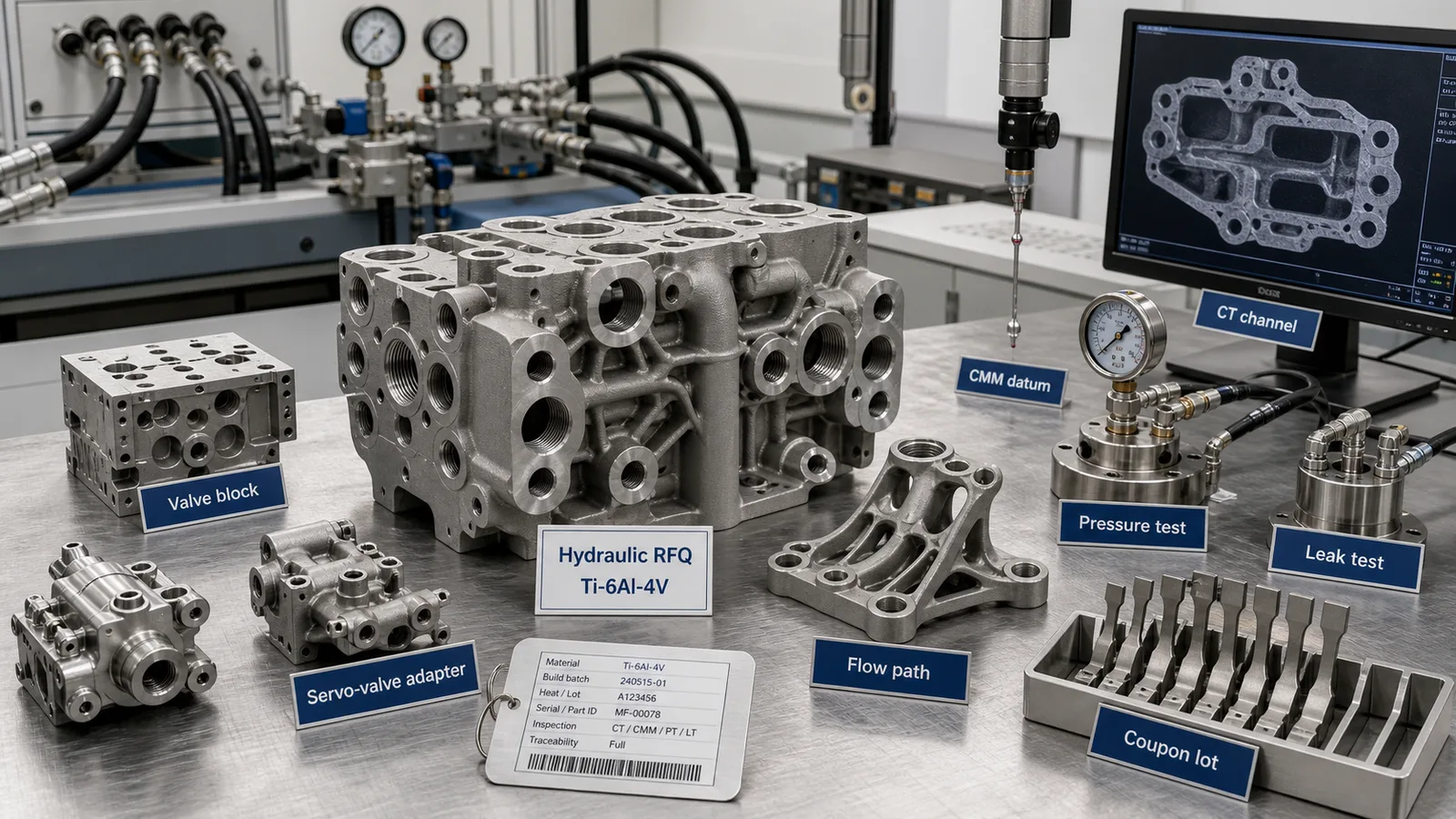
- Pressure or leak test report tied to the accepted configuration.
- Flow test or pressure-drop check if performance depends on channel openness.
- Surface roughness checks on sealing, fatigue, or contact surfaces.
- Material certification, COA, COC, heat-treatment record, build record, powder lot, and traceability.
- Coupons or density evidence when the acceptance basis requires them.
The broader framework is in Titanium AM Qualification and Inspection Evidence. The key is to define evidence that answers real risk, not to add every possible test to every prototype.
Cost: Do Not Compare Print Price Against Delivered Hardware
Thermal hardware can hide cost in places that are easy to miss during early RFQ:
- Design iteration and thermal review.
- Build orientation and support strategy.
- Stress relief, HIP, and heat treatment.
- Support removal from ports and thin features.
- Machining of sealing faces, threads, O-ring grooves, and datums.
- Cleaning, drying, passivation, and contamination control.
- CT, CMM, pressure testing, flow testing, and documentation.
- Rework if internal channels cannot be cleaned or verified.
Cost is easiest to control before the geometry is frozen. Remove unnecessary sealed voids, keep ports accessible, machine only functional surfaces, let noncritical surfaces remain as-built, and define evidence by risk class. For quote normalization, use Titanium 3D Printing Cost Drivers: How to Reduce RFQ Price and the Titanium AM RFQ and Procurement Guide.
Better RFQ Wording for a Titanium Heat Exchanger
Weak RFQ:
Please quote this titanium 3D printed heat exchanger.
Better RFQ:
Please review this compact thermal-management component for Ti-6Al-4V LPBF. The two internal flow circuits are functional heat-transfer paths. Critical features are the machined sealing faces, port threads, mounting datums, and channel wall thickness between circuits. Please identify powder-removal access, cleaning method, support strategy, stress relief, HIP recommendation if any, machining stock, CT feasibility, pressure-test assumptions, CMM scope, and any geometry changes needed before quotation. Quote the delivered accepted part, not only the printed shape.
This wording helps procurement compare suppliers on the route that matters: print, clean, machine, inspect, test, and document.
RFQ Checklist
Send the supplier:
- STEP file and drawing with section views of the channels.
- Target alloy, material condition, and whether substitutions are allowed.
- Quantity, lot size, prototype or production intent, and lead time.
- Heat load, fluid, flow rate, inlet temperature, pressure, pressure drop, and cleanliness requirement.
- Operating environment: temperature, corrosion exposure, vibration, thermal cycling, and service life.
- Critical surfaces: sealing faces, O-ring grooves, ports, threads, datums, mounting pads, and contact faces.
- Channel information: minimum feature size, blind regions, powder-removal access, and accepted internal roughness.
- Post-processing expectations: stress relief, HIP, machining, finishing, cleaning, passivation, and packaging.
- Inspection scope: CMM, CT, wall thickness, flow test, pressure test, leak test, roughness, coupons, and traceability.
- Permission for supplier DfAM changes before final pricing.
If the RFQ does not include pressure, flow, cleaning, and inspection assumptions, suppliers may quote different products under the same part number.
When to Redesign or Avoid Titanium AM
Redesign before quotation when:
- Channels have no practical powder exit.
- The smallest critical feature cannot be cleaned or inspected.
- Pressure testing is required but wall thickness and port geometry are vague.
- The thermal contact face needs high flatness but no machining stock exists.
- Internal roughness controls performance but no finishing or flow-test route is defined.
- A fine lattice is sealed inside a pressure boundary without CT or cleaning logic.
- The part is large, simple, high volume, or easily made from conventional tube, plate, or machined stock.
Avoid titanium AM when a conventional heat exchanger or cold plate meets the thermal, cost, lead-time, and evidence requirements with lower risk. Additive manufacturing should earn its place by improving the system, not by making the CAD model more complex.
Bottom Line
Titanium 3D printed heat exchangers can be valuable when they combine compact thermal routing, corrosion resistance, structural integration, fewer joints, and low-volume manufacturing speed. The strongest cases are not generic “complex parts.” They are heat-transfer components where internal channels, pressure integrity, cleanliness, machining, inspection, and documentation can be planned as one route.
For an RFQ review, send the CAD, drawing, thermal duty, pressure and flow requirements, target alloy, quantity, post-processing expectations, and inspection scope through the RFQ inputs page or email info@szcomo.com.
- Heat exchangers
- Thermal management
- Internal channels
- LPBF
- DFAM
- CT
- Pressure testing
- RFQ