· Updated - TITANIUM 3DP Engineering - Engineering Guides - 13 min read
Titanium 3D Printing for Spacecraft and Satellite Components
Engineering RFQ guide for titanium 3D printed spacecraft and satellite components, covering Ti-6Al-4V, LPBF, deployment mechanisms, propulsion manifolds, vibration, TVAC, CT, CMM, and traceability.
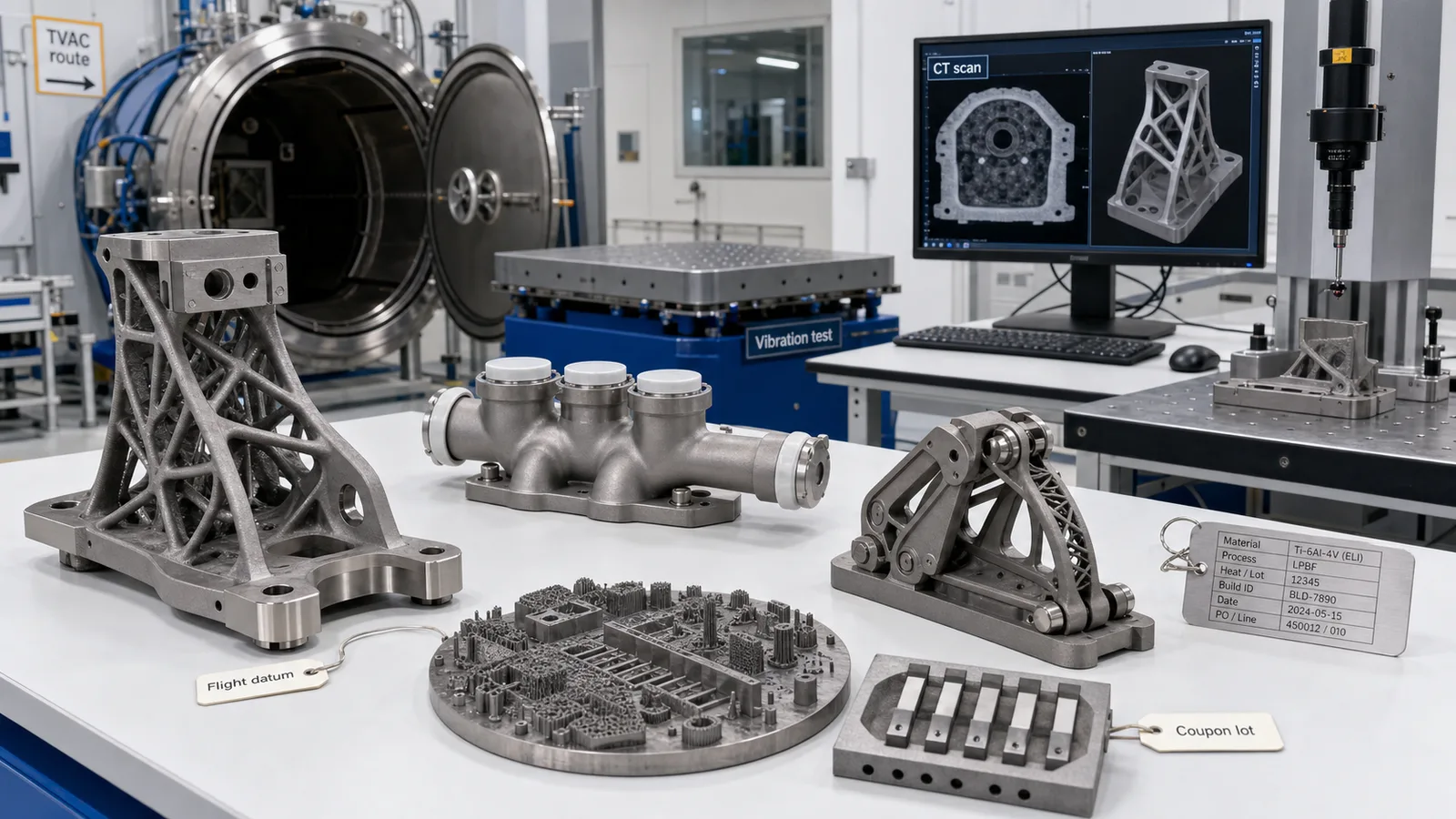
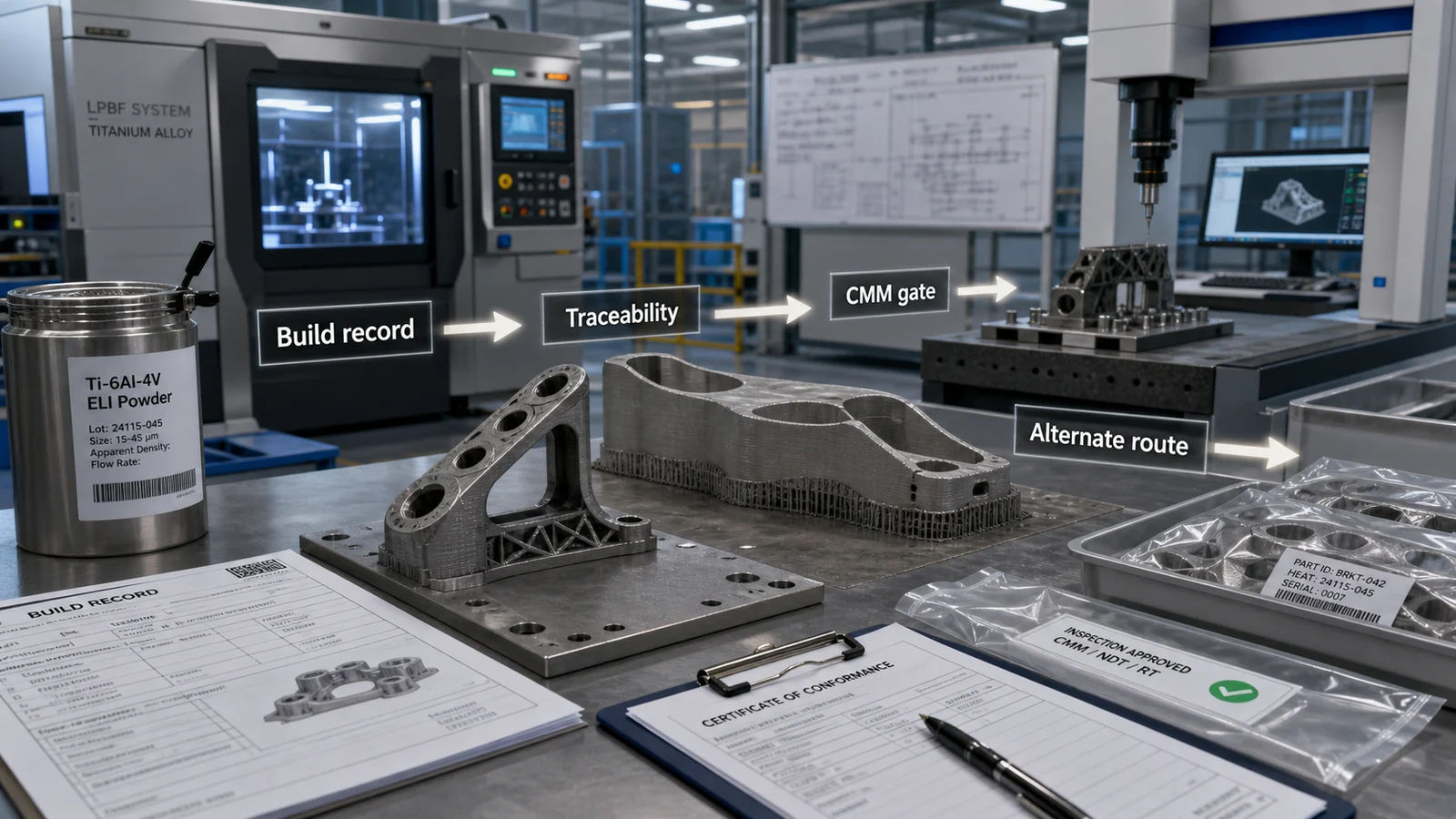
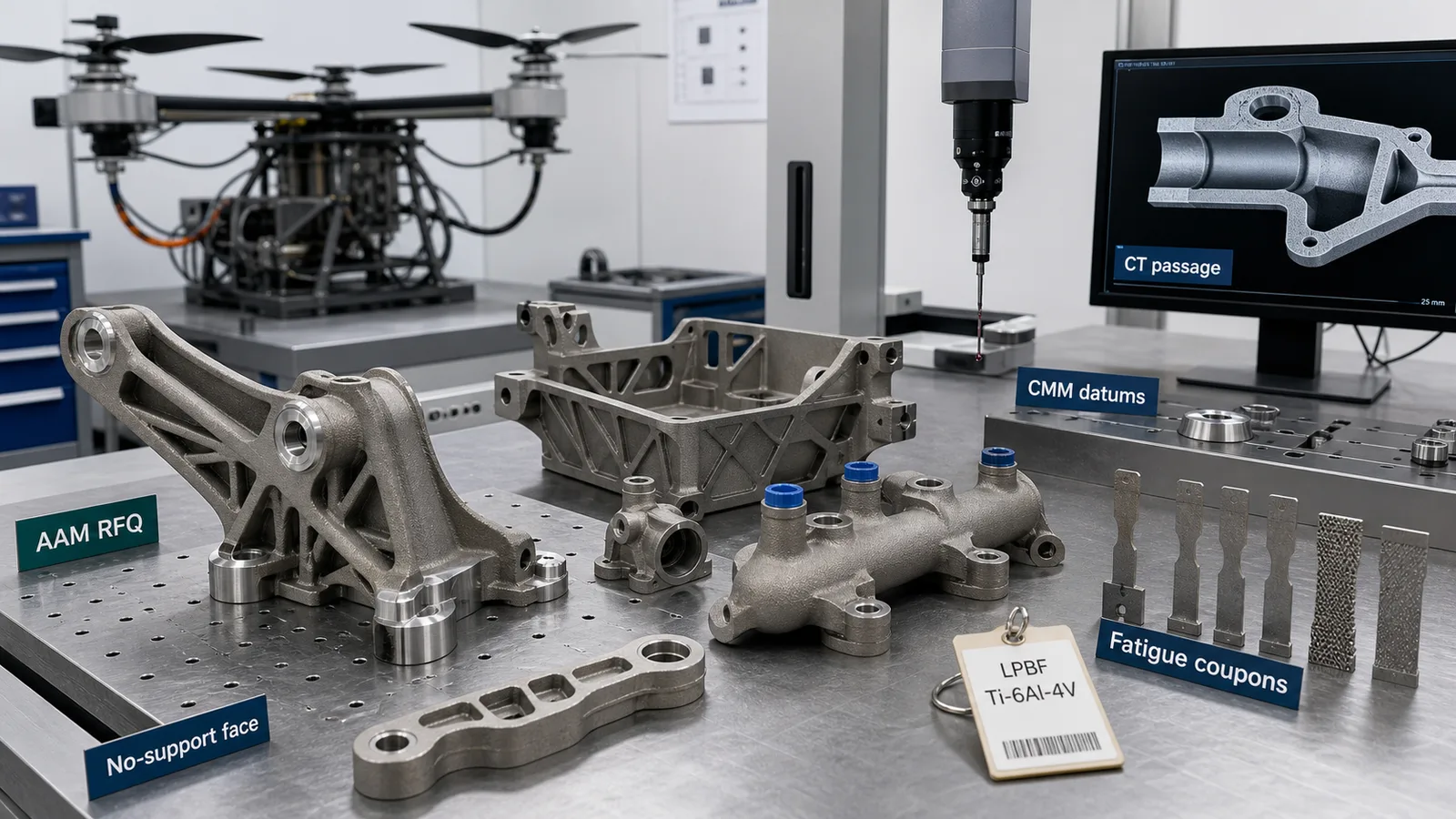
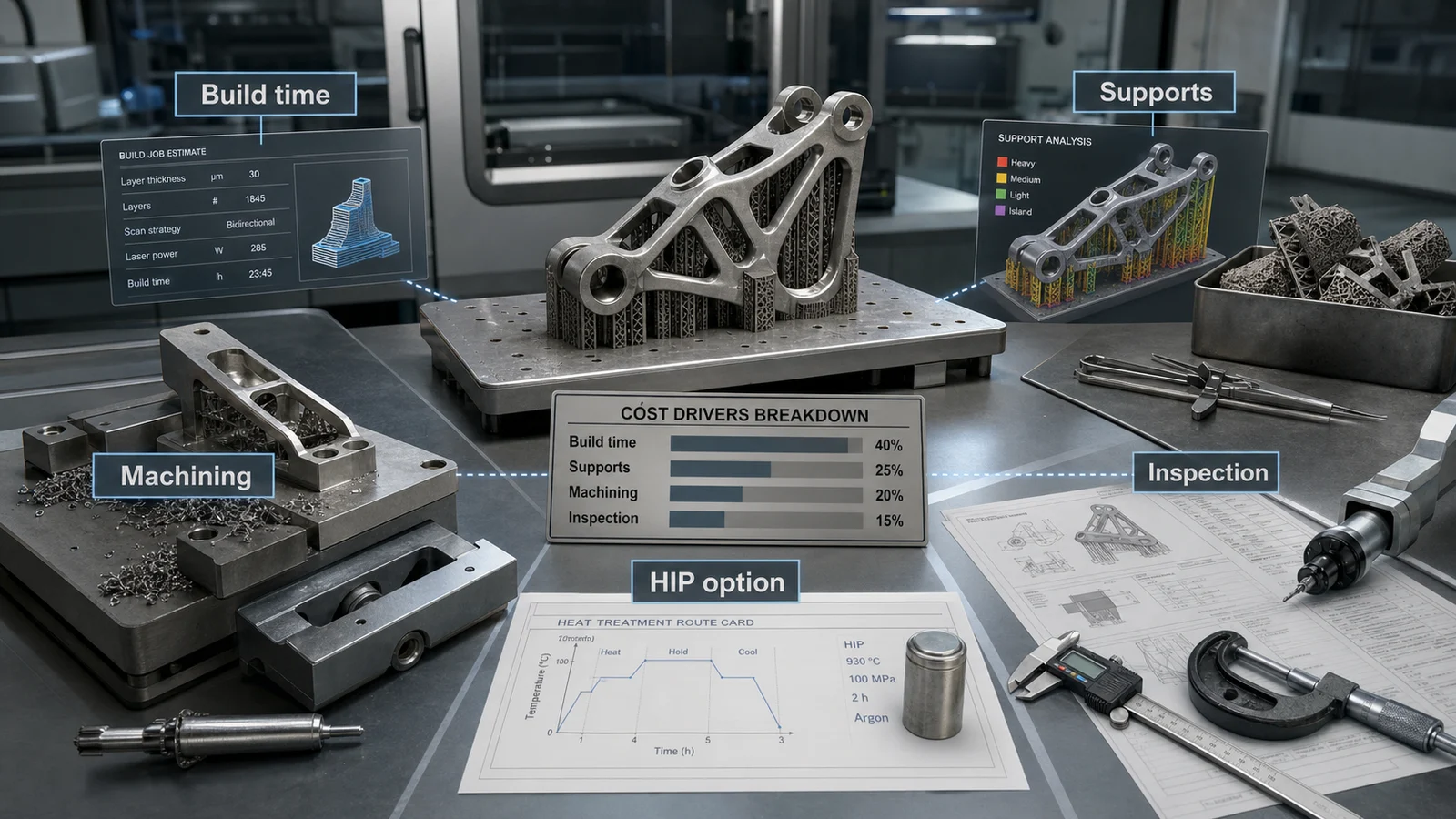
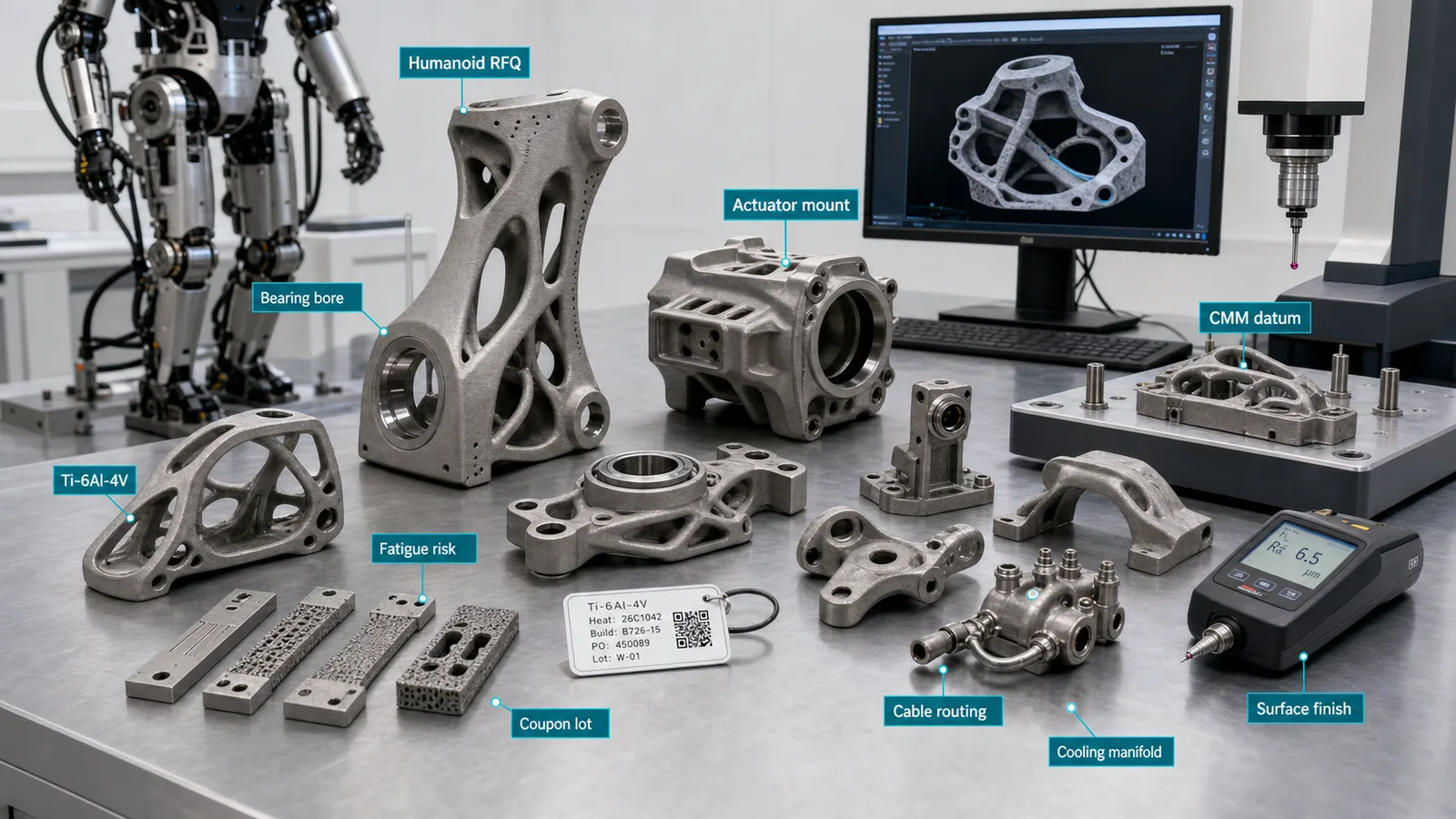
Representative article image; not a customer acceptance record or proof of a qualified manufacturing route. Refer to the cited sources and part-specific inspection records for engineering evidence.
On this page
Titanium 3D printing is worth reviewing for spacecraft and satellite components when a part needs low mass, high stiffness, compact packaging, fewer fasteners, integrated flow paths, or a controlled alternate route for low-volume flight-style hardware. It is not a shortcut around mission assurance, environmental testing, configuration control, material traceability, or export-controlled data handling.
For space hardware RFQs, the better question is not only whether Ti-6Al-4V can be printed. The better question is whether the supplier can deliver a manufacturing route that survives engineering review: process selection, build orientation, datum planning, machining, CT or CMM evidence, vibration and thermal-vacuum assumptions, witness coupons, documentation, and a clear boundary between prototype, engineering model, qualification unit, and flight hardware.
For the broader sourcing context, start with Titanium 3D Printing for Aerospace and Defense Supply Chains and use this guide for spacecraft- and satellite-specific decisions.
Quick Answer
Titanium additive manufacturing can be a strong fit for spacecraft and satellite components when the part is compact, high-value, geometry-limited, mass-sensitive, and evidence-driven.
Good candidates include:
- Lightweight equipment brackets, optical bench mounts, avionics supports, sensor brackets, and star-tracker-adjacent structures.
- Antenna deployment mechanism parts, compliant mechanism prototypes, hinge brackets, latch bodies, and compact mechanism housings.
- Small propulsion or fluid-system manifolds where integrated passages reduce fittings, plugs, welds, and leak paths.
- Thermal-control brackets, radiator support features, heat-pipe interface brackets, and compact heat-transfer support hardware.
- RF, communication, and payload support components that benefit from stiffness-to-mass optimization.
- Non-flight engineering models, vibration-test articles, qualification-like builds, and witness coupon sets.
- Low-volume replacement or sustainment parts where conventional tooling, forgings, or billet machining create excessive lead time.
Weak candidates include simple plates, spacers, shafts, commodity brackets, large tolerance-driven blocks, and any flight-critical part where the RFQ does not define acceptance evidence, environmental test expectations, material condition, configuration control, and supplier quality responsibility.
If conventional machining can meet the mass, stiffness, lead-time, and evidence requirements with lower risk, use the When Not to Use Titanium Additive Manufacturing screen before asking for a print quote.
Why Spacecraft AM Is Timely in 2026
Identify the hardware’s release stage before comparing manufacturing routes: a fit-check model, ground-test fixture, qualification article, and flight part require different evidence. Preserve the drawing revision, material condition, process configuration, and approval authority when a part moves between those stages.
Several public signals make this a timely 2026 topic:
- The Satellite Industry Association’s 2026 State of the Satellite Industry Report page notes that the FY2025 report was released in May 2026 and reports 296 commercially procured launches in 2025, a 32% increase over 2024.
- NASA’s 2026 State-of-the-Art of Small Spacecraft Technology report says small spacecraft have become a primary means for commercial, government, private, and academic institutions to access space.
- The NASA Small Spacecraft Technology summary describes rapidly accelerating SmallSat technology and notes that small satellites are moving beyond low-Earth-orbit science missions into deep-space and lunar applications.
- NASA’s Structures, Materials, and Mechanisms chapter highlights deployable structures such as antennas, radiators, solar panels, booms, and instruments, and points to deployment mechanisms as an area of increasing mission capability.
- JPL’s 2026 3D-Printed Part Springs Forward update describes a titanium additively manufactured compliant mechanism that combined a hinge, panel, compression spring, and torsion springs into one deployed space demonstration article.
- NASA-STD-6030 defines additive manufacturing requirements for NASA spaceflight hardware, which is a useful reminder that space AM is controlled manufacturing, not only innovative geometry.
These sources do not mean every satellite component should be printed. They show why spacecraft teams keep reviewing AM for mass, packaging, deployment mechanisms, flow paths, schedule pressure, and evidence-backed alternate routes.
Where Titanium AM Fits in Space Hardware
Titanium AM is strongest when it solves a specific spacecraft constraint. It should not be selected only because titanium sounds aerospace-ready.
| Component family | Why titanium AM can help | Main RFQ risk | Evidence to define |
|---|---|---|---|
| Equipment and payload brackets | High stiffness-to-mass, integrated cable clearance, fewer fasteners | Fatigue, datum control, support scars | Build orientation, machined datums, CMM, coupon plan |
| Deployment mechanism hardware | Part consolidation and compact stowed geometry | Repeatability, friction surfaces, spring behavior | Functional test boundary, machining, vibration evidence |
| Propulsion and fluid manifolds | Fewer plugs, welds, fittings, and leak paths | Powder removal and leak acceptance | CT scope, pressure/leak test, cleaning route |
| Thermal-control supports | Compact packaging and interface integration | Contact surfaces and distortion | Flatness, machined lands, thermal interface notes |
| RF and payload mounts | Lightweight stiffness and constrained packaging | Resonance and dimensional stability | Modal assumptions, CMM, vibration test context |
| Engineering model and qualification-like articles | Fast iteration without tooling | Overclaiming flight readiness | Configuration label, document package, stage boundary |
This page focuses on spacecraft and satellite hardware. For aircraft, defense, and broader alternate supply routes, use the aerospace and defense supply-chain guide.
Manufacturing Stage Must Be Stated
The most common quoting problem is that “space part” means different things to different teams.
An RFQ should identify the stage:
- Concept demonstrator.
- Non-flight prototype.
- Engineering model.
- Structural or thermal development article.
- Qualification unit.
- Flight-like build.
- Flight hardware.
- Ground support equipment.
- Spare or sustainment part.
The same CAD model may need very different evidence packages at each stage. A non-flight prototype may need fast turnaround, basic material confirmation, and visible geometry. A qualification-like article may need a frozen process route, build record, coupons, CT, CMM, thermal processing records, and environmental test assumptions. Flight hardware may require customer-controlled requirements, supplier approvals, deviation control, and mission-specific quality documentation.
Do not let the supplier guess the stage. If the stage is unclear, the quote will either hide risk or price an evidence package that the current project does not need.
Material Selection: Ti-6Al-4V Is Common, but Not Automatic
Ti-6Al-4V is the common starting point for many printed titanium spacecraft components because it combines strength-to-weight performance, process familiarity, and broad aerospace use. Ti-6Al-4V ELI may be discussed when a program has its own material basis or low-interstitial requirement. CP titanium can be relevant for corrosion or compatibility-driven hardware, but it is not a default replacement for structural Ti-6Al-4V.
For powder-bed routes, ASTM F2924 covers additively manufactured Ti-6Al-4V components using full-melt powder bed fusion, while ASTM F3001 covers Ti-6Al-4V ELI components using full-melt powder bed fusion. Those references are not a complete spacecraft acceptance plan, but they help prevent vague RFQ wording such as “aerospace titanium.”
Define:
- Alloy grade and standard.
- Powder lot, reuse rule, and chemistry traceability.
- LPBF, EBM, DED, or supplier-recommended process.
- Build orientation and support contact restrictions.
- Stress relief, HIP, heat treatment, and final material condition.
- Witness coupons, orientation, location, and test method.
- Required documents: COA, COC, build record, heat-treatment record, and inspection reports.
Use Titanium AM Material Selection: Ti-6Al-4V, ELI, and CP Titanium before fixing the material line in the purchase order.
Spacecraft Parts Fail in Systems, Not in Isolation
A printed bracket may look successful on the bench and still be a weak spacecraft part if the system-level constraints were ignored. Space hardware sees launch vibration, acoustic load, shock events, thermal cycling, vacuum exposure, contamination limits, assembly preload, connector constraints, and inspection requirements.
For RFQ purposes, separate the load and environment assumptions:
- Static load case and mounting preload.
- Random vibration, sine vibration, shock, or acoustic exposure if relevant.
- Thermal-vacuum or thermal cycling assumptions.
- Cleanliness and contamination-sensitive surfaces.
- Outgassing-sensitive neighboring hardware, if the assembly includes nonmetallic elements.
- Electrical bonding, grounding, or isolation needs.
- Thermal interface locations and contact pressure.
- Assembly access for torque tools, inserts, fasteners, and harness routing.
The supplier may not own final environmental testing, but the manufacturing route must not make those tests harder. Support scars on a fatigue-critical edge, trapped powder in a manifold, or a missing datum pad can create problems that appear only after the part enters the spacecraft integration flow.
Deployment Mechanisms Need More Than Part Consolidation
The JPL titanium compliant mechanism example is useful because it shows why additive manufacturing gets attention in spacecraft mechanisms: fewer parts, compact stowed volume, and integrated motion features. The RFQ lesson is not “print every hinge.” The lesson is that mechanism parts need a route that controls geometry, surface contact, repeatability, and test evidence.
For deployment or mechanism hardware, define:
- Whether the part is a structural bracket, hinge body, compliant element, latch, cover, or test article.
- Motion surfaces that must be machined, polished, coated, or excluded from support contact.
- Spring-like geometry and whether AM material properties are part of the design basis.
- Stowed and deployed envelope.
- Fastener, bearing, bushing, pin, and shaft interfaces.
- Inspection dimensions and gauge points.
- Functional test responsibilities.
- Vibration and thermal-vacuum context.
If a mechanism depends on elastic deformation, do not treat it like a normal static bracket. Fatigue, surface finish, notch sensitivity, and build orientation need earlier review. The Titanium 3D Printing Fatigue Design guide is the right companion page for that discussion.
Internal Flow Paths Raise the Acceptance Bar
Propulsion, thermal, pneumatic, and fluid-control hardware can be attractive AM candidates because printed titanium can integrate passages, reduce fittings, and remove welds or plugs. It can also create hidden failure modes.
Risk areas include:
- Blind passages where unmelted powder is difficult to remove.
- Long channels below the supplier’s reliable depowdering window.
- Thin walls next to ports, bosses, or threaded interfaces.
- Down-facing surfaces with roughness that changes pressure drop.
- Unsupported internal turns that create powder traps.
- Leak paths around as-built surfaces, plugs, or post-machined ports.
- CT resolution that cannot see the smallest critical feature.
NASA/JPL’s Perseverance rover coverage of 3D-printed metal parts describes X-ray inspection used to check for defects and powder-free internal channels on MOXIE hardware. The spacecraft RFQ lesson is the same for titanium manifolds: internal geometry needs a removal, cleaning, inspection, and acceptance plan.
For deeper channel-specific sourcing logic, use Titanium 3D Printed Internal Channels: Powder Removal and CT. For pressure and thermal hardware, pair this with Titanium 3D Printed Heat Exchangers: Thermal Management RFQ Guide.
Datum Planning Still Controls the Final Part
Spacecraft components often combine organic lightweight geometry with conventional precision interfaces. The printed shape may be complex, but the assembly still needs bores, flat pads, threaded inserts, alignment features, contact faces, cable clearances, and gauge points.
The drawing should define:
- Primary, secondary, and tertiary datums.
- Which surfaces are machined after printing.
- Which surfaces may remain as-built.
- Machining stock on datum pads and bores.
- Fastener-hole tolerance and edge distance.
- Flatness, parallelism, perpendicularity, and position callouts where they matter.
- Inspection sequence after stress relief, HIP if used, machining, and finishing.
- Surfaces where support contact is prohibited.
Avoid tight all-over tolerances. They make the quote expensive without making the part more reliable. Use Titanium 3D Printing Tolerances: Datum Planning and CMM to separate functional interfaces from noncritical lightweight surfaces.
Process Choice: LPBF, EBM, and DED Have Different Roles
For satellite and spacecraft parts, LPBF is often the first process reviewed for compact high-value titanium components. It can support detailed brackets, small manifolds, mechanism housings, and lattice-like weight reduction when depowdering and support removal are realistic.
EBM may be considered when the supplier’s aerospace history, part size, material behavior, surface expectations, and design rules match the application. DED is usually more relevant for larger near-net structures, repair, or feature addition than for fine satellite mechanism hardware.
| Decision factor | LPBF tendency | EBM tendency | DED tendency |
|---|---|---|---|
| Compact bracket or mount | Strong fit | Possible | Usually not first choice |
| Fine internal channels | Possible, but CT and cleaning matter | Case-dependent | Usually weak |
| Large near-net structure | Limited by build envelope | Limited by machine envelope | Stronger fit |
| Repair or added feature | Rare in this context | Rare in this context | Stronger fit |
| Surface finish before machining | Fine but rough as-built surfaces remain | Rougher as-built surfaces are common | Near-net and machined route |
| Quote risk | Support, depowder, distortion, CT | Surface, feature size, supplier fit | Deposition quality, NDT, machining stock |
Use Titanium AM Process Selection: LPBF vs EBM vs DED when the process is not already fixed by program requirements.
Qualification Evidence Should Match the Mission Risk
Space hardware can be over-tested or under-specified. Both create problems. Over-testing a quick non-flight prototype wastes time. Under-specifying a qualification-like or flight-style component pushes risk into integration.
Typical evidence may include:
- Material certificate, powder lot, build record, machine record, parameter set, and operator record if required.
- Stress relief, HIP, heat-treatment, and furnace batch records.
- Witness coupon results for density, tensile, fatigue, chemistry, or customer-defined properties.
- CMM report for machined datums, bores, and assembly interfaces.
- CT report for internal passages, hidden features, or defect-sensitive regions.
- Surface roughness or visual inspection by defined zone.
- Leak, pressure, proof, or flow test for manifolds and thermal hardware.
- Vibration or thermal-vacuum test context when the supplier is responsible for the test article.
- COA, COC, marking, packaging, and revision traceability.
- Nonconformance, repair, rework, and deviation records.
For the general evidence framework, use Titanium AM Qualification and Inspection Evidence. NASA-STD-6030 is also useful as a reminder that flight hardware AM requirements must be tailored and controlled, not improvised after the build.
Cost: Compare Accepted Hardware, Not Printed Mass
A titanium AM spacecraft quote may look expensive because the supplier includes engineering review, thermal processing, machining, CT, CMM, coupons, and documentation. A cheaper quote may simply omit the evidence required to make the part usable.
Cost drivers include:
- DfAM review and build-orientation study.
- Support strategy and removal access.
- Powder controls and documentation.
- Stress relief, HIP, or heat treatment.
- Machining of datums, bores, pads, ports, threads, and mating faces.
- Cleaning, depowdering, passivation, and handling.
- CT, CMM, leak testing, pressure testing, roughness checks, and coupons.
- Packaging, marking, configuration control, and release paperwork.
- Rebuild risk if internal features or distortion are not controlled.
Control cost by defining the part stage. A concept demonstrator should not carry the same evidence package as a flight-style component. A qualification-like build should not be priced as a cosmetic prototype.
Use Titanium 3D Printing Cost Drivers: How to Reduce RFQ Price and the Titanium AM RFQ and Procurement Guide to normalize quotes around delivered evidence.
Better RFQ Wording
Weak RFQ:
Please quote this 3D printed titanium satellite bracket.
Better RFQ:
Please review this Ti-6Al-4V LPBF spacecraft equipment bracket as an engineering-model build with a possible qualification-like follow-on. Critical features are the three machined datum pads, two payload mounting bores, cable-clearance region, no-support surfaces, and witness coupon set. Please quote stress relief, support removal, machining, CMM, material traceability, build record, and packaging. Identify whether HIP, CT, fatigue coupons, or vibration-test support are recommended for the next build stage and state the cost and lead-time impact.
That request gives the supplier enough information to quote a delivered part instead of a printed shape.
Spacecraft Titanium AM RFQ Checklist
Send the supplier:
- STEP file and drawing with datums, critical surfaces, and revision level.
- Program stage: prototype, engineering model, qualification unit, flight-like build, flight hardware, spare, or ground support.
- Alloy, material standard, process preference, and whether supplier recommendation is allowed.
- Quantity, lot size, target lead time, and repeat-build expectation.
- Functional surfaces: datum pads, bores, threads, inserts, sealing faces, thermal interfaces, motion surfaces, and grounding points.
- Noncritical surfaces that may remain as-built.
- Prohibited support-contact areas.
- Internal passages, powder-removal access, and cleaning expectations.
- Post-processing: stress relief, HIP if required, machining, finishing, passivation, cleaning, and packaging.
- Inspection scope: CMM, CT, leak, proof, pressure, roughness, visual, coupon, vibration, or thermal-vacuum support.
- Documentation: COA, COC, powder lot, build record, heat-treatment record, inspection report, nonconformance handling, and marking.
- Data-control and export-control requirements before controlled technical data is transmitted.
If the RFQ omits the stage, acceptance evidence, and configuration boundary, suppliers will quote different products under the same part number.
When to Redesign or Avoid Titanium AM
Redesign before quotation when:
- The part has hidden powder traps with no depowdering path.
- Precision bores, datum faces, or sealing surfaces lack machining stock.
- Support contact lands on fatigue-critical or motion surfaces.
- Lattice or topology features cannot be inspected or cleaned.
- A thin wall sits next to a threaded port or high-load fastener.
- The smallest critical internal feature is below practical CT resolution.
- No one has defined vibration, thermal, cleanliness, or assembly assumptions.
- The quote expects flight-like evidence but the CAD is still a rough concept.
Avoid titanium AM when a machined, forged, sheet-metal, composite, or standard catalog solution meets mass, stiffness, lead time, and evidence requirements with lower risk.
Bottom Line
Titanium 3D printing can be valuable for spacecraft and satellite components when it solves a real space-hardware problem: mass reduction, compact packaging, part consolidation, internal flow paths, deployment mechanism integration, low-volume iteration, or a documented alternate route to accepted hardware.
The strongest projects define stage, alloy, process, datums, post-processing, inspection evidence, environmental context, and documentation before pricing. The weakest projects ask for a printed titanium shape and postpone acceptance until integration.
For an RFQ review, send CAD, drawing, mission stage, target alloy, quantity, critical features, post-processing expectations, inspection scope, and document requirements through the RFQ inputs page or email info@szcomo.com.
- Spacecraft
- Satellite
- Aerospace
- LPBF
- Ti6al4v
- Qualification
- Vibration
- Tvac
- RFQ