· Updated - TITANIUM 3DP Engineering - Engineering Guides - 11 min read
Titanium 3D Printing for Aerospace and Defense Supply Chains
How aerospace and defense buyers can use titanium 3D printing for supply-chain resilience without confusing speed, qualification, traceability, and production acceptance.
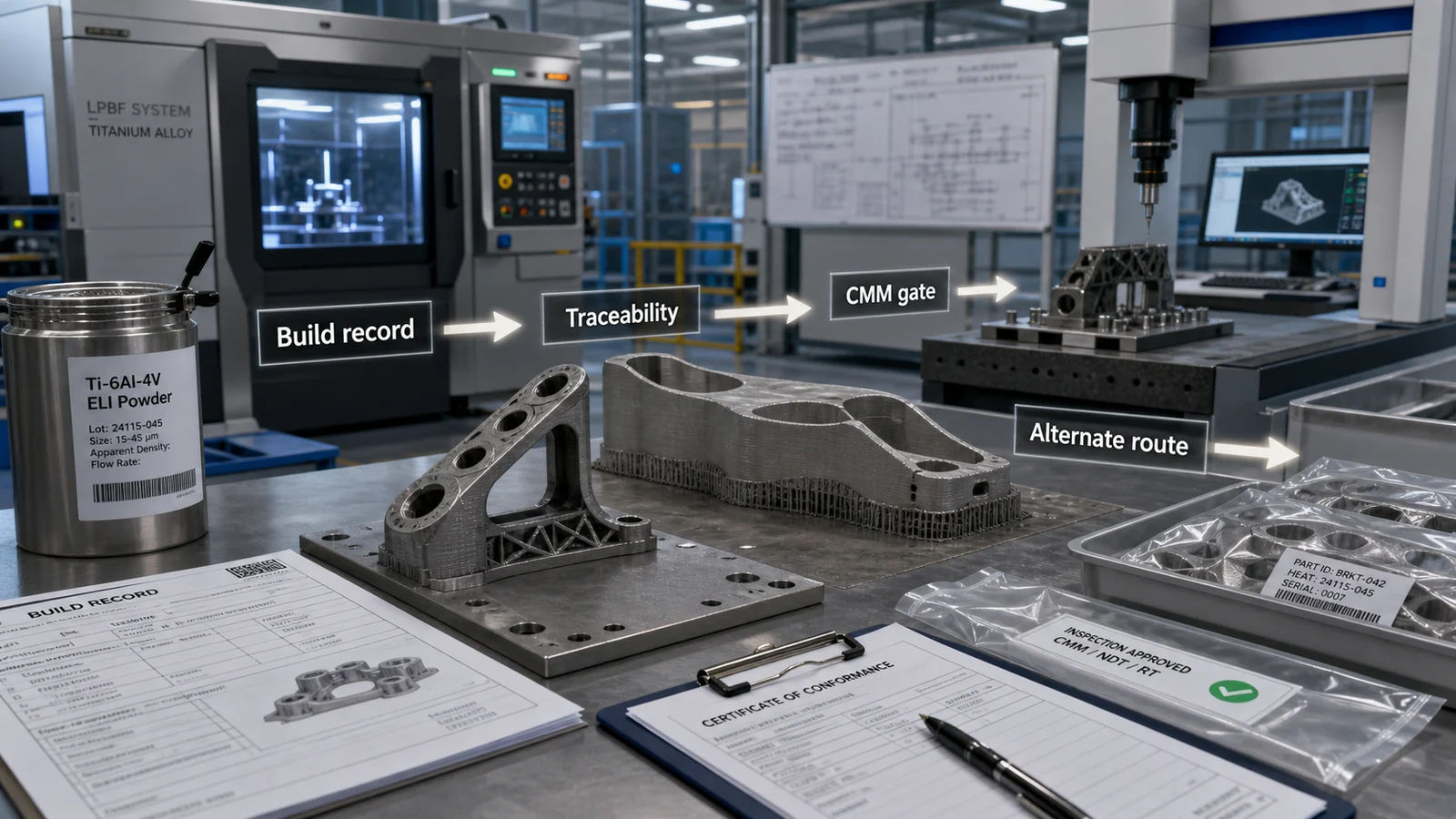
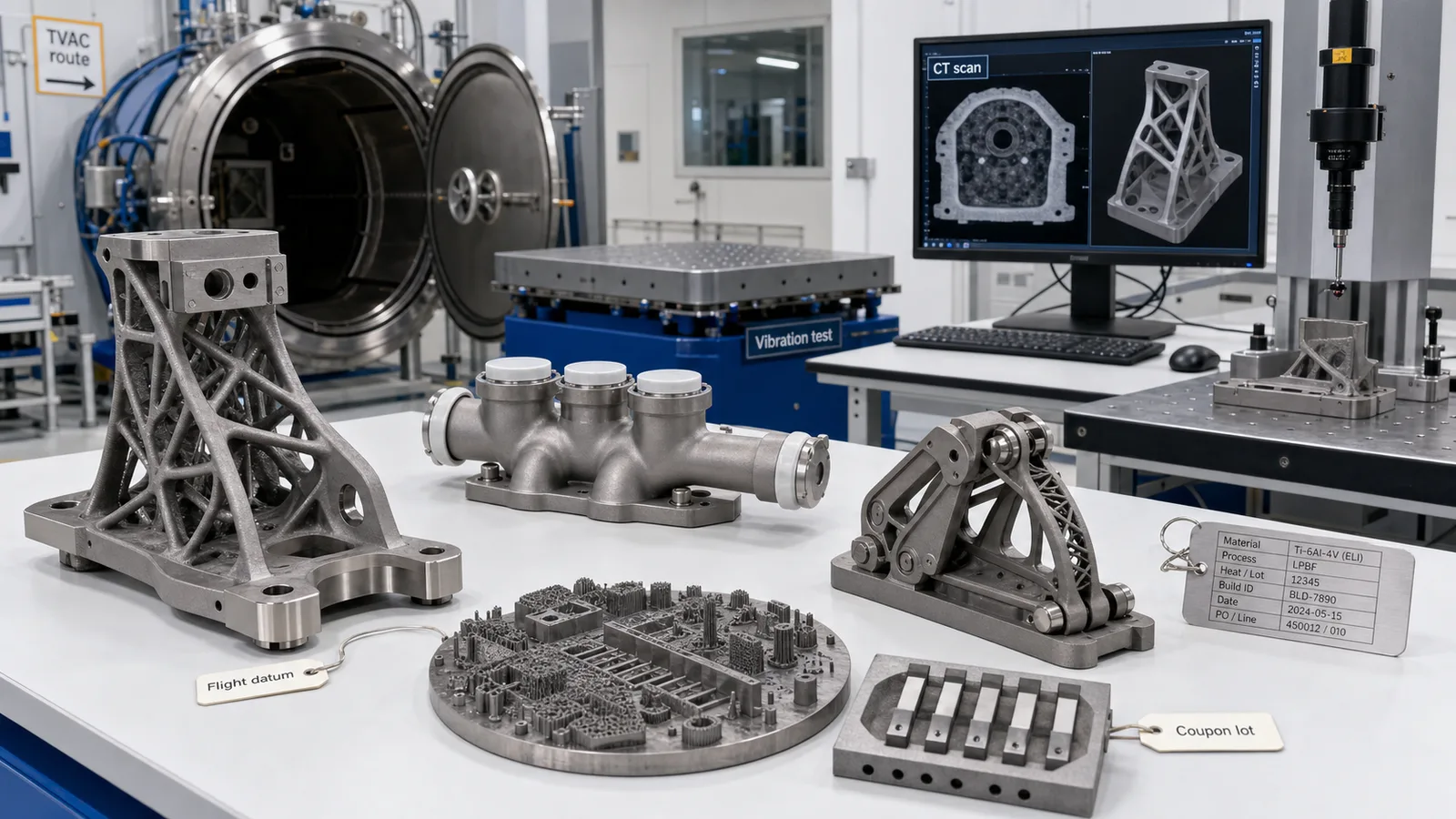
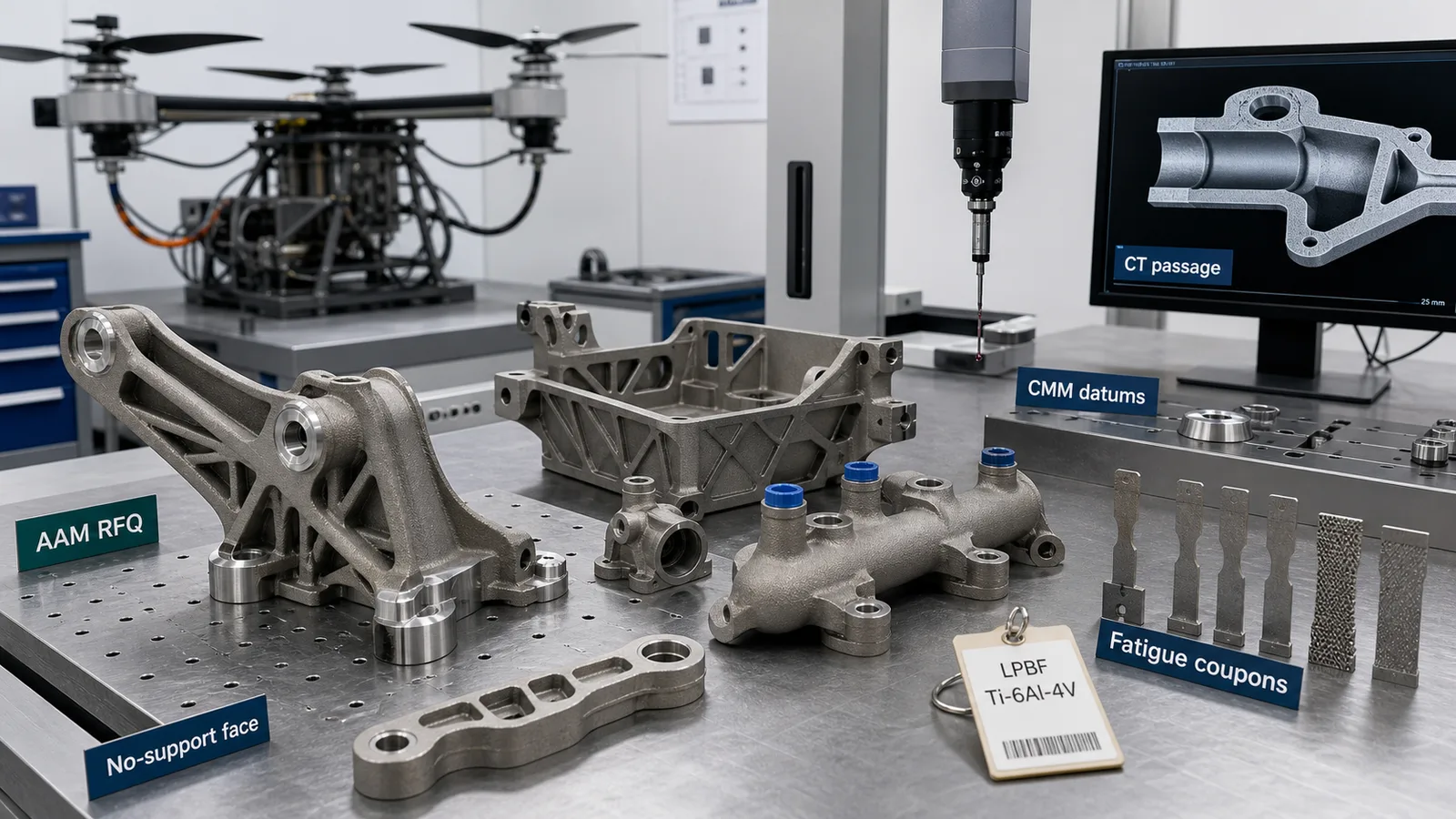
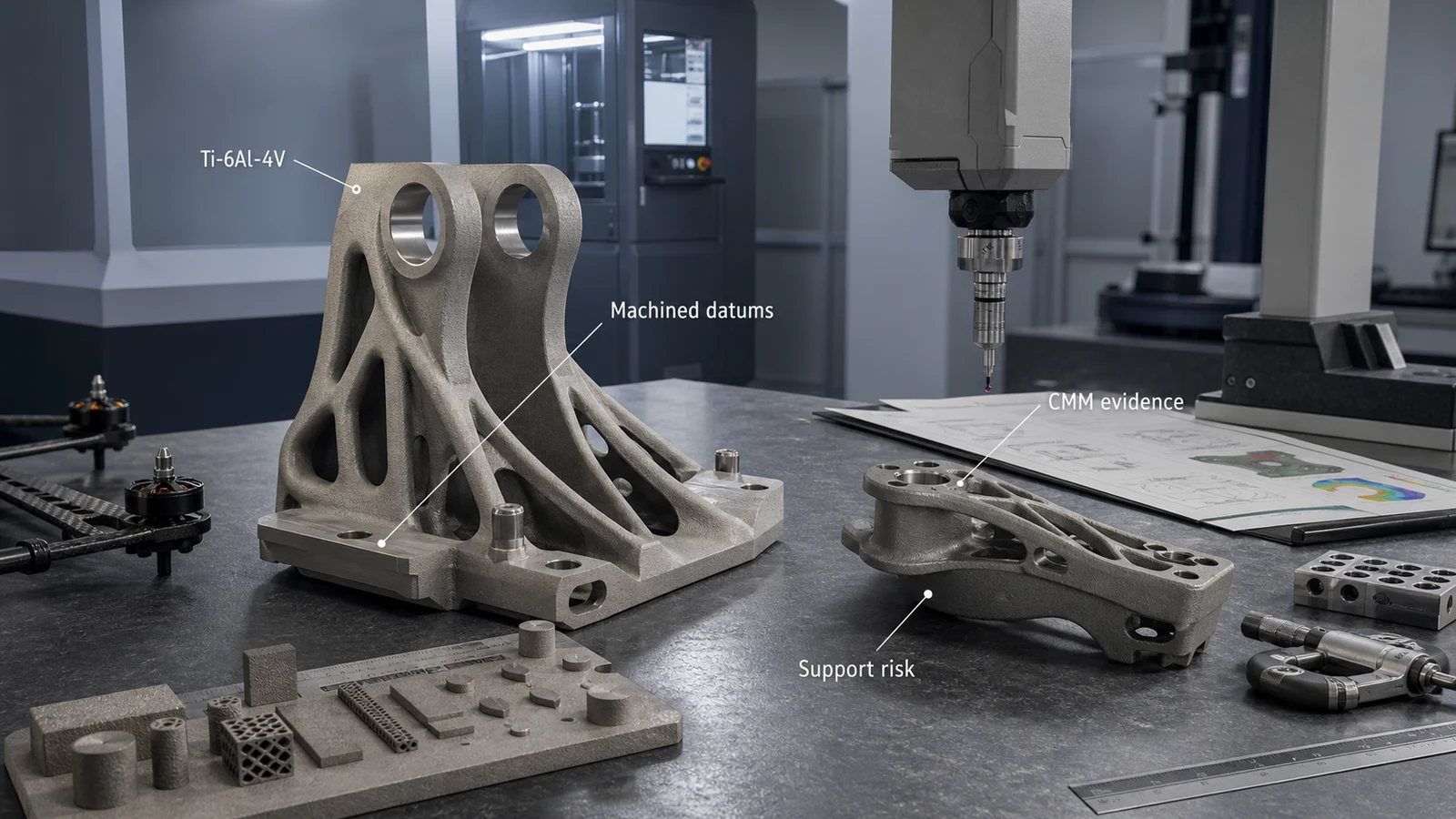
Representative article image; not a customer acceptance record or proof of a qualified manufacturing route. Refer to the cited sources and part-specific inspection records for engineering evidence.
On this page
Titanium 3D printing is moving from an engineering curiosity into a serious aerospace and defense supply-chain tool. The current interest is not only about lighter brackets or complex manifolds. It is about readiness: shortening long lead-time routes, reducing dependence on large forgings or hard-to-source stock, creating qualified alternatives, and keeping critical programs moving when conventional supply chains are under pressure.
That does not mean every titanium aerospace part should be printed. Supply-chain resilience is not the same as print speed. A useful titanium AM program still needs the right process, alloy, material traceability, post-processing route, inspection evidence, qualified suppliers, and a drawing that makes the final acceptance state clear.
This guide explains how to evaluate titanium 3D printing for aerospace and defense supply chains without confusing a printable shape with a production-ready part.
Why This Topic Is Hot in 2026
Public industry signals in 2026 show why titanium AM is receiving more attention from aerospace and defense teams:
- Airbus reported titanium wire-DED integration work for A350 cargo-door-surround parts, including qualified supplier production, ultrasonic inspection, final machining, and installation.
- GKN Aerospace and AFRL launched the TITAN-AM program to mature wire-fed laser metal deposition for large-scale titanium aerostructures, including material datasets, simulation, non-destructive inspection, and structural demonstrations.
- QinetiQ reported a flight test of an LPBF titanium hinge made from recycled titanium, showing how material recovery and AM can intersect with aerospace supply-chain strategy.
- Deloitte’s 2026 aerospace and defense outlook describes supply-chain resiliency, mission readiness, and “speed to field” as major industry themes.
- PwC’s aerospace and defense supply-chain analysis highlights titanium and nickel as critical inputs affected by concentrated production, sanctions, trade friction, cost pressure, qualification timelines, and manufacturing-capability constraints.
The long-term lesson is practical: aerospace and defense buyers are not only asking whether titanium AM can make complex geometry. They are asking whether it can create a controlled alternate route to accepted hardware.
Quick Answer
Titanium 3D printing can support aerospace and defense supply-chain resilience when the project has one or more of these drivers:
- Conventional forging, casting, or billet machining has excessive lead time or buy-to-fly waste.
- The part gains value from weight reduction, part consolidation, internal passages, or design freedom.
- A large near-net titanium structure can be deposited and finish machined instead of hogged from stock.
- A compact high-value component can be produced with LPBF, then heat treated, machined, inspected, and documented.
- The program needs a qualified alternate supplier or a bridge route while the final conventional supply chain matures.
- Material efficiency, recycled feedstock, or localized production matters, but only with traceability and acceptance evidence.
Do not use titanium AM only because a part is late. Use it when the full route to acceptance is faster, more resilient, or technically better than the conventional route.
Supply-Chain Resilience Is a Manufacturing Route
A weak AM decision treats the printer as the supply-chain solution. A strong decision treats titanium AM as one route inside a controlled manufacturing system.
The route includes:
- Design and risk review.
- Alloy and feedstock selection.
- LPBF, EBM, DED, or hybrid process choice.
- Build orientation or deposition strategy.
- Stress relief, HIP if justified, and thermal process records.
- Support removal, depowdering, or deposited-stock cleanup.
- Machining of datums, bores, threads, sealing faces, and assembly interfaces.
- CMM, CT, ultrasonic inspection, coupons, leak tests, or other evidence as required.
- COA, COC, powder or wire lot traceability, build records, and deviation control.
If a quote only covers printing, it does not solve supply-chain risk. It simply moves the risk downstream into machining, inspection, or approval.
For a broader procurement checklist, use the Titanium AM RFQ and Procurement Guide.
Where Titanium AM Helps Aerospace and Defense Buyers
Titanium AM is strongest when it reduces a real bottleneck or creates a functional advantage. These are the most common high-value cases.
Large Near-Net Structural Blanks
Wire-fed DED and related deposition routes can be useful when a large titanium part would otherwise require long-lead forgings, expensive plate, or extreme material removal. The printed shape is not the final part. It is a near-net blank that must be machined, inspected, and accepted.
This route can reduce buy-to-fly waste and shorten tooling dependence, but it requires careful control of deposition quality, distortion, machining stock, datum strategy, NDT, and material data. DED is not a shortcut around qualification. It is a different qualification problem.
For process choice details, see Titanium AM Process Selection: LPBF vs EBM vs DED.
Compact High-Value LPBF Parts
LPBF can be valuable for compact titanium aerospace and defense parts where geometry matters: brackets, mounts, ducts, small manifolds, sensor housings, thermal-management parts, lightweight structures, and low-volume replacement hardware.
For hydraulic manifolds, actuator valve blocks, servo-valve adapters, and pressure-tested fluid-power components, use Titanium 3D Printing for Hydraulic Manifolds and Fluid Power Components to define cleaning, CT, CMM, pressure testing, and traceability.
For unmanned aircraft programs, the same compact-part logic often appears in payload brackets, sensor mounts, motor junctions, and thermal-adjacent hardware. The drone-specific screening path is covered in Titanium 3D Printing for Drone and UAV Parts.
The strongest LPBF cases usually have at least one of these benefits:
- Reduced mass without sacrificing stiffness.
- Fewer joints, welds, plugs, or fasteners.
- Internal flow paths or compact packaging.
- Low-volume production where tooling is the bottleneck.
- Fast design iteration before production configuration is frozen.
The weak cases are simple blocks, plates, shafts, or tolerance-driven parts that are better machined conventionally. That screening logic is covered in When Not to Use Titanium Additive Manufacturing.
Alternate Qualified Supply Routes
For defense and aerospace programs, supply-chain resilience often means having more than one viable route. Titanium AM may support a bridge route, a second source, or a localized route when the conventional supplier base is constrained.
However, a second route must still match the acceptance basis. A forged part, a machined billet part, and an AM-plus-machined part may be geometrically interchangeable while having different microstructure, surface condition, residual stress history, defect population, and inspection evidence.
If the program needs interchangeable hardware, the RFQ should ask suppliers to explain the equivalency basis, not simply quote the same drawing.
Material Efficiency and Recycled Titanium
Recycled titanium and material-efficient AM are becoming part of the public aerospace conversation. That is relevant because titanium supply can be exposed to geopolitical pressure, processing concentration, cost volatility, and long qualification timelines.
Still, recycled feedstock is not automatically acceptable because it is sustainable. The acceptance question is whether the material lot, chemistry, oxygen content, powder or wire condition, mechanical properties, process history, and documentation meet the part risk class.
For material decisions, pair this review with Titanium AM Material Selection: Ti-6Al-4V, ELI, and CP Titanium.
LPBF vs DED for Supply-Chain Resilience
The process choice should follow the bottleneck.
| Supply-chain problem | LPBF fit | DED fit | RFQ risk to control |
|---|---|---|---|
| Compact lightweight bracket | Strong fit | Usually not first choice | Support scars, fatigue, machining, CMM |
| Internal manifold or duct | Strong fit if depowderable | Usually weak for fine enclosed channels | Powder removal, CT, pressure/leak testing |
| Large near-net structural blank | Limited by build size | Stronger fit | Deposition quality, NDT, machining stock |
| Repair or feature addition | Sometimes possible but uncommon | Often a stronger conversation | Repair boundary, heat input, inspection |
| Tooling-free bridge production | Strong for small parts | Strong for larger near-net parts | Acceptance equivalency and documentation |
| Material-efficiency strategy | Useful where geometry supports it | Useful where buy-to-fly waste is high | Feedstock traceability and mechanical evidence |
This is why “Can you 3D print this?” is a weak RFQ question. A better question is: “Which AM route creates an accepted part faster or more resiliently than the conventional route, and what evidence proves it?”
Qualification Must Be Planned Before the Quote
The biggest mistake in aerospace and defense AM sourcing is treating qualification as a later paperwork step. For titanium AM, qualification affects design, supplier selection, process choice, post-processing, inspection, and price.
The RFQ should define:
- Part criticality and intended use.
- Whether the part is prototype, ground support, non-flight, flight-like, or production hardware.
- Alloy grade and applicable material condition.
- Required process if fixed, or permission for supplier recommendation.
- Heat treatment, stress relief, HIP, surface finishing, and machining expectations.
- CMM, CT, ultrasonic, dye penetrant, leak, proof, fatigue, or coupon evidence as applicable.
- Traceability level for powder or wire lot, machine, build, parameter set, operator, post-processing batch, and inspection reports.
- Deviation, nonconformance, and change-control expectations.
For the evidence framework, use Titanium AM Qualification and Inspection Evidence.
Supplier Readiness: What to Ask Before Sending the Drawing
Not every metal AM supplier is ready for aerospace or defense work. Before sending sensitive geometry or locking a quote, ask capability questions that reveal whether the supplier understands the route.
Useful supplier questions include:
- Which titanium alloys are active in your qualified process window?
- Is the quote for print-only, near-net blank, or delivered accepted part?
- What post-processing is included?
- Which surfaces are assumed to be machined?
- What datum strategy do you expect for CMM?
- What inspection evidence is included by default and what is optional?
- Can you provide powder or wire lot traceability?
- How are parameter changes, orientation changes, and build interruptions documented?
- What is the largest build or deposition envelope available for this route?
- What are the known no-go features for your process?
- Can you support repeat builds, not only one prototype?
For defense-related work, export-control and data-handling requirements must be handled through the buyer’s compliance process before controlled technical data is transmitted. The manufacturing route cannot compensate for a poor data-control path.
Design Controls That Make AM More Resilient
Supply-chain resilience improves when the part is designed for the route. It gets worse when a conventional drawing is sent to an AM supplier with no hierarchy of requirements.
Strong AM drawings identify:
- Functional surfaces.
- Noncritical as-built surfaces.
- Machined datum pads.
- Bores, threads, sealing faces, and bearing lands.
- No-support areas.
- Support-removal access.
- Internal powder-removal access.
- CT or NDT areas of interest.
- Surface finish requirements by region.
- Inspection sequence after machining.
Weak drawings use tight all-over tolerances, vague “smooth finish” notes, undefined datums, and unclear inspection expectations. That creates supplier risk margin and program delays.
For drawing strategy, use Titanium 3D Printing Tolerances: Datum Planning and CMM and Titanium DfAM Rules for LPBF and EBM.
Cost: Faster Is Not Always Cheaper
AM can reduce lead time and material waste, but it may not reduce first-article cost. Aerospace and defense parts often need more evidence, not less.
Cost can increase because of:
- Process review and build preparation.
- Support strategy or deposition simulation.
- Stress relief, HIP, or controlled heat treatment.
- Machining fixtures and datum creation.
- NDT, CT, CMM, coupons, roughness measurement, or proof testing.
- Build records, certificates, traceability, and quality closeout.
- First-article iteration before the production route stabilizes.
That does not make AM the wrong route. It means procurement should compare total route risk: lead time, qualification burden, supplier concentration, material waste, rework risk, and future repeatability.
The Titanium 3D Printing Cost Drivers article explains how to normalize quotes around delivered accepted parts.
RFQ Scenario: A Defense Sensor Bracket
Consider a Ti-6Al-4V sensor bracket for a defense platform. The conventional route requires machined billet, multiple setups, and a long material lead time. The design has a high stiffness-to-weight requirement, several cable-clearance features, two precision mounting bores, and one surface that must locate the sensor repeatably.
A weak RFQ says:
Please 3D print this bracket quickly in titanium.
This may create a low print-only price, but it does not define the accepted part.
A stronger RFQ says:
Please review this Ti-6Al-4V sensor bracket for LPBF production as an alternate supply route. Functional features are the two mounting bores, sensor location face, and three datum pads. Noncritical external surfaces may remain as-built after support removal and cleaning. Please quote the delivered accepted part including stress relief, support removal, machining of functional features, CMM report, material traceability, build record, and any recommended design changes to reduce support contact or fatigue risk. Identify whether HIP, CT, or coupons are recommended for this risk class and state the impact on cost and lead time.
The second RFQ is longer, but it is easier to quote correctly because it defines function, route, evidence, and supplier decision points.
Aerospace and Defense RFQ Checklist
Use this checklist when titanium AM is being considered for a supply-chain problem:
- Program context: prototype, bridge route, alternate supplier, sustainment, or production.
- Part risk class and whether the hardware is flight, ground, test, or noncritical.
- Alloy grade and material condition.
- Conventional baseline route and why it is constrained.
- Target process: LPBF, EBM, DED, hybrid, or supplier recommendation.
- Critical surfaces, datum scheme, bores, threads, sealing faces, and inspection interfaces.
- As-built surfaces that do not need machining.
- Required post-processing and what is open for supplier recommendation.
- NDT scope, CMM scope, CT scope, coupons, proof tests, leak tests, or functional tests.
- Traceability documents: COA, COC, powder or wire lot, build record, heat-treatment record, inspection report, deviation log.
- Expected repeat quantity and whether the quote should include production transition assumptions.
- Data-control, export-control, and program-specific handling requirements before technical data transfer.
Review a Second-Source Proposal Before Release
A second supplier is not interchangeable with the incumbent simply because it offers the same alloy and process name. Ask for a written comparison against the controlled requirements:
| Review item | Supplier response to request | Decision before release |
|---|---|---|
| Drawing and specification | Revision list and exceptions | Design authority confirms the controlling requirements |
| Manufacturing route | Proposed machine/process, material condition, post-processing providers, and changes from the approved route | Identify requalification or additional evidence needed |
| Inspection and records | Method, coverage, acceptance criteria, lot linkage, and proposed record package | Quality and procurement confirm included evidence and exclusions |
| Future changes | Which material, process, provider, or inspection changes require notification or approval | Agree change control before repeat orders |
Use the existing supplier-response checklist to record open exceptions. This is a procurement review aid, not an aerospace qualification procedure or proof of supplier approval.
Bottom Line
Titanium 3D printing can improve aerospace and defense supply-chain resilience, but only when it is treated as a controlled route to accepted hardware. The value is not the printed shape alone. The value is a faster, more resilient, or technically better route that still produces the material condition, geometry, inspection evidence, and traceability required by the program.
The best AM sourcing conversations start with the bottleneck, define the acceptance basis, and let the process follow the part. That is how titanium AM moves from a rapid prototype to a credible aerospace and defense supply-chain option.
- Aerospace
- Defense
- Supply chain
- LPBF
- DED
- Qualification
- Traceability
- RFQ