· Updated - TITANIUM 3DP Engineering - Engineering Guides - 15 min read
Titanium 3D Printing for Industrial Valves, Pump Parts, and Flow Control Hardware
Engineering RFQ guide for titanium 3D printed industrial valves, pump parts, static mixers, nozzles, and flow control hardware, covering corrosion exposure, seal faces, pressure testing, CT, CMM, machining, and traceability.
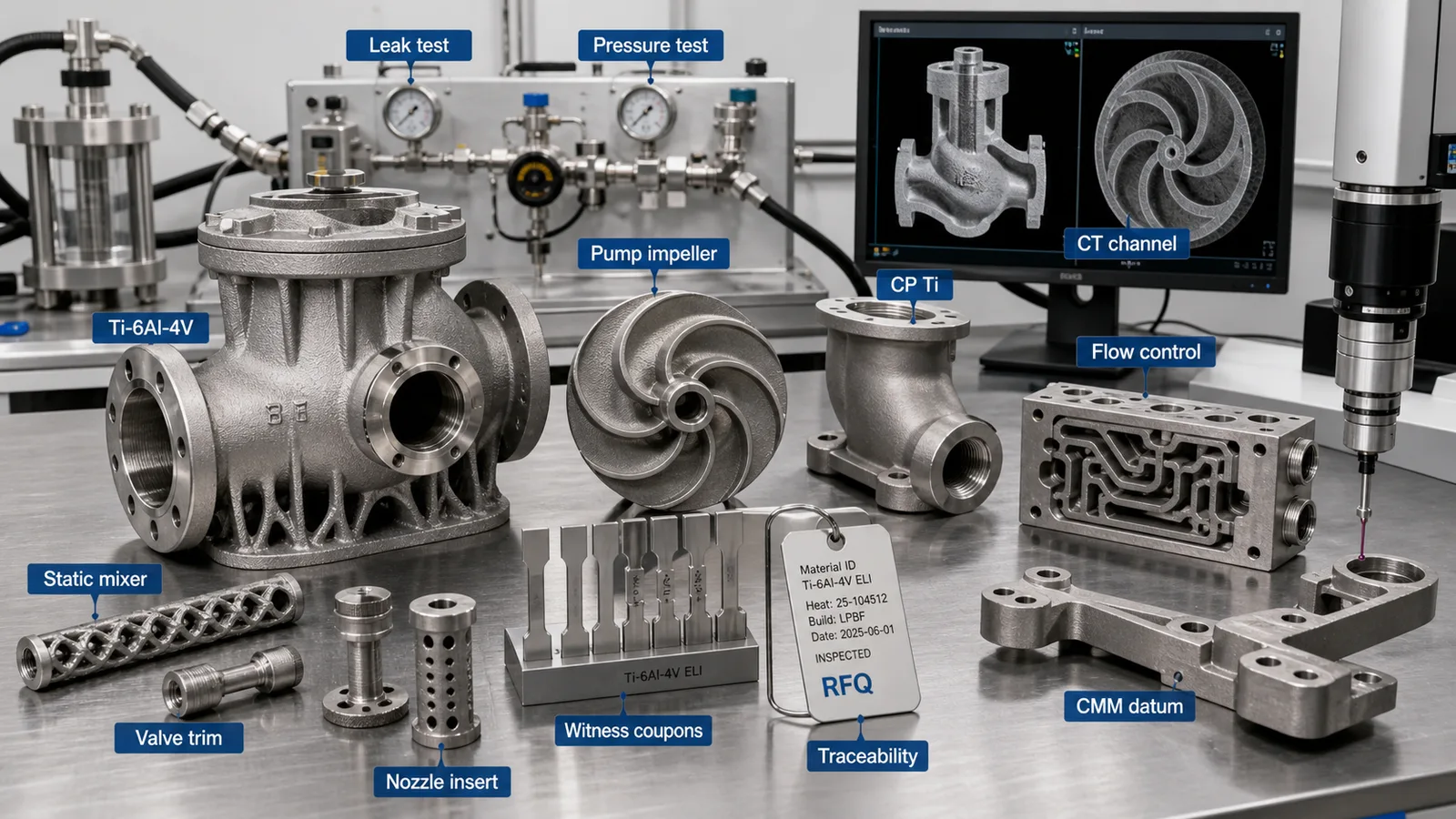
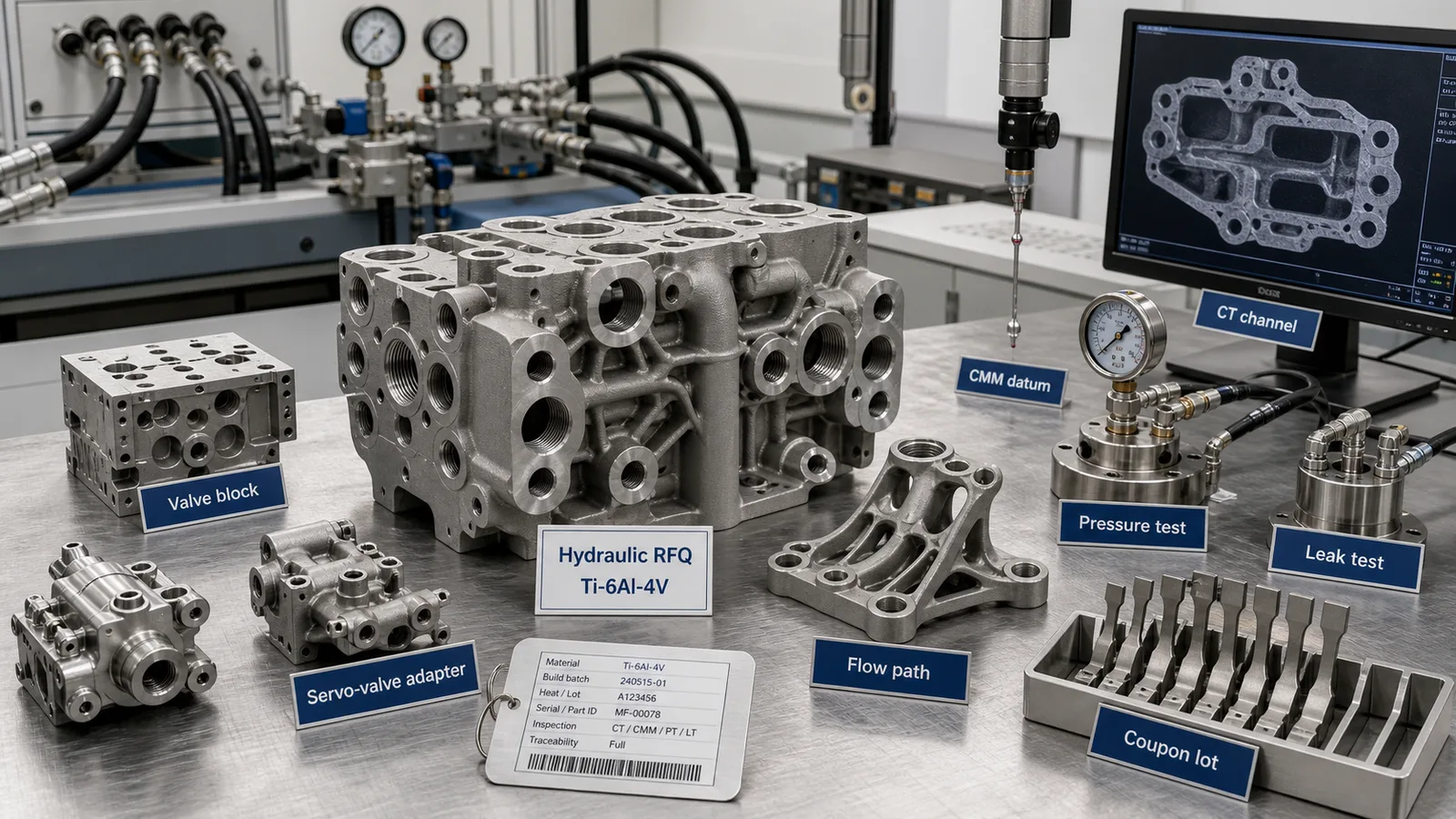
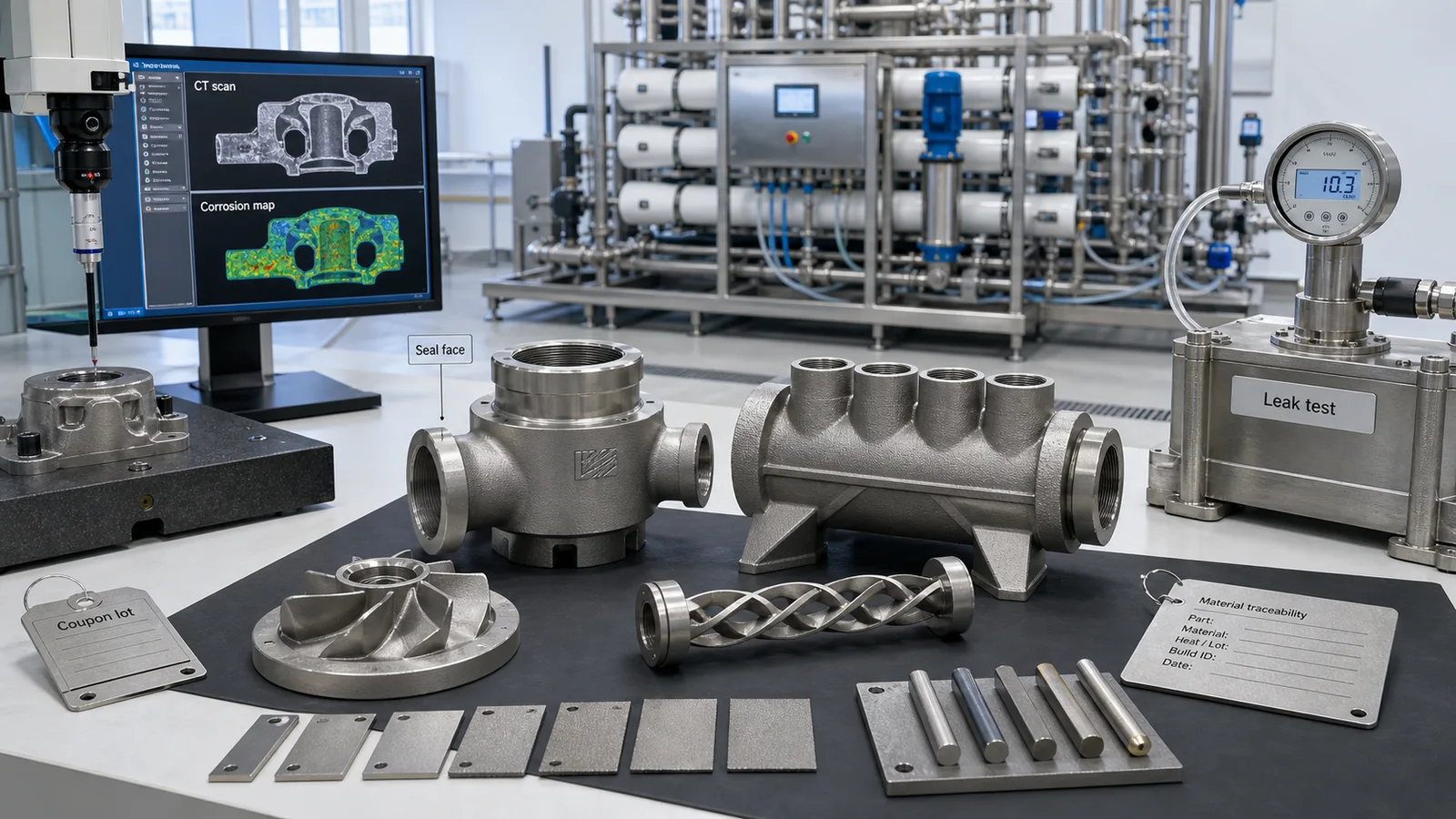
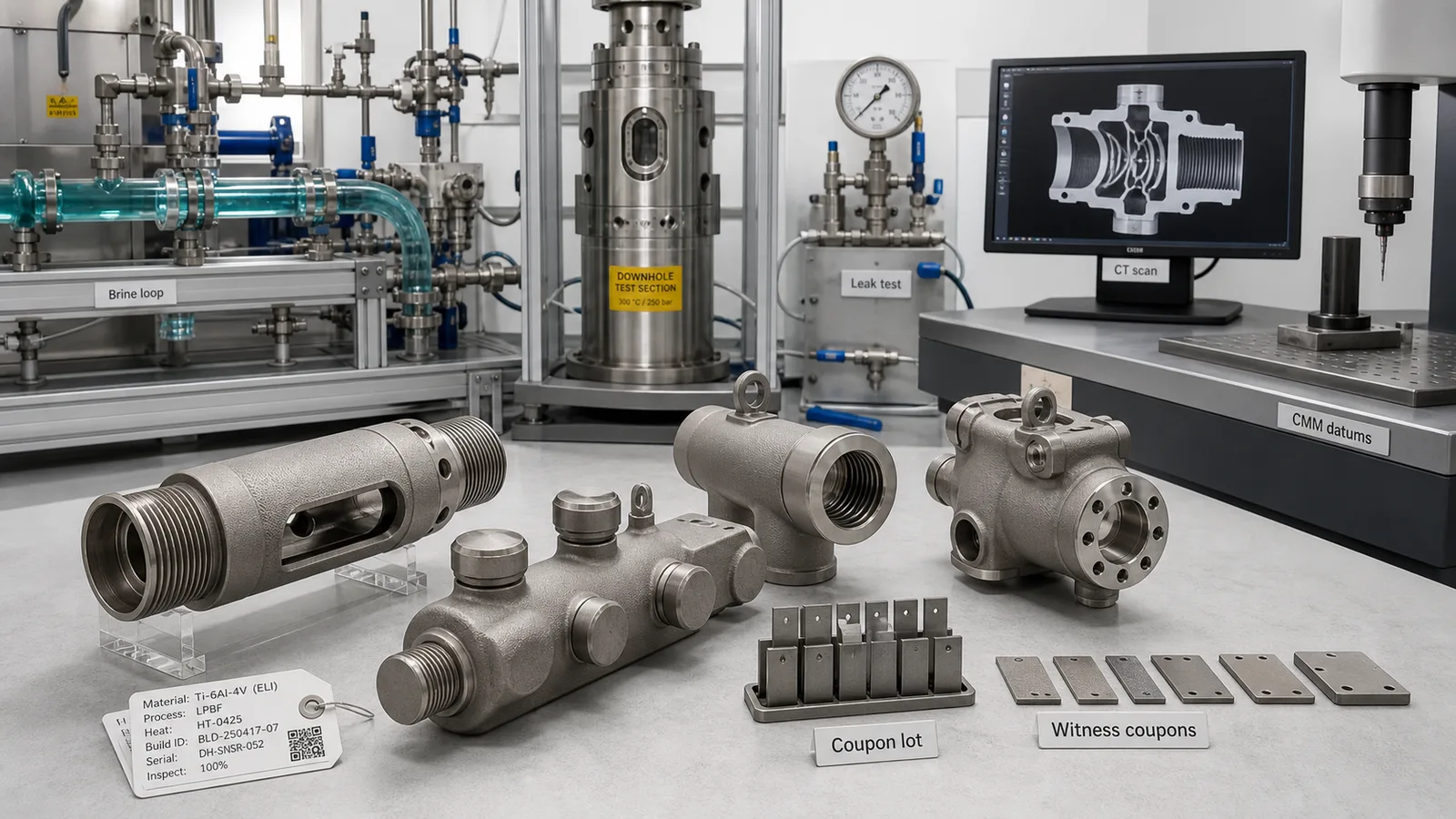
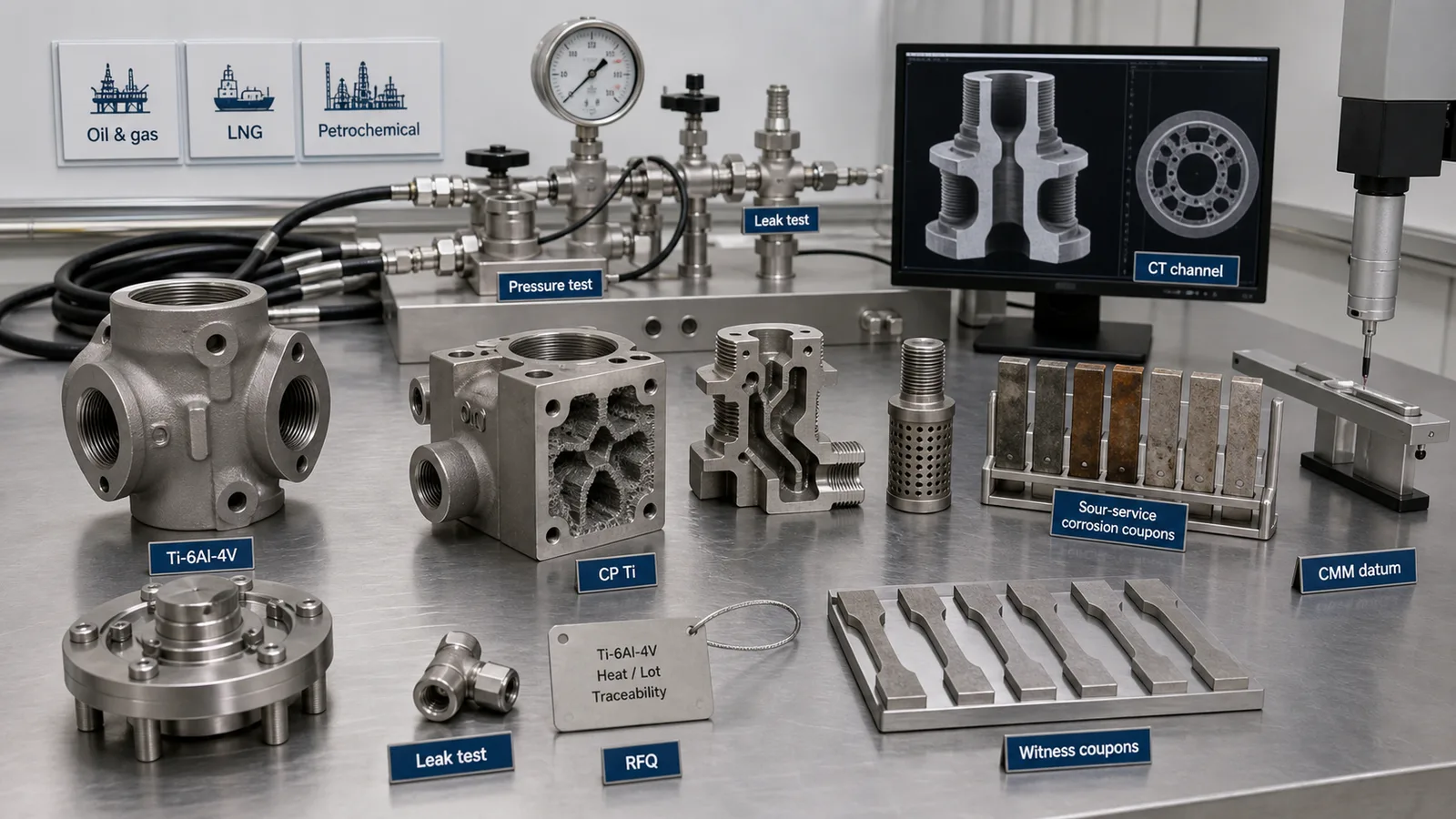
Representative article image; not a customer acceptance record or proof of a qualified manufacturing route. Refer to the cited sources and part-specific inspection records for engineering evidence.
On this page
Titanium 3D printing for industrial valves, pump parts, and flow control hardware is worth reviewing when a compact process component needs corrosion resistance, low-volume custom geometry, fewer leak paths, fast pilot-line iteration, or internal flow paths that are difficult to machine. It is not a default replacement for catalog valves, commodity pump parts, simple pipe spools, cast housings, or standard machined blocks.
The practical question is not “Can a valve body or pump adapter be printed?” The useful question is “Can titanium AM deliver a finished, machined, clean, leak-tested, inspected, traceable flow-control component that solves a real system problem better than machining, casting, fabrication, or buying standard hardware?”
This page is a cross-industry RFQ guide for process engineers, equipment builders, pilot-plant teams, and procurement teams comparing titanium additive manufacturing for valve bodies, valve trim trials, pump adapters, pump impeller development, nozzles, static mixer coupons, sample blocks, sensor bodies, dosing blocks, and compact flow-control hardware.
For oil and gas, LNG, refinery, petrochemical, produced-water, and offshore process hardware where API 20S, sour-service review, pressure testing, and operator acceptance may apply, pair this page with Titanium 3D Printing for Oil & Gas, LNG, and Petrochemical Hardware. For acid leach sample blocks, slurry nozzles, flotation dosing bodies, static mixer coupons, and mineral-processing flow-control hardware, use Titanium 3D Printing for Mining, Mineral Processing, and Hydrometallurgy Hardware.
Quick Answer
Titanium additive manufacturing is a strong candidate for industrial valves, pump parts, and flow-control hardware when the part is compact, high-value, corrosion-exposed, interface-heavy, low-volume, or functionally improved by internal geometry.
Good candidates include:
- CP titanium or Ti-6Al-4V valve bodies with integrated ports, machined seats, and low-volume custom routing.
- Valve trim prototypes, seat carriers, bypass blocks, and flow inserts used for development testing.
- Pump adapters, pump casings for trials, seal carriers, and impeller development parts in corrosive service.
- Static mixers, dosing nozzles, reagent injection bodies, and flow-distribution coupons with difficult internal geometry.
- Sample blocks, sensor housings, filter adapters, and analytical instrument interfaces for pilot skids.
- Corrosion coupon racks and exposure fixtures where titanium material condition and traceability matter.
- Pressure, leak, and flow test fixtures that need titanium compatibility and fast iteration.
Weak candidates include high-volume catalog valves, certified pressure-retaining valve bodies without a qualification path, commodity pump impellers, large tanks, large pipe spools, simple flanges, simple machined plates, and any wetted part where chemistry, pressure, cleaning, sealing, and acceptance evidence are unclear.
Why This Topic Is Timely and Evergreen
For valve and pump hardware, define the sealing or rotating interface before evaluating additive geometry. A valve body, replaceable seat carrier, static mixer, and impeller require different dimensional, surface, load, and functional checks. The proposed route must include the finishing and verification needed for that specific function.
The recent market context makes those searches more valuable:
- The UN World Water Development Report 2026 keeps water scarcity, climate pressure, and unequal water access in the global policy conversation, which supports long-term demand for desalination, industrial water reuse, brine handling, and water-treatment pilot hardware.
- The IEA’s Global Hydrogen Review 2026 tracks hydrogen production, demand, policy, infrastructure, trade, investment, and innovation, keeping attention on balance-of-plant hardware, leak testing, and corrosion-exposed test systems.
- IEA and OECD work on critical mineral traceability shows why material records, lot traceability, and supply-chain evidence matter in energy and critical-minerals hardware.
- ASME’s advanced manufacturing standards work shows that additive manufacturing is moving into more formal engineering conversations, including pressure equipment and code-adjacent components.
- Research and conference activity around additive manufactured valve bodies, flow components, pressure equipment, and hydraulic manifolds keeps the technical discussion active. That does not qualify a buyer’s part automatically, but it does reinforce the need for route-aware RFQs.
The long-term value is simple: valves, pumps, nozzles, mixers, manifolds, and process adapters are recurring hardware families across water treatment, chemical processing, hydrogen, carbon capture, critical minerals, battery recycling, marine systems, AI liquid cooling, and industrial pilot plants.
Where Titanium AM Fits Best
Titanium AM is strongest when it solves more than one problem at the same time: corrosion plus compact routing, low-volume iteration plus traceability, internal geometry plus fewer fittings, or material compatibility plus fast replacement.
| Hardware family | Why titanium AM can help | Main RFQ risk | Evidence to define |
|---|---|---|---|
| Valve body or bypass block | Integrated ports, fewer plugs, compact routing | Seal leakage and pressure boundary risk | Machined seats, CMM, pressure/leak test |
| Valve trim or seat trial | Fast iteration for flow and wear development | Surface finish, erosion, fit | Machining plan, roughness, test duty |
| Pump adapter or seal carrier | Low-volume interface hardware in corrosive service | Flatness, runout, seal quality | CMM, machined faces, roughness |
| Pump impeller development part | Complex blades and fast trial geometry | Balance, cavitation, fatigue, erosion | Runout, balance, surface finish, test plan |
| Static mixer or dosing nozzle | Internal geometry that is hard to machine | Powder removal and blockage | CT or flow test, cleaning route |
| Sample block or sensor body | Integrated taps and short flow paths | Dead legs and contamination | Cleaning route, leak test, material records |
| Corrosion coupon rack | Matched titanium exposure hardware | Over-specifying a simple holder | Alloy, surface condition, coupon traceability |
The best RFQ defines the delivered state, not only the printed shape. A finished valve body may require printing, stress relief, support removal, HIP if justified, machining, cleaning, leak testing, CMM, CT, roughness checks, material records, and controlled packaging.
Start With the Process Exposure Map
For industrial valves and pump parts, material selection cannot be separated from media exposure. A titanium part may see chloride brine, seawater, acidic leachate, alkaline cleaning chemistry, hydrogen, oxygen, CO2, amine solvent, coolant, deionized water, black mass slurry, abrasive solids, hot fluid, stagnant crevices, galvanic contact, pressure cycling, or periodic CIP/SIP cleaning.
Define:
- Process fluid, concentration, pH, contaminants, solids, and cleaning chemistry.
- Temperature range, stagnation periods, aeration, dissolved oxygen, and pressure cycles.
- Whether the part is wetted, pressure-retaining, vacuum-facing, thermal, structural, or only a fixture.
- Mating materials, fasteners, coatings, liners, elastomers, and galvanic isolation assumptions.
- Whether crevice corrosion, erosion, cavitation, scaling, fouling, or particle retention controls acceptance.
- Whether the titanium part needs CP titanium, Ti-6Al-4V, Ti-6Al-4V ELI, or another material route.
For chemical and water-treatment exposure screening, use Titanium 3D Printing for Chemical Processing and Water Treatment Parts. For seawater and brine systems, use the desalination and brine concentration guide.
Valve Bodies and Valve Trim Need Seal Discipline
Valve hardware is often controlled by interfaces rather than the bulk printed shape. A printed titanium body can reduce cross-drilling, plugs, dead legs, and welded bosses, but valve seats and seal faces still need a route that produces acceptable geometry and finish.
Define:
- Valve type, port map, flow direction, and pressure class or development pressure.
- Seat geometry, seal type, gasket interface, O-ring groove, or metal-seat requirement.
- Stem, guide, packing, actuator, sensor, or instrumentation interface.
- Which surfaces are machined, lapped, polished, coated, or left as-built.
- Whether the part is a prototype, test fixture, pilot skid component, or production-intent valve body.
- Leak threshold, pressure-hold method, vacuum test, bubble test, helium leak test, or other acceptance method.
Do not rely on as-built LPBF texture for valve seats, O-ring grooves, gasket lands, or metal-seal faces. Add machining stock and define final inspection. Use Titanium 3D Printing Tolerances: Datum Planning and CMM before sending the drawing.
Pump Parts: Adapters Are Easier Than Final Impellers
Pump-related titanium AM has different risk levels. A pump adapter, seal carrier, filter interface, or low-volume casing trial may be a practical AM candidate. A final production impeller is a harder project because balance, blade finish, erosion, cavitation, fatigue, and hydraulic performance can dominate acceptance.
Good pump-related AM candidates include:
- Custom pump adapters for pilot skids and test loops.
- Seal carriers, bearing-adjacent housings, and interface blocks with final machining.
- Corrosion-resistant test casings or covers for low-volume validation.
- Impeller development parts used to compare geometry before a production route is selected.
- Small pump fixtures, alignment tools, and pressure-test adapters.
High-risk pump details include:
- As-built blade surfaces in high-velocity liquid paths.
- Unbalanced impellers after support removal or finishing.
- Rough surfaces that promote cavitation, residue, or erosion.
- Thin blade roots near high cyclic stress.
- Hidden passages that trap powder or cleaning media.
- Shaft bores, wear-ring regions, and seal faces without machining stock.
For fatigue-sensitive rotating or pressure-cycled parts, use Titanium 3D Printing Fatigue Design before treating an impeller or rotating flow part as production-ready.
Static Mixers, Nozzles, and Flow Inserts Need Cleaning Logic
Static mixers, dosing nozzles, reagent injectors, and flow-distribution inserts are attractive AM candidates because internal geometry can be hard to machine. They are also easy to underquote.
Review:
- Minimum feature size and whether it can be depowdered.
- Blind regions, dead legs, thin restrictions, and sharp turns.
- Whether the part sees solids, precipitates, scale, crystals, black mass, brine, biofouling, or resin beads.
- Whether internal roughness affects mixing, pressure drop, fouling, cleaning, or erosion.
- Whether CT, borescope, flow test, pressure-drop test, or destructive sectioning is needed.
- Whether abrasive flow finishing, chemical finishing, polishing, or passivation is appropriate.
Use Titanium 3D Printed Internal Channels: Powder Removal and CT before freezing a static mixer, dosing body, nozzle, or compact flow-control block.
Material Selection: CP Titanium vs Ti-6Al-4V
CP titanium can be a strong candidate for corrosion-focused flow-control hardware where strength requirements are moderate and chloride or process chemistry drives the material decision. It may be reviewed for seawater sample blocks, brine pilot parts, chemical dosing bodies, low-pressure process adapters, coupon racks, and corrosion exposure fixtures.
Ti-6Al-4V is often the first review path for compact structural flow hardware, higher-strength adapters, pump-related housings, stronger valve blocks, and parts where supplier familiarity and mechanical performance matter. Ti-6Al-4V ELI may be reviewed when ductility, fracture behavior, or a more conservative acceptance basis matters.
The grade decision should follow the part’s job:
- Use CP titanium when corrosion exposure is the main driver and loads are moderate.
- Use Ti-6Al-4V when strength-to-weight ratio, threads, bolt preload, stiffness, or compact structural geometry matters.
- Review Ti-6Al-4V ELI when the project has stricter ductility or acceptance needs.
- Avoid titanium when lined steel, duplex stainless, nickel alloy, polymer, ceramic, graphite, conventional titanium fabrication, or a catalog part meets the duty at lower risk.
For a full alloy screen, use Titanium AM Material Selection: Ti-6Al-4V, ELI, and CP Titanium.
Pressure, Leak, Flow, and Code Boundaries
Industrial valves and pump parts often sit near pressure boundaries. Titanium AM should not be used to bypass code, safety, or customer acceptance requirements. If a part is pressure-retaining, hydrogen-facing, sour-service, regulated, or safety-critical, the buyer must define the applicable standard, acceptance evidence, and qualification path.
Define:
- Working pressure, proof pressure, burst requirement if any, pressure cycling, and hold time.
- Test medium and whether it matches the operating fluid.
- Leak threshold, measurement method, fixture method, and port sealing plan.
- Whether pressure, leak, and flow testing occur before or after machining, finishing, passivation, cleaning, and packaging.
- Whether every circuit is tested separately.
- Whether CT, CMM, roughness, coupons, NDE, or serial traceability is required.
- Whether the supplier is quoting a development component or a production-intent pressure part.
The Titanium AM Qualification and Inspection Evidence guide helps define CT, CMM, coupon, and documentation scope without turning every prototype into an over-tested production article.
Surface Finish, Machining, and Cleaning
As-built titanium AM surfaces are useful on noncritical exterior geometry, ribs, brackets, and some low-risk flow bodies. They are usually not acceptable as final seal faces, bearing interfaces, precision bores, valve seats, or pump running surfaces.
Separate surfaces by function:
- Valve seats, O-ring grooves, gasket lands, and lapped interfaces.
- Threaded ports, tube-fitting seats, pressure taps, and instrumentation ports.
- Shaft bores, seal carrier faces, wear-ring regions, and impeller interfaces.
- Wetted internal channels where roughness affects pressure drop, fouling, or cleaning.
- Pump blade surfaces where cavitation, erosion, or balance matters.
- Fatigue or pressure-cycle surfaces where support scars are unacceptable.
- Datum pads and bolt faces that need CMM control.
- Noncritical exterior surfaces that may remain as-built or bead blasted.
Cleaning is part of the delivered component, not a footnote. A flow-control component that contains powder, chips, abrasive media, polishing residue, cleaning solution, oil, salt, black mass, brine, or particles is not ready for process use.
For the broader route, use Post-Processing for Titanium 3D Printing.
Process Choice: LPBF First, EBM and DED Selectively
LPBF is usually the first route reviewed for compact titanium valves, pump adapters, nozzles, static mixers, sample blocks, and flow-control hardware because it supports fine internal geometry, compact porting, and low-volume precision parts. It also brings powder removal, support strategy, surface finish, residual stress, and machining access into the RFQ.
EBM may be reviewed when geometry, feature size, and surface expectations fit the supplier’s route. DED is usually better for larger near-net blanks, repair-like work, cladding, or machining-stock parts, not fine clean internal channels or precision valve interfaces.
Use Titanium AM Process Selection: LPBF vs EBM vs DED when the supplier should recommend the route rather than only quote a process named in the drawing.
Cost Should Be Compared Against Delivered Hardware
Titanium AM can look expensive if the buyer compares only print price against a raw casting, billet, or catalog fitting. The useful comparison is delivered hardware value.
Compare:
- AM valve body plus machining, cleaning, CMM, pressure/leak testing, and traceability.
- Conventional machined block plus drilling, plugging, deburring, leak testing, and assembly.
- Fabricated part plus welds, fittings, NDE, rework, and leak-path stack-up.
- Cast or forged route plus tooling, minimum order quantity, qualification, and lead time.
- Catalog hardware plus adapters, extra fittings, extra space, corrosion mismatch, or test-loop compromises.
- Development value from faster iteration and fewer revisions.
Use Titanium 3D Printing Cost Drivers before comparing suppliers only on print price.
Example RFQ: Titanium Valve Body for a Pilot Skid
A practical RFQ might describe a CP titanium or Ti-6Al-4V LPBF valve body for a pilot skid. The current assembly uses a machined block, two adapters, several fittings, and a short external tube run. The engineering team wants a compact flow body with fewer leak paths, integrated sensor ports, and a machined seal interface.
The RFQ should include:
- CAD model and 2D drawing with revision.
- Process fluid, concentration, pH, solids, temperature, and cleaning chemistry.
- Working pressure, proof pressure, leak threshold, and test method.
- Valve type, seat geometry, seal type, port standard, and actuator or instrument interfaces.
- Surfaces that must be machined: valve seat, gasket face, threads, O-ring groove, datum pads, bolt faces, and ports.
- Internal channel size, blind regions, flow direction, pressure drop target, and cleaning route.
- Material target: CP titanium, Ti-6Al-4V, Ti-6Al-4V ELI, or supplier recommendation.
- Post-processing: stress relief, HIP if justified, machining, finishing, passivation, cleaning, drying, packaging.
- Inspection scope: CMM, CT or flow test, pressure test, leak test, roughness, coupons, COA, COC, build record, and powder lot.
- Prototype quantity, pilot quantity, and expected revision cadence.
Better RFQ wording:
Please review this titanium AM valve body as delivered accepted process hardware. The part carries chloride-rich pilot fluid at the stated temperature and pressure and includes two machined seal seats, four threaded ports, one sensor pocket, and two CMM datum pads. Please recommend CP titanium or Ti-6Al-4V based on the exposure notes; identify powder-removal access, support strategy, machining stock, cleaning route, pressure/leak test method, CMM scope, CT or flow-test recommendation, material traceability, and any DfAM changes needed before quotation. Quote the finished, tested, documented part, not only the printed shape.
Example RFQ: Pump Adapter and Static Mixer Coupon
A second RFQ might combine two development parts: a titanium pump adapter for a brine test loop and a static mixer coupon for process screening. The adapter is an interface problem; the mixer is an internal-geometry problem. They should not be quoted with the same evidence package.
For the pump adapter, define:
- Bolt pattern, gasket face, port standard, datum scheme, and final machining.
- Fluid, pressure, temperature, corrosion exposure, and cleaning route.
- CMM scope for flange, port, and datum geometry.
- Leak or pressure test tied to the final machined state.
For the static mixer coupon, define:
- Mixer length, element geometry, minimum gap, pressure drop target, and flow rate.
- Depowdering access, cleaning method, and whether CT or destructive sectioning is needed.
- Accepted roughness or finishing route.
- Whether the coupon is for learning, process qualification, or production-intent hardware.
The supplier can quote more accurately when the RFQ separates interface risk from internal-flow risk.
Choose the Next Engineering Check
Use these related pages to build a complete sourcing decision:
- Chemical and water-treatment exposure: Titanium 3D Printing for Chemical Processing and Water Treatment Parts
- Seawater and brine concentration: Titanium 3D Printing for Seawater Desalination and Brine Concentration Hardware
- Lithium brine and DLE pilot hardware: Titanium 3D Printing for Direct Lithium Extraction
- Battery recycling and critical minerals processing: Titanium 3D Printing for Battery Recycling and Critical Minerals Processing Parts
- Carbon capture process hardware: Titanium 3D Printing for Carbon Capture Hardware
- Hydrogen balance-of-plant and test hardware: Titanium 3D Printing for Hydrogen Hardware
- Marine and subsea pump or valve adapters: Titanium 3D Printing for Marine and Subsea Parts
- Hydraulic manifolds and fluid power: Titanium 3D Printing for Hydraulic Manifolds
- AI data center coolant adapters: Titanium 3D Printing for AI Data Center Liquid Cooling Hardware
- Internal channels, CT, and trapped powder: Titanium 3D Printed Internal Channels
- Tolerances, datums, and CMM: Titanium 3D Printing Tolerances
- RFQ deliverables: Titanium AM RFQ and Procurement Guide
When Not to Use Titanium AM
Do not use titanium AM for industrial valves, pump parts, or flow-control hardware when:
- A catalog valve, fitting, pump component, or machined block already meets the requirement.
- The part is high volume, low complexity, and price-sensitive.
- The internal passages cannot be depowdered, cleaned, inspected, or flow checked.
- Seal faces, valve seats, threads, shaft bores, or gasket lands lack machining stock.
- Pressure, leak, flow, cleanliness, or code requirements are undefined.
- Cavitation, erosion, or balance controls performance but the test plan is missing.
- A pressure-retaining or safety-critical part lacks a qualification path.
- Lined steel, stainless, duplex, nickel alloy, polymer, graphite, ceramic, or conventional titanium fabrication is lower risk.
Use When Not to Use Titanium Additive Manufacturing before quoting a simple process part. Titanium AM should earn its place by improving corrosion resistance, compact routing, leak-path reduction, low-volume iteration, evidence, or system integration.
Bottom Line
Titanium 3D printing can be valuable for industrial valves, pump parts, and flow-control hardware when it turns a difficult process component into a compact, corrosion-aware, cleanable, machined, tested, documented part. The strongest candidates are valve bodies, valve trim trials, pump adapters, seal carriers, static mixers, dosing nozzles, sample blocks, sensor housings, corrosion fixtures, and flow-test coupons where exposure, sealing, cleaning, and evidence are planned before quote comparison.
The weak cases are simple shapes, commodity valves, standard pump parts, large fabricated equipment, and any wetted or pressure part where the RFQ ignores material exposure, powder removal, surface finish, machining, leak testing, and traceability.
If you are reviewing a titanium valve body, pump adapter, impeller development part, static mixer, dosing nozzle, sample block, sensor housing, process manifold, or flow-control component, send the CAD model, drawing, process fluid, pressure, temperature, target alloy, quantity, post-processing expectations, and inspection scope through the TITANIUM 3DP RFQ page. Include the surfaces that need machining, the passages that need CT or flow testing, and the leak or pressure test required for acceptance.
- Industrial valves
- Pump parts
- Flow control
- Process equipment
- Static mixers
- Corrosion
- Leak testing
- Pressure testing
- CMM
- RFQ