· Updated - TITANIUM 3DP Engineering - Engineering Guides - 14 min read
Titanium 3D Printing for eVTOL and Advanced Air Mobility Hardware
Engineering RFQ guide for titanium 3D printed eVTOL and advanced air mobility hardware, covering lightweight brackets, propulsion mounts, battery structures, cooling parts, fatigue, CMM, CT, and traceability.
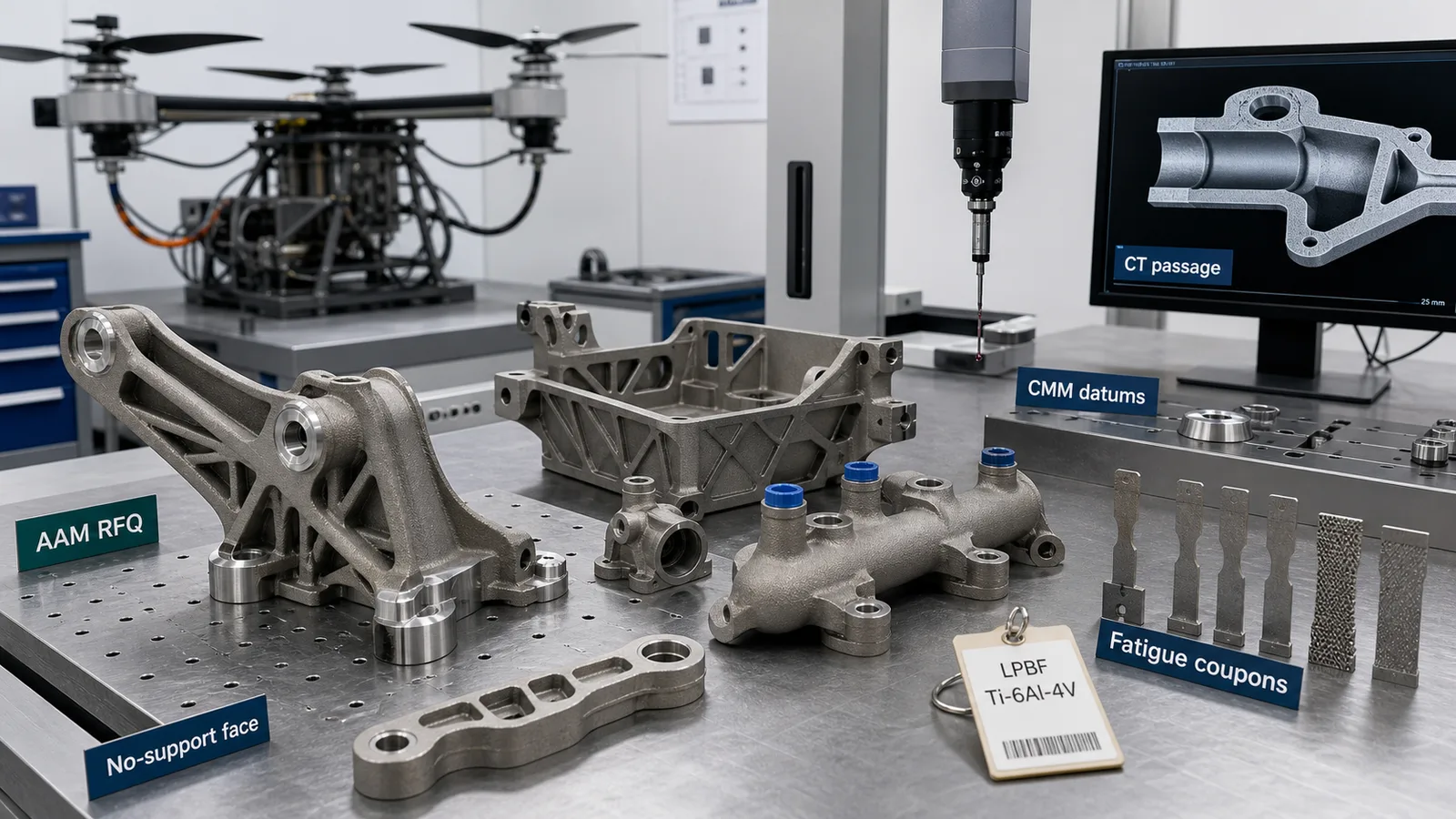
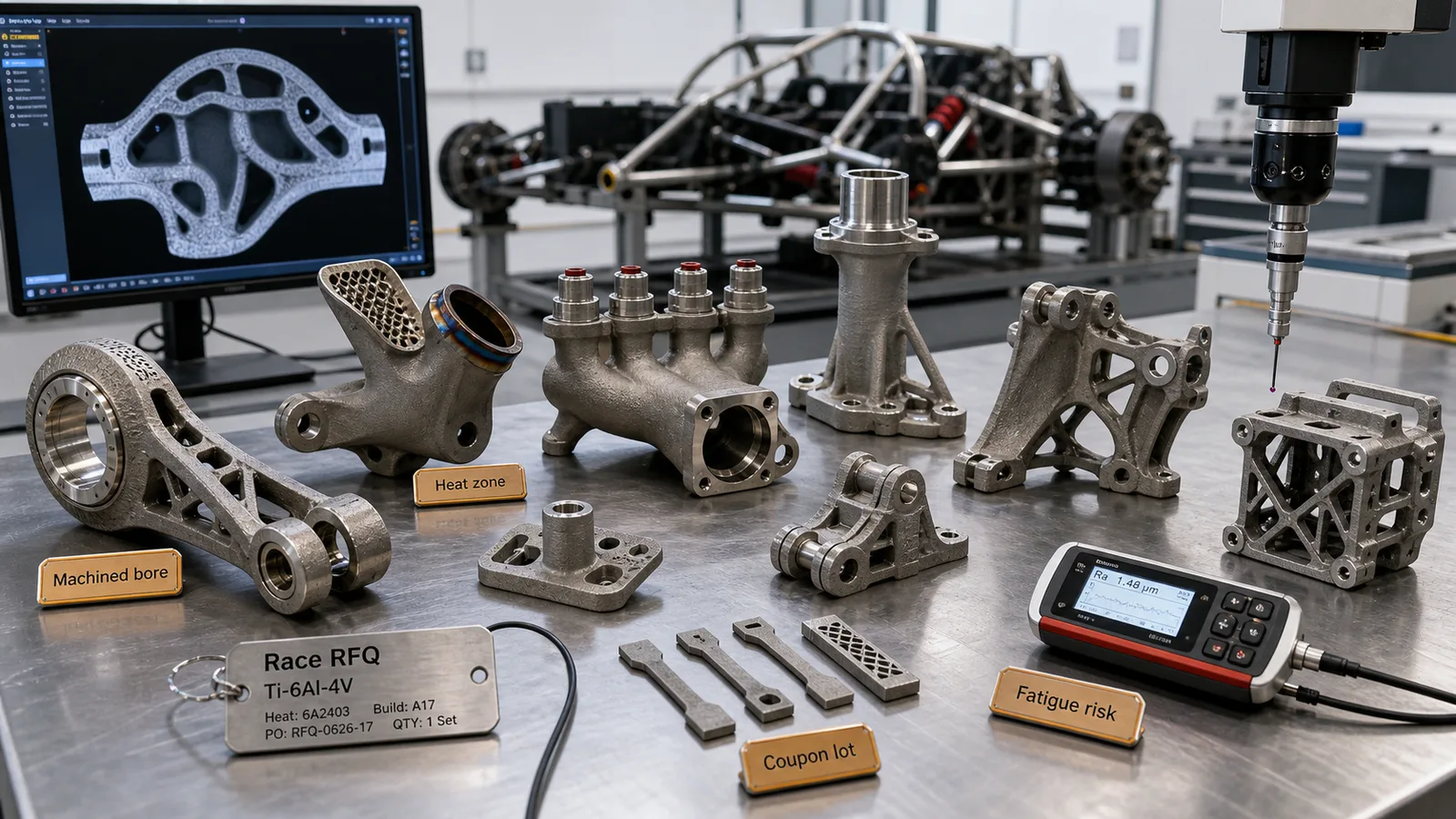
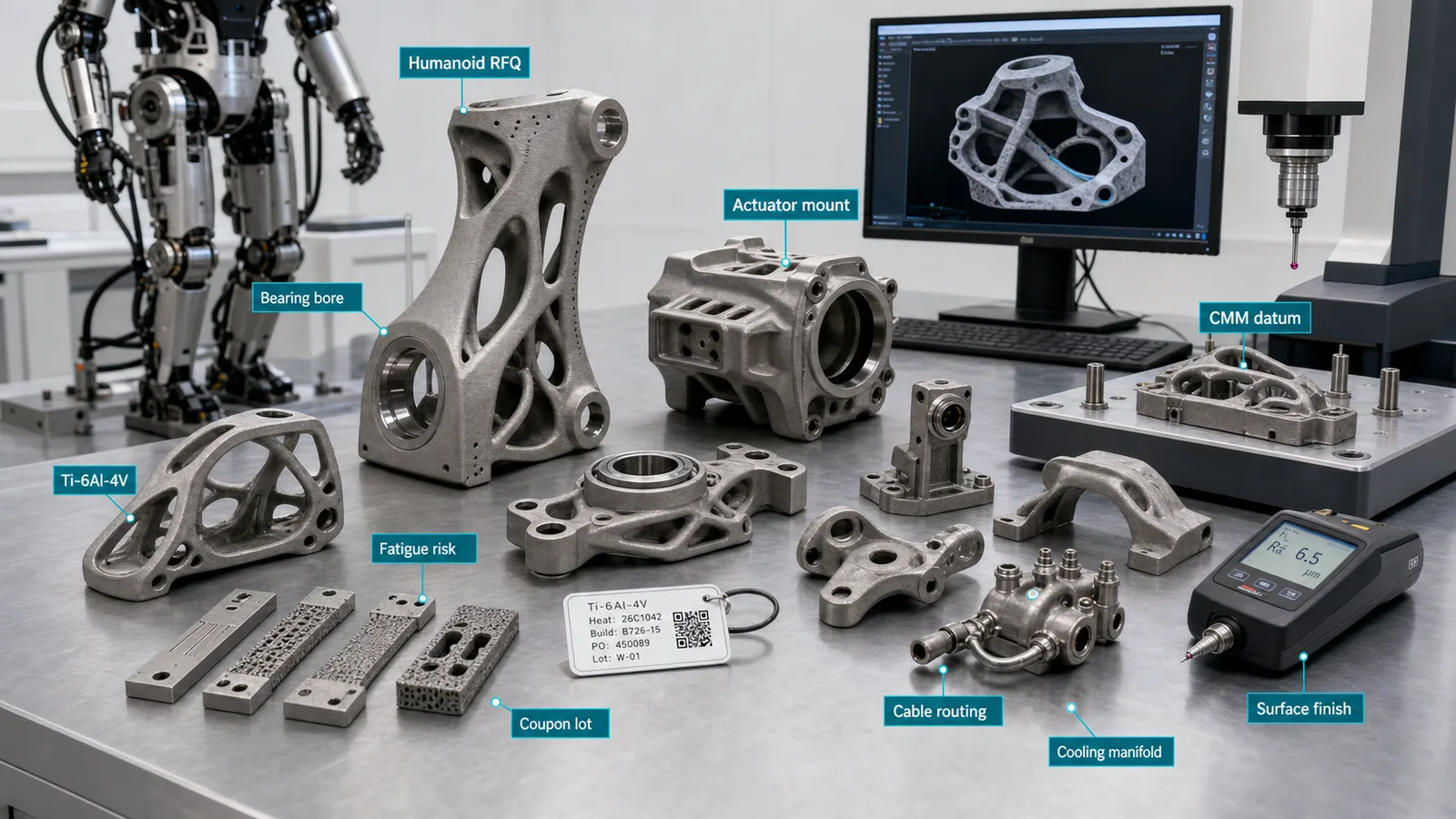
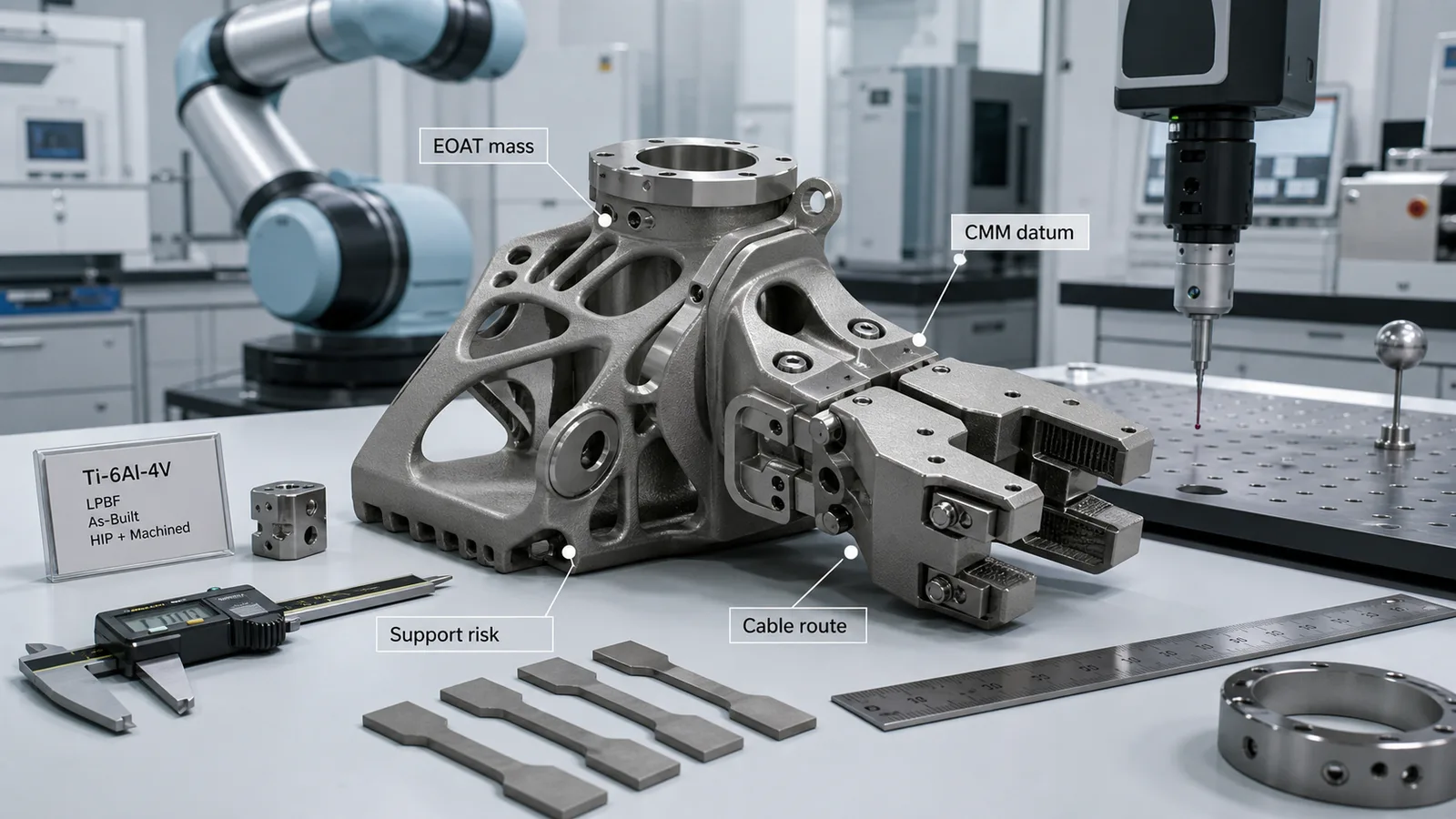
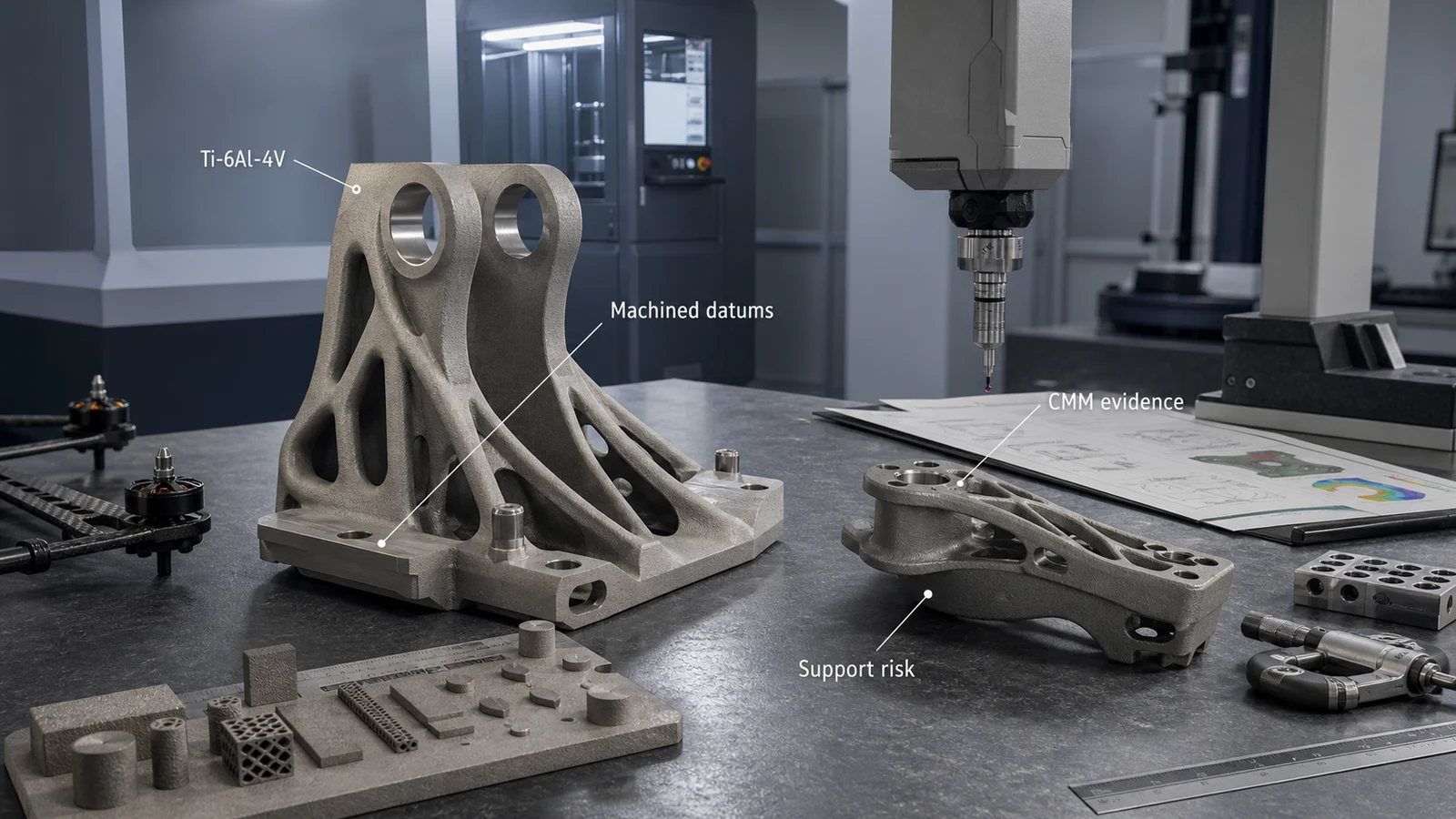
Representative article image; not a customer acceptance record or proof of a qualified manufacturing route. Refer to the cited sources and part-specific inspection records for engineering evidence.
On this page
Advanced air mobility teams are asking a different titanium 3D printing question than small drone teams. The question is not simply whether a bracket can be made lighter. It is whether a compact aircraft part can move from concept hardware into a controlled route with fatigue awareness, machined interfaces, inspection evidence, material traceability, and a supplier conversation that supports flight-test or production planning.
That makes eVTOL and AAM hardware a strong but selective fit for titanium additive manufacturing. Titanium AM can help when the part is high-value, compact, interface-heavy, thermally exposed, or difficult to machine from billet without high material waste. It becomes weak when the part is a simple plate, a low-cost fairing, a large commodity structure, or any safety-critical flight article without a funded qualification path.
This guide focuses on RFQ-ready engineering decisions for eVTOL, cargo AAM, regional air mobility prototypes, and powered-lift test hardware. It does not claim that printing a titanium part makes it certified flight hardware. Certification basis, airworthiness approval, and program acceptance remain the buyer’s responsibility.
Why eVTOL and AAM Titanium AM Is Timely in 2026
The eVTOL market has moved from concept renderings into a more serious aircraft-development phase. That matters for titanium AM because early vehicle programs need lighter hardware, faster iteration, supplier options, and more disciplined evidence packages.
Public signals make the timing clear:
- The FAA describes Advanced Air Mobility aircraft as typically highly automated, electrically powered, and capable of vertical takeoff and landing.
- The FAA’s powered-lift final rule adopted a Special Federal Aviation Regulation for a 10-year period to help integrate powered-lift aircraft into the National Airspace System.
- NASA’s Advanced Air Mobility mission is producing data for electric air taxis, drones, and safe integration work with the FAA, with passenger transport, cargo delivery, and public-service use cases in scope.
- NASA’s recent national airspace overview describes its FAA partnership as preparing the National Airspace System for future aircraft such as drones and air taxis.
- EASA’s Special Condition for VTOL continues to define a dedicated certification path for small VTOL-capable aircraft in Europe.
None of these sources means a specific eVTOL part should be printed in titanium. They explain why AAM engineering teams are now moving from “can we build a demonstrator?” toward “can we build inspectable, repeatable, traceable hardware fast enough to support aircraft development?”
For a broader aerospace sourcing frame, pair this article with Titanium 3D Printing for Aerospace and Defense Supply Chains. For smaller uncrewed aircraft, use the separate Drone and UAV Parts guide.
Quick Answer
Titanium 3D printing is most useful for eVTOL and AAM hardware when the part has at least one hard driver:
- Weight reduction is valuable, but stiffness, fatigue, and interface location must be preserved.
- The geometry has a compact load path that can be ribbed, shelled, or consolidated.
- The part has multiple machined interfaces that benefit from near-net printing plus final CNC.
- Thermal exposure, battery safety packaging, or propulsion proximity makes aluminum or polymer less attractive.
- Internal passages, cable routing, or cooling features reduce assembly count.
- Low-volume flight-test or ground-test hardware needs faster iteration than tooling can support.
- The program needs traceable delivered parts, not print-only prototypes.
Good candidates include propulsion pylon brackets, rotor or motor-adjacent mounts, battery tray corner nodes, avionics and sensor brackets, thermal-management manifolds, actuator links, test-stand hardware, compact hinge components, and ground-test fixtures.
When the candidate part is a hydraulic actuator block, compact valve manifold, or pressure-tested flow body, use Titanium 3D Printing for Hydraulic Manifolds and Fluid Power Components alongside the AAM-specific screening below.
Weak candidates include large skins, low-load covers, simple flat brackets, cosmetic fairings, very large monolithic structures, and parts where certification evidence is missing from the budget.
How eVTOL Hardware Differs From Small UAV Hardware
Drone and UAV parts are already a good titanium AM application area, but AAM hardware raises the evidence burden. A small UAV payload bracket may be accepted through program-specific testing. An eVTOL or powered-lift program usually brings a heavier aircraft, higher stored energy, more public safety scrutiny, and a more formal path from prototype to flight-test configuration.
The design questions also change:
- A rotor pylon bracket is not only a lightweight bracket. It may influence vibration, alignment, maintainability, and load transfer.
- A battery structure is not only a tray. It may affect thermal paths, crash load assumptions, electrical isolation, and inspection access.
- A cooling manifold is not only a fluid part. It may need pressure testing, cleaning validation, CT review, and leak evidence.
- A sensor mount is not only a bracket. It may define calibration stability, CMM datum strategy, and repeatable assembly.
This is why an AAM RFQ should define the hardware state clearly: concept prototype, ground-test article, flight-test support, non-flight tool, or candidate production route. The same CAD file can need very different evidence packages depending on that state.
Best-Fit eVTOL and AAM Hardware Map
| Hardware family | Why titanium AM can help | Main risk to control | Evidence to request |
|---|---|---|---|
| Propulsion pylon brackets | Compact high-load geometry, reduced fasteners, local stiffness tuning | Fatigue, vibration, support scars | Machined bores, CMM, surface finish, coupons if justified |
| Battery tray corner nodes | Strong local load transfer with packaging freedom | Thermal path, electrical isolation, crash load assumptions | Datum report, material traceability, proof or fit check |
| Cooling manifolds and cold-side parts | Integrated passages, fewer fittings, compact routing | Powder removal, leak path, pressure loss | CT, cleaning record, pressure or helium leak test |
| Avionics and sensor mounts | Stable optical or inertial alignment in tight envelopes | Datum ambiguity and assembly repeatability | Machined datum pads, CMM report, flatness notes |
| Actuator links and hinge hardware | High specific strength and compact load paths | Bearing surfaces, fatigue, wear interfaces | CNC-finished bores, roughness, CMM, surface treatment scope |
| Ground-test and flight-test fixtures | Fast iteration with flight-like material behavior | Over-specifying evidence for non-flight parts | Fit check, material certs, controlled revision record |
The best candidates are rarely selected because they are “complex.” They are selected because additive geometry creates a measurable aircraft or test-program benefit after post-processing and inspection are included.
Weight Savings Must Not Break Modal Behavior
In eVTOL hardware, lightweighting is only useful when the system still behaves correctly. Removing 15 percent of mass from a bracket can be harmful if it reduces stiffness near a motor, shifts a sensor alignment, lowers a local resonance, or creates a thin rib that becomes fatigue-sensitive after support removal.
A stronger RFQ asks the supplier to protect the functional behavior, not just reduce mass. Useful inputs include:
- Target mass and maximum acceptable mass.
- Static and cyclic load cases.
- Vibration or modal concerns around propulsors, rotors, fans, and actuators.
- Interfaces that require machined bores, flatness, perpendicularity, or position control.
- No-support regions around fatigue-sensitive or cosmetic-critical faces.
- Surfaces allowed to remain as-built.
- Whether the part is for ground test, flight test, or production planning.
If the main value is weight reduction, the article on Titanium Additive Manufacturing Applications That Achieved Real Weight Reduction gives the broader decision pattern. For eVTOL hardware, the same rule applies with less tolerance for vague acceptance criteria.
Fatigue and Vibration Are the Boundary Conditions
Powered-lift aircraft have multiple vibration sources: rotors, propulsors, gearboxes where used, fans, motors, actuators, landing events, and airframe coupling. Titanium AM can produce high-value lightweight hardware, but fatigue behavior is strongly affected by geometry, surface condition, residual stress, heat treatment, support removal, and machining choices.
High-risk details include:
- Support contact on tensile fatigue surfaces.
- Printed holes used directly for bearing or fastener location.
- Sharp rib intersections in topology-optimized structures.
- Thin ribs tied into thick bosses without generous transitions.
- As-built surfaces under clamp loads.
- Hidden powder or rough internal surfaces in pressurized passages.
- Datum pads placed where the part is too flexible to inspect repeatably.
For fatigue-sensitive hardware, the RFQ should ask for the proposed build orientation, protected faces, post-processing route, and whether HIP, surface finishing, shot peening, machining, or coupons are recommended for the specific risk class. The buyer should not apply every expensive evidence step to every prototype, but the supplier must explain which step changes the decision.
Use Titanium 3D Printing Fatigue Design for the deeper fatigue route and Titanium DfAM Rules for LPBF and EBM for support, overhang, and thin-wall constraints.
Thermal and Battery-Adjacent Parts Need a Different Review
Many AAM vehicles are electrically powered, so hardware near batteries, power electronics, inverters, motors, and cooling loops needs more than a generic lightweighting review. Titanium is not always the first material for thermal conductivity, but it can be useful where corrosion resistance, strength, temperature margin, compact packaging, or fluid compatibility matters more than peak conductivity.
Possible titanium AM candidates include:
- Compact cooling manifolds in constrained envelopes.
- Structural coolant-routing brackets.
- Battery tray corner or crash-load nodes.
- Sensor or controller mounts near heat sources.
- Test-stand adapters for fluid, vibration, or thermal cycling.
- Hybrid thermal-structural parts where aluminum loses temperature or corrosion margin.
For cooling parts, the hidden risk is often not the print. It is cleaning and proof. Internal passages need realistic depowdering access, minimum channel sizes that match the supplier route, CT or borescope scope where appropriate, pressure or leak testing, and clear acceptance criteria.
If the part includes internal passages, use Titanium 3D Printed Internal Channels: Powder Removal and CT. If the main value is thermal packaging, the Titanium 3D Printed Heat Exchangers guide explains when internal flow geometry justifies AM cost.
Material Choice: Ti-6Al-4V Is the Usual Starting Point
For most structural eVTOL and AAM hardware, Ti-6Al-4V is the first material reviewed because supplier process windows, post-processing routes, and inspection conversations are relatively mature. Ti-6Al-4V ELI may be relevant when ductility, fracture behavior, or tighter interstitial control matters, but it should not be specified automatically.
CP titanium is a different tool. It can be useful for corrosion resistance, ductility, or selected fluid compatibility, but it is not a direct substitute for high-strength structural brackets.
The material line in the RFQ should define:
- Alloy and allowed substitutions.
- Required material condition after heat treatment.
- Whether HIP is required, optional, or supplier-recommended.
- Powder or feedstock traceability requirements.
- Coupon or mechanical evidence expectations.
- Any corrosion, temperature, fluid, or cleaning exposure that affects acceptance.
For alloy screening, use Titanium AM Material Selection: Ti-6Al-4V, ELI, and CP Titanium.
Process Choice: LPBF Leads for Compact AAM Parts
LPBF is usually the first process reviewed for compact eVTOL hardware: brackets, mounts, links, manifolds, small thermal parts, sensor supports, and battery-structure nodes. It supports detailed geometry and thin ribbed load paths, but it also brings support strategy, surface condition, depowdering, residual stress, and machining sequence into the quote.
EBM can be discussed when the geometry and surface expectations match the supplier’s route. DED is usually not the first choice for fine eVTOL brackets, but it may be relevant for larger near-net blanks, repair-like features, or ground-test hardware that will be heavily machined afterward.
Do not ask only, “Can you print this in titanium?” Ask which route produces the accepted hardware:
- LPBF for detailed compact parts and internal features.
- EBM only where supplier capability and surface expectations fit.
- DED for larger near-net or repair-style hardware with machining stock.
- CNC machining, sheet metal, composites, or aluminum when AM does not improve weight, lead time, evidence, or packaging.
For process selection, use Titanium AM Process Selection: LPBF vs EBM vs DED. For no-go screening, use When Not to Use Titanium Additive Manufacturing.
Datum Planning, CMM, CT, and Traceability
The most expensive mistake in AAM titanium AM sourcing is comparing a printed shape against a delivered accepted part. A print-only quote may exclude machined datums, post-processing, fixture work, CMM, CT, pressure testing, cleaning records, coupons, and documentation. That makes the first quote look cheaper while moving approval risk downstream.
For interface-heavy eVTOL hardware, define the inspection state before quotation:
- Which datum pads are machined after stress relief.
- Which bores, threads, bearing lands, and sealing faces are finished by CNC.
- Which as-built surfaces are acceptable.
- Which areas are no-support zones.
- Whether CMM reports are needed for every part or first article only.
- Whether CT is required for internal channels, powder traps, hidden wall thickness, or defect screening.
- Whether coupons represent the build direction and post-processing state.
- What COA, COC, build record, powder lot, heat-treatment record, and inspection report are required.
The CMM and datum strategy is covered in Titanium 3D Printing Tolerances: Datum Planning and CMM. The broader evidence package is covered in Titanium AM Qualification and Inspection Evidence.
Cost: Compare the Route, Not the Printer
Titanium AM can reduce material waste, tooling dependency, assembly count, and iteration time. It can also increase first-article cost when the part needs fatigue review, HIP, machining fixtures, CT, CMM, pressure testing, coupons, and detailed documentation.
That is not a failure of the process. It is the price of turning a promising geometry into hardware that an AAM team can review seriously.
Cost is easier to control when the buyer separates must-have evidence from optional evidence:
- Machine only functional interfaces instead of every surface.
- Leave noncritical ribs and exterior surfaces as-built if fatigue and assembly allow.
- Use CT only where hidden geometry or defect risk affects acceptance.
- Request coupons when the result will change approval, not as a default checkbox.
- Let the supplier suggest orientation and support changes before the drawing is frozen.
- Quote prototype, flight-test, and production planning states separately when evidence levels differ.
For quote normalization, use Titanium 3D Printing Cost Drivers: How to Reduce RFQ Price and the Titanium AM RFQ and Procurement Guide.
RFQ Scenario: eVTOL Propulsion Pylon Bracket
Consider a Ti-6Al-4V propulsion pylon bracket for an eVTOL flight-test article. The machined billet baseline is stiff but heavy and wastes material. The envelope is fixed by the motor, fairing, cable route, and inspection access. The part needs four precision mounting bores, two datum pads, clearance for wiring, and a load path that avoids support scars on the main tensile face.
A weak RFQ says:
Please 3D print this eVTOL bracket in titanium.
A stronger RFQ says:
Please review this propulsion pylon bracket for Ti-6Al-4V LPBF as a delivered functional part. The part is intended for flight-test evaluation, not certified production release. Functional features are the four mounting bores, two machined datum pads, motor-side flatness surface, and protected tensile face. Noncritical external ribs may remain as-built after support removal and cleaning. Please quote stress relief, support removal, machining of functional features, CMM report, material traceability, build record, and recommended inspection evidence. Identify whether HIP, surface finishing, CT, or coupons are recommended for this fatigue and vibration risk class, and separate mandatory cost from optional risk-reduction cost.
The second RFQ is longer, but it lets engineering, procurement, and quality compare the actual route rather than a print-only number.
eVTOL Titanium AM RFQ Checklist
Send the supplier:
- STEP file and drawing with datums.
- Hardware state: concept, ground-test, flight-test, non-flight fixture, or production candidate.
- Target alloy, usually Ti-6Al-4V unless another alloy is justified.
- Quantity, schedule, repeat-build expectations, and whether first article is separate.
- Load case summary: static load, vibration, fatigue, landing or impact assumptions, temperature, and fluid exposure.
- Critical features: bores, threads, sealing faces, bearing lands, datum pads, and flatness surfaces.
- Surfaces allowed to remain as-built.
- No-support regions and support-removal access limits.
- Internal passages, cooling channels, cable-routing features, or hollow volumes.
- Post-processing expectations: stress relief, HIP if justified, machining, finishing, cleaning, passivation, or coating.
- Inspection and documentation: CMM, CT, roughness, coupons, pressure or leak test, proof test, COA, COC, build record, powder lot, heat-treatment record, and deviation log.
- Permission for supplier DfAM feedback before final quotation.
If the part is controlled by certification or program-specific airworthiness requirements, include that context before supplier selection. A titanium AM supplier can support the manufacturing evidence, but it cannot define the aircraft approval basis for the buyer.
When to Avoid Titanium AM for AAM Hardware
Avoid titanium AM when the part is:
- A simple flat bracket that machines quickly from plate.
- A large cover, fairing, or skin where composites or sheet processes fit better.
- A high-volume low-load part where tooling cost is already justified.
- A structural flight part with no budget for fatigue, inspection, and documentation.
- A precision shaft, bearing race, or wear surface that still needs conventional manufacturing.
- A thermal part where aluminum or copper solves the heat problem better.
- A design where powder removal, support removal, or inspection access is impossible.
Titanium AM is strongest when geometry, material performance, and evidence align. If only one of those is true, the project needs a harder screening review before it becomes an RFQ.
Bottom Line
Titanium 3D printing can support eVTOL and advanced air mobility programs when the part is compact, high-value, weight-sensitive, interface-heavy, or constrained by thermal and packaging requirements. The best use cases are not decorative aircraft concepts. They are propulsion brackets, battery nodes, sensor mounts, cooling manifolds, actuator links, and test hardware where additive geometry improves the route to accepted hardware.
The practical question is not “Can this be printed?” It is “Can this titanium AM route deliver a lighter, stiffer, inspectable, documented part that the program can review with confidence?”
For an RFQ review, send CAD, drawing, load context, target alloy, quantity, lead time, post-processing expectations, and inspection requirements through the RFQ inputs page or email info@szcomo.com.
- Evtol
- Advanced air mobility
- Aerospace
- Lightweighting
- Fatigue
- LPBF
- CT
- CMM
- Traceability
- RFQ