· Updated - TITANIUM 3DP Engineering - Engineering Guides - 14 min read
Titanium 3D Printing for AI Data Center Liquid Cooling Hardware
Engineering RFQ guide for titanium 3D printed AI data center liquid cooling hardware, covering cold plates, manifolds, coolant compatibility, leak testing, CT, CMM, surface finish, and cost control.
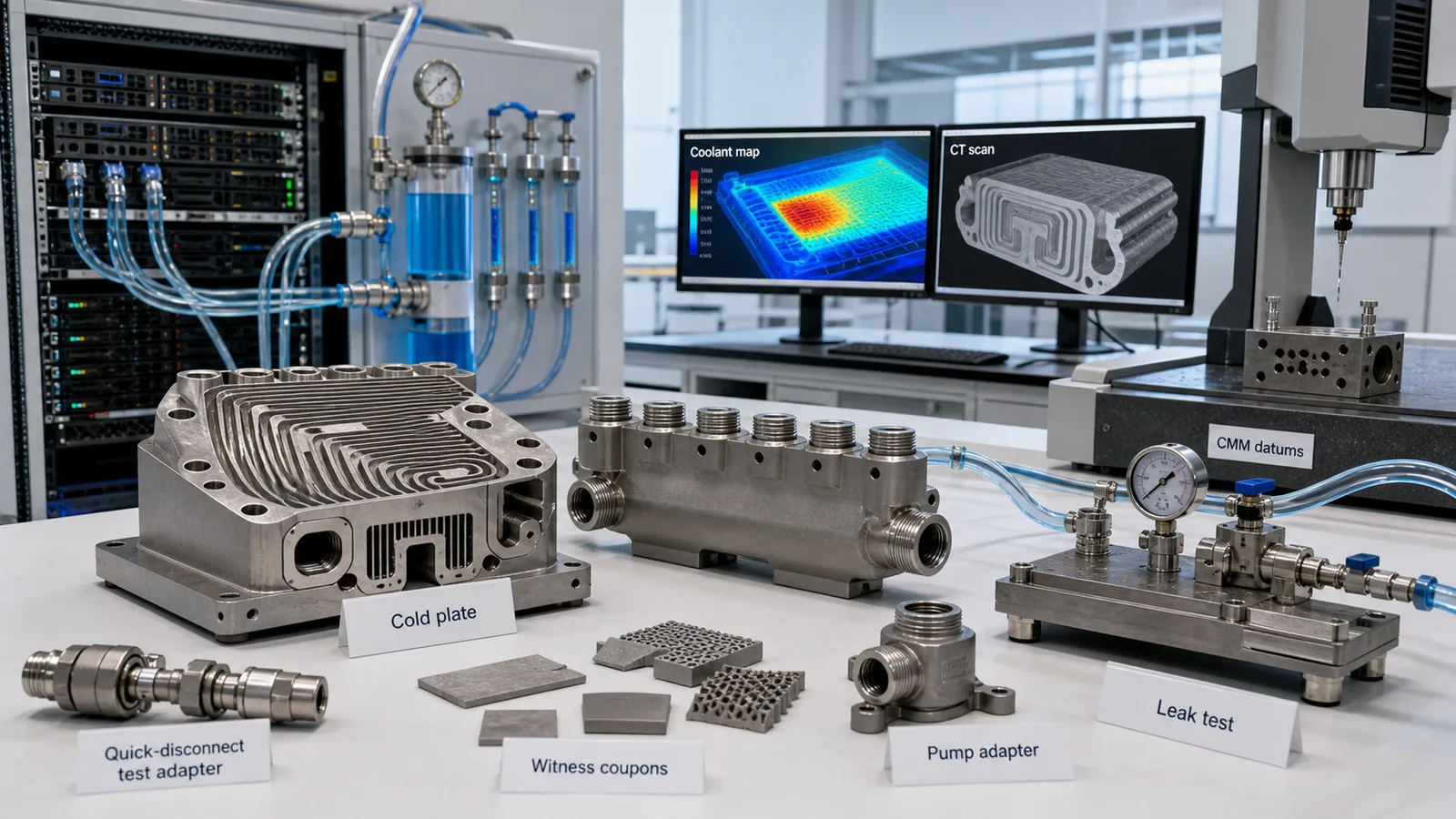
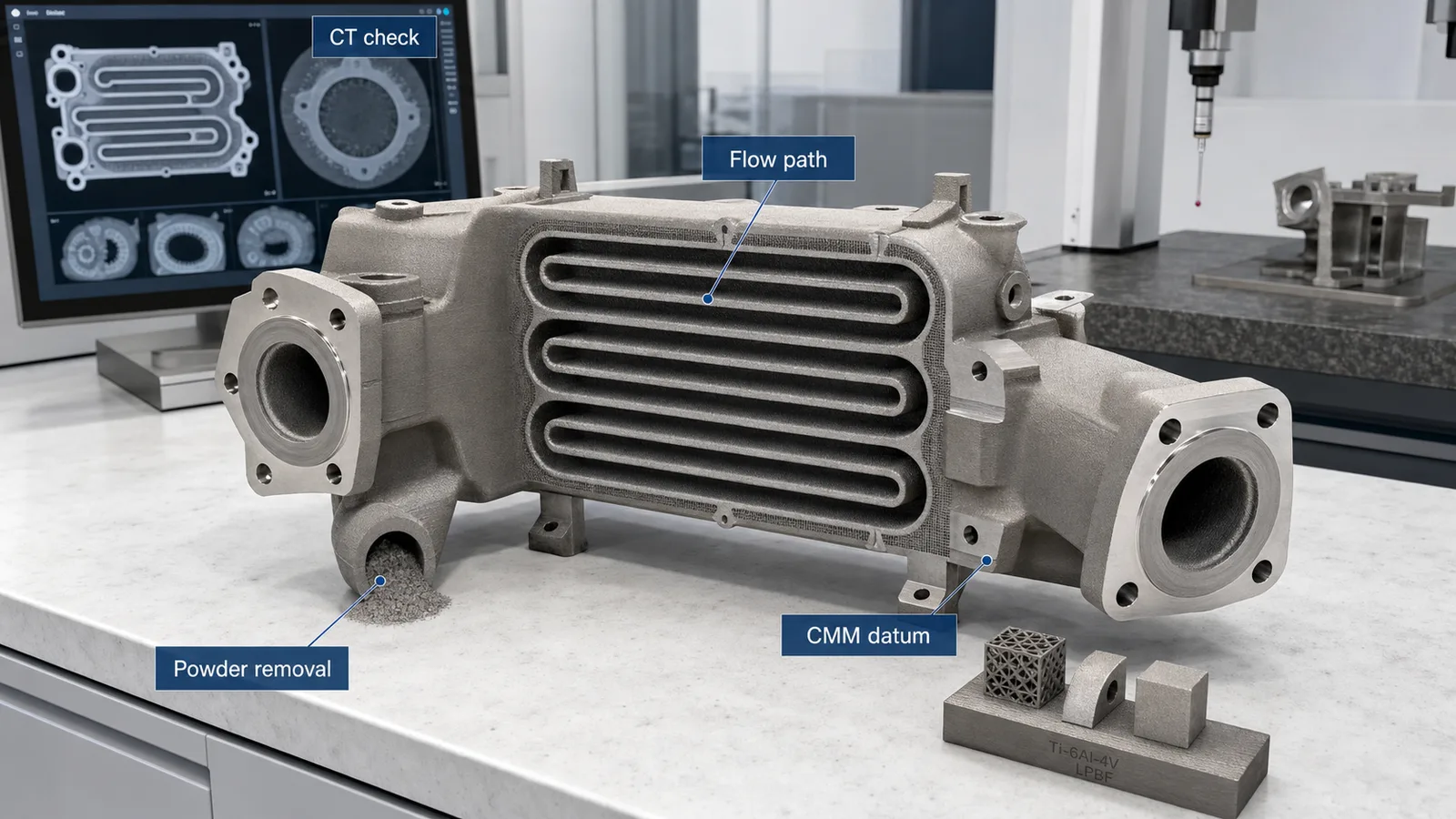
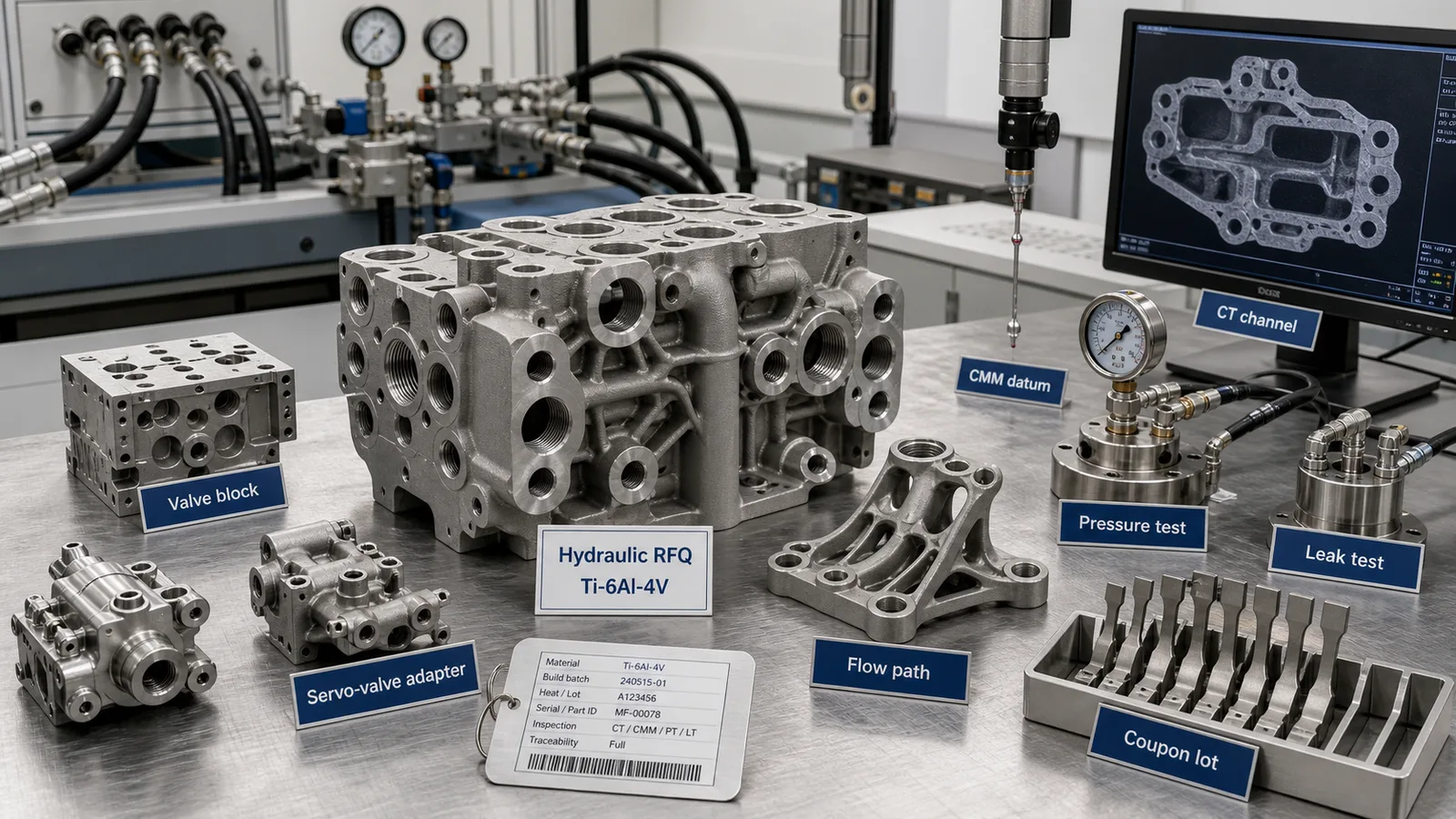
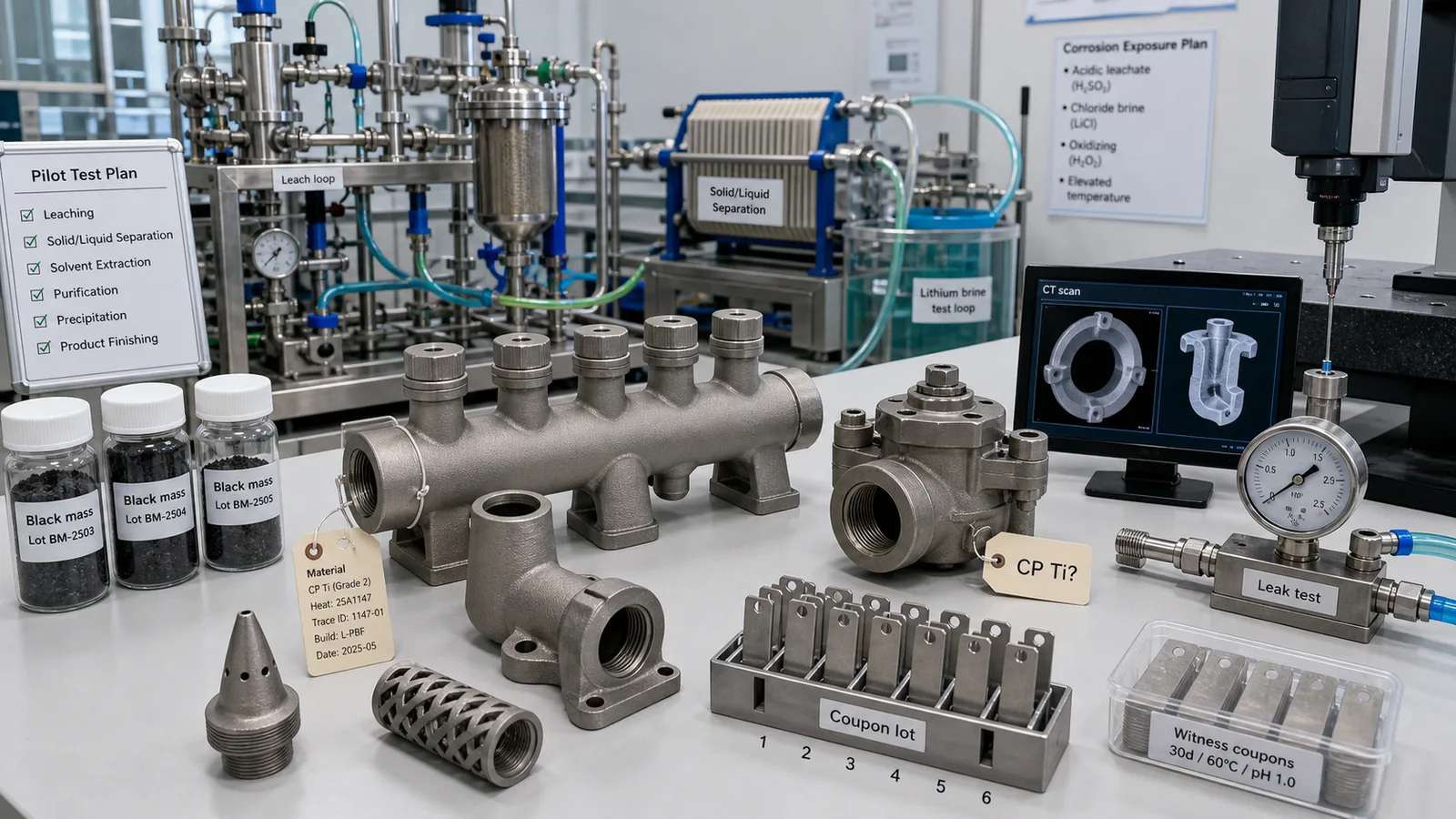
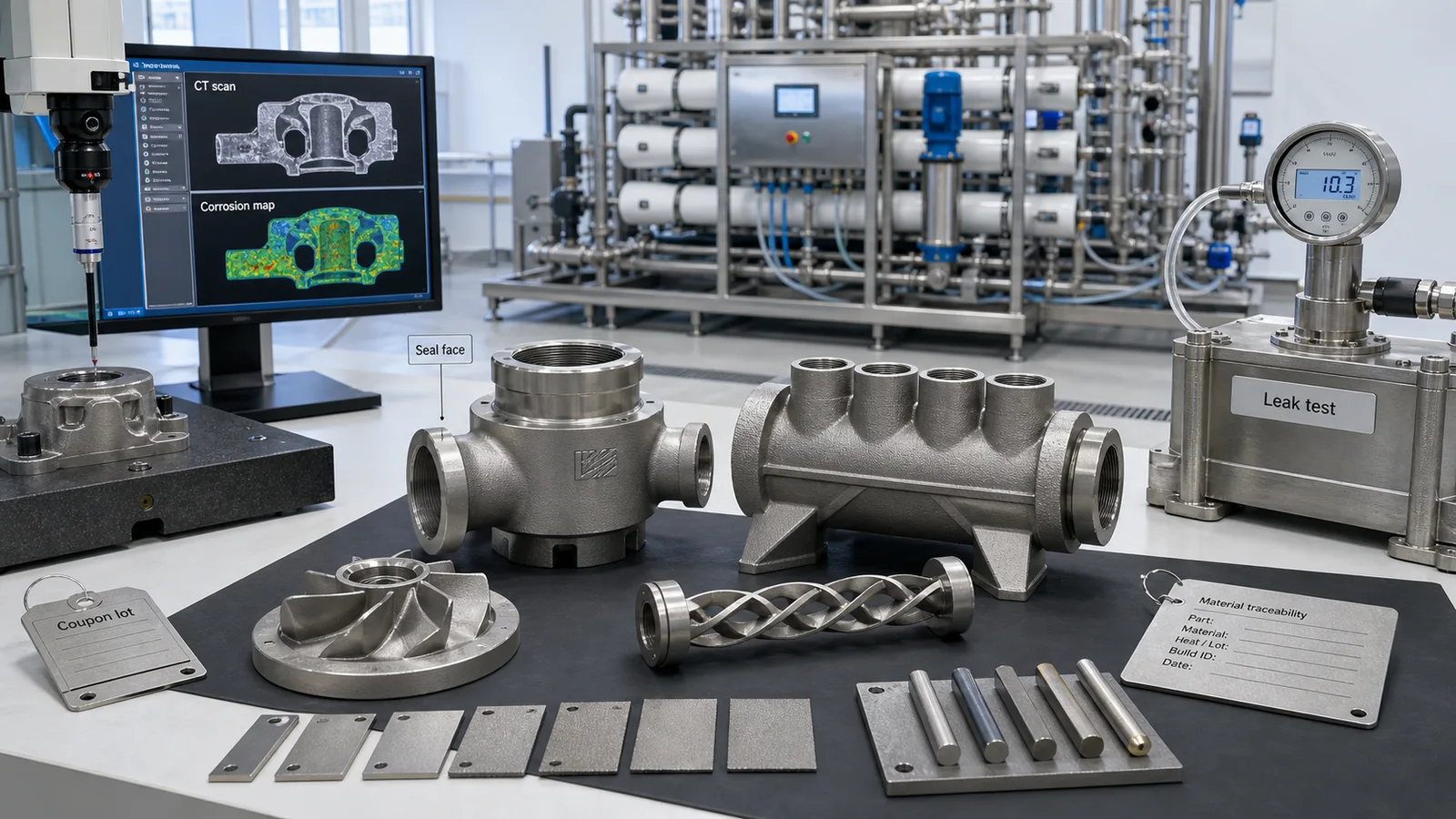
Representative article image; not a customer acceptance record or proof of a qualified manufacturing route. Refer to the cited sources and part-specific inspection records for engineering evidence.
On this page
Titanium 3D printing for AI data center liquid cooling hardware is useful when corrosion resistance, compact routing, low-volume test hardware, reduced fittings, or hard-to-machine internal channels create a real engineering advantage. It is not a default replacement for copper cold plates, aluminum heat sinks, stainless manifolds, or commercial liquid-cooling assemblies.
The right question is not “Can a titanium cold plate be printed?” The better RFQ question is whether the complete route can deliver thermal duty, coolant compatibility, leak integrity, seal faces, clean internal passages, CMM evidence, CT evidence when needed, and traceability at a cost that makes sense for the data center hardware program.
For the broader thermal framework, start with Titanium 3D Printed Heat Exchangers and use this guide for AI data center liquid-cooling-specific decisions. For pump adapters, coolant distribution blocks, quick-disconnect test hardware, and other flow-control parts that overlap with industrial process equipment, use Titanium 3D Printing for Industrial Valves, Pump Parts, and Flow Control Hardware.
Quick Answer
Titanium additive manufacturing is worth reviewing for AI data center liquid cooling when the part is compact, corrosion-exposed, prototype-heavy, interface-dense, or improved by internal routing that conventional machining cannot deliver efficiently.
Good candidates include:
- Liquid-cooling manifolds with many ports, sensor locations, drain points, and leak-test interfaces.
- Development cold plates or thermal test blocks where internal channel geometry changes between design iterations.
- Coolant distribution adapters, pump adapters, and quick-disconnect test hardware.
- Titanium brackets or integrated structural cooling bodies where mass, stiffness, and coolant routing interact.
- Corrosion-resistant test fixtures for deionized water, glycol-water, inhibitor packages, or unusual coolant trials.
- High-value low-volume hardware for lab validation, accelerated life testing, or pilot racks.
- CT-inspected internal-channel samples used to validate manufacturability before a larger cooling program.
Weak candidates include commodity copper cold plates, high-volume stamped or skived heat sinks, simple machined manifolds, standard stainless fittings, generic rack plumbing, and any coolant path where the RFQ does not define thermal duty, pressure, leak threshold, coolant chemistry, seal condition, cleaning route, and inspection scope.
If copper, aluminum, stainless steel, polymer, brazed assemblies, skived fins, machined plates, or catalog liquid-cooling parts meet the thermal, cost, lead-time, and evidence requirements with lower risk, use the When Not to Use Titanium Additive Manufacturing screen before requesting production pricing.
Why AI Liquid Cooling Is Timely in 2026
For a liquid-cooling component, identify whether it transfers heat, distributes coolant, supports equipment, or connects dissimilar interfaces. A titanium support or corrosion-exposed adapter needs a different justification from a cold plate: evaluate the actual coolant, heat-transfer duty, pressure loss, and maintenance route before choosing the material.
Recent public signals show the context:
- The IEA’s 2026 Key Questions on Energy and AI notes that global data center electricity demand grew by 17% in 2025 and projects demand rising from about 485 TWh in 2025 to roughly 950 TWh in 2030.
- The IEA’s broader Energy and AI report frames data centers as critical infrastructure for training and running AI models, with electricity demand more than doubling by 2030 in its base case.
- The DOE release for the 2024 United States Data Center Energy Usage Report says U.S. data center electricity use rose from 58 TWh in 2014 to 176 TWh in 2023, with a 2028 estimate range of 325-580 TWh.
- ASHRAE’s 2025 article on liquid cooling cold plates describes cold plates as metal structures with fins and channels that move heat from high-density processors into a pumped liquid.
- The Open Compute Project’s Cooling Environments work and its Cold Plate page show how direct-to-chip cold plate requirements are becoming more formal and vendor-neutral.
These signals do not mean every AI cooling part should be made in titanium. They do explain why engineering teams are asking better questions about leak paths, coolant compatibility, internal-channel cleanliness, proof testing, and supplier evidence.
Where Titanium AM Fits in a Liquid-Cooling Stack
Data center liquid cooling is a system. Heat leaves the chip, moves through a thermal interface into a cold plate, enters a server loop, passes through manifolds and quick disconnects, reaches a coolant distribution unit, and finally rejects heat to a facility loop. Titanium AM only fits selected points in that chain.
| Part family | Why titanium AM can help | Main RFQ risk | Evidence to define |
|---|---|---|---|
| Prototype cold plate | Fast internal-channel iteration and integrated ports | Lower conductivity than copper | Thermal test basis, pressure drop, leak test |
| Coolant manifold | Fewer fittings, compact routing, sensor and drain integration | Powder removal and hidden residue | CT or flow check, cleaning route, CMM |
| Pump or CDU adapter | Corrosion resistance and low-volume custom geometry | Seal faces and threaded ports | Machined interfaces, pressure test, roughness |
| Quick-disconnect test block | Repeatable lab setup and compact porting | Leak path stack-up | Leak threshold, fixture method, CMM datums |
| Structural cooling bracket | Combined stiffness, mounting, and coolant routing | Fatigue and flatness | Load case, machined pads, CMM |
| Coupon or channel sample | Process evidence before hardware commitment | Over-testing simple samples | CT scope, roughness, build record |
The strongest cases are development, pilot-line, or specialized hardware where additive geometry removes joints, improves packaging, shortens iteration, or lets the team test a coolant path that would be difficult to drill or braze.
For semiconductor-adjacent thermal and vacuum hardware, see Titanium 3D Printing for Semiconductor Equipment Parts. For coolant chemistry, corrosion, and water-loop assumptions, pair this with Titanium 3D Printing for Chemical Processing and Water Treatment Parts.
Titanium Is Not a Copper Substitute
Titanium’s value in data center cooling is not high thermal conductivity. Copper and aluminum usually win when heat spreading is the only target. Titanium earns a review when the system also needs corrosion resistance, strength-to-weight performance, mechanical integration, low-volume manufacturability, coolant compatibility, or unusual internal routing.
The material trade-off should be explicit:
- Use copper or copper alloys when thermal conductivity is the dominant requirement and corrosion/weight/geometry risk is manageable.
- Use aluminum when low mass and conventional machining or extrusion can meet the coolant and corrosion requirements.
- Use stainless steel when manufacturability, cost, cleanliness, and corrosion behavior fit the loop.
- Review titanium when corrosion resistance, stiffness, low mass, difficult internal geometry, or low-volume test hardware changes the system.
- Avoid titanium when its conductivity penalty would force a larger, heavier, or hotter design without solving another problem.
This is why titanium cold-plate RFQs should include thermal duty, contact area, wall thickness, channel layout, allowable pressure drop, coolant, and test condition. A STEP file alone is not enough.
Use Titanium AM Material Selection: Ti-6Al-4V, ELI, and CP Titanium when the material is not locked. Ti-6Al-4V is common in LPBF supply chains; CP titanium may be more relevant when corrosion behavior matters more than strength, but supplier availability must be checked early.
Coolant Compatibility Comes Before Geometry
Data center liquid cooling does not use one universal fluid. A loop may contain deionized water, treated water, propylene glycol mixtures, corrosion inhibitors, biocides, dielectric fluids in adjacent systems, cleaning fluids, dissolved oxygen, particles, or mixed-metal contact. Those details change whether titanium is helpful, neutral, or unnecessary.
Define:
- Coolant type, concentration, inhibitor package, and expected maintenance interval.
- Conductivity target, pH, dissolved oxygen, chloride level, and particulate limits if known.
- Temperature range, pressure, flow rate, and stagnation periods.
- Contact with copper, aluminum, stainless steel, nickel plating, elastomers, polymers, coatings, or brazed assemblies.
- Whether galvanic isolation, dielectric breaks, or specific fasteners are required.
- Whether the part will be flushed, passivated, dried, capped, and packaged after machining.
- Whether the part is a lab prototype, pilot rack part, reliability-test article, or production-intent component.
Do not specify “coolant compatible” without the coolant. A supplier cannot choose alloy, finish, cleaning, or test scope from that phrase.
Cold Plates and Internal Channels Need Acceptance Rules
Printed titanium can create curved channels, split flow paths, integral manifolds, and compact test features. The same geometry can also create powder traps, high pressure drop, rough heat-transfer surfaces, and hard-to-clean dead regions.
High-risk features include:
- Blind channels with no powder exit or flushing route.
- Fine pin-fin or lattice regions that CT cannot resolve at the required threshold.
- Parallel paths with no flow-balance check.
- Sharp internal shelves where powder or coolant residue can collect.
- Thin walls between coolant and electronics-facing surfaces without inspection rules.
- O-ring grooves, seal lands, or contact faces that lack machining stock.
- Internal supports or down-facing roofs in functional coolant paths.
- Sealed weight-reduction voids connected to wetted regions.
If thermal performance depends on the channel, define pressure drop, flow test, roughness target, CT scope, and cleaning route before quoting. If the cold plate is only a thermal development article, the evidence can be lighter. If it is a production-intent module installed near expensive electronics, the acceptance basis must be stronger.
Use Titanium 3D Printed Internal Channels: Powder Removal and CT before freezing a printed cold plate, coolant manifold, or multi-circuit test body.
Seal Faces, Quick Disconnects, and Datums Decide Usability
Liquid cooling hardware is unforgiving because small leaks can damage expensive equipment and create downtime. A printed titanium body should not rely on as-built surfaces for sealing or precision assembly.
Define every functional interface:
- O-ring grooves, gasket lands, flat seal faces, quick-disconnect seats, and threaded ports.
- Pump, CDU, rack manifold, hose, tube, and sensor interfaces.
- Datum pads for CMM inspection and assembly repeatability.
- Mounting flatness for thermal contact or board-level alignment.
- Drain, fill, purge, vent, and sample points.
- Surfaces that may remain as-built and surfaces that must be machined, polished, lapped, or finished.
Add machining stock to seal faces, O-ring grooves, threaded ports, datum pads, and thermal contact surfaces. If the quote only includes printing, support removal, and bead blasting, it is probably not a delivered liquid-cooling component.
For the drawing side, use Titanium 3D Printing Tolerances: Datum Planning and CMM.
Leak Testing and Pressure Testing Must Be Early
Leak testing is not a box to tick at the end of the RFQ. It affects port design, fixture design, machining sequence, cleaning, and cost.
Define:
- Working pressure, proof pressure, and pressure cycling if relevant.
- Test fluid or gas and whether it is compatible with the part condition.
- Allowable leakage, hold time, and test temperature.
- Whether testing happens before or after final machining, cleaning, and passivation.
- Which ports are capped and which are connected during testing.
- Whether the test covers each circuit separately or the full assembly.
- Whether pressure drop, flow balance, or thermal performance is part of acceptance.
Weak wording:
Include leak testing.
Better wording:
Quote this titanium AM coolant manifold as delivered accepted hardware. The part carries treated water-glycol coolant in a direct-to-chip test loop. Please include final machining of O-ring grooves, threaded ports, and datum pads; cleaning after machining; pressure hold at the agreed proof pressure; leak threshold and hold time; CMM for ports and datums; and CT or flow-test recommendation for the internal channels.
That wording gives the supplier a route to price, not just a part shape.
Surface Finish, Cleaning, and Residue Control
As-built titanium AM surfaces are not equivalent to machined or skived surfaces. Roughness may increase local heat-transfer area in some designs, but it can also increase pressure drop, trap particles, hold cleaning residue, and make leak testing harder.
Separate surfaces by function:
- Chip-facing thermal contact surfaces that need flatness and controlled finish.
- Seal faces, O-ring grooves, gasket lands, and quick-disconnect seats.
- Wetted channels where roughness affects pressure drop, flow balance, or cleaning.
- Threaded ports and fitting seats that need final machining.
- Fatigue-sensitive or pressure-cycled surfaces with support scars.
- Datum pads and bolt faces that need CMM evidence.
- Noncritical exterior surfaces that may remain as-built or bead blasted.
Post-processing may include stress relief, HIP when justified, machining, abrasive flow finishing, chemical finishing, blasting, passivation, ultrasonic cleaning, drying, capping, and clean packaging. The route should match the risk class.
Use Post-Processing for Titanium 3D Printing when defining delivered condition.
Process Choice: LPBF Usually Leads for Compact Cooling Parts
LPBF is usually the first process reviewed for compact titanium cooling hardware because it supports fine channels, integrated manifolds, thin walls, small ports, and low-volume precision parts. EBM may fit selected geometries when the supplier route and surface expectations make sense. DED is usually a better discussion for larger near-net or repair hardware, not small clean coolant channels.
Process choice affects:
- Minimum channel size and powder-removal feasibility.
- Internal roof quality, roughness, and pressure drop.
- Support contact on seal faces, thermal contact faces, and datums.
- Distortion near flat plates and bolted interfaces.
- Stress relief, HIP, machining, finishing, cleaning, and passivation sequence.
- CT, CMM, leak test, pressure test, coupon, and traceability scope.
- Cost and lead time.
Use Titanium AM Process Selection: LPBF vs EBM vs DED when the supplier should recommend a route instead of simply quoting a process named in the drawing.
Inspection Evidence Should Match Hardware Risk
An AI cooling RFQ can be over-tested or under-tested. A geometry trial coupon does not need the same evidence as a manifold installed near a rack of accelerators. A production-intent coolant path near electronics may need CT, CMM, leak testing, pressure testing, cleaning evidence, and material traceability.
Typical evidence includes:
- CMM report for ports, datum pads, O-ring grooves, seal faces, mounting holes, and flatness.
- CT inspection for internal channels, trapped powder, wall thickness, hidden defects, or blockage when risk justifies it.
- Pressure, leak, flow, or pressure-drop test tied to the accepted configuration.
- Surface roughness checks on thermal contact, sealing, or wetted-cleanability surfaces.
- Material certification, COA, COC, heat-treatment record, build record, powder lot, and traceability.
- Inspection photos for support removal, machined features, critical surfaces, and test setup.
- Witness coupons when the build condition, material basis, or acceptance route requires them.
Use Titanium AM Qualification and Inspection Evidence to choose evidence by risk. A cheap quote without evidence can become expensive if the part cannot be accepted into a test rack.
Cost: Compare Delivered Cooling Hardware
Titanium AM can reduce fittings, shorten thermal prototype iteration, and combine cooling passages with structural features. It can also hide cost in post-processing and evidence.
Cost drivers include:
- Thermal design iteration and manufacturability review.
- Build orientation, support volume, and support removal.
- Stress relief, HIP if justified, and heat treatment.
- Machining of seal faces, thermal contact faces, threads, O-ring grooves, and datums.
- Internal cleaning, flushing, drying, and capping.
- Surface finishing, passivation, abrasive flow finishing, or chemical finishing.
- CT, CMM, leak testing, pressure testing, flow testing, and roughness checks.
- Material records, lot traceability, inspection reports, and packaging.
- Rework if internal channels cannot be cleaned or verified.
Control cost before geometry is frozen. Remove unnecessary sealed cavities, keep coolant paths cleanable, machine only functional surfaces, define evidence by risk, and allow supplier DfAM changes before final pricing.
For quote normalization, use Titanium 3D Printing Cost Drivers: How to Reduce RFQ Price and the Titanium AM RFQ and Procurement Guide.
Better RFQ Wording
Weak RFQ:
Please quote this titanium 3D printed cold plate.
Better RFQ:
Please review this titanium AM liquid-cooling component for an AI accelerator test loop. The part includes one coolant inlet, one outlet, two sensor ports, an O-ring sealed cover face, and internal channels that must be cleanable. The coolant is treated water-glycol for lab validation. Please identify alloy recommendation, support strategy, machining stock, powder-removal access, cleaning route, pressure-test method, leak threshold, CMM scope, CT or flow-test recommendation for the internal channel, surface condition, material traceability, and any DfAM changes needed before quotation. Quote the delivered accepted part, not only the printed shape.
That wording helps procurement compare suppliers on the same delivered route: print, stress relieve, depowder, machine, clean, inspect, test, document, and package.
AI Liquid-Cooling Titanium AM RFQ Checklist
Send the supplier:
- STEP file and drawing with datums, section views, and critical surfaces.
- Target alloy, material condition, and whether substitutions are allowed.
- Quantity, prototype or production intent, lot definition, and target lead time.
- Cooling duty: heat load, contact area, flow rate, pressure drop, inlet temperature, outlet temperature, and allowable temperature rise.
- Coolant: water, glycol mixture, inhibitor package, pH, conductivity, chlorides, dissolved oxygen, cleaning fluid, and maintenance assumptions if known.
- Interfaces: O-ring grooves, gasket lands, threaded ports, quick disconnects, sensor ports, drain/fill/vent points, mounting pads, and thermal contact faces.
- Internal channel details: minimum feature size, blind regions, powder-removal access, accepted roughness, flushing route, and drainability.
- Post-processing expectations: stress relief, HIP if justified, machining, finishing, passivation, cleaning, drying, capping, and packaging.
- Inspection scope: CMM, CT, pressure test, leak test, flow test, pressure-drop check, roughness, coupons, COA, COC, build record, powder lot, and inspection photos.
- Permission for supplier DfAM changes before final pricing.
If the RFQ does not define thermal duty, coolant, sealing, pressure, cleaning, and evidence, suppliers may quote very different products under the same part number.
When to Redesign or Avoid Titanium AM
Redesign before quotation when:
- Coolant channels have no practical powder exit, flushing path, or drain point.
- Thermal contact faces, O-ring grooves, or threaded ports lack machining stock.
- Copper-level thermal conductivity is required but no system reason justifies titanium.
- Internal roughness controls pressure drop, but no finishing or flow-test route is defined.
- CT cannot resolve the smallest critical internal feature.
- Leak testing is required but pressure, method, hold time, and leakage limit are vague.
- Mixed-metal coolant contact creates galvanic uncertainty with no compatibility plan.
- A conventional cold plate or machined manifold would meet the requirement with lower acceptance risk.
Avoid titanium AM when standard copper, aluminum, stainless, polymer, brazed, skived, extruded, machined, or catalog liquid-cooling hardware meets the thermal, cost, lead-time, and evidence requirements with lower risk.
Bottom Line
Titanium 3D printing can be valuable for AI data center liquid cooling hardware when it solves a real hardware problem: compact coolant routing, fewer leak paths, corrosion-resistant test hardware, low-volume iteration, integrated ports, or documented internal-channel evidence. The strongest candidates are manifolds, development cold plates, pump and CDU adapters, quick-disconnect test blocks, structural cooling brackets, and channel samples where coolant compatibility, sealing, machining, cleaning, and evidence are planned from the start.
The weak cases are commodity cold plates, simple fittings, high-volume standard parts, and any coolant path where the RFQ ignores thermal duty, alloy selection, powder removal, surface finish, cleaning, leak testing, and traceability.
For an RFQ review, send CAD, drawing, cooling duty, coolant details, pressure and leak requirement, target alloy, quantity, post-processing expectations, and inspection scope through the RFQ inputs page or email info@szcomo.com.
- Data centers
- Ai infrastructure
- Liquid cooling
- Cold plates
- Thermal management
- Internal channels
- Leak testing
- Coolant compatibility
- RFQ