· Updated - TITANIUM 3DP Engineering - Engineering Guides - 13 min read
Titanium 3D Printing for Medical Device and Orthopedic Implant Parts
Engineering RFQ guide for titanium 3D printed medical device and orthopedic implant parts, covering Ti-6Al-4V ELI, porous structures, CT, CMM, cleaning, traceability, and procurement evidence.
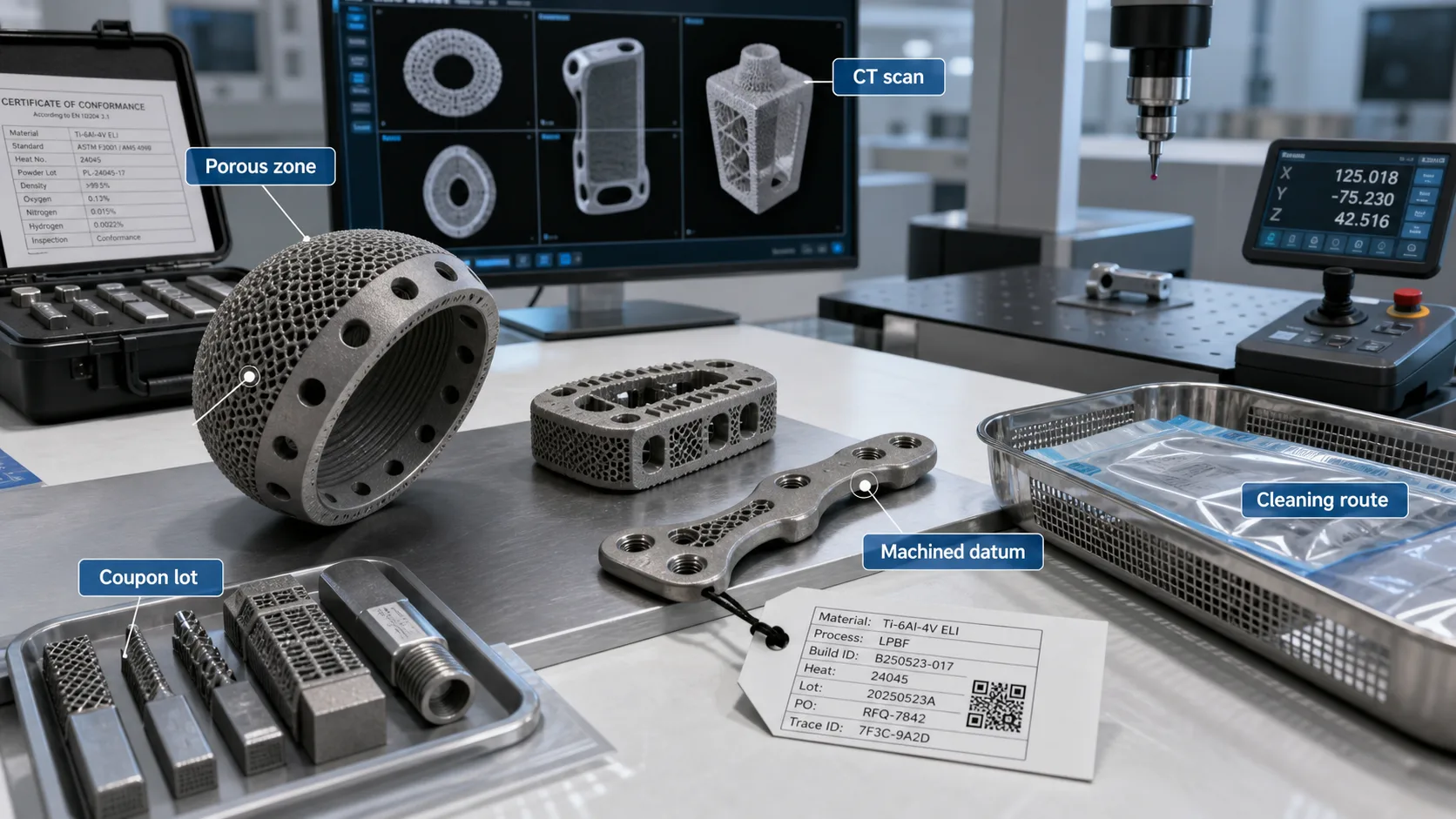
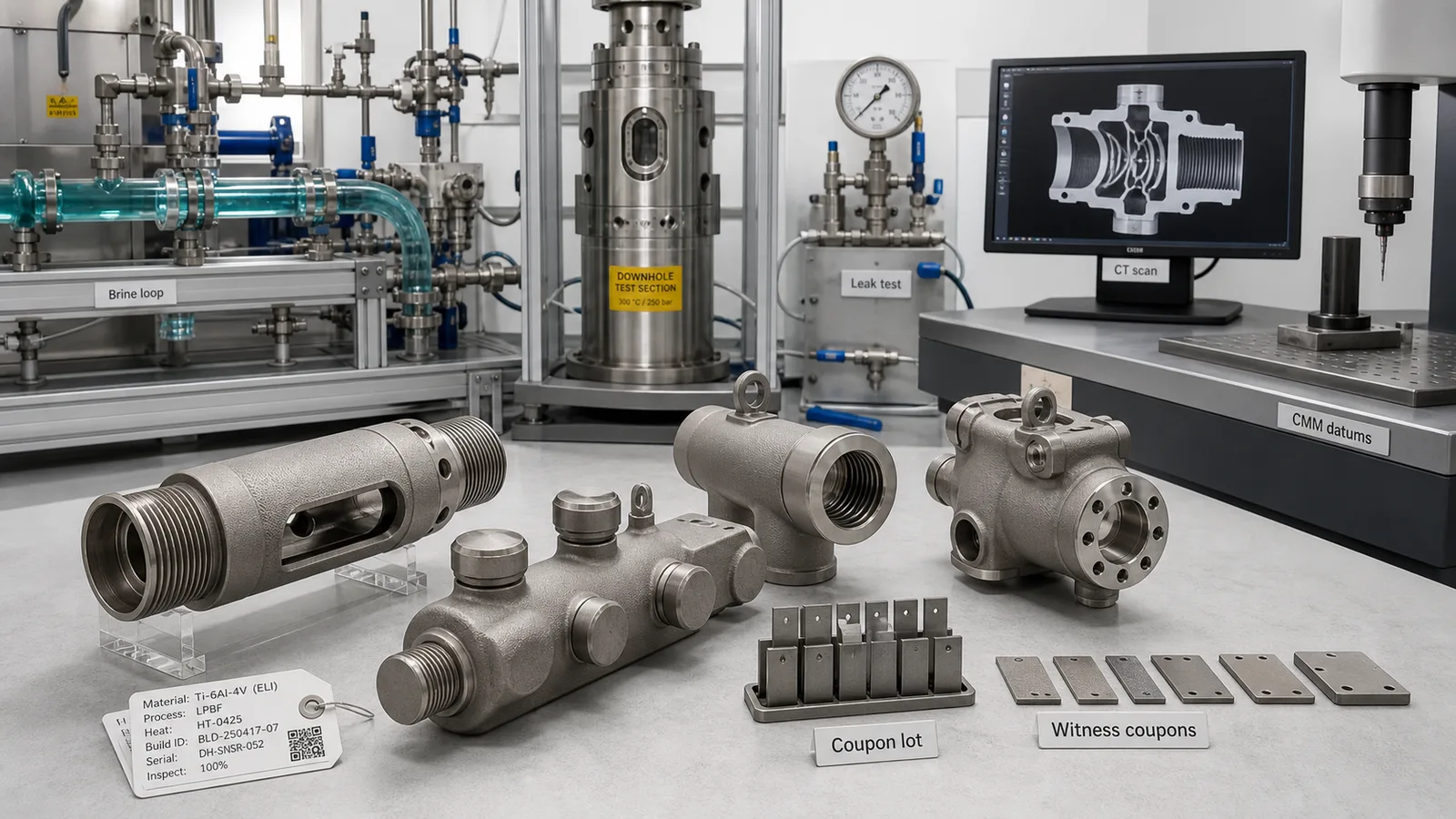
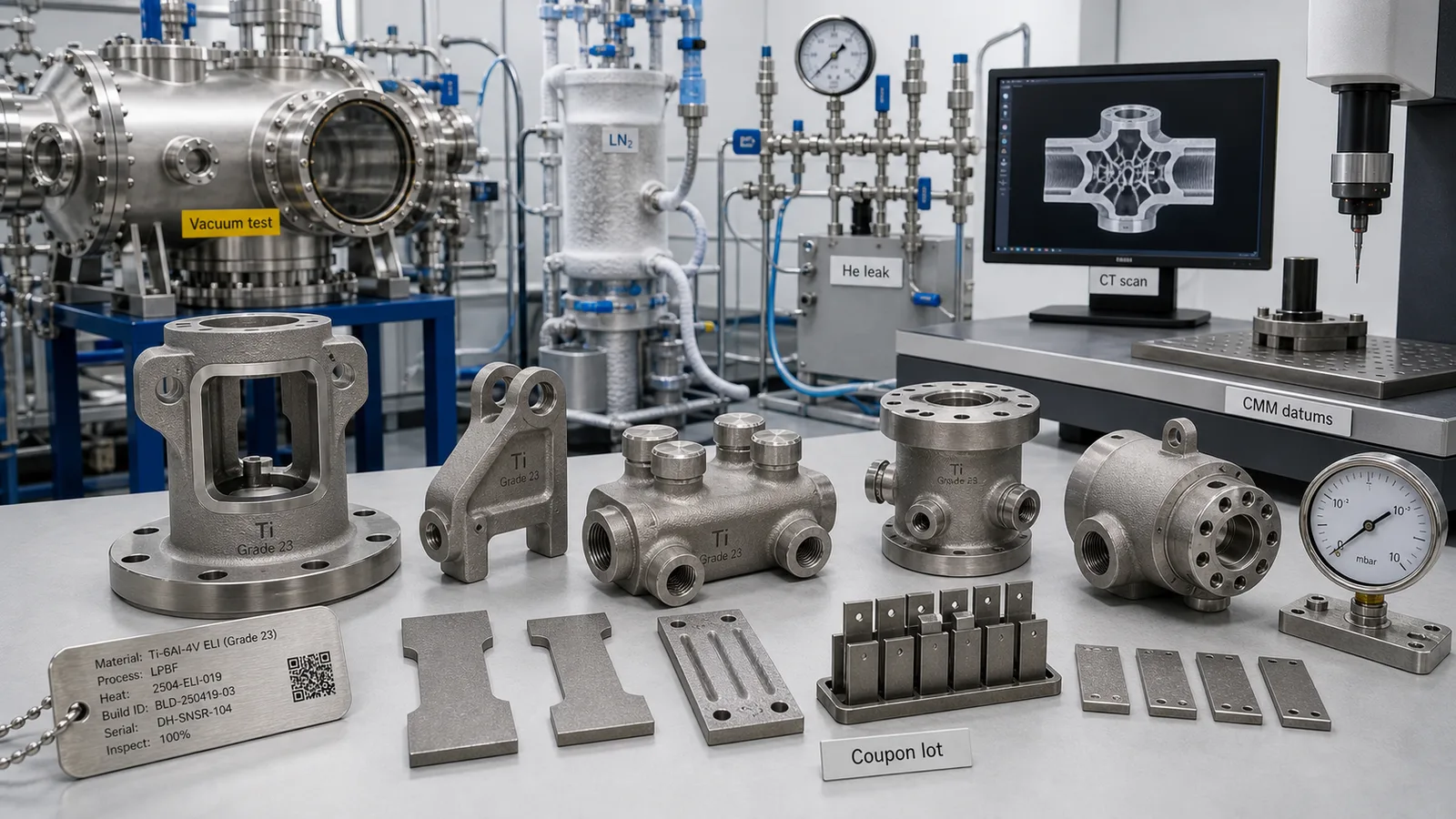
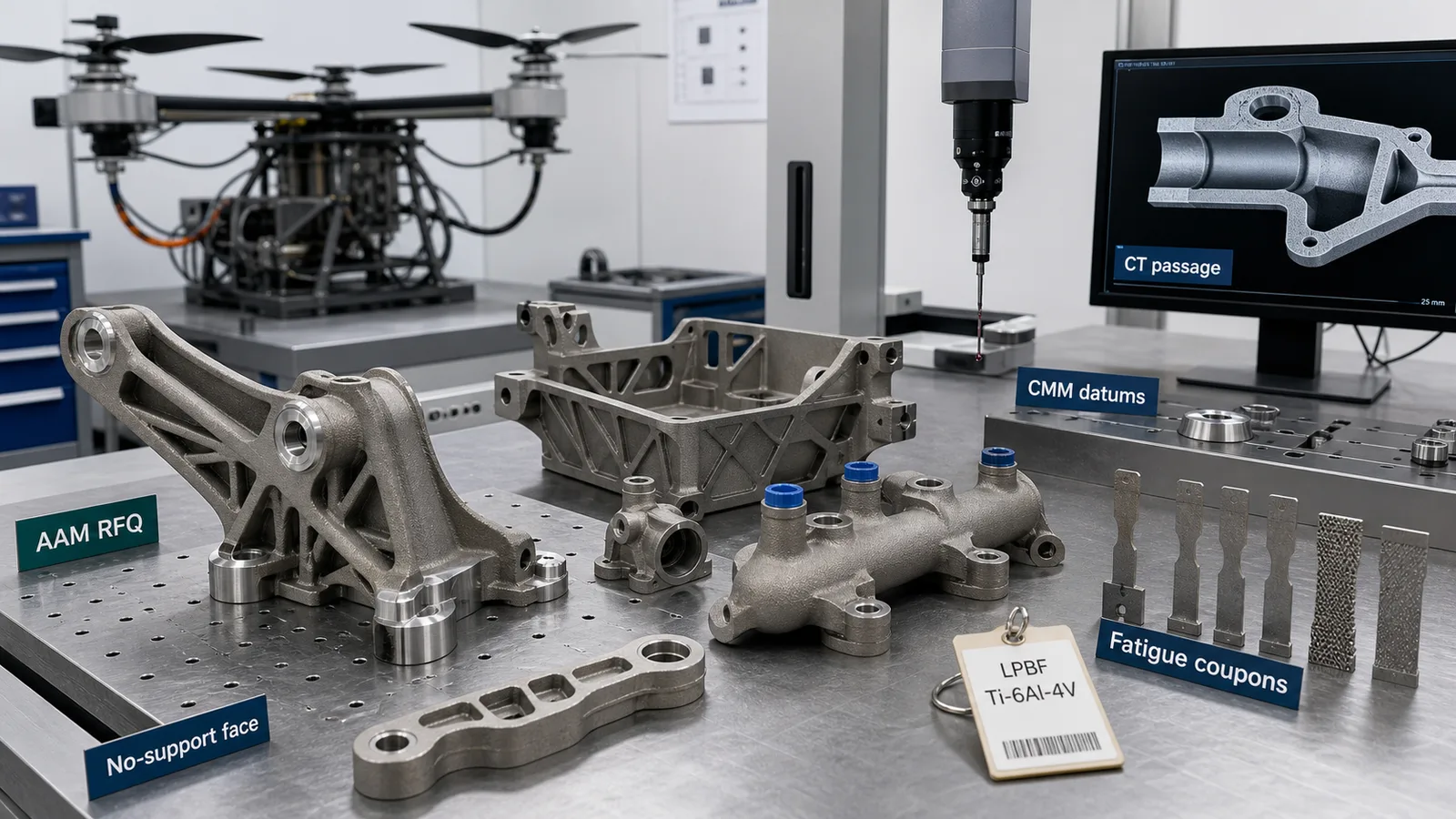
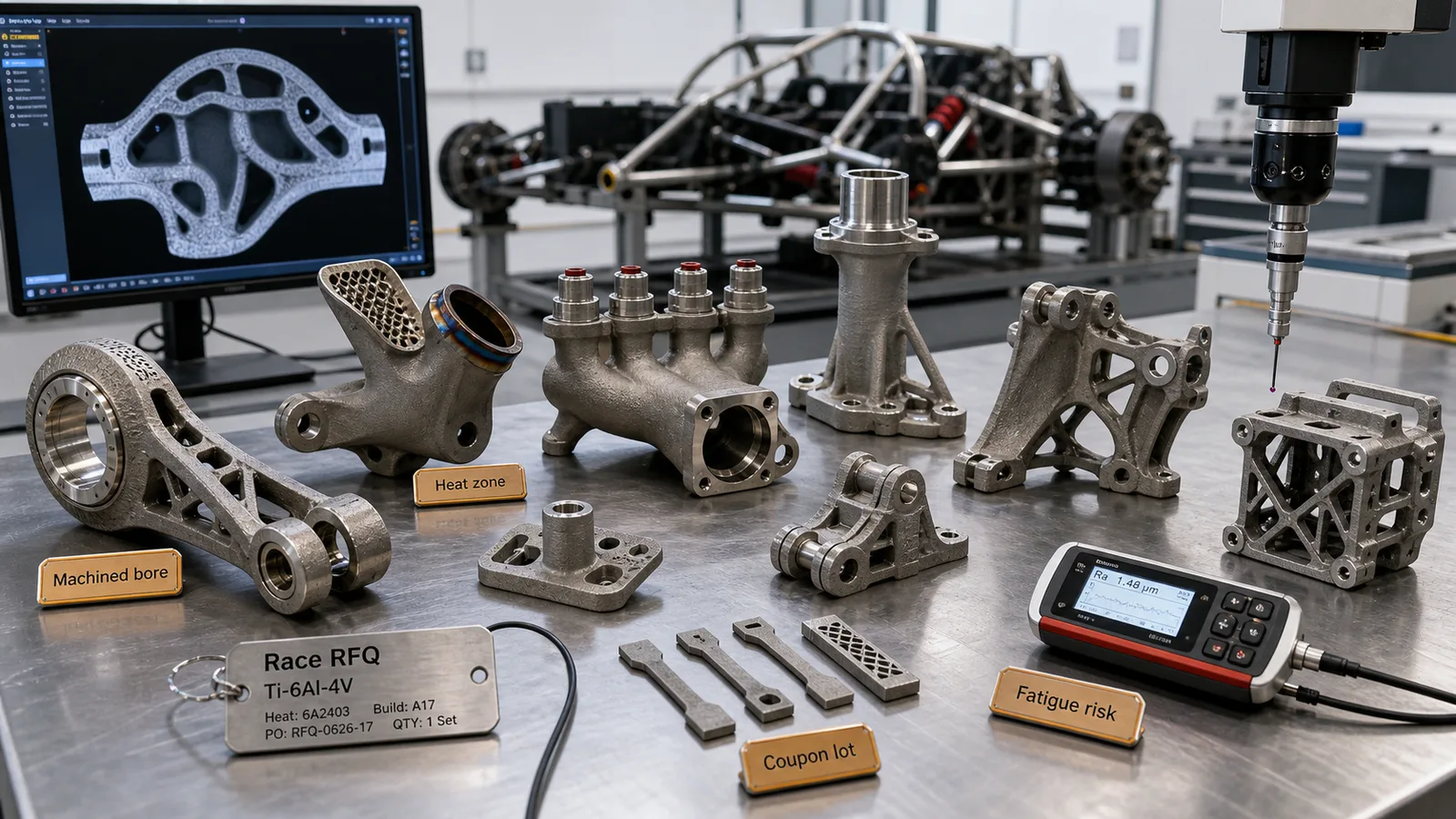
Representative article image; not a customer acceptance record or proof of a qualified manufacturing route. Refer to the cited sources and part-specific inspection records for engineering evidence.
On this page
Titanium 3D printing for medical device and orthopedic implant parts is valuable when a regulated manufacturer needs porous geometry, patient-matched form, low-volume iteration, strong documentation, or geometry that conventional machining cannot deliver efficiently. It is not a shortcut around design controls, biocompatibility, sterilization validation, regulatory submission, or clinical responsibility.
For medical device RFQs, the important question is not only whether Ti-6Al-4V ELI can be printed. The better question is whether the complete route can define material condition, build orientation, porous feature control, cleaning, surface finish, CT, CMM, coupons, traceability, packaging, and the evidence expected by the device owner.
For a broader application map, start with Titanium 3D Printing Applications and use this guide for medical-device-specific sourcing decisions.
Quick Answer
Titanium additive manufacturing is worth reviewing for medical device and orthopedic implant hardware when the part needs porous titanium, patient-matched shape, complex internal geometry, compact lightweight structure, strong traceability, or low-volume design iteration before a validated production route is frozen.
Good candidates include:
- Orthopedic implant prototypes and production-intent test articles with porous zones.
- Spinal cages, acetabular cup trials, tibial or extremity implant development parts, and trauma plate prototypes.
- Surgical instrument components, drill guides, cutting guides, and fixation trial hardware when the device owner controls validation.
- Anatomical or patient-matched parts where conventional machining creates too much lead time or geometry compromise.
- Test coupons, fatigue specimens, porous material coupons, and cleaning validation samples.
- Medical device fixtures, inspection gauges, and manufacturing aids that need titanium compatibility or stiffness.
- Low-volume design iterations where tooling would slow engineering review.
Weak candidates include simple machined plates, commodity instruments, cosmetic trial parts, high-volume stamped or forged parts, and any patient-contact part where the RFQ does not define regulatory role, material standard, cleaning route, inspection evidence, packaging condition, and responsibility for final device approval.
If conventional machining, forging, casting, molding, or standard instrument sourcing can meet the requirement with lower validation burden, use the When Not to Use Titanium Additive Manufacturing screen before requesting production pricing.
Why Medical Device AM Is Timely in 2026
Medical-device sourcing starts with the intended use, device classification, design authority, and validation plan. A porous implant, reusable instrument, and development fixture have different cleaning, mechanical, and release requirements. This guide screens those manufacturing questions; it does not establish device approval or patient suitability.
Recent and durable public signals explain the context:
- The FDA’s 3D Printing of Medical Devices page notes that additive manufacturing can support patient-specific devices and complex internal structures, and lists orthopedic implants, cranial implants, surgical instruments, dental restorations, and prosthetics as examples of medical device use.
- The FDA guidance on Technical Considerations for Additive Manufactured Medical Devices outlines testing and characterization considerations for devices that include additively manufactured components.
- The FDA’s point-of-care 3D printing discussion paper keeps the regulatory conversation active around where medical devices are designed, printed, and controlled.
- Grand View Research’s 2026 orthopedic implant market forecast projects continued orthopedic implant demand, which keeps attention on implant manufacturing, revision workflows, and personalized device development.
- ASTM F3001-14(2021) remains a relevant reference for additively manufactured Ti-6Al-4V ELI powder-bed-fusion components, including material, process, thermal processing, HIP, inspection, certification, marking, and packaging requirements.
These sources do not mean a supplier can make clinical claims. They show why medical OEMs and engineering teams keep asking better RFQ questions about titanium AM, especially when porous surfaces, CT evidence, traceability, and validated post-processing determine whether a part is usable.
Where Titanium AM Fits in Medical Device Hardware
Titanium is not selected only because it is printable. It is selected when the material, geometry, surface condition, and evidence route match the device owner’s design and regulatory basis.
| Part family | Why titanium AM can help | Main RFQ risk | Evidence to define |
|---|---|---|---|
| Orthopedic implant development part | Porous zones, anatomical geometry, low-volume iteration | Regulatory and validation assumptions | Material standard, CT, coupons, cleaning route |
| Spinal cage or porous implant prototype | Integrated lattice and structural body | Porosity control and fatigue | CT, coupon testing, fatigue plan, HIP decision |
| Patient-matched plate or cranial-style part | Geometry from imaging and low-volume production | Datum and traceability control | Drawing datums, CMM, revision control |
| Surgical guide or instrument component | Complex geometry and rapid iteration | Sterilization and surface finish assumptions | Material, cleaning, finish, packaging state |
| Medical test fixture or gauge | Stiff custom hardware for inspection or manufacturing | Over-specifying clinical evidence | Risk class, CMM, material record |
| Coupon and validation set | Lot evidence and process characterization | Mismatch between coupons and part geometry | Build orientation, coupon location, test method |
The strongest use cases are not generic “medical 3D printing.” They are cases where additive geometry solves a documented engineering problem: porous structure, patient-matched shape, reduced assembly, faster design iteration, or repeatable test evidence.
RFQ Boundary: Manufacturing Is Not Clearance
A medical device RFQ should state who owns the regulated device, design inputs, validation plan, regulatory pathway, and final release decision. A titanium AM supplier may support manufacturing, DfAM review, material records, inspection, coupons, and traceability, but that does not replace the device manufacturer’s quality system or regulatory responsibility.
Define:
- Whether the part is nonclinical prototype, cadaver-lab part, design verification article, process validation part, manufacturing aid, or production-intent device component.
- Whether the supplier is making a patient-contact device, a prototype, an instrument component, or a fixture.
- Which standards, drawings, specifications, and quality agreements apply.
- Whether the part will be sterilized, cleaned, passivated, packaged, or shipped as a manufacturing intermediate.
- Whether the supplier must follow a customer-approved manufacturing plan or propose one.
- Which documents are required: COA, COC, build record, powder lot, heat treatment record, HIP record, inspection report, cleaning record, and packaging note.
Weak wording:
Please quote this 3D printed titanium medical implant.
Better wording:
Please review this Ti-6Al-4V ELI LPBF orthopedic device component as a production-intent engineering build for the device owner’s validation program. Critical features are the porous ingrowth zone, machined datum faces, screw holes, CT-inspected internal geometry, cleaning route, coupon set, material traceability, and packaging condition. Please quote the delivered evidence package, not only the printed shape.
That wording is slower to write, but it prevents a supplier from pricing the wrong risk class.
Material Selection: Ti-6Al-4V ELI Is Common, but Define It
Ti-6Al-4V ELI is commonly reviewed for medical titanium AM because it has a lower interstitial basis than standard Ti-6Al-4V and is widely referenced in medical-device supply chains. CP titanium may be relevant for some device or instrument applications where corrosion behavior, ductility, or chemical compatibility matters more than high strength. The alloy decision should not be inferred from the CAD model.
Define:
- Target alloy and material standard.
- Powder chemistry, powder reuse rules, and powder lot traceability.
- Build orientation and whether support contact is allowed on functional regions.
- Stress relief, HIP, heat treatment, and final material condition.
- Coupon type, location, orientation, and acceptance basis.
- Mechanical properties, density, chemistry, microstructure, and surface requirements.
- Whether the part is prototype, verification, validation, or production-intent.
Use Titanium AM Material Selection: Ti-6Al-4V, ELI, and CP Titanium before locking the material line. If ASTM F3001 is the intended purchasing basis, review the dedicated Ti-6Al-4V ELI Grade 23 / F3001 material path. A vague “medical grade titanium” note is not enough for an RFQ.
Porous Titanium Needs Geometry Evidence
Porous titanium is one of the major reasons medical device teams review additive manufacturing. It can create controlled surface architecture or lattice-like regions that are hard to machine. It also creates difficult questions around minimum strut thickness, unmelted powder, cleaning, CT resolution, fatigue, and repeatability.
High-risk features include:
- Porous zones with no clear boundary to solid load-bearing regions.
- Lattice members below the supplier’s stable process window.
- Unsupported surfaces that become rougher than the design assumes.
- Powder traps inside porous or blind features.
- Porous regions that are difficult to clean, dry, and inspect.
- Sharp transitions between porous and solid regions.
- Screw holes or machined datums too close to lattice edges.
- Coupons that do not represent the actual porous geometry.
CT may be useful, but CT is not a magic acceptance method. The RFQ should define resolution, acceptance criteria, inspected regions, and whether the CT method can see the smallest critical features. For hidden geometry and powder-removal logic, use Titanium 3D Printed Internal Channels: Powder Removal and CT.
Datum Planning and Machining Still Matter
Medical titanium AM parts often combine as-built porous structures with machined features. A spinal cage, cup trial, plate, instrument, or guide may need screw holes, datum planes, mating faces, threads, taper interfaces, or inspection pads that cannot be left as-built.
Define:
- Primary, secondary, and tertiary datums.
- Which faces, bores, screw holes, slots, and edges require machining.
- Machining stock on critical surfaces.
- Surface finish and edge-break requirements.
- CMM report scope and pass/fail dimensions.
- Whether final dimensions are measured before or after cleaning, passivation, and packaging.
- Whether porous regions are excluded from standard CMM measurement.
Use Titanium 3D Printing Tolerances: Datum Planning and CMM when turning a printed medical concept into a measurable drawing. The supplier should not infer inspection strategy from the model alone.
Surface Finish, Cleaning, and Packaging Are Part of the Product
A medical RFQ that omits surface finish and cleaning is incomplete. As-built titanium surfaces may include partially fused particles, support scars, trapped powder, and rough down-facing regions. Some of those surfaces may be intentional. Others may be unacceptable.
Separate surfaces by function:
- Porous zones where the geometry is functional.
- Machined datum, mating, screw, and interface surfaces.
- Fatigue-critical surfaces.
- Patient-contact or instrument-contact surfaces, if applicable.
- Hidden powder-prone features.
- Exterior noncritical regions.
- Surfaces that require passivation, polishing, blasting, or other finishing.
- Surfaces that must remain untouched after final cleaning.
Cleaning and packaging should be described as delivered condition, not assumed after shipment. The supplier may provide a cleaned manufacturing intermediate, a packaged engineering sample, or a production-intent component under a defined quality agreement. These are different products.
For finishing route decisions, use Post-Processing for Titanium 3D Printing.
Fatigue, HIP, and Mechanical Evidence
Medical device components may see cyclic load, impact, bending, torsion, or screw-related stress. Porous geometry and surface condition can change fatigue behavior. HIP may help density and defect population in some cases, but it is not automatically correct for every device geometry or validation plan.
Define:
- Load case and whether fatigue is relevant.
- Static, fatigue, compression, shear, torsion, or pull-out test expectations.
- Whether coupons represent the part orientation, porous structure, and thermal route.
- Whether HIP is required, optional, or prohibited by the device owner’s plan.
- Surface finish in fatigue-critical regions.
- Whether CT or metallography is required before mechanical testing.
- Whether test results are for screening, design verification, or production release.
Use Titanium 3D Printing Fatigue Design to decide what belongs in the quote. A high-strength material line does not solve a poor surface, unsupported transition, or unrepresentative coupon.
Inspection Evidence: Match the Risk Class
Medical-device-related titanium AM parts can be over-tested or under-tested. A nonclinical prototype does not need the same evidence as a production-intent implant component. A manufacturing fixture does not need the same evidence as a porous patient-contact device.
Typical evidence includes:
- Material certificate, powder lot, build record, heat-treatment record, and HIP record if used.
- COA, COC, product marking, packaging note, and revision traceability.
- CMM report for machined datums, screw holes, mating features, and critical dimensions.
- CT report for porous zones, hidden powder traps, wall thickness, and internal features where risk justifies it.
- Surface roughness or visual inspection for defined surfaces.
- Coupon test results for density, tensile, fatigue, or customer-defined properties.
- Cleaning record, inspection photos, and packaging evidence.
- Nonconformance and rework records if applicable.
Use Titanium AM Qualification and Inspection Evidence to define the evidence package. The goal is not to request every test. The goal is to request the evidence that matches the device owner’s risk class and validation plan.
Process Choice: LPBF and EBM Need Different Assumptions
LPBF is often reviewed for fine porous geometry, small orthopedic components, instrument hardware, and precision interfaces. EBM may be considered when the device history, supplier capability, surface expectations, and geometry fit. DED is usually more relevant for larger near-net or repair-style hardware than for fine medical porous structures.
Process choice affects:
- Minimum feature size and lattice stability.
- Surface texture and powder-removal behavior.
- Support contact and build orientation.
- Porous zone repeatability.
- Stress relief, HIP, machining, and finishing sequence.
- CT, CMM, coupon, and traceability scope.
- Cost and lead time.
Use Titanium AM Process Selection: LPBF vs EBM vs DED if the supplier should recommend the process rather than only quote a named route.
Cost: Compare Validated Evidence, Not Print Price
Medical titanium AM quotes can look expensive because they include work that a print-only quote hides. They can also look cheap when the evidence package is missing.
Cost drivers include:
- Design review and manufacturability feedback.
- Build orientation and support strategy.
- Powder lot control and documentation.
- Stress relief, HIP, heat treatment, and thermal records.
- Machining of datums, holes, mating features, and critical edges.
- Cleaning, passivation, packaging, and handling controls.
- CT, CMM, roughness checks, coupon tests, and inspection reports.
- Lot release documentation and revision traceability.
- Rework or scrap if porous geometry, cleaning, or CT criteria are not achievable.
Control cost by separating prototypes from production-intent builds, defining only the evidence needed for the current stage, and allowing supplier DfAM feedback before the drawing is frozen. For quote normalization, use Titanium 3D Printing Cost Drivers: How to Reduce RFQ Price and the Titanium AM RFQ and Procurement Guide.
Better RFQ Wording
Weak RFQ:
Please quote this titanium 3D printed implant.
Better RFQ:
Please review this Ti-6Al-4V ELI LPBF orthopedic device component for the device owner’s engineering validation program. The part includes a controlled porous zone, machined datum faces, screw holes, and a required coupon set. Please identify build orientation, support strategy, machining stock, stress relief, HIP recommendation if any, powder lot traceability, CT scope for porous geometry, CMM scope, cleaning and packaging condition, and any DfAM changes needed before quotation. Quote the delivered evidence package, not only the printed shape.
That wording helps procurement compare the actual delivered route: print, depowder, stress relieve, HIP if required, machine, finish, clean, inspect, document, and package.
Medical Titanium AM RFQ Checklist
Send the supplier:
- STEP file and drawing with datums, section views, and critical surfaces.
- Device stage: concept prototype, nonclinical prototype, verification build, validation build, fixture, or production-intent component.
- Target alloy, material standard, powder controls, and whether substitutions are allowed.
- Quantity, lot size, revision level, and target lead time.
- Functional surfaces: porous zones, machined datums, screw holes, mating faces, threads, edges, and contact regions.
- Post-processing expectations: stress relief, HIP if justified, machining, finishing, cleaning, passivation, drying, and packaging.
- Inspection scope: CMM, CT, roughness, visual inspection, coupons, density, tensile, fatigue, cleaning record, COA, COC, build record, powder lot, and heat-treatment record.
- Quality agreement, regulatory role, document retention, and nonconformance handling assumptions.
- Permission for supplier DfAM changes before final pricing.
If the RFQ does not define regulatory role, material condition, porous geometry evidence, cleaning, and traceability, suppliers may quote different products under the same part number.
When to Redesign or Avoid Titanium AM
Redesign before quotation when:
- Porous zones cannot be cleaned, inspected, or represented by coupons.
- Screw holes, datum faces, or mating features lack machining stock.
- Lattice members are below the supplier’s stable process window.
- Support contact lands on fatigue-critical or functional surfaces.
- CT cannot resolve the smallest critical feature.
- Cleaning and packaging requirements are undefined.
- A simple machined or forged part would meet the requirement with lower validation burden.
Avoid titanium AM when conventional machining, forging, casting, molding, or standard device sourcing delivers the same function with lower cost, shorter validation time, better supplier readiness, or clearer regulatory evidence.
Bottom Line
Titanium 3D printing can be valuable for medical device and orthopedic implant parts when it solves a real device-manufacturing problem: porous titanium geometry, patient-matched form, low-volume iteration, compact lightweight structure, or documented test evidence. The strongest candidates are orthopedic development parts, porous implant prototypes, spinal-cage-style components, patient-matched plates, surgical instrument parts, validation coupons, and device manufacturing fixtures where evidence is planned from the start.
The weak cases are simple shapes and any patient-contact or production-intent part where the RFQ ignores material standards, cleaning, CT, CMM, coupon design, surface finish, traceability, and regulatory responsibility.
For an RFQ review, send CAD, drawing, device stage, target alloy, porous geometry requirements, quantity, post-processing expectations, cleaning and packaging assumptions, and inspection scope through the RFQ inputs page or email info@szcomo.com.
- Medical
- Orthopedic
- Implants
- Porous titanium
- Ti6al4v ELI
- CT
- CMM
- RFQ