· Updated - TITANIUM 3DP Engineering - Engineering Guides - 8 min read
Titanium 3D Printing Applications: Where Ti-6Al-4V AM Creates Value
A decision guide to titanium 3D printing applications, organized by the engineering problems Ti-6Al-4V additive manufacturing can solve rather than by industry labels.
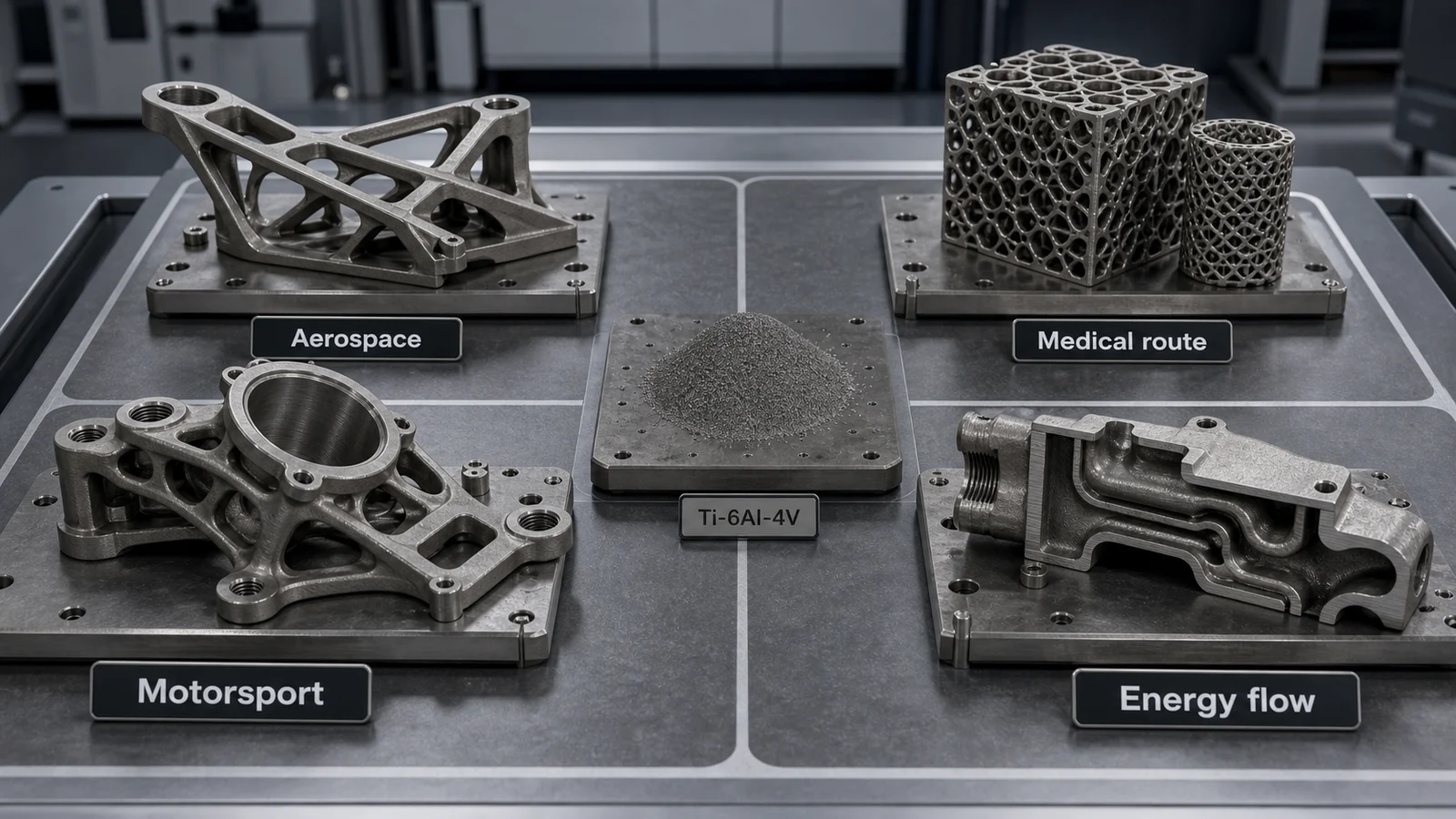
Representative article image; not a customer acceptance record or proof of a qualified manufacturing route. Refer to the cited sources and part-specific inspection records for engineering evidence.
On this page
The best titanium 3D printing applications begin with a part-level engineering constraint, not an industry name. Aerospace, medical, robotics, motorsport, energy, and chemical processing all use titanium, but an industry label does not make a component suitable for additive manufacturing.
Ti-6Al-4V powder bed fusion creates the strongest value when it changes the hardware: lower moving mass, integrated flow paths, fewer leak interfaces, patient-specific geometry, unavailable low-volume supply, or a near-net form that would otherwise waste substantial titanium. If a part is simple and tool-accessible, CNC machining may still be the better route.
Short Answer: Which Titanium Parts Are Good AM Candidates?
Start with the function that conventional manufacturing struggles to deliver. Strong candidates commonly have one or more of these characteristics:
- Load paths can be redesigned to remove mass while retaining stiffness or strength.
- Curved or branching internal passages replace drilled intersections, tubing, or plugs.
- Several components can be consolidated with a measurable assembly, leak, or alignment benefit.
- Geometry must match a patient, test article, vehicle package, or other unique envelope.
- Demand is low, variable, or obsolete tooling makes conventional supply impractical.
- Titanium is required for strength-to-weight or corrosion performance and complex geometry makes conventional processing expensive.
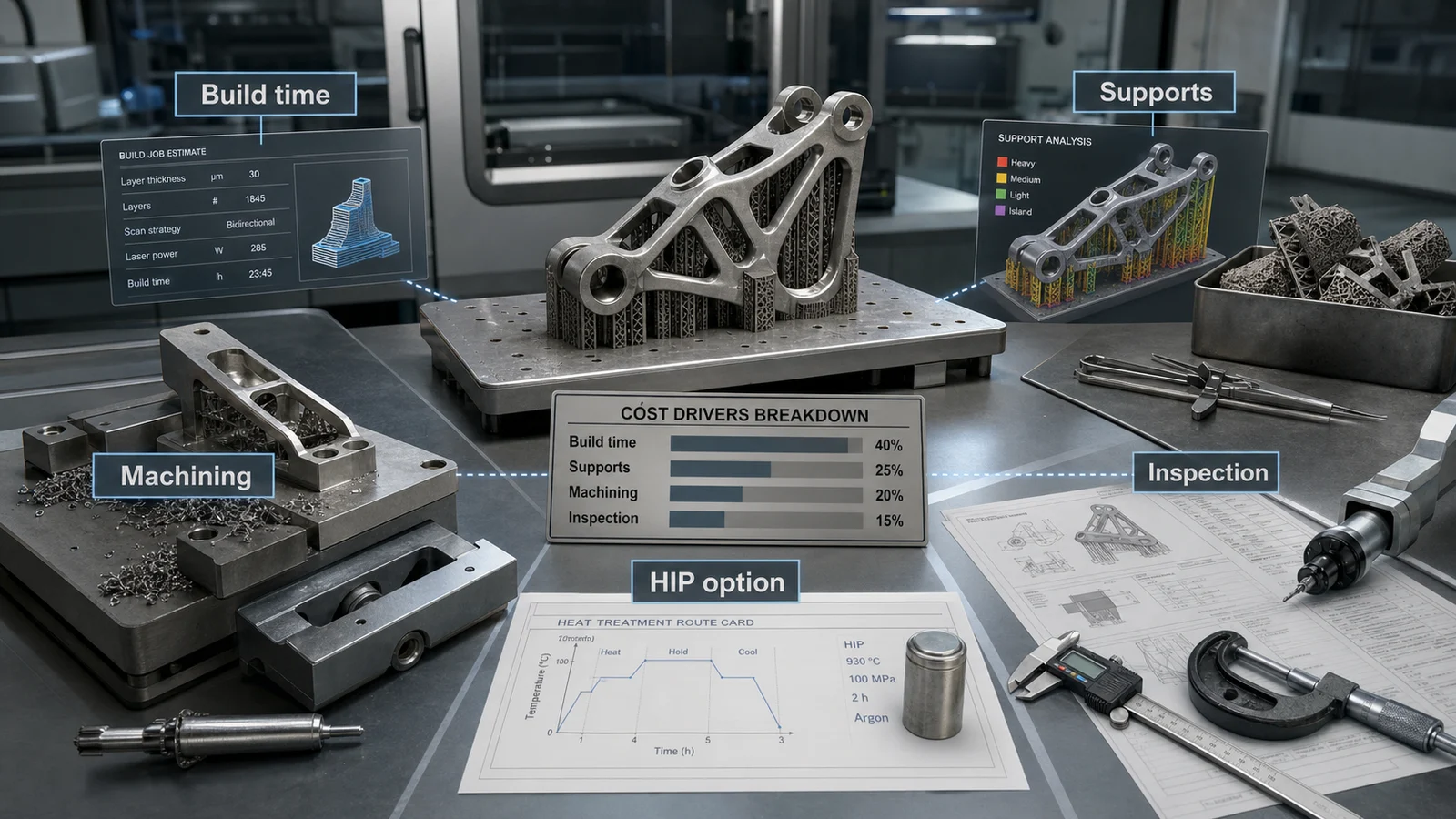
Complexity alone is not value. Every candidate must also have a credible plan for supports, powder removal, heat treatment, machining, surface condition, inspection, and release documentation.
Application-Fit Matrix
| Engineering intent | Typical hardware | Where AM can create value | Common disqualifier | Next decision guide |
|---|---|---|---|---|
| Reduce moving or flight mass | Brackets, mounts, robot wrists, UAV structures | Load-path geometry, lower inertia, compact integration | Simple plate geometry or no measurable system benefit | Fatigue and surface strategy |
| Integrate fluid or thermal paths | Manifolds, valve bodies, nozzles, compact exchangers | Curved channels, fewer joints, smaller package | Trapped powder, unacceptable roughness, uninspectable passages | Internal channels and CT |
| Consolidate an assembly | Housings, duct-and-mount assemblies, fluid junctions | Fewer fasteners, seals, welds, and alignment stack-ups | One expensive part replaces cheap serviceable modules without a system gain | AM vs CNC selection |
| Match unique anatomy or envelope | Patient-matched structures, surgical planning hardware, custom interfaces | Individual geometry and porous features | Undefined regulatory responsibility or validation route | Project-specific regulatory and quality review |
| Restore low-volume supply | Legacy spares, bridge production, custom tooling hardware | No hard tooling, digital geometry, near-net production | No design authority, incomplete drawing, or unknown material basis | RFQ and traceability |
| Resist aggressive media | Valve, pump, water-treatment, and chemical-process hardware | Titanium corrosion behavior plus integrated geometry | Material choice is valid but geometry is easy to machine | Valve and flow hardware |
The matrix deliberately separates the reason to use titanium from the reason to use AM. Corrosion resistance can justify titanium without justifying printing. Internal geometry can justify printing without making Ti-6Al-4V the best alloy. Both choices need an engineering basis.
1. Lightweight Load-Bearing Structures
Titanium AM can place material along load paths instead of preserving the rectangular envelope of plate or billet. This is useful where mass affects fuel use, payload, acceleration, cycle time, or actuator sizing.
Candidate parts include aircraft brackets, UAV sensor mounts, motorsport hardware, robot end effectors, and compact structural housings. The useful metric is not percentage mass removed in CAD. It is the change in system behavior after accounting for stiffness, fatigue, interfaces, fasteners, finish, and qualification.
Thin members, abrupt transitions, down-facing surfaces, and support scars can become fatigue-sensitive. Topology optimization therefore needs manufacturing constraints and a surface strategy, not just a low-mass shape. For application-specific screening, see the aerospace supply-chain guide, drone and UAV guide, motorsport guide, or robotics and automation guide.
2. Internal Flow and Thermal Geometry
Powder bed fusion can produce curved, branching, compact passages that are difficult to drill or mill. This can reduce plugs, external tubes, welds, brazed joints, dead volume, and package size in manifolds, valve bodies, nozzles, cooling hardware, and heat exchangers.
The same hidden geometry that creates value also creates the main manufacturing risk. A useful design must answer:
- Where does loose or partially sintered powder leave the part?
- Can every channel be cleaned and can cleanliness be verified?
- Is as-built internal roughness acceptable for flow, pressure loss, and fouling?
- Can the pressure boundary be inspected and leak tested?
- Does CT have sufficient access and resolution for the feature and acceptance threshold?
- Can ports, threads, and sealing faces be machined from stable datums?
Do not promise thermal improvement from geometric complexity alone. Titanium has lower thermal conductivity than common copper and aluminum alloys, so a titanium heat-exchanger application needs a system-level reason such as corrosion resistance, pressure capability, mass, or integration.
3. Part Consolidation and Leak-Path Reduction
Consolidating components can eliminate fasteners, seals, welds, plugs, alignment operations, and inventory items. That can improve reliability and reduce assembly labor in fluid systems, ducts, housings, and compact mechanisms.
The engineering case should quantify what disappears. “Five parts became one” is incomplete unless the new design also reduces failure opportunities, package size, mass, lead time, or total delivered cost.
Consolidation can also make repair harder and concentrate qualification risk in one component. Keep modules separate when they need different materials, replacement intervals, inspection access, or supplier routes.
4. Patient-Specific and Porous Geometry
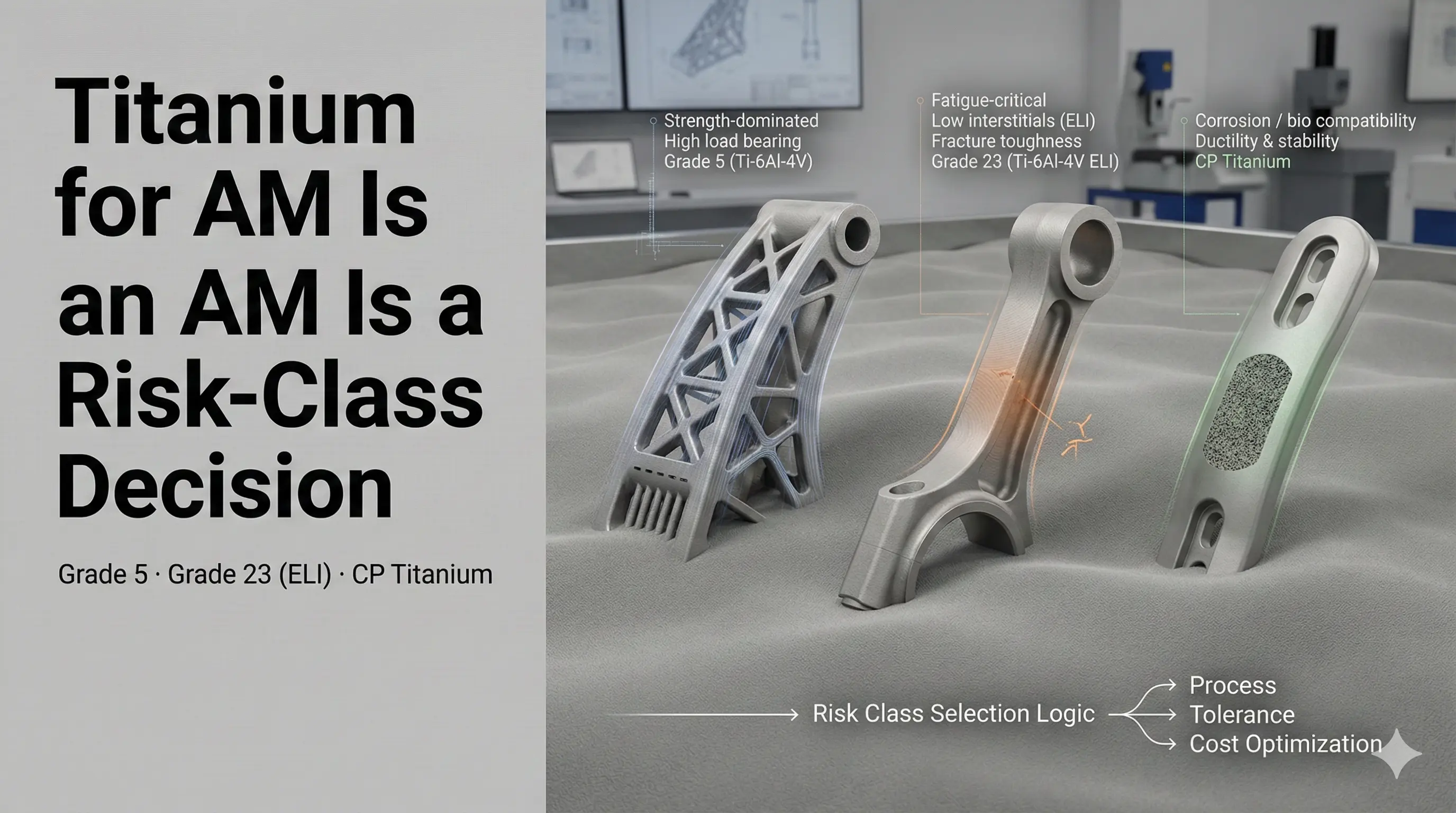
Medical applications are frequently associated with titanium AM because imaging-derived shapes, custom interfaces, and controlled porous structures are difficult to create conventionally. Ti-6Al-4V ELI may be relevant where tighter interstitial limits are specified.
Manufacturability is only one part of the decision. Design control, biocompatibility, cleaning, sterilization, validation, traceability, regulatory responsibility, and market-specific approval remain project requirements. A supplier quote should not be interpreted as regulatory acceptance, and generic mechanical-property data should not be used as device-specific evidence.
5. Low-Volume Spares and Alternate Supply
AM can support obsolete, customized, or low-volume parts when original tooling is unavailable, minimum order quantities are impractical, or conventional lead time threatens operations. The strongest cases have controlled geometry, known functional requirements, design authority, and a defined equivalence or requalification route.
A scan or old sample alone is not a complete production definition. Legacy replacements may require dimensional reconstruction, material identification, load review, interface confirmation, test planning, and approval by the responsible organization. Digital inventory is valuable only when configuration and release records are controlled.
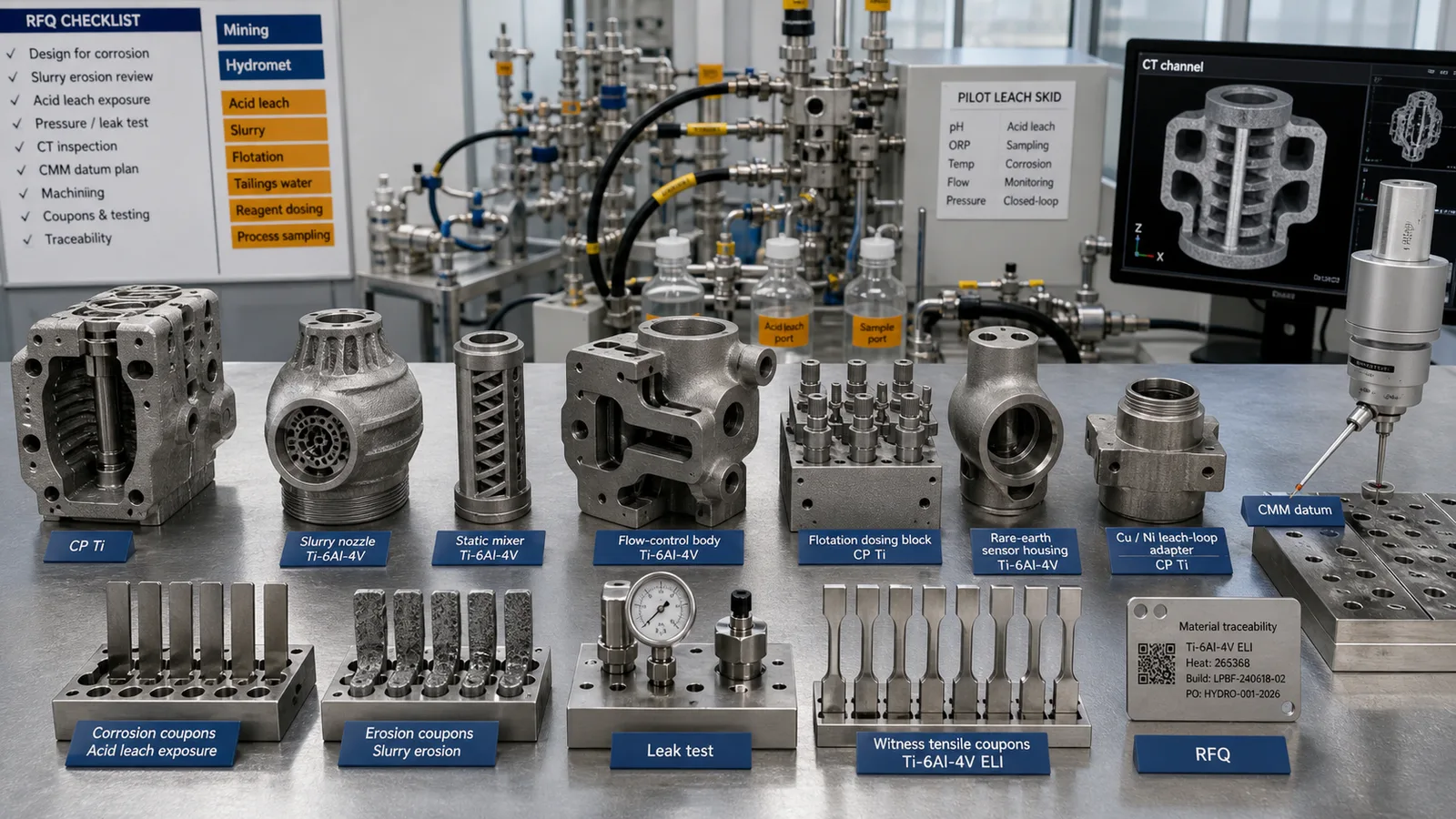
6. Corrosion-Resistant Flow Hardware
Chemical processing, seawater, desalination, and energy systems may use titanium for corrosion performance. AM becomes relevant when the hardware also benefits from integrated channels, compact manifolds, reduced joints, or low-volume supply.
This distinction prevents an expensive mistake: printing a simple valve body merely because titanium is difficult to machine. Start with media, concentration, temperature, pressure, galvanic interfaces, erosion, crevice conditions, and the applicable material basis. Then determine whether geometry creates an additive advantage. The chemical processing and water-treatment guide addresses that application boundary.
Applications That Sound Attractive but Often Fail Screening
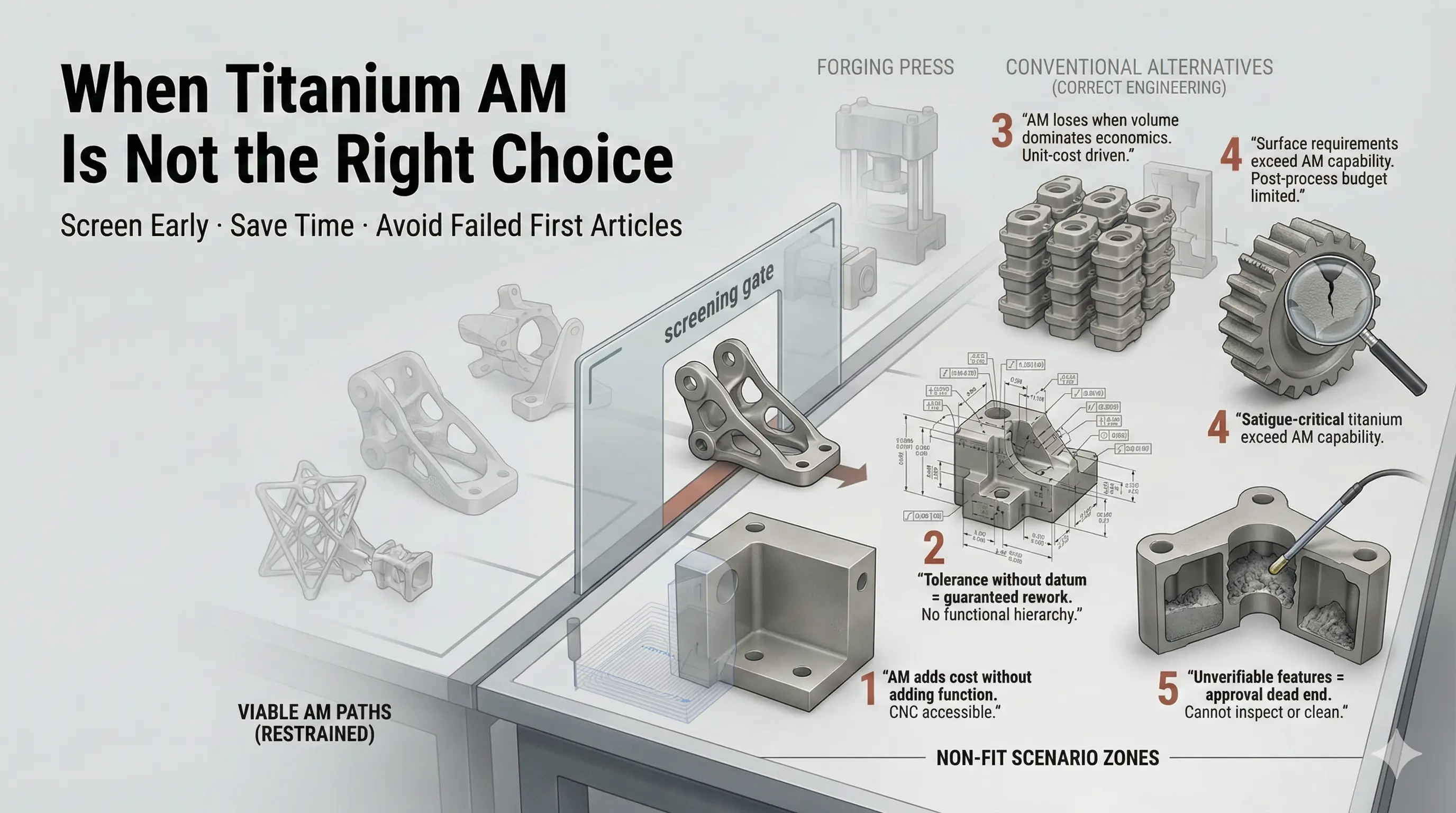
Simple brackets with no system benefit
A bracket may be printable but still cheaper and easier to qualify from plate. Lightweighting matters only when reduced mass changes performance enough to offset redesign, printing, finishing, and evidence.
Hidden lattices without a cleaning and inspection route
A lattice can reduce nominal mass while trapping powder and making internal defects difficult to assess. If the feature cannot be cleaned or tied to a testable requirement, it is not production-ready geometry.
Drop-in replacement for a forging
Matching alloy chemistry and external dimensions does not reproduce forging grain flow, defect behavior, or existing design allowables. A process change needs a new technical and qualification basis.
High-volume, low-complexity hardware
When geometry is stable and simple, machining, casting, forging, or another mature route often has stronger unit economics. AM may still serve prototypes or bridge production without being the correct steady-state process.
A “medical” or “aerospace” label without acceptance requirements
Industry labels do not define quality. The RFQ must identify applicable specifications, critical features, material condition, test methods, acceptance thresholds, lot controls, traceability, and required records.
Evidence Should Follow the Failure Mode
Avoid ordering every possible inspection by default. Define the failure mode first, then choose evidence that can detect or control it.
| Risk | Examples of useful controls or evidence |
|---|---|
| External dimension or interface error | Datum strategy, machining plan, CMM report, functional gauge |
| Internal blockage or residual powder | Drain design, documented cleaning, borescope where accessible, CT where technically suitable |
| Pressure-boundary leakage | Proof pressure, pressure decay, helium leak test, penetrant or CT as justified |
| Fatigue-sensitive surface or defect | Orientation and support control, surface finishing, HIP where justified, coupons and representative testing |
| Material or process traceability | Powder lot records, build records, heat-treatment certificates, material testing, controlled traveler |
| Thermal or flow underperformance | Flow, pressure-drop, thermal-cycle, or application-representative performance test |
ASTM F2924 addresses additively manufactured Ti-6Al-4V by powder bed fusion. ISO/ASTM 52911-1 provides design guidance for laser-based powder bed fusion. Neither replaces the part drawing, project-specific acceptance plan, or regulatory requirements.
From Application Idea to Quote
Before asking for production pricing, provide:
- A STEP or native CAD model and controlled drawing.
- The material designation, governing specification, and delivered condition.
- The engineering reason for considering AM.
- Prototype quantity, production quantity, annual demand, and schedule.
- Critical interfaces, loads, pressure, temperature, media, and life requirements.
- Machining, finish, cleaning, inspection, test, and documentation expectations.
- Permission for the supplier to identify a better CNC, AM, or hybrid route.
Use the Ti-6Al-4V / TC4 material guide to align alloy terminology, the cost guide to compare complete quote scope, and the AM vs CNC guide to screen the manufacturing route.
Sources and Scope
This page is an application-selection framework rather than a claim that every listed component is suitable for production. The NIST powder bed fusion overview explains the process family, while the NIST additive manufacturing standards and benchmarks collection provides broader standards context.
Part-specific feasibility depends on geometry, loads, environment, material specification, supplier capability, and acceptance evidence. To assess a real part, request a titanium AM manufacturability review with the model, drawing, quantity, and operating conditions.
- Titanium 3D printing applications
- Ti6al4v
- Tc4
- Application fit
- Part consolidation
- Internal channels
- Lightweighting