· Updated - TITANIUM 3DP Engineering - Engineering Guides - 16 min read
Titanium 3D Printing for Geothermal and Downhole Energy Parts
Engineering RFQ guide for titanium 3D printed geothermal and downhole energy parts, covering brine exposure, sensor housings, manifolds, DLE test hardware, leak testing, CT, CMM, and traceability.
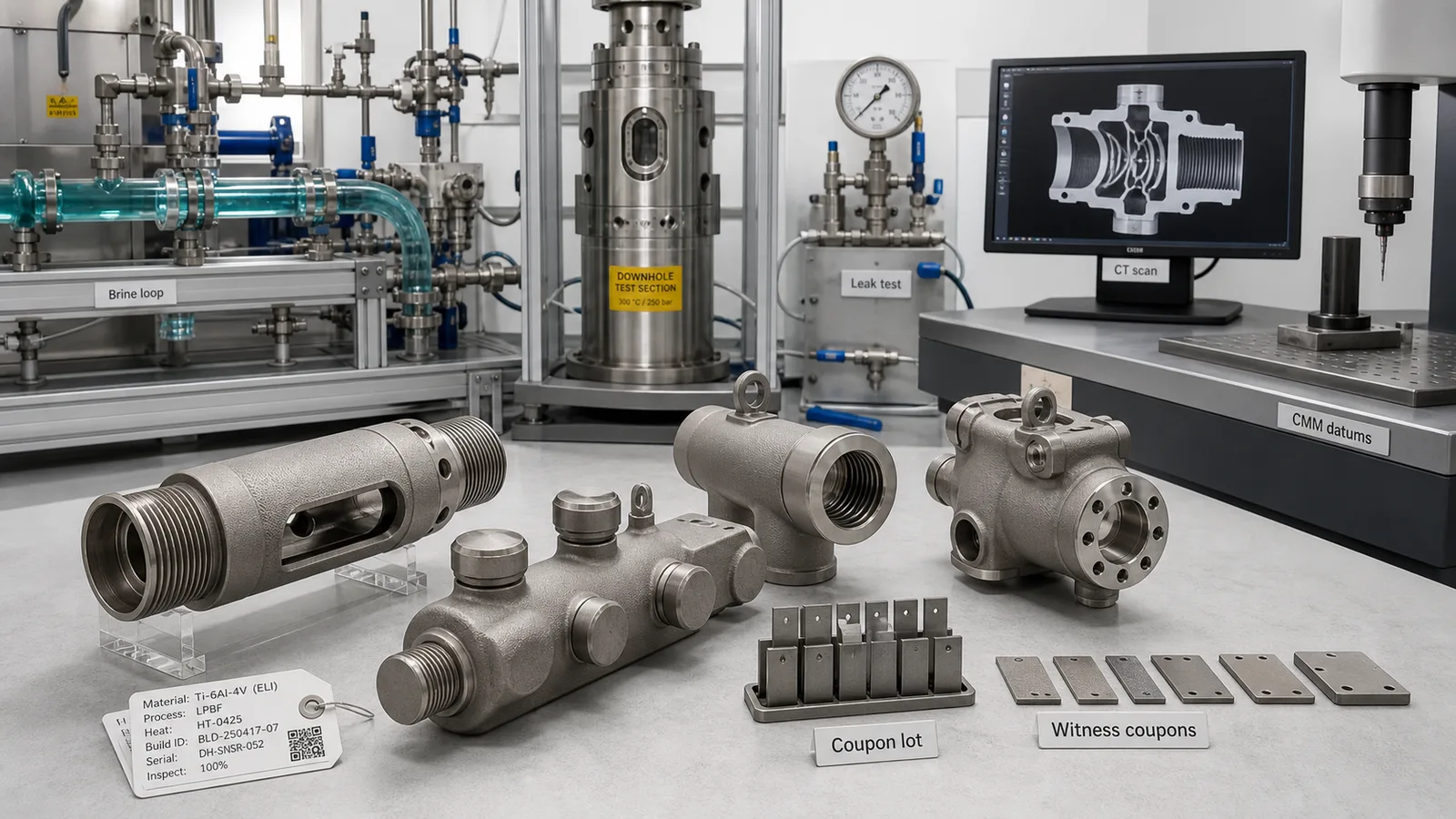
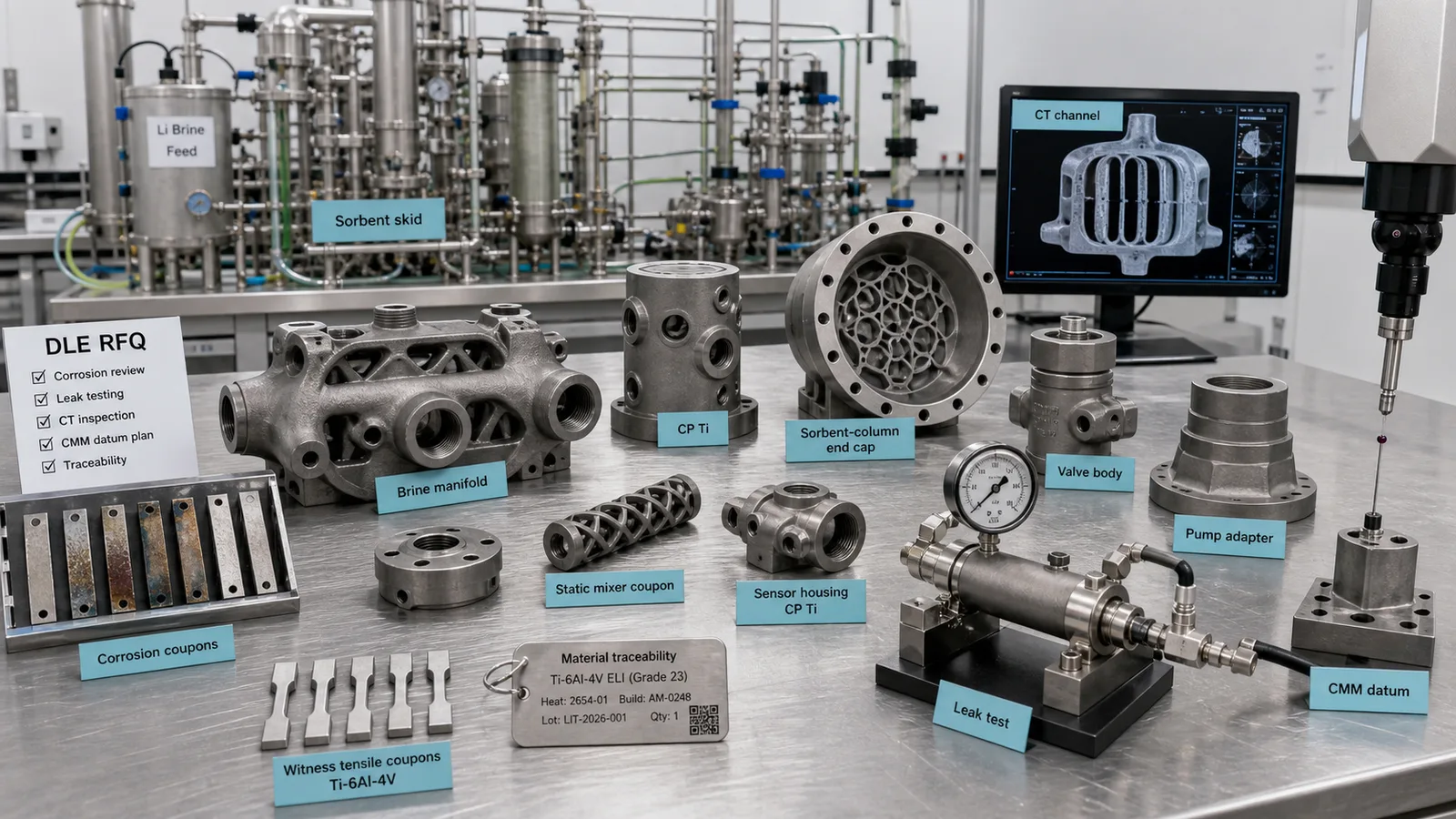
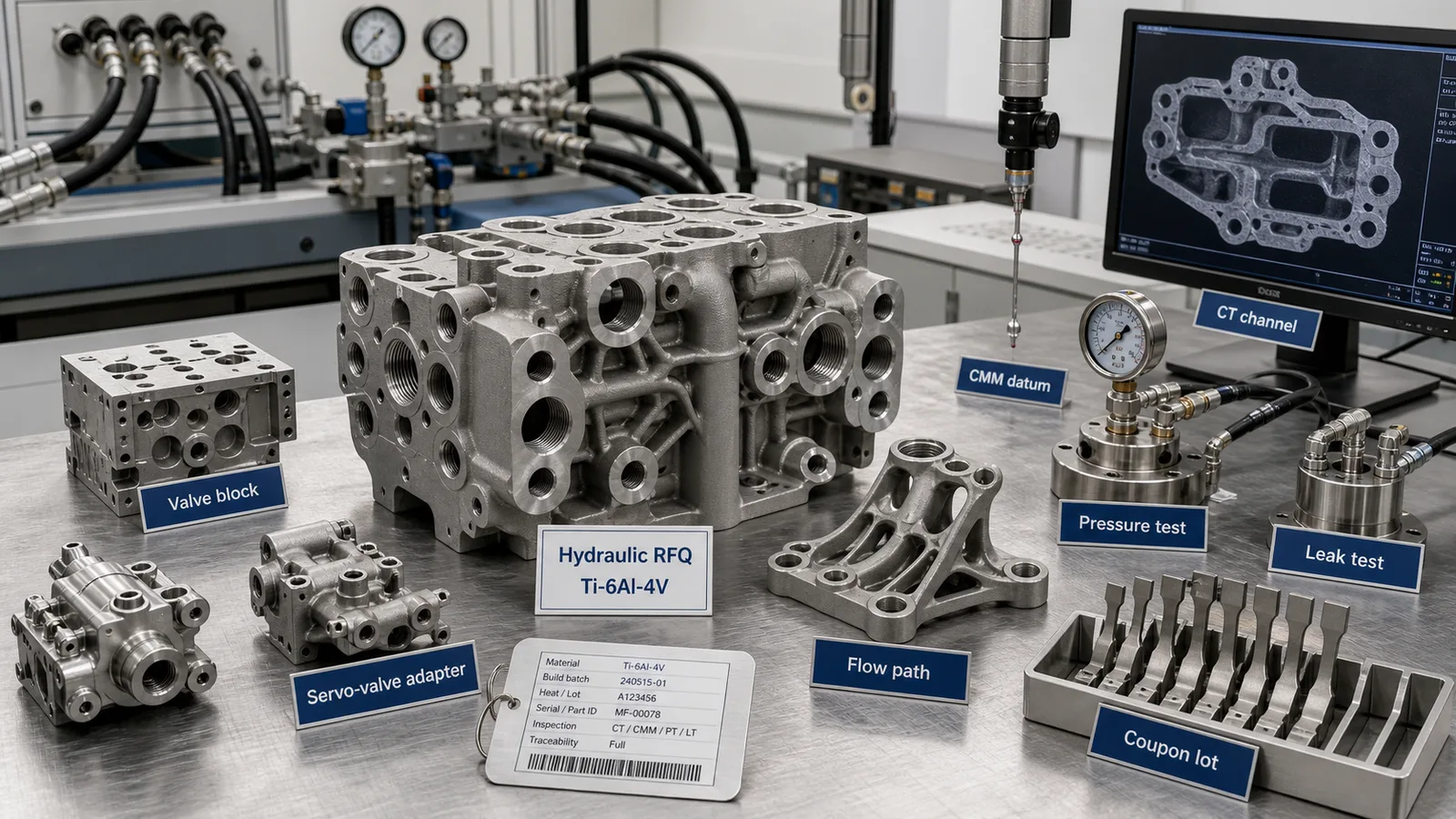
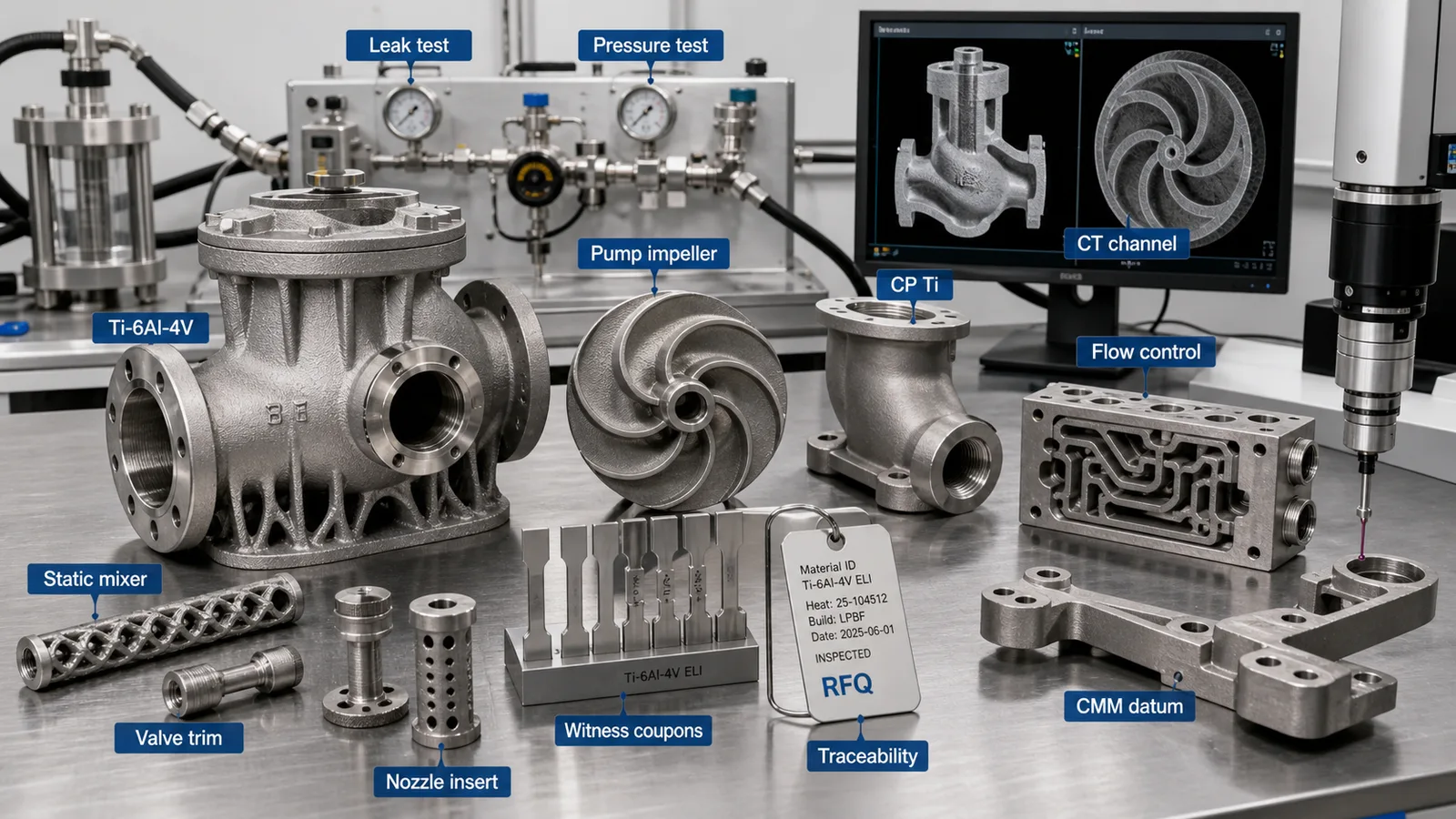
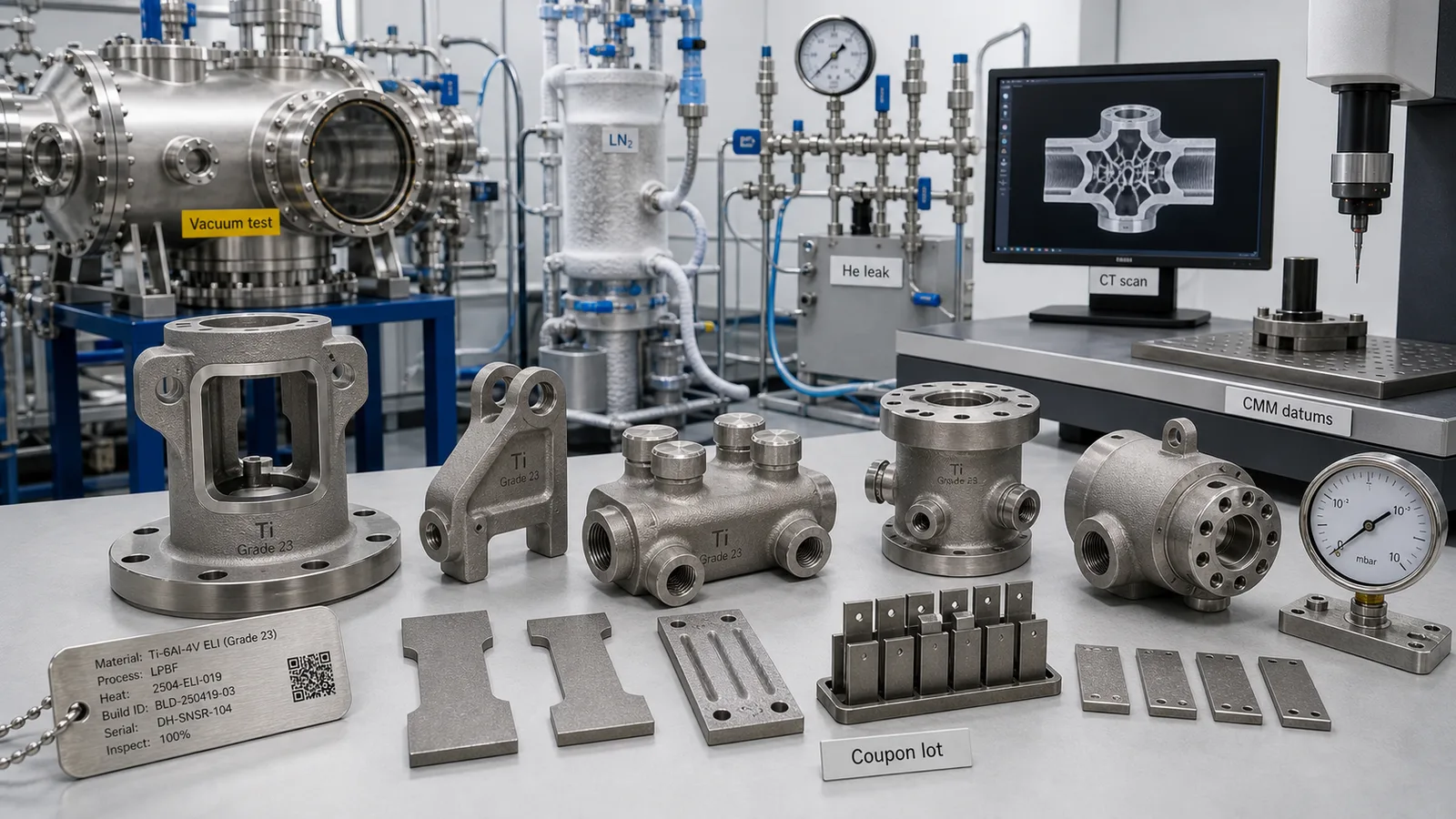
Representative article image; not a customer acceptance record or proof of a qualified manufacturing route. Refer to the cited sources and part-specific inspection records for engineering evidence.
On this page
Titanium 3D printing for geothermal and downhole energy parts is worth reviewing when hot brine, compact wellbore packaging, corrosion exposure, low-volume test hardware, fewer leak paths, or difficult internal routing creates a real engineering advantage. It is not a shortcut around pressure qualification, sour-service screening, corrosion testing, cleaning, or field acceptance.
The best RFQs treat a printed titanium downhole sensor housing, brine manifold, flow adapter, coupon rack, direct lithium extraction test body, instrument block, pump adapter, or geothermal test fixture as delivered energy hardware. That means the quote must cover exposure mapping, titanium grade, pressure and leak testing, machined seal faces, powder removal, CT where hidden channels matter, CMM, material records, and traceability.
For the broader process-fluid context, start with Titanium 3D Printing for Chemical Processing and Water Treatment Parts. For DLE brine manifolds, sorbent skid adapters, and lithium brine pilot hardware, use Titanium 3D Printing for Direct Lithium Extraction and Brine Processing Hardware. For adjacent critical-minerals pilot loops, pair this with Titanium 3D Printing for Battery Recycling and Critical Minerals Processing Parts. Use this guide for geothermal and downhole-specific sourcing decisions.
For produced-water, oilfield brine, LNG, refinery, and petrochemical process hardware where API 20S, sour-service screening, and operator acceptance may apply, use Titanium 3D Printing for Oil & Gas, LNG, and Petrochemical Hardware. For mining and hydrometallurgy streams beyond geothermal brines, including acid leach loops, slurry erosion fixtures, and rare-earth process hardware, use Titanium 3D Printing for Mining, Mineral Processing, and Hydrometallurgy Hardware.
Quick Answer
Titanium additive manufacturing is a strong candidate for geothermal and downhole energy parts when the component is compact, corrosion-exposed, interface-heavy, low-volume, difficult to machine from billet, or improved by internal channels that can be cleaned and verified.
Good candidates include:
- Downhole sensor housings, instrument carriers, cable-routing bodies, and compact electronics protection sleeves.
- Geothermal brine manifolds, test-loop adapters, sample blocks, flow conditioners, and corrosion coupon racks.
- Direct lithium extraction brine test bodies, membrane-cell hardware, ion-exchange cartridge adapters, and pilot skid fixtures.
- Pump, valve, filter, and separator adapters for hot saline or mineral-rich process streams.
- Compact pressure, leak, and flow test fixtures for geothermal R&D programs.
- Heat-transfer and thermal-management bodies where titanium compatibility and internal routing both matter.
- Low-volume spares or development parts where a machined, welded, or drilled route is slow and geometry-constrained.
Weak candidates include commodity pipe spools, large pressure vessels, simple plates, catalog fittings, high-volume cast parts, and any pressure-retaining or sour-service part where the RFQ does not define fluid chemistry, temperature, pressure, H2S/CO2 assumptions, seal faces, proof test, leak threshold, cleaning route, and documentation.
If machining, welding, forged stock, nickel alloy, stainless, lined steel, polymer, ceramic, or catalog downhole hardware meets the service and evidence requirements with lower risk, use the When Not to Use Titanium Additive Manufacturing screen before requesting production pricing.
Why This Topic Is Timely in 2026
Geothermal is moving into a broader industrial-energy conversation because it can provide continuous power, heat, and storage while drawing on drilling, completions, subsurface, and project-management skills that already exist in oil and gas supply chains.
Recent public signals show the context:
- The IEA Future of Geothermal Energy executive summary says geothermal could meet up to 15% of global electricity demand growth to 2050 if technology improvements and cost reductions continue.
- The IEA also notes that geothermal can provide continuous electricity, heat, and storage, and that global geothermal capacity had a utilization rate above 75% in 2023.
- DOE’s Next-Generation Geothermal Liftoff announcement says advanced geothermal could increase U.S. geothermal energy production to 90 GW or more by 2050.
- DOE geothermal program material on the Enhanced Geothermal Shot describes the goal of reducing enhanced geothermal system costs by 90% by 2035.
- DOE’s geothermal lithium page explains why direct lithium extraction from geothermal brines is being researched as a way to pair geothermal electricity with domestic lithium recovery.
- A DOE page on whether geothermal energy can solve the lithium shortfall highlights hot salty geothermal brine as both an energy resource and a potential lithium source.
These signals do not mean every geothermal or downhole part should be printed in titanium. They explain why engineering teams are asking better RFQ questions about corrosion-resistant test hardware, compact brine routing, fewer leak paths, pressure evidence, internal-channel inspection, and documented material condition.
Where Titanium AM Fits in Geothermal Hardware
Geothermal hardware is not one market. A lab brine coupon fixture, an aboveground direct lithium extraction skid part, a geothermal heat-loop adapter, a downhole sensor housing, and a pressure-containing well tool have very different evidence requirements.
| Part family | Why titanium AM can help | Main RFQ risk | Evidence to define |
|---|---|---|---|
| Downhole sensor housing | Compact packaging, corrosion resistance, integrated ports | Pressure, temperature, seals, and electronics interfaces | Machined seals, CMM, pressure or leak test |
| Geothermal brine manifold | Fewer fittings and shorter process paths | Brine chemistry, scale, trapped powder | Exposure map, cleaning route, CT or flow test |
| DLE brine test body | Low-volume iteration for lithium extraction trials | Chloride, temperature, solids, membrane interfaces | Alloy review, leak test, coupon records |
| Flow adapter or sample block | Integrated sampling, pressure taps, drains | Dead legs and deposit collection | Drainability, surface condition, CMM |
| Pump or valve adapter | Custom interface for pilot systems | Seal faces and erosion | Machining plan, roughness, pressure test |
| Coupon rack or exposure fixture | Matched titanium exposure hardware | Over-specifying a simple holder | Alloy, finish, coupon lot traceability |
| Thermal or heat-loop body | Internal channels plus corrosion resistance | Powder removal and pressure integrity | CT, flow test, leak or proof test |
The right candidate is usually a compact, interface-dense part where additive manufacturing reduces fittings, integrates measurement points, shortens pilot iteration, or makes a cleanable corrosion-resistant path practical.
For thermal hardware, use Titanium 3D Printed Heat Exchangers. For seawater-adjacent offshore energy equipment, use Titanium 3D Printing for Marine, Subsea, and Offshore Parts.
Start With an Exposure and Duty Map
“Geothermal brine service” is not a material requirement. Geothermal fluids can vary widely by field, depth, temperature, dissolved salts, silica, sulfides, carbon dioxide, pH, oxygen ingress, scaling tendency, solids, treatment chemistry, and operating cycle. A useful RFQ starts with the exposure and duty map, not only the material name.
Define:
- Fluid source: geothermal brine, synthetic brine, condensate, cooling water, injection fluid, produced fluid, cleaning solution, or test medium.
- Chemistry: chloride, sulfate, carbonate, silica, lithium, sodium, potassium, calcium, magnesium, iron, H2S, CO2, dissolved oxygen, inhibitors, or treatment chemicals if known.
- Temperature, pressure, flow rate, pressure cycling, thermal cycling, stagnation, and duty cycle.
- Solids, scale, precipitates, entrained sand, corrosion products, or filter cake.
- Whether the part is downhole, wellhead-adjacent, aboveground skid hardware, lab hardware, pilot hardware, or production-intent hardware.
- Mating materials: stainless, duplex stainless, nickel alloy, carbon steel, polymers, ceramics, elastomers, graphite, or coated surfaces.
- Acceptance tests: CMM, CT, pressure test, leak test, flow test, roughness, coupon evidence, material traceability, or customer-specific qualification.
Do not ask for titanium only as a generic corrosion-resistant label. Ask for the titanium grade, delivered condition, exposed surfaces, mating materials, and acceptance route that match the actual brine and duty cycle.
Brine, Scaling, and Chlorides Are Not One Requirement
Hot brines create design problems that are easy to hide in a printed part. Chlorides, silica scale, carbonate scale, sulfides, solids, and pH changes can turn a clean CAD channel into a difficult service path.
High-risk features include:
- Blind brine passages with no powder exit or flushing route.
- Long dead legs near sample ports, pressure taps, or sensor pockets.
- Sharp shelves where scale, solids, or corrosion products can collect.
- Small restrictions that may trap both AM powder and process solids.
- Thin walls between incompatible fluids or between process and electronics cavities.
- As-built roughness in channels where deposit growth or pressure drop matters.
- Threaded ports that intersect rough internal AM surfaces without a cleaning plan.
- Sealed cavities connected to wetted areas.
If a channel controls flow, heat transfer, sampling, pressure drop, or cleanability, define powder removal, internal roughness, minimum feature size, CT scope, flow test, and cleaning access before quotation.
Use Titanium 3D Printed Internal Channels: Powder Removal and CT before freezing a printed geothermal manifold, DLE test body, flow adapter, or heat-transfer component.
Sour Service and H2S Need Customer-Controlled Standards
Some geothermal and downhole environments can include H2S, CO2, chlorides, low pH, or high temperature. That does not mean a supplier should casually label a printed titanium part “sour service ready.”
If sour service, wet H2S, oil and gas production standards, or customer field standards apply, define them before pricing. The official ISO 15156-1:2020 page describes general principles for selecting and qualifying metallic materials for H2S-containing environments in oil and gas production and natural-gas sweetening plants. It is the buyer’s responsibility to decide whether that framework, a company specification, or another acceptance basis applies.
RFQs should identify:
- Whether H2S is present and whether the part is in sour-service scope.
- Temperature, pressure, pH, chlorides, CO2, elemental sulfur, oxygen, and other cracking or corrosion drivers.
- Maximum hardness, heat treatment, strength level, surface condition, and residual-stress assumptions if the governing specification controls them.
- Whether AM material, post-processing, HIP, machining, surface finishing, and lot records are acceptable under the customer’s rules.
- Qualification tests, coupons, documentation, and responsible approval authority.
Do not let “titanium” replace sour-service review. The material, process route, post-processing, and acceptance standard must be aligned before a printed part is treated as field-ready.
Sensor Housings and Tool Bodies Need Machined Interfaces
Downhole and geothermal test hardware often combines a rugged exterior with precise functional interfaces. Titanium AM can help with compact bodies, organic transitions, integrated bosses, cable routing, and low-volume geometry. It should not rely on as-built AM surfaces for seals, threads, sensor datums, or pressure interfaces.
Define every controlled feature:
- O-ring grooves, gasket lands, metal-seal surfaces, threaded ends, and pressure shoulders.
- Electrical feedthrough regions, cable-routing paths, connector seats, and sensor datums.
- Tube fitting ports, pressure taps, sample ports, vent ports, and drain features.
- Datum pads, bolt faces, dowel holes, inspection features, and reference surfaces.
- Surfaces that may remain as-built, bead blasted, polished, machined, lapped, or coated.
Add machining stock to seal faces, threads, O-ring grooves, gasket lands, datum pads, and any interface that controls assembly or leakage. If a port intersects an AM channel, define how that transition is cleaned and inspected.
For drawing and measurement strategy, use Titanium 3D Printing Tolerances: Datum Planning and CMM.
Material Choice: Ti-6Al-4V, ELI, or CP Titanium
Ti-6Al-4V is often the first AM quote route because it is widely available in LPBF supply chains, strong, and familiar to suppliers. Ti-6Al-4V ELI may be reviewed when ductility, fracture behavior, or a specific acceptance basis matters. CP titanium may be relevant when corrosion behavior, ductility, or chemical compatibility matters more than high strength.
For geothermal and downhole parts, the alloy question belongs near the start of the RFQ. A supplier who can print Ti-6Al-4V may not have a mature CP titanium route. A buyer who needs a CP titanium exposure body should not accept a Ti-6Al-4V price as equivalent without review.
Choose the material based on:
- Brine chemistry, H2S/CO2, temperature, pressure, solids, scaling, cleaning chemicals, and oxygen ingress.
- Whether the part is structural, flow-carrying, pressure-retaining, sensor-protective, or only a coupon holder.
- Strength, ductility, fatigue, fracture, and corrosion requirements.
- Supplier availability for LPBF, EBM, or another route in the requested grade.
- Post-processing, passivation, machining, coating, or finishing requirements.
- Documentation level: COA, COC, powder lot, heat-treatment record, build record, inspection report, and traceability.
Use Titanium AM Material Selection: Ti-6Al-4V, ELI, and CP Titanium when the alloy is not locked. Do not let three suppliers quote three different titanium grades under the same geothermal part number.
Process Choice: LPBF Usually Leads for Compact Hardware
Separate an accessible surface-loop test part from a downhole pressure-retaining component before selecting a process. Record location, retrieval and inspection access, normal and upset conditions, thermal cycling, external loads, and the consequence of leakage. A surface-loop prototype does not qualify the same design for downhole use.
Ask the supplier which proposed alloy, manufacturing condition, finished interfaces, and verification route are supported for that location. If the operating envelope or acceptance authority is unresolved, quote feasibility work rather than a released service part. Use the LPBF, EBM, and DED comparison for general process differences instead of choosing a route from part size alone.
Post-Processing and Cleaning Decide the Delivered Part
As-built titanium AM surfaces are not equivalent to machined, polished, chemically finished, or conventionally wrought surfaces. In geothermal service, roughness can trap powder, scale, salt crystals, corrosion products, test fluid, and cleaning residue. In downhole hardware, support scars and rough transitions can also affect fatigue, seals, pressure cycling, or assembly.
Separate surfaces by function:
- Seal faces, O-ring grooves, gasket lands, threaded shoulders, and metal-seal regions.
- Wetted channels where roughness affects pressure drop, scaling, or cleanability.
- Sensor datums, connector interfaces, tube-fitting seats, and machined ports.
- Fatigue or pressure-cycle surfaces where support scars are unacceptable.
- Datum pads, bolt faces, bores, and inspection surfaces that require CMM control.
- Noncritical exterior surfaces that may remain as-built or bead blasted.
Post-processing may include stress relief, HIP when justified, support removal, machining, abrasive flow finishing, chemical finishing, blasting, passivation, ultrasonic cleaning, drying, capping, packaging, and inspection photos. The sequence matters because a part can pass a dimensional check and still be unacceptable if powder or residue remains in a hidden brine path.
Use Post-Processing for Titanium 3D Printing when defining delivered condition.
Inspection Evidence Should Match the Risk
Geothermal titanium AM parts can be over-tested or under-tested. A coupon rack does not need the same evidence as a pressure-carrying downhole housing. A DLE membrane-cell adapter may need leakage, surface, and cleanliness evidence that a simple fixture does not.
Typical evidence includes:
- CMM report for datums, seal faces, ports, threads, bolt patterns, gasket lands, and machined features.
- CT inspection for internal channels, trapped powder, wall thickness, hidden defects, or blockage where risk justifies it.
- Pressure, leak, flow, pressure-drop, drainability, or thermal-cycle test tied to the accepted configuration.
- Surface roughness checks on sealing, fatigue, or wetted-cleanability regions.
- Material certification, COA, COC, heat-treatment record, build record, powder lot, and traceability.
- Inspection photos for support removal, machined features, critical surfaces, and test setup.
- Witness coupons or tensile coupons when the lot, process, or acceptance basis requires them.
Use Titanium AM Qualification and Inspection Evidence to choose evidence by risk. A low quote with no CT, no leak test, no CMM, and no material records may simply be quoting a printed shape, not an accepted energy part.
Cost: Compare Delivered Energy Hardware
Titanium AM can reduce fittings, shorten geothermal pilot-loop iteration, integrate ports, and replace difficult drilling. It can also hide cost in post-processing, testing, and documentation.
Cost drivers include:
- Manufacturability review and brine exposure review.
- Build orientation and support strategy.
- Support removal from ports, ribs, channels, and sensor pockets.
- Stress relief, HIP if justified, and heat treatment.
- Machining of seals, threads, gasket lands, bores, pressure shoulders, and datum pads.
- Internal cleaning, flushing, drying, and residue verification.
- Passivation, polishing, abrasive flow finishing, or chemical finishing.
- CT, CMM, leak testing, pressure testing, flow testing, roughness checks, and thermal-cycle testing.
- Material records, lot traceability, inspection reports, customer forms, and packaging.
- Rework if internal channels cannot be cleaned, measured, or verified.
Control cost before geometry is frozen. Remove unnecessary sealed cavities, keep brine paths cleanable, machine only functional surfaces, define evidence by risk, and let suppliers propose DfAM changes before final pricing.
For quote normalization, use Titanium 3D Printing Cost Drivers: How to Reduce RFQ Price and the Titanium AM RFQ and Procurement Guide.
Better RFQ Wording
Weak RFQ:
Please quote this titanium 3D printed geothermal part.
Better RFQ:
Please review this titanium AM brine manifold for a geothermal pilot loop. The part carries hot chloride-rich brine during short-duration test campaigns and includes six threaded ports, two sample ports, one drain, one sensor pocket, and a machined gasket face. Please recommend Ti-6Al-4V, Ti-6Al-4V ELI, or CP titanium based on the exposure notes; identify powder-removal access, support strategy, machining stock, cleaning route, pressure-test method, leak threshold, CMM scope, CT or flow-test recommendation for the internal channels, material traceability, and any DfAM changes needed before quotation. Quote the delivered accepted part, not only the printed shape.
That wording helps procurement compare suppliers on the same route: print, stress relieve, depowder, machine, clean, inspect, test, document, and package.
Geothermal Titanium AM RFQ Checklist
Send the supplier:
- STEP file and drawing with datums, section views, critical surfaces, and pressure boundaries.
- Target alloy, material condition, and whether substitutions are allowed.
- Quantity, prototype or production intent, lot definition, and target lead time.
- Service location: downhole, wellhead-adjacent, aboveground skid, lab loop, pilot plant, or development fixture.
- Fluid chemistry: geothermal brine, synthetic brine, condensate, injection fluid, cleaning fluid, H2S, CO2, chlorides, pH, solids, inhibitors, and temperature.
- Pressure, proof pressure, pressure cycling, thermal cycling, leak threshold, flow rate, pressure drop, and test method.
- Functional interfaces: seal faces, O-ring grooves, gasket lands, threads, ports, sensor datums, connector interfaces, cable paths, and mounting pads.
- Internal channel details: minimum feature size, blind regions, powder-removal access, accepted roughness, flushing route, drainability, and CT scope.
- Mating materials, elastomers, coatings, fasteners, isolation requirements, and galvanic or compatibility assumptions.
- Post-processing expectations: stress relief, HIP if justified, machining, finishing, passivation, cleaning, drying, capping, and packaging.
- Inspection scope: CMM, CT, pressure test, leak test, flow test, roughness, coupons, COA, COC, build record, powder lot, and inspection photos.
- Permission for supplier DfAM changes before final pricing.
If the RFQ does not define exposure, sealing, pressure, cleaning, inspection, and traceability, suppliers may quote very different products under the same part number.
When to Redesign or Avoid Titanium AM
Redesign before quotation when:
- Brine channels have no practical powder exit, flushing path, or drain point.
- Scale, solids, or corrosion products can collect in inaccessible dead zones.
- Seal faces, gasket lands, O-ring grooves, metal-seal shoulders, or threaded ports lack machining stock.
- H2S, CO2, chlorides, temperature, pressure, or sour-service assumptions are unknown.
- Internal roughness controls pressure drop, scaling, or cleaning, but no finishing or flow-test route is defined.
- The part mixes process fluid, electronics cavities, or incompatible fluids across thin walls with no inspection basis.
- CT cannot resolve the smallest critical internal feature.
- Pressure or leak testing is required but pressure, method, hold time, port sealing, and leakage limit are vague.
- CP titanium is required but the supplier route only supports Ti-6Al-4V.
- A simple machined, fabricated, lined, polymer, stainless, nickel alloy, or catalog route would meet the requirement with lower acceptance risk.
Avoid titanium AM when conventional manufacturing meets the corrosion, pressure, lead-time, and evidence requirements with lower risk. Titanium AM should earn its place through compact routing, fewer leak paths, documented internal geometry, low-volume iteration, corrosion-exposed test hardware, or a real delivered-system advantage.
Bottom Line
Titanium 3D printing can be valuable for geothermal and downhole energy parts when it solves a real hardware problem: compact brine routing, fewer fittings, low-volume pilot hardware, sensor-housing integration, DLE test-loop iteration, pressure/leak evidence, or documented internal channels. The strongest candidates are downhole sensor housings, geothermal brine manifolds, sample blocks, flow adapters, pump and valve adapters, DLE brine test bodies, coupon racks, and thermal test hardware where exposure, sealing, machining, cleaning, and evidence are planned from the start.
The weak cases are simple shapes, commodity fittings, large fabricated equipment, high-volume standard parts, and any pressure or brine path where the RFQ ignores alloy selection, H2S/CO2 assumptions, powder removal, surface finish, cleaning, leak testing, and traceability.
For an RFQ review, send CAD, drawing, brine exposure map, pressure and leak requirement, target alloy, quantity, post-processing expectations, and inspection scope through the RFQ inputs page or email info@szcomo.com.
- Geothermal
- Downhole
- Energy
- Brine
- Corrosion
- Sensor housings
- Leak testing
- CT
- CMM
- RFQ