· Updated - TITANIUM 3DP Engineering - Engineering Guides - 16 min read
Titanium 3D Printing for Hydrogen Electrolyzer and Fuel Cell Parts
Screen titanium AM hydrogen hardware by exposure: PEM interfaces, water circuits, gas pressure boundaries, and structural fixtures need different material, cleaning, coating, and acceptance evidence.
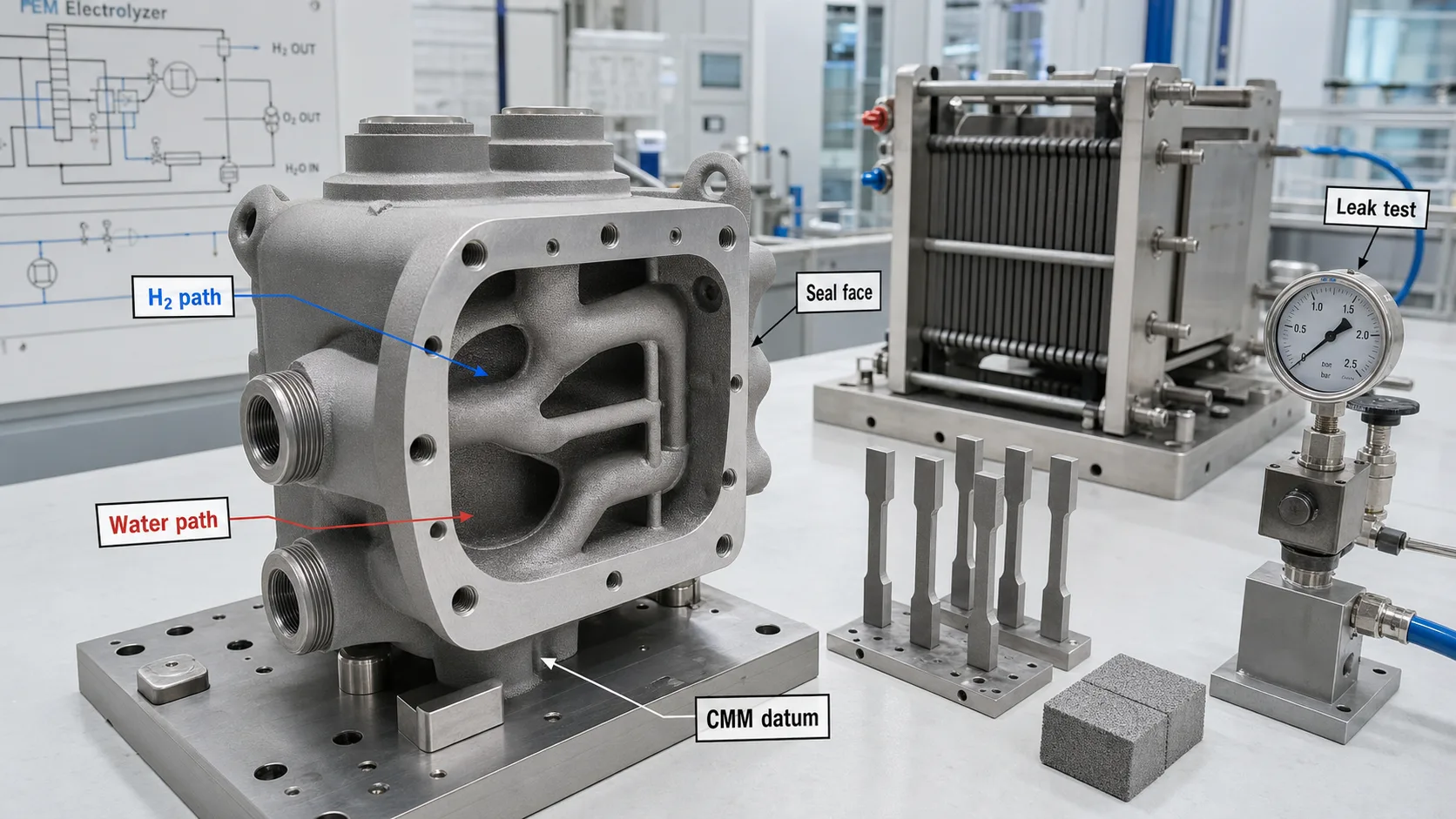
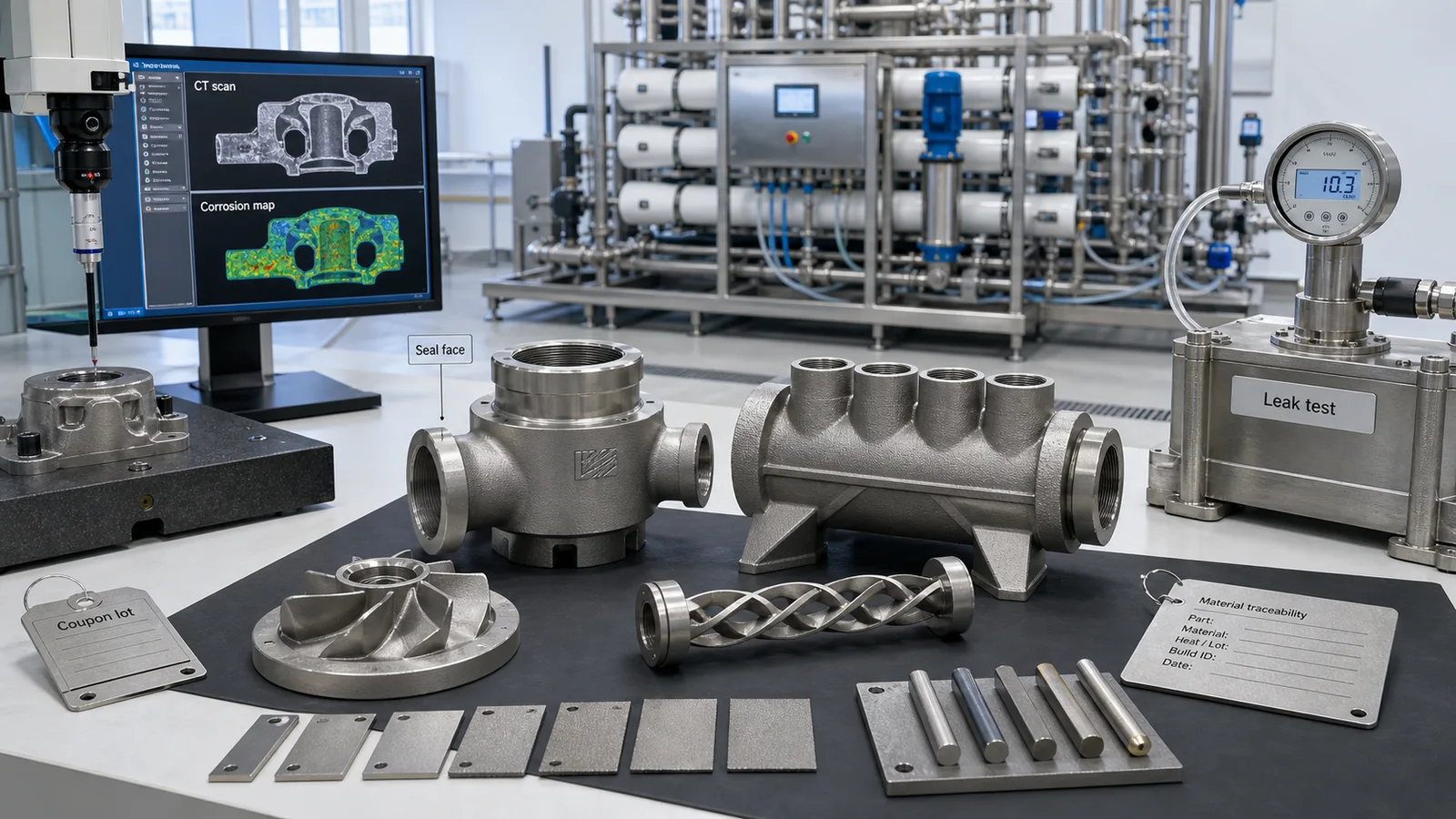
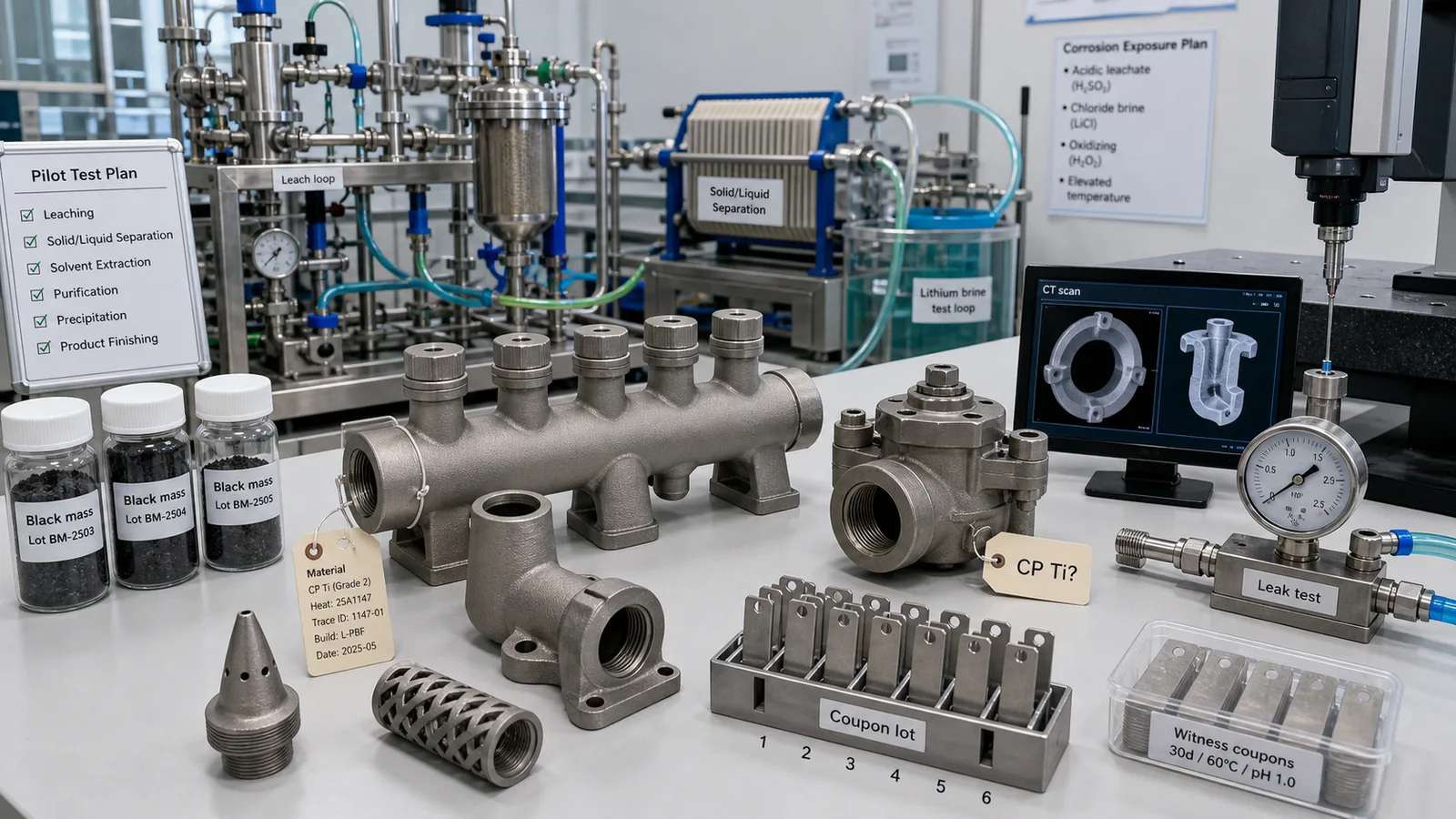
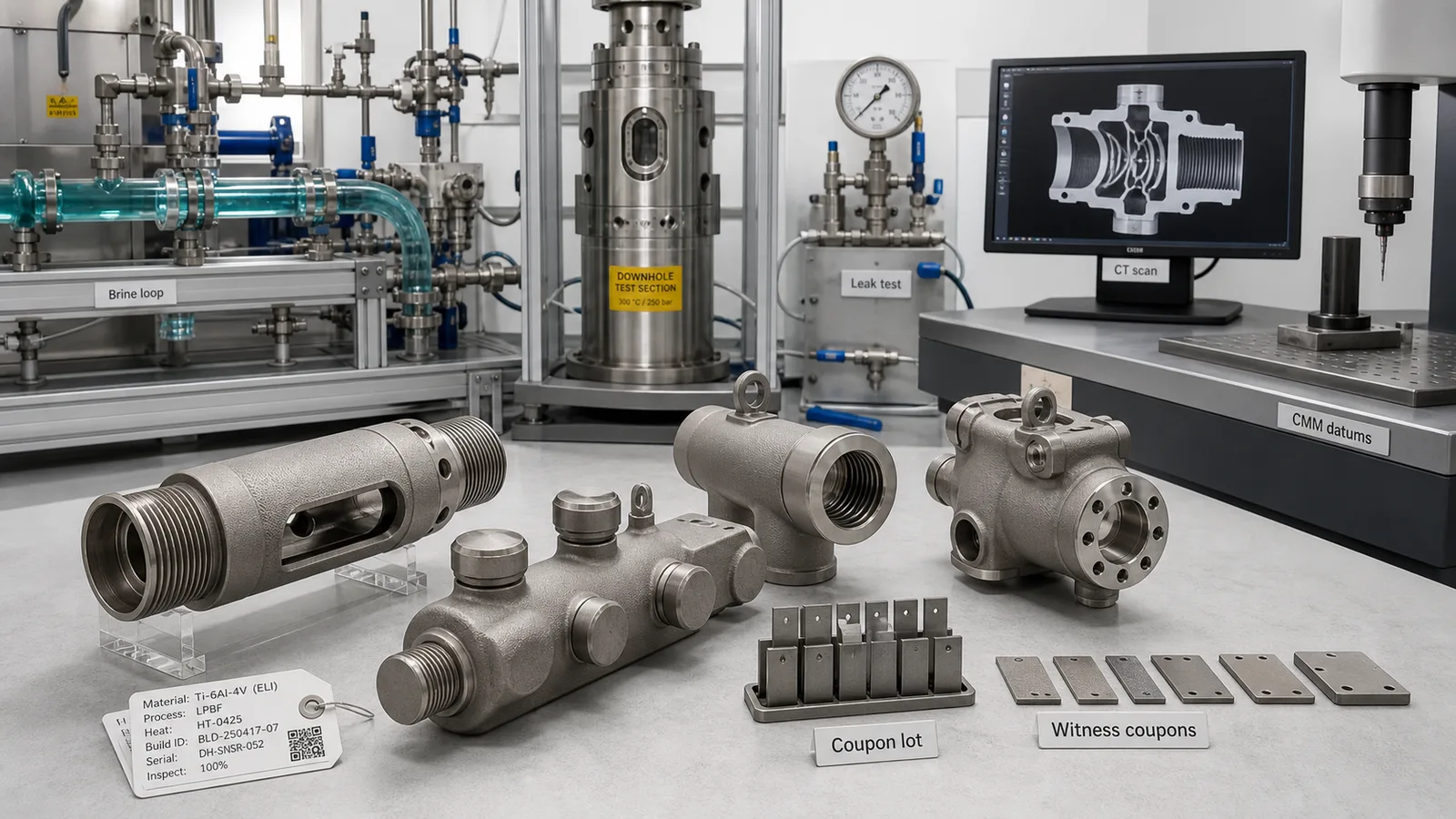
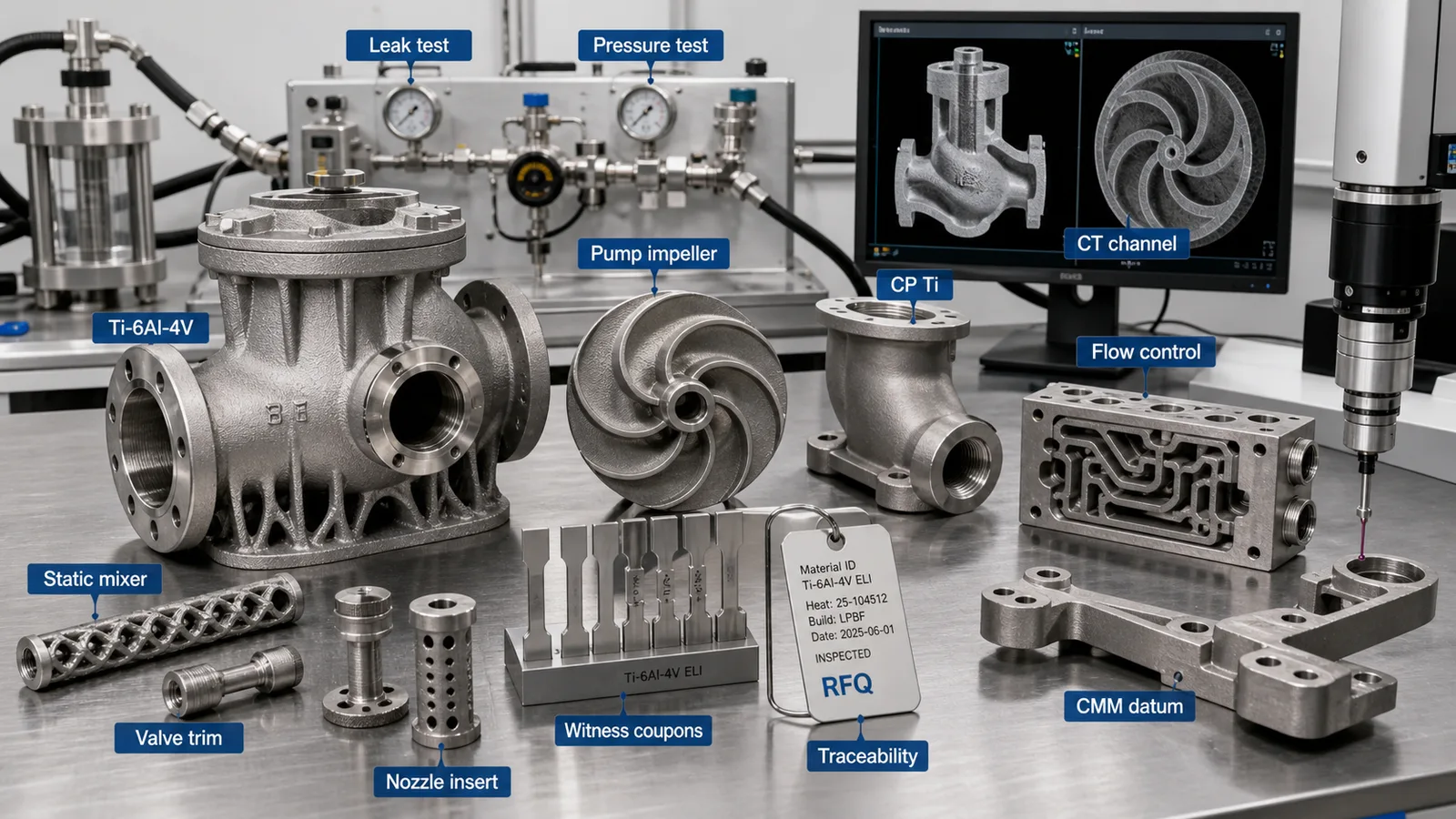
Representative article image; not a customer acceptance record or proof of a qualified manufacturing route. Refer to the cited sources and part-specific inspection records for engineering evidence.
On this page
Titanium 3D printing for hydrogen electrolyzer and fuel cell parts is useful when corrosion resistance, compact flow routing, low-volume iteration, reduced fittings, or difficult machining creates a real system advantage. It is not a shortcut around hydrogen safety, stack qualification, electrochemical validation, or pressure-boundary evidence.
Hydrogen hardware has a narrow tolerance for vague RFQs. A printed titanium manifold, PEM electrolyzer test plate, coolant body, fuel cell fixture, sensor mount, or balance-of-plant adapter may need machined seal faces, coating review, leak testing, cleaning, CMM, CT, material traceability, and a clear statement of whether the part touches hydrogen, oxygen, water, coolant, electrolyte, or only the outside of the system.
For a broad material and application map, start with Titanium 3D Printing Applications and use this guide for hydrogen-specific RFQ decisions. For pump adapters, valve bodies, purge blocks, and other industrial flow-control hardware that is not unique to hydrogen stacks, use Titanium 3D Printing for Industrial Valves, Pump Parts, and Flow Control Hardware.
For hydrogen hardware tied to LNG, refinery, gas-processing, or petrochemical sites, use Titanium 3D Printing for Oil & Gas, LNG, and Petrochemical Hardware to separate general energy-site pressure, leak, and operator acceptance questions from stack-specific requirements.
Quick Answer
Titanium additive manufacturing is worth reviewing for hydrogen hardware when the part is compact, high-value, low-volume, corrosion-exposed, interface-heavy, or constrained by flow routing that conventional machining cannot deliver efficiently.
Candidate families for review, subject to material compatibility and a defined validation route, include:
- PEM electrolyzer development hardware with complex water, oxygen, or hydrogen routing.
- Titanium flow manifolds and balance-of-plant adapters that reduce fittings and leak paths.
- Fuel cell or electrolyzer test fixtures that need corrosion resistance, stiffness, and rapid design iteration.
- Coolant or humidification hardware where titanium compatibility and compact channels matter.
- Sensor blocks, sample ports, purge manifolds, and pressure-test adapters with machined sealing faces.
- Stack development plates or experimental flow-field bodies where electrochemical validation is part of the program.
- Corrosion-resistant brackets, shields, clamps, and fixtures near wet hydrogen equipment.
- Low-volume spares or pilot-line hardware where supplier lead time is more costly than additive review.
Weak candidates include high-volume stamped plates, simple machined blocks, commodity stainless fittings, large low-stress covers, storage vessels, and any hydrogen pressure-boundary part where the required code, leak threshold, proof test, material condition, and acceptance evidence are not defined.
If the part can be made from standard tube, machined plate, conventional manifolds, or stamped hardware with lower acceptance risk, run the When Not to Use Titanium Additive Manufacturing screen before asking for production pricing.
Why Hydrogen Hardware Is Timely in 2026
Hydrogen remains a current engineering topic in 2026 because electrolyzer deployment, industrial decarbonization, hydrogen hubs, ammonia projects, heavy transport trials, and stack cost reduction are still active. The market is also more selective than it was during the first wave of project announcements. That is exactly why RFQs need to focus on delivered hardware risk, not only on additive manufacturing capability.
Recent public signals show the context:
- The IEA Global Hydrogen Review 2025 reported that global installed water electrolysis capacity reached 2 GW in 2024, with more than 1 GW added through July 2025, while low-emissions hydrogen still accounted for less than 1% of global hydrogen production.
- The IEA also noted that operational, under-construction, or final-investment-decision low-emissions hydrogen projects could exceed 4 million tonnes per year by 2030, despite cancellations and delays.
- The DOE technical targets for PEM electrolysis keep cost, durability, and stack performance in focus, including the broader goal of low-cost hydrogen at $2/kg H2 by 2026 and $1/kg H2 by 2031.
- The DOE Critical Materials Assessment notes that titanium is used in PEM electrolyzer gas diffusion layers and bipolar plates at the anode because of corrosion resistance in the acidic anode environment.
These signals do not mean every hydrogen part should be printed in titanium. They do explain why engineers are reviewing corrosion-resistant, compact, documented hardware more carefully: the economic target is tight, the durability target is long, and the hardware has to survive real water, gas, pressure, electrical, and cleaning conditions.
Where Titanium AM Fits in Hydrogen Systems
Titanium is not the default material for hydrogen systems. Stainless steel, nickel alloys, graphite, coated metals, polymers, elastomers, and conventional machined parts may be better depending on the location. Titanium earns a review when its corrosion resistance, strength-to-weight ratio, compatibility, or additive geometry creates a system benefit that pays for the post-processing and evidence.
| Part family | Why titanium AM can help | Main RFQ risk | Evidence to define |
|---|---|---|---|
| PEM electrolyzer flow or test hardware | Compact water, oxygen, and hydrogen routing with fewer fittings | Electrochemical and coating assumptions | Exposure map, coating review, leak test, CMM |
| Balance-of-plant manifold | Fewer tube joints and compact routing | Powder removal and internal cleanliness | CT or flow check, cleaning route, pressure test |
| Fuel cell coolant or humidifier hardware | Combined channels, ports, and mounting structure | Internal roughness and sealing | Flow test, machined seal faces, leak test |
| Sensor or purge adapter | Compact port layout in a tight equipment envelope | Thread quality and seal control | Machining stock, CMM, pressure test |
| Test fixture or stack development plate | Fast iteration for lab or pilot-line programs | Comparing prototype logic with production logic | Revision control, material traceability, inspection scope |
| Wet-area bracket or clamp | Corrosion resistance and low mass near equipment | Over-specifying titanium where simpler materials work | Exposure, load case, surface finish |
The strongest applications are not generic “hydrogen parts.” They are small to mid-size components where internal routing, corrosion exposure, machining interfaces, and low-volume iteration create measurable value.
For compact thermal hardware in hydrogen systems, pair this guide with Titanium 3D Printed Heat Exchangers. For internal routing, use Titanium 3D Printed Internal Channels.
PEM Electrolyzer Parts Need an Exposure Map
The first RFQ question is not “Can this be printed?” The first question is “What does each surface see?”
| Location | Information needed before material selection | What must not be assumed |
|---|---|---|
| External structural fixture | Loads, temperature, adjacent materials, and any actual chemical exposure | Being near a hydrogen system does not make it a gas-wetted part |
| Water or coolant circuit | Full chemistry, contaminants, cleaning cycle, pressure, and temperature | Compatibility of a different circuit transfers to this one |
| PEM anode-side plate or porous transport interface | Electrochemical exposure, contact resistance, compression, coating, joining, and cleaning requirements | A dense LPBF body is interchangeable with a qualified porous transport layer |
| Hydrogen gas pressure boundary | Gas condition, pressure and temperature envelope, cyclic duty, governing design rules, and material compatibility evidence | Corrosion resistance or a passed leak test proves hydrogen-service durability |
The DOE critical-materials assessment identifies titanium use in PEM anode-side components; it does not validate a Ti-6Al-4V LPBF route or a particular porous structure. For gas service, Sandia’s Technical Reference for Hydrogen Compatibility of Materials is a source for materials-data review, not blanket approval of titanium AM hardware. If applicable material and route evidence is missing, keep the proposal at evaluation stage rather than production release.
For a porous transport component, request the required transport behavior, pore-structure characterization, particle-release and cleaning criteria, coating/contact requirements, and a representative electrochemical test plan. Do not substitute a generic density certificate for these requirements. Assign each criterion and its approval to the stack designer and proposed supplier before quoting the manufacturing route.
A PEM electrolyzer environment can involve deionized water, oxygen, hydrogen, acidic membrane-related conditions, high potential regions, coolant, purge gas, compression hardware, seals, coatings, and electrical contact surfaces. Titanium may be attractive in some locations and wrong in others. For example, titanium corrosion resistance can be useful near the anode environment, but electrical contact resistance and coating behavior may control whether a titanium plate is acceptable.
Define the exposure map before quotation:
- Does the part contact water, hydrogen, oxygen, coolant, electrolyte, cleaning chemistry, or only ambient air?
- Is it a functional flow-field plate, a manifold, a fixture, a compression component, or external support hardware?
- Does the surface carry electrical current or only route fluid?
- Are coating, passivation, nitriding, plating, or surface modification assumptions part of the design?
- Are gaskets, O-rings, metal seals, or compression interfaces used?
- Is this for laboratory testing, pilot-line hardware, field equipment, or production stack hardware?
- What lifetime, duty cycle, temperature, pressure, and cleaning route are assumed?
Do not let a supplier quote a stack-facing titanium AM part from a STEP file alone. The drawing should separate wetted surfaces, seal faces, electrical contact surfaces, cosmetic surfaces, and machining datums.
Hydrogen Safety Starts With Seals and Tests
Hydrogen service changes the acceptance conversation. Hydrogen is small, leak-prone, and often tied to safety procedures beyond the printed part itself. A titanium AM part near hydrogen should not be accepted because it “looks dense.” It needs a route that controls porosity, sealing faces, threads, ports, cleaning, and testing.
Define:
- Working pressure, proof pressure, and whether pressure cycling matters.
- Gas, water, oxygen, coolant, or mixed-service circuits.
- Leak-test method, port sealing method, allowable leakage, and hold time.
- Whether helium leak testing, hydrogen leak testing, pressure decay, bubble testing, or another method applies.
- Which seal faces are machined and which surfaces may remain as-built.
- Whether threads are printed, machined, inserted, or tapped after stress relief.
- Whether the test happens before or after final cleaning, coating, and assembly.
- Whether the part is pressure-retaining hardware, a test adapter, or a non-pressure support part.
Weak wording:
Include leak testing.
Better wording:
Include final machining of all seal faces and threaded ports, then leak test the hydrogen path after cleaning. Please state the proposed test method, pressure, hold time, port sealing method, allowable leakage, and whether CT or proof pressure testing is recommended before shipment.
That wording helps procurement compare accepted hydrogen hardware, not print-only quotes.
Internal Channels: Useful but Easy to Underquote
Additive manufacturing can reduce drilled cross-holes, plugs, tube fittings, welded bosses, and external manifolds. That is attractive in hydrogen balance-of-plant hardware because each joint can be a leak path or maintenance point. The hidden cost is that internal channels must be depowdered, cleaned, inspected, and proven open.
High-risk features include:
- Blind gas or water channels with no powder exit.
- Fine restrictions that partially sintered powder can block.
- Sharp internal turns that trap powder or cleaning media.
- Parallel flow paths with no flow-balance check.
- Thin walls between hydrogen, oxygen, water, or coolant circuits.
- Internal lattices or porous regions connected to functional flow.
- Threaded ports placed too close to as-built internal surfaces.
- Sealed voids that cannot be inspected or cleaned.
If a channel controls performance, ask whether CT, borescope, flow test, pressure drop measurement, or proof testing belongs in the quote. The answer depends on risk. A noncritical purge adapter may not need CT. A compact multi-circuit manifold with hidden branches may need it.
Use the deeper internal channel and powder removal guide before freezing any hydrogen manifold geometry.
Surface Finish and Coatings Are Functional, Not Cosmetic
Hydrogen and electrolyzer hardware often treats surface condition as a functional requirement. As-built LPBF titanium can have rough surfaces, partially fused particles, support scars, local oxidation, and finishing variation. That may be acceptable on an exterior bracket and unacceptable on a seal face, wetted path, flow-field contact surface, or fatigue-critical pressure feature.
Separate surfaces by function:
- Seal faces that require machining and surface roughness control.
- Threaded ports and O-ring grooves that require final machining.
- Wetted channels where roughness affects cleaning, pressure drop, or particle retention.
- Electrical contact regions where coating and contact resistance matter.
- Fatigue or pressure-cycle regions where support scars are not acceptable.
- Exterior surfaces that can remain as-built.
- Cleaning and packaging surfaces that need particle control.
Post-processing may include stress relief, HIP when justified, machining, abrasive flow finishing, chemical finishing, passivation, coating, nitriding, cleaning, drying, and controlled packaging. The right route depends on exposure and acceptance.
For the wider finishing framework, use Post-Processing for Titanium 3D Printing.
Material Selection: Ti-6Al-4V, ELI, or CP Titanium
Do not start with a default titanium alloy for all hydrogen equipment. First classify the component as external structure, liquid-wetted hardware, electrochemical interface, or hydrogen gas pressure boundary. Review Ti-6Al-4V, ELI, CP titanium, and non-titanium alternatives against the exact exposure, delivery condition, and required evidence. Availability of an LPBF powder or a material certificate does not establish hydrogen compatibility, electrochemical durability, or permission to substitute one grade for another.
The material decision should follow the location:
- Hydrogen, oxygen, water, coolant, cleaning chemistry, or ambient exposure.
- Pressure, pressure cycling, and leak consequence.
- Electrical conductivity, coating, and contact-resistance assumptions.
- Strength, stiffness, bolt preload, and compression load.
- Temperature and thermal cycling.
- Surface finish and cleaning route.
- Required documentation, COA, COC, build record, powder lot, and traceability.
Do not specify an alloy only because a supplier can print it. Tie the alloy to exposure, strength, and acceptance. For the alloy comparison, use Titanium AM Material Selection: Ti-6Al-4V, ELI, and CP Titanium.
Process Choice: LPBF Usually Leads, but It Is Not Automatic
LPBF is usually the first process reviewed for compact hydrogen hardware because it supports fine geometry, internal routing, manifolds, ports, and high-value low-volume parts. EBM may be considered when the supplier route and geometry fit. DED is usually a better discussion for larger near-net shapes, repair, or machining-stock components, not small clean internal gas paths.
Process choice affects:
- Minimum channel size and powder-removal feasibility.
- As-built surface condition in wetted channels.
- Support contact on pressure or fatigue surfaces.
- Distortion near seal faces and stack interfaces.
- Stress relief, HIP, coating, machining, and cleaning sequence.
- CT, CMM, leak test, pressure test, coupons, and traceability.
- Cost and lead time.
Use Titanium AM Process Selection: LPBF vs EBM vs DED when the supplier should recommend the route instead of only quoting a process named on the RFQ.
DfAM Rules for Hydrogen Hardware
DfAM for hydrogen parts should reduce leak, cleanliness, and acceptance risk. A lighter or more complex shape is not enough.
Useful rules include:
- Keep supports away from seal faces, threads, O-ring grooves, pressure-cycle surfaces, and electrical contact areas.
- Add machining stock to ports, seal faces, gasket lands, datum pads, bolt pads, and threaded regions.
- Avoid blind hydrogen, oxygen, water, or coolant channels.
- Add powder-removal and cleaning access before the model is frozen.
- Separate functional flow paths from weight-reduction cavities.
- Avoid internal lattices in wetted or gas-carrying regions unless they can be inspected and cleaned.
- Use smooth internal transitions to reduce powder traps and flow dead zones.
- Keep hydrogen and oxygen circuits separated by defensible wall thickness and test logic.
- Define no-support regions and machined datums before the supplier selects build orientation.
The broader support, overhang, thin-wall, and trapped-powder rules are covered in Titanium DfAM Rules for LPBF and EBM.
Datum Planning for Stack and Test Integration
Hydrogen equipment often contains repeating cells, compression plates, gaskets, tubing, sensors, and fixtures. A printed part may fail the build if ports or seal faces are slightly wrong, even when the printed geometry is dense and strong.
Define:
- Primary datum face and secondary locating features.
- Stack compression or fixture contact surfaces.
- Port positions, bolt circles, threaded holes, and seal lands.
- Machined faces versus as-built surfaces.
- CMM report scope and pass/fail dimensions.
- Whether parts are interchangeable or tied to a single lab fixture.
- Whether coating or finishing changes the final measured dimensions.
Do not ask a supplier to infer datum control from a CAD model. Put the acceptance features on the drawing. For more detail, use Titanium 3D Printing Tolerances: Datum Planning and CMM.
Inspection Evidence: Match the Hydrogen Risk
Hydrogen hardware can be under-tested or over-tested. The right evidence depends on whether the part is a non-pressure bracket, a water manifold, a hydrogen gas path, a stack-facing flow plate, or a pressure-retaining component.
Typical evidence includes:
- CMM report for datums, seal faces, ports, bolt patterns, and stack interfaces.
- CT inspection for hidden channels, wall thickness, trapped powder, or internal defects where risk justifies it.
- Leak or pressure test report tied to the accepted configuration.
- Flow or pressure-drop test when channel openness affects function.
- Surface roughness checks on seal, contact, fatigue, or wetted regions.
- Cleaning record and inspection photos where particle or residue risk matters.
- Material certification, COA, COC, heat-treatment record, build record, powder lot, and traceability.
- Coating, passivation, or surface-treatment documentation when the surface is functional.
Use Titanium AM Qualification and Inspection Evidence to choose evidence by risk class. Requesting every possible test for a lab bracket wastes budget. Requesting no evidence for a hidden hydrogen path creates acceptance risk.
Cost: Compare Delivered Hydrogen Hardware
Titanium AM can reduce fittings, shorten prototype iteration, and combine flow routing with structure. It can also hide cost in post-processing, testing, and documentation.
Cost drivers include:
- Build orientation and support strategy.
- Support removal from ports, ribs, and internal openings.
- Stress relief, HIP if justified, and heat treatment.
- Machining of seal faces, ports, threads, gasket lands, and datum pads.
- Coating, passivation, finishing, cleaning, drying, and packaging.
- CT, CMM, leak testing, pressure testing, flow testing, and roughness checks.
- Rework if powder remains in a hidden path.
- Revision iteration during stack or pilot-line integration.
- Documentation required by engineering, quality, or the end customer.
Control cost before the geometry is frozen. Remove unnecessary sealed cavities, keep channels cleanable, machine only functional surfaces, let noncritical surfaces remain as-built, and define evidence by risk. For quote normalization, use Titanium 3D Printing Cost Drivers: How to Reduce RFQ Price and the Titanium AM RFQ and Procurement Guide.
Better RFQ Wording
Weak RFQ:
Please quote this titanium 3D printed hydrogen manifold.
Better RFQ:
Please review this titanium AM component for a PEM electrolyzer test system. The part contains separate water and hydrogen paths and must be quoted as delivered accepted hardware, not only as a printed shape. Critical features are the machined seal faces, threaded ports, gasket land, stack fixture datums, and pressure-test interfaces. Please identify powder-removal access, support strategy, machining stock, alloy recommendation, coating or passivation assumptions, cleaning route, CT or flow-test feasibility, leak-test method, CMM scope, material traceability, and any DfAM changes needed before quotation.
That wording gives the supplier permission to review the route and gives procurement a better basis for comparing quotes.
Hydrogen Titanium AM RFQ Checklist
Send the supplier:
- STEP file and drawing with datums, section views, and critical surfaces.
- Target alloy, material condition, and whether supplier substitutions are allowed.
- Quantity, prototype or production intent, and target lead time.
- Exposure map: hydrogen, oxygen, water, coolant, cleaning chemistry, ambient support, or electrical contact.
- Working pressure, proof pressure, leak threshold, pressure cycling, and test method.
- Functional interfaces: seal faces, gasket lands, O-ring grooves, ports, threads, bolt holes, sensor bosses, stack faces, and compression surfaces.
- Internal channel details: minimum feature size, blind regions, powder-removal access, accepted roughness, and cleaning route.
- Post-processing expectations: stress relief, HIP if justified, machining, coating, finishing, passivation, cleaning, drying, and packaging.
- Inspection scope: CMM, CT, leak test, pressure test, flow test, roughness, coupons, COA, COC, build record, powder lot, and inspection photos.
- Permission for supplier DfAM changes before final pricing.
If the RFQ does not define exposure, sealing, pressure, cleanliness, and evidence, suppliers may quote very different products under the same part number.
When to Redesign or Avoid Titanium AM
Redesign before quotation when:
- Hydrogen or water channels have no practical powder exit.
- Seal faces, gasket lands, or threaded ports lack machining stock.
- The part needs electrical contact performance but coating or contact-resistance assumptions are undefined.
- Internal roughness controls cleaning or pressure drop, but no flow or finishing route is defined.
- CT cannot resolve the smallest critical feature.
- Leak testing is required but pressure, method, threshold, and port sealing are vague.
- A simple machined manifold would meet the requirement with lower risk.
Avoid titanium AM when standard fittings, machined stainless manifolds, stamped plates, graphite or coated plates, polymer components, or conventional fixtures meet the hydrogen, cost, lead-time, and evidence requirements with lower risk.
Bottom Line
Titanium 3D printing can be valuable for hydrogen electrolyzer and fuel cell hardware when it solves a real engineering problem: compact routing, fewer leak paths, corrosion resistance, faster low-volume iteration, integrated test features, or documented pilot-line hardware. The strongest candidates are manifolds, test fixtures, stack development plates, coolant or humidifier bodies, purge adapters, and wet-area support hardware where exposure, sealing, machining, cleaning, and evidence are planned from the start.
The weak cases are simple shapes, high-volume commodity plates, storage vessels, and any hydrogen path where the RFQ ignores powder removal, surface finish, leak testing, pressure acceptance, coating, and traceability.
For an RFQ review, send CAD, drawing, exposure map, pressure and leak requirement, target alloy, quantity, post-processing expectations, and inspection scope through the RFQ inputs page or email info@szcomo.com.
- Hydrogen
- Electrolyzer
- Fuel cell
- Pem
- Gas manifolds
- Leak testing
- Corrosion
- RFQ