· Updated - TITANIUM 3DP Engineering - Engineering Guides - 16 min read
Titanium 3D Printing for Oil & Gas, LNG, and Petrochemical Hardware
Engineering RFQ guide for titanium 3D printed oil and gas, LNG, refinery, and petrochemical hardware, covering corrosion exposure, sour-service review, API 20S, pressure testing, CT, CMM, machining, and traceability.
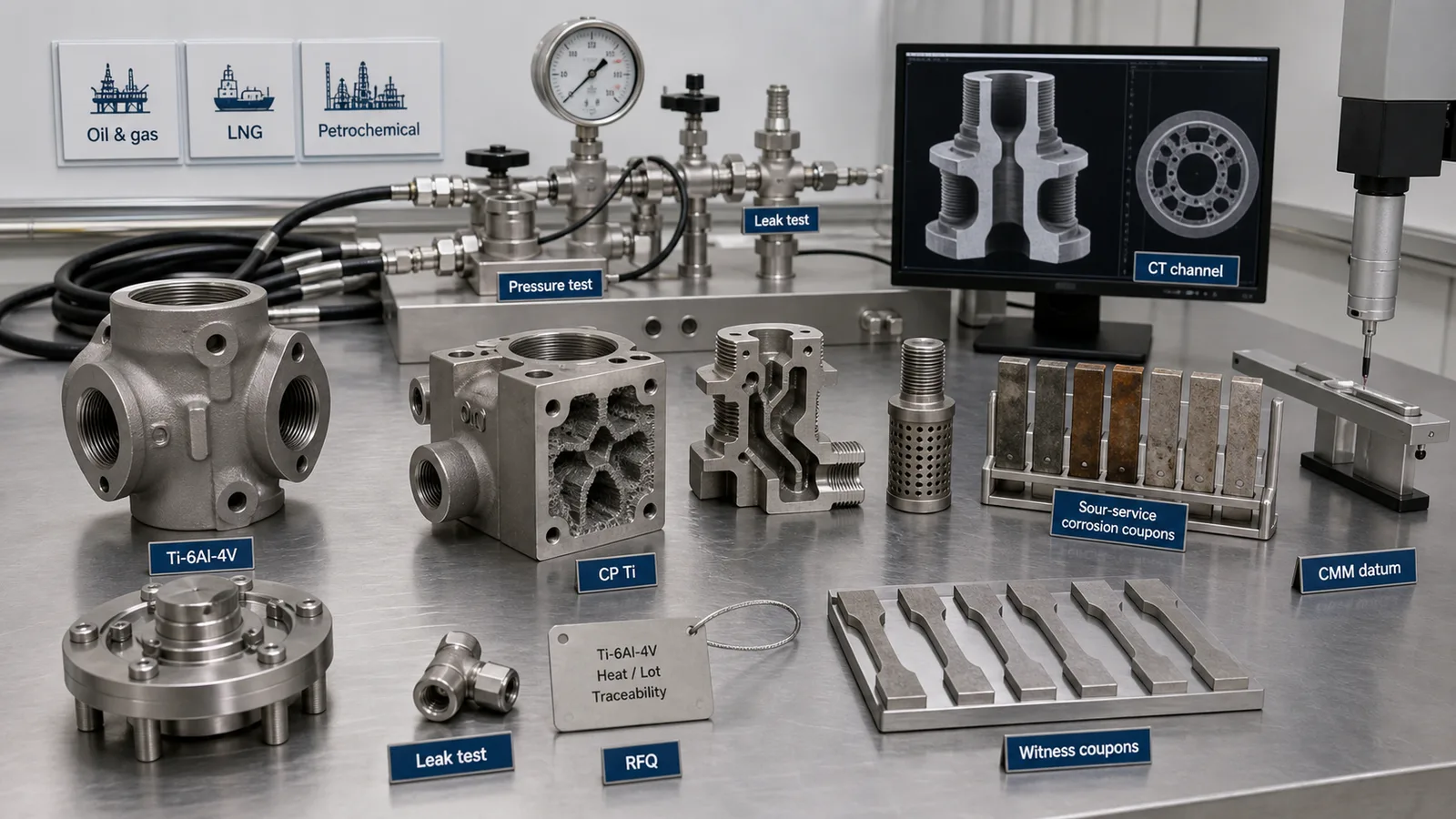
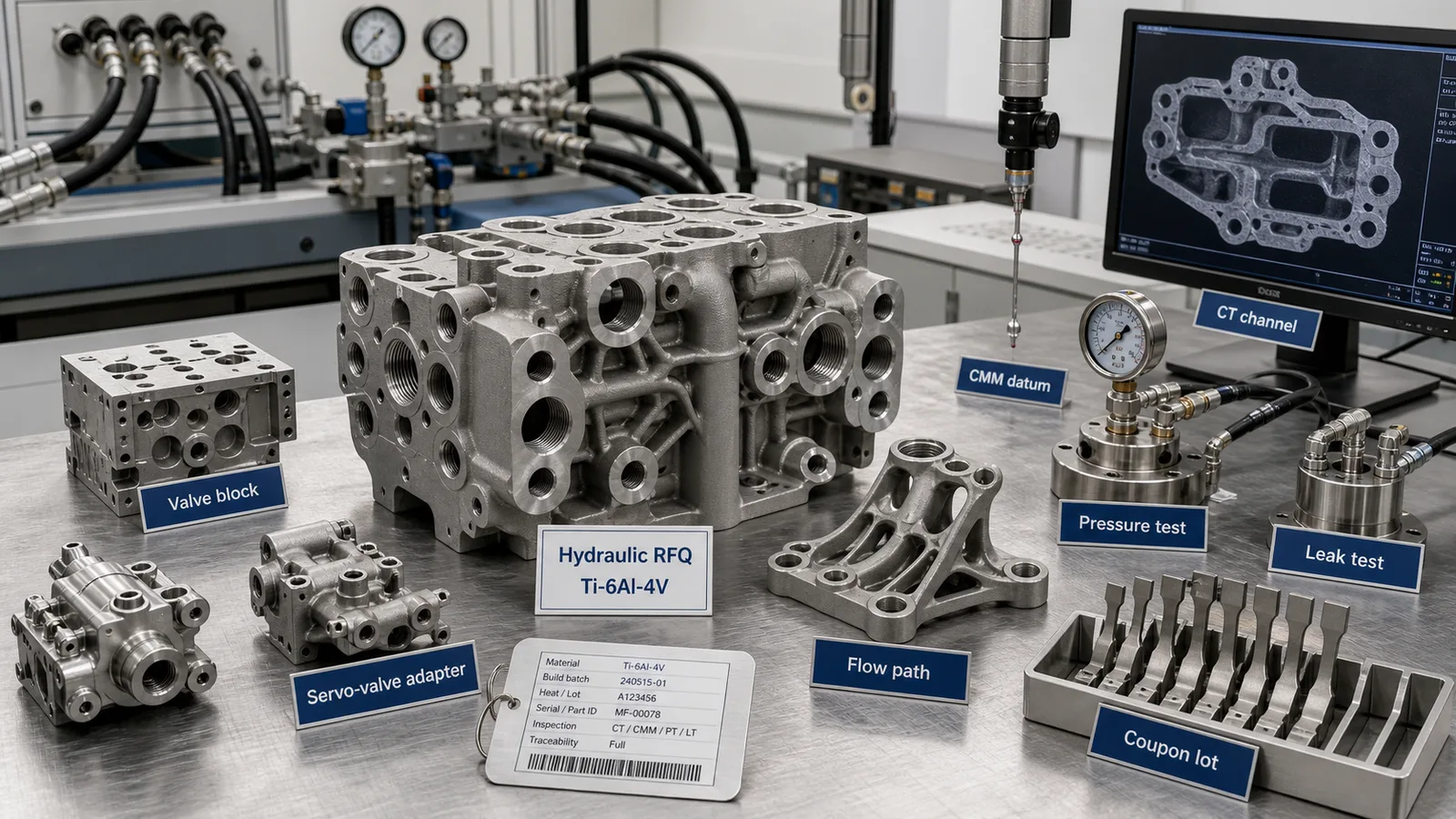
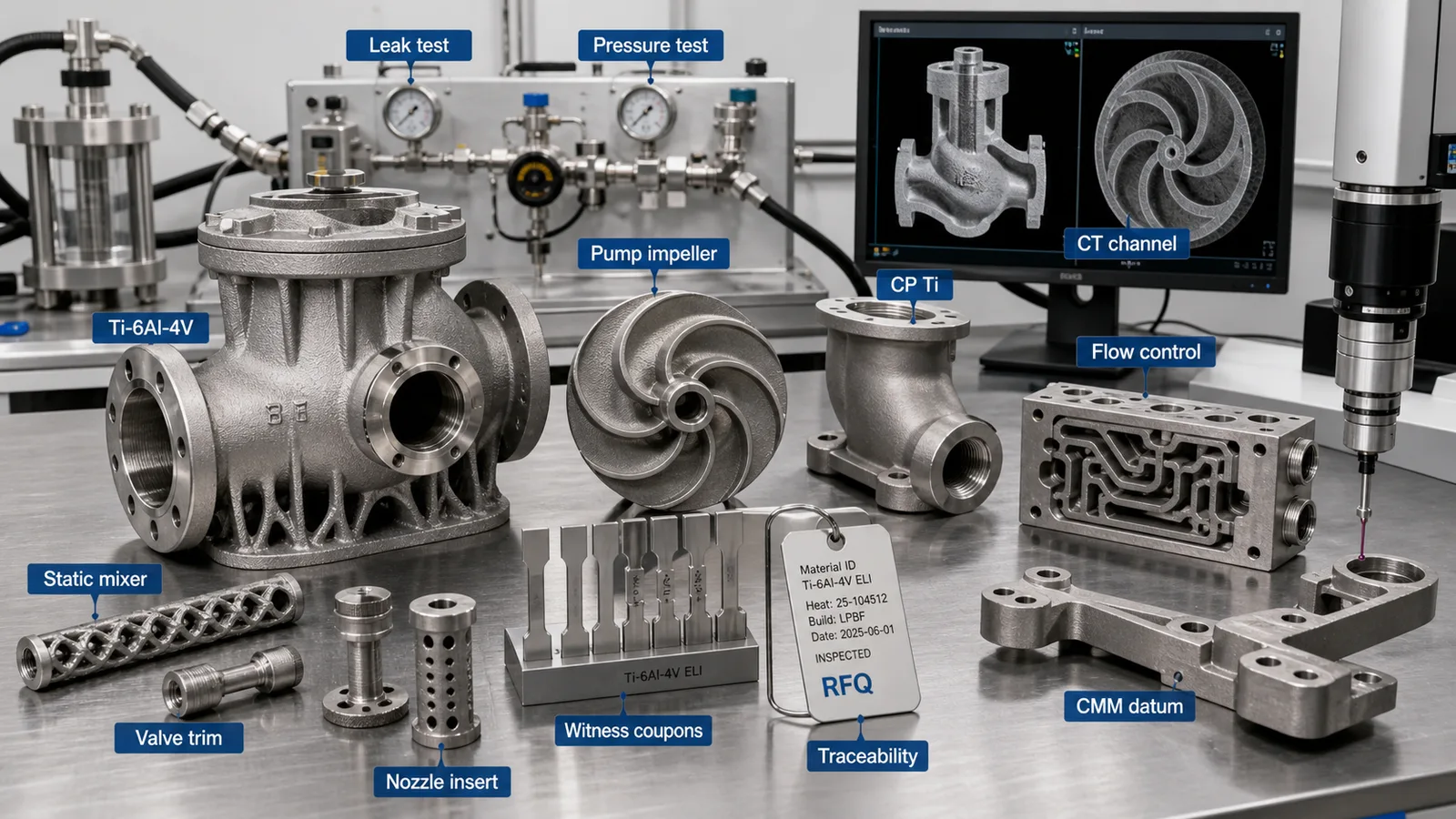
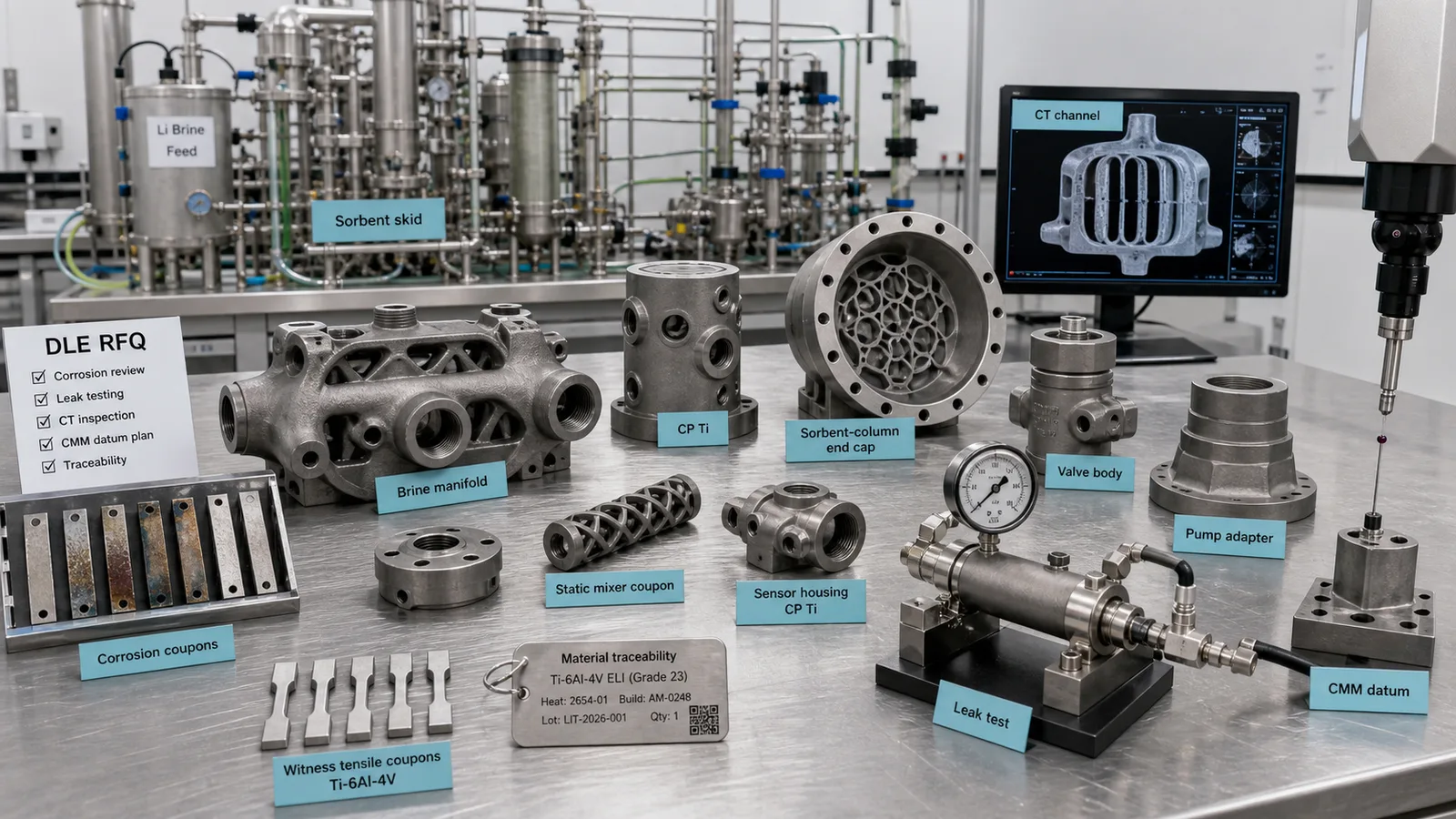
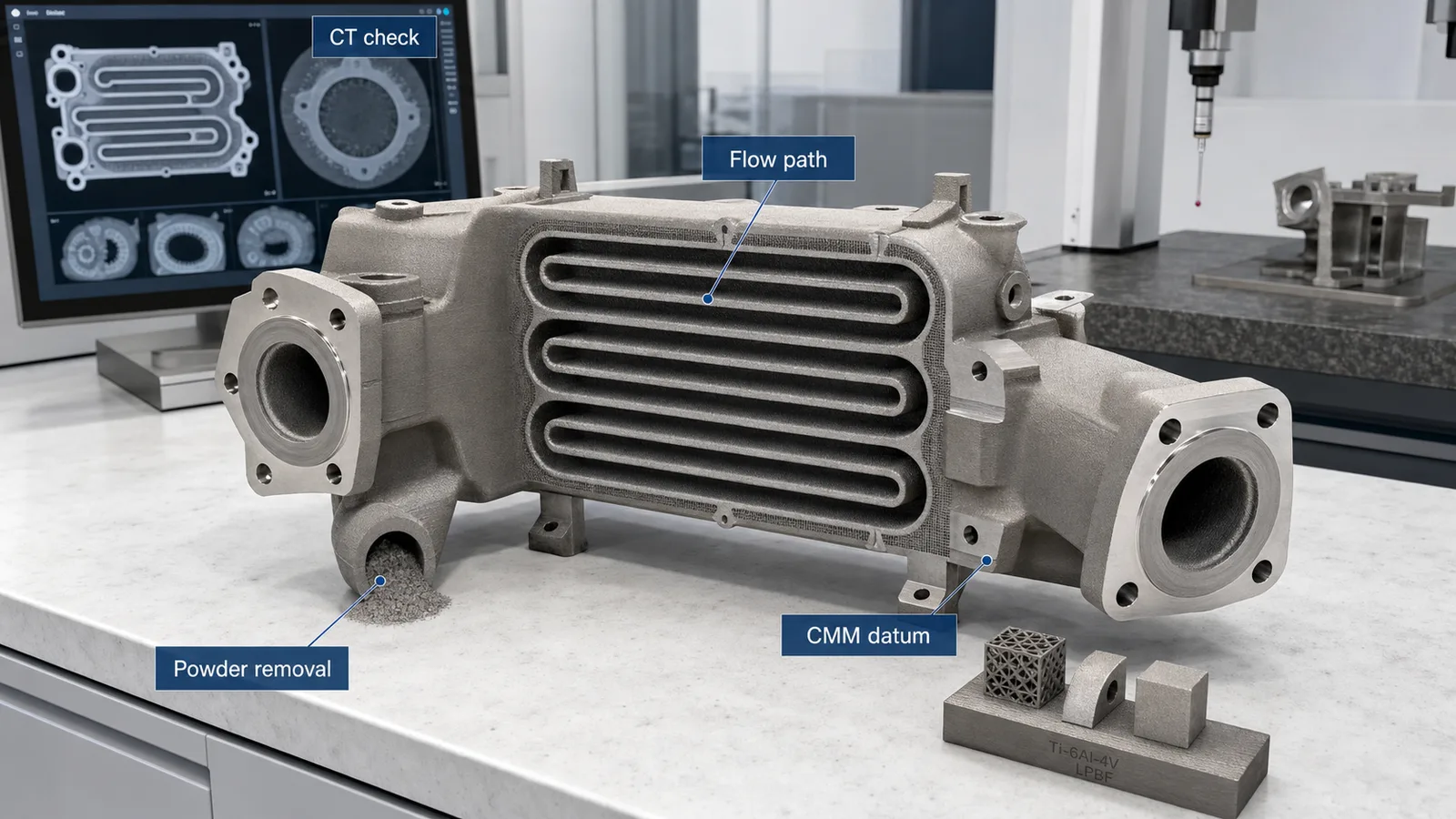
Representative article image; not a customer acceptance record or proof of a qualified manufacturing route. Refer to the cited sources and part-specific inspection records for engineering evidence.
On this page
Titanium 3D printing for oil and gas, LNG, refinery, and petrochemical hardware is worth reviewing when a compact high-value component needs corrosion resistance, low-volume replacement, integrated flow paths, fewer leak points, difficult conventional machining, or a controlled alternate manufacturing route. It is not a default replacement for catalog valves, pipe spools, pressure vessels, flanges, standard pump parts, or commodity refinery hardware.
The useful question is not “Can this oilfield part be printed?” The useful question is “Can titanium additive manufacturing deliver a finished, machined, tested, inspected, documented component that meets the service environment and acceptance basis better than machining, forging, casting, fabrication, repair, or buying the standard part?”
This page is written for engineers and procurement teams comparing titanium additive manufacturing for offshore valve adapters, produced-water sample blocks, LNG instrument housings, petrochemical flow-control bodies, refinery nozzles, corrosion coupon fixtures, compact manifolds, pressure-test adapters, low-volume spares, and development hardware.
Quick Answer
Titanium AM can be a strong candidate for oil and gas or petrochemical hardware when the part is compact, corrosion-exposed, interface-heavy, low-volume, obsolete, lead-time-sensitive, or improved by internal geometry that can be cleaned and verified.
Good candidates include:
- Offshore valve adapters, compact manifolds, sensor bodies, and pressure-test fixtures where corrosion resistance and fewer leak paths matter.
- Produced-water sample blocks, brine test bodies, corrosion coupon racks, and exposure fixtures that need titanium material records.
- LNG or cryogenic-adjacent instrument housings, test adapters, purge blocks, and leak-test hardware where low-temperature behavior must be defined.
- Petrochemical flow-control bodies, dosing nozzles, static mixer coupons, and catalyst or reagent injection development parts.
- Refinery inspection fixtures, nozzle inserts, burner-adjacent brackets, and low-volume test hardware when heat, corrosion, or packaging creates a real need.
- Legacy or obsolete compact spares where AM can shorten a long casting, forging, or special-machining route.
- DED near-net repair or replacement candidates where the final route includes machining, NDT, and acceptance evidence.
Weak candidates include long pipe spools, large pressure vessels, simple flanges, high-volume commodity valve bodies, standard pump impellers, simple machined blocks, welded assemblies that already meet the duty, and any pressure-retaining or sour-service part where chemistry, pressure, temperature, test method, code boundary, and documentation are vague.
Why This Topic Is Timely and Evergreen
Start by separating non-pressure tooling, process-wetted components, and pressure-retaining hardware. Record the exact fluid, contaminants, pressure and temperature envelope, cyclic duty, and applicable customer specification. An LNG sensor support and a sour-service flow body must not share a material acceptance assumption simply because both belong to an energy project.
The recent market context keeps those searches valuable:
- The IEA Oil Market Report - June 2026 highlights how oil supply, refinery runs, trade routes, and product availability can change quickly. That keeps maintenance, replacement, and alternate-route sourcing relevant for process hardware.
- The IEA Gas Market Report, Q2-2026 covers gas and LNG market security during a disrupted 2025/26 heating season, reinforcing why LNG and gas infrastructure teams care about uptime, testing, and reliable component supply.
- API’s Standard 20S update keeps additive manufacturing qualification, production control, inspection, marking, and documentation in the oil and natural gas conversation.
- DNV’s additive manufacturing work on building trust in printed parts frames AM adoption around qualification, performance evidence, and industrial assurance rather than novelty.
- ISO 15156-1:2020 describes material-selection and qualification principles for equipment in H2S-containing oil and gas production environments. That matters because sour-service language cannot be guessed from a CAD model.
The long-term value is practical: upstream, midstream, LNG, refining, petrochemical, offshore, produced-water, hydrogen, carbon capture, geothermal, and critical-minerals projects all use compact process hardware where corrosion, leak paths, pressure testing, material records, and downtime risk can decide the manufacturing route.
Where Titanium AM Fits Best
Titanium AM is strongest when it solves more than one oil and gas hardware problem at the same time: corrosion plus compact routing, low-volume replacement plus traceability, internal geometry plus fewer fittings, or rapid development plus a defined test package.
| Hardware family | Why titanium AM can help | Main RFQ risk | Evidence to define |
|---|---|---|---|
| Offshore valve adapter | Corrosion resistance, custom ports, fewer fittings | Pressure boundary, seal quality, galvanic contact | Machined seats, pressure/leak test, CMM |
| Produced-water sample block | Integrated taps, drains, and sensor pockets | Brine chemistry, solids, dead legs | Exposure map, cleaning route, leak test |
| LNG instrument housing | Compact low-volume hardware near cold service | Thermal contraction, seal behavior, low-temperature acceptance | Material condition, leak test, CMM |
| Petrochemical flow body | Internal routing, dosing, mixing, or sampling geometry | Powder removal and cleanliness | CT or flow test, cleaning evidence |
| Refinery nozzle or insert | Fast iteration for injection, mixing, or test duty | Heat, erosion, coking, and material fit | Surface finish, test duty, inspection |
| Sour-service coupon rack | Matched exposure hardware and traceability | Treating coupons as production approval | Alloy, surface condition, lot records |
| DED repair or near-net adapter | Reduced lead time for large or obsolete geometry | Distortion, NDT, machining stock | NDT, machining plan, final CMM |
| Pressure-test fixture | Titanium compatibility and fast custom interfaces | Over-specifying a non-production tool | Test pressure, seal details, documentation level |
The best RFQ defines the delivered state, not only the printed shape. A finished oil and gas titanium AM component may require printing, heat treatment, support removal, HIP if justified, machining, cleaning, NDT, CT, CMM, pressure testing, leak testing, material records, process records, and controlled packaging.
Start With the Service Map
“Oil and gas service” is not a material requirement. A titanium part used in a produced-water loop, LNG skid, sweet gas analyzer, sour gas line, refinery pilot unit, petrochemical dosing skid, offshore seawater system, or downhole test tool may need completely different controls.
Define the service map before asking for price:
- Segment: upstream production, offshore, subsea, LNG, gas processing, refinery, petrochemical, produced water, pilot plant, lab test, or maintenance spare.
- Media: crude oil, condensate, natural gas, LNG-adjacent purge gas, produced water, seawater, brine, amine, glycol, acid gas, hydrocarbon vapor, wash fluid, cleaning chemistry, or inert test fluid.
- Chemistry: chloride, CO2, H2S, oxygen, water content, pH, sand, scale, inhibitor, sulfur compounds, acids, caustic, solvent, or unknowns.
- Temperature, working pressure, proof pressure, flow rate, pressure cycling, thermal cycling, and start-stop duty.
- Whether the part is structural, wetted, pressure-retaining, flow-carrying, seal-facing, sensor-adjacent, or only a test fixture.
- Applicable project specification, code boundary, API 20S expectation, ISO 15156/NACE MR0175 review, company standard, or buyer-controlled acceptance route.
If the RFQ says only “titanium oilfield part,” suppliers must guess the risk. If the RFQ states the media, duty, evidence, and acceptance basis, suppliers can quote the finished hardware route.
Titanium Is Not a Universal Oilfield Alloy
Titanium can be useful in chloride, seawater, produced-water, brine, and selected chemical environments. It also has limits. Oil and gas service may involve H2S, CO2, hydrogen charging, galvanic contact, erosion, high temperature, sour-service cracking concerns, fire risk, coking, solids, and project-specific material restrictions.
Ti-6Al-4V is often the first AM alloy reviewed because it is widely available through LPBF and can support compact structural parts, brackets, housings, adapters, and test fixtures. It should not be treated as a universal wetted-material answer for every sour, hot, erosive, or pressure-critical oilfield environment.
CP titanium can be more relevant when corrosion behavior and ductility matter more than high strength, especially for certain seawater, brine, or chemical-exposure test hardware. The supplier’s CP titanium AM route, material data, heat treatment, and inspection package must be reviewed early.
Ti-6Al-4V ELI can be relevant for toughness-sensitive or high-reliability discussions, but it still does not remove the need to define service environment, heat treatment, surface condition, testing, and acceptance.
For a broader alloy screen, use Titanium AM Material Selection: Ti-6Al-4V, ELI, and CP Titanium. Do not ask three suppliers to quote different titanium grades under one oil and gas part number unless the RFQ explicitly asks for an alloy comparison.
Sour Service and H2S Need a Separate Gate
Sour-service language should not be added casually to a titanium AM RFQ. If the part is exposed to H2S-containing oil and gas production environments, the buyer’s materials engineer or project specification must define the sour-service basis and whether ISO 15156/NACE MR0175 applies.
A useful sour-service RFQ should state:
- Whether the part is in sour service, sweet service, unknown service, or lab screening only.
- H2S partial pressure or service designation if available.
- CO2, chloride, pH, temperature, pressure, water phase, and galvanic contacts.
- Whether the part is pressure-retaining, safety-critical, production-intent, or a noncritical coupon fixture.
- Required material qualification, corrosion testing, hardness or heat-treatment limits, surface condition, and documentation.
- Whether the buyer accepts AM material under the applicable project specification.
Titanium AM may still be useful for sour-service test fixtures, coupon racks, non-pressure housings, or selected low-risk development components. It should not be positioned as a shortcut around material selection, environmental cracking review, or operator approval.
Pressure, Leak, and Code Boundaries Decide Acceptance
Oil and gas hardware often carries pressure, gas, liquid hydrocarbon, sour media, seawater, brine, or cleaning chemistry. A printed part should not be accepted because it “looks dense.” It needs a test and documentation route tied to the function.
Define:
- Working pressure, proof pressure, burst requirement if applicable, and test fluid.
- Leak-test method: helium leak, pressure decay, bubble test, hydrostatic test, pneumatic test, vacuum test, or buyer-specified method.
- Allowable leakage, hold time, temperature, port sealing method, and fixture responsibility.
- Whether test happens after machining and final cleaning.
- CT, NDT, CMM, surface roughness, coupon, material record, and process record expectations.
- API 20S or DNV-style qualification requirements if those belong in the sourcing package.
Use Titanium AM Qualification and Inspection Evidence to match evidence to risk. A noncritical inspection fixture does not need the same evidence package as a pressure-retaining gas path.
Valves, Pumps, Nozzles, and Flow Bodies Need Finished Surfaces
Many oil and gas AM inquiries are really valve, pump, nozzle, or flow-control inquiries. The geometry may be printable, but the acceptance surfaces are usually machined.
Plan machining stock for:
- Valve seats, trim interfaces, O-ring grooves, gasket lands, flange faces, and metal-seal surfaces.
- Threaded ports, tube-fitting seats, API-style connections, bolt faces, and datum pads.
- Pump adapter bores, seal carriers, wear interfaces, and shaft-adjacent faces.
- Nozzle seats, flow inserts, static mixer interfaces, and removable cartridge surfaces.
Use Titanium 3D Printing for Industrial Valves, Pump Parts, and Flow Control Hardware when the buyer needs a cross-industry valve, pump, static mixer, or flow-control sourcing route. This page focuses on the additional oil and gas, LNG, refinery, and petrochemical acceptance questions.
LNG and Cryogenic-Adjacent Hardware Need Low-Temperature Review
LNG hardware can make titanium attractive because low-volume instrument bodies, purge blocks, sensor housings, leak-test adapters, and structural support features may need clean geometry and reliable documentation. That does not make every LNG component a titanium AM candidate.
Define:
- Whether the part sees actual cryogenic temperature, cold gas, ambient purge gas, or only a nearby support role.
- Minimum design temperature, thermal cycling, warm-up and cool-down rate, and seal material.
- Differential contraction with stainless steel, nickel alloy, aluminum, polymer, elastomer, or coating.
- Leak-test method at room temperature and whether cold testing is required.
- Surface finish, cleanliness, and outgassing or contamination expectations if applicable.
For cryogenic and vacuum-style evidence logic, the sourcing questions overlap with Titanium 3D Printing for Quantum Computing and Cryogenic Hardware, even when the end market is LNG rather than research equipment.
Produced Water, Brine, and Geothermal Overlap
Produced water and oilfield brines can include chloride, CO2, H2S, scale, sand, dissolved metals, inhibitors, organic carryover, bacteria, oxygen ingress, and cleaning chemicals. Titanium AM can help with compact sample blocks, coupon holders, brine manifolds, sensor housings, and test-loop adapters, but only when deposits, solids, and cleaning are planned.
Avoid blind pockets and dead legs where solids, scale, oil residue, or powder can collect. Add drains where practical. Define whether CT, borescope, pressure drop, flow test, or destructive sectioning is needed for internal channels.
For hot brine and downhole-adjacent parts, use Titanium 3D Printing for Geothermal and Downhole Energy Parts. For seawater and brine concentration, use Titanium 3D Printing for Seawater Desalination and Brine Concentration Hardware. For lithium brine pilot skids, use Titanium 3D Printing for Direct Lithium Extraction and Brine Processing Hardware.
Internal Channels Must Be Cleanable and Inspectable
Internal channels are one of the main reasons to review titanium AM for petrochemical, refinery, LNG, and oilfield hardware. They can replace drilled cross-holes, plugs, welded bosses, external tubing, and stacked plates. They can also trap powder, cleaning media, hydrocarbons, salts, scale, catalyst residue, or solids.
High-risk features include:
- Blind branches with no powder exit.
- Long tortuous passages with small diameters.
- Sudden restrictions near threaded ports.
- Internal lattices connected to wetted flow.
- Dead legs near sensor pockets or sample taps.
- Thin walls between gas and liquid circuits.
- Channels too small for CT resolution or functional flow testing.
Use Titanium 3D Printed Internal Channels: Powder Removal and CT before freezing a compact manifold, nozzle, static mixer, dosing body, or sample block. The RFQ should state whether CT, flow testing, pressure drop, borescope, cleaning validation, or sectioned prototypes are required.
Process Choice: LPBF for Compact Hardware, DED for Different Problems
LPBF is usually the first titanium AM process reviewed for compact oil and gas hardware because it supports fine internal channels, ports, brackets, sensor housings, sample blocks, and small manifolds. It also brings powder removal, support strategy, internal roughness, residual stress, and machining access into the quote.
DED can make sense for larger near-net shapes, repair, cladding-adjacent work, replacement geometry that needs final machining, or heavy components where a billet route is slow. DED is not usually the first choice for small sealed channels or clean miniature gas paths.
EBM may be reviewed when supplier capability, geometry, surface condition, and material route fit the part, but it is less often the default for tight oil and gas flow-control features.
Use Titanium AM Process Selection: LPBF vs EBM vs DED when the supplier should recommend a route based on geometry and acceptance evidence rather than only quote the process named in the drawing.
Cost Should Be Compared Against Downtime and Delivered Evidence
Titanium AM is not automatically cheaper than machining, forging, casting, or buying a standard part. It becomes credible when the delivered part reduces downtime, avoids tooling delay, consolidates multiple fittings, replaces an obsolete low-volume component, speeds test-loop iteration, or enables evidence that a conventional route cannot provide quickly.
Compare total delivered cost:
- Engineering review and DfAM.
- Build orientation, supports, heat treatment, and powder handling.
- HIP if justified by risk class.
- Machining of seal faces, threads, gasket lands, bores, datums, and functional interfaces.
- Cleaning, drying, capping, packaging, and contamination control.
- CT, NDT, CMM, pressure test, leak test, roughness, coupons, COA, COC, build record, and traceability.
- Downtime cost, outage window, qualification time, and procurement lead time.
Use Titanium 3D Printing Cost Drivers: How to Reduce RFQ Price before comparing suppliers on print price alone. A cheap print-only quote may not be an accepted oil and gas component.
Example RFQ: Produced-Water Sample Block
A practical RFQ might describe a CP titanium or Ti-6Al-4V produced-water sample block for a test skid. The current assembly uses multiple fittings, a sample tee, a drain, and a sensor adapter. The engineering team wants fewer leak paths, a compact layout, integrated pressure taps, and material traceability for corrosion review.
The RFQ should include:
- CAD model and 2D drawing with revision.
- Produced-water chemistry, chloride, CO2, H2S assumption, pH, solids, oil carryover, inhibitor, temperature, and pressure.
- Working pressure, proof pressure, leak threshold, test method, and test fluid.
- Sample port, drain, sensor pocket, gasket, O-ring, fitting, and thread details.
- Surfaces that must be machined: seal faces, threads, gasket lands, datum pads, and ports.
- Internal channel size, cleaning access, flow direction, dead-leg limits, and drainability.
- Material target: CP titanium, Ti-6Al-4V, Ti-6Al-4V ELI, or supplier recommendation.
- Inspection scope: CMM, CT or flow test, pressure/leak test, roughness, coupons, COA, COC, build record, and powder lot.
Better RFQ wording:
Please review this titanium AM produced-water sample block as delivered accepted test hardware. The part carries chloride-rich produced water during pilot testing and includes two sample ports, one drain, one sensor pocket, two threaded process connections, and a machined gasket face. Please recommend CP titanium or Ti-6Al-4V based on the exposure notes; identify powder-removal access, support strategy, machining stock, cleaning route, pressure/leak test method, CMM scope, CT or flow-test recommendation, material traceability, and any DfAM changes needed before quotation. Quote the finished, tested, documented part, not only the printed shape.
Example RFQ: LNG Instrument Housing and Leak-Test Adapter
A second RFQ might cover a titanium LNG-adjacent instrument housing and a leak-test adapter used in a development skid. The housing has a structural and sealing role; the adapter is a test fixture. They should not be assigned the same risk class automatically.
For the housing, define:
- Minimum design temperature and whether the part sees cryogenic liquid, cold gas, ambient gas, or only external cold exposure.
- Seal type, gasket land, O-ring material, bolt pattern, datum scheme, and final machining.
- CMM scope for mounting pads, sensor location, ports, and seal faces.
- Leak-test method and whether cold testing is required.
- Material record, heat treatment, and any low-temperature toughness requirement.
For the leak-test adapter, define:
- Test pressure, gas, leak threshold, port sealing method, and repeated-use duty.
- Whether the adapter is a fixture only or part of shipped equipment.
- Machining and surface finish needed for repeatable seals.
- Documentation level appropriate to a test fixture.
Separating these functions helps suppliers quote realistic evidence instead of over-testing the fixture or under-testing the installed housing.
Choose the Next Engineering Check
Use these related pages to build a complete sourcing decision:
- Cross-industry valve, pump, and flow-control hardware: Titanium 3D Printing for Industrial Valves, Pump Parts, and Flow Control Hardware
- Chemical and water-treatment exposure: Titanium 3D Printing for Chemical Processing and Water Treatment Parts
- Marine, subsea, and offshore hardware: Titanium 3D Printing for Marine, Subsea, and Offshore Parts
- Geothermal and downhole brine hardware: Titanium 3D Printing for Geothermal and Downhole Energy Parts
- Seawater and brine concentration: Titanium 3D Printing for Seawater Desalination and Brine Concentration Hardware
- Carbon capture and CO2 process hardware: Titanium 3D Printing for Carbon Capture Hardware
- Hydrogen balance-of-plant and test hardware: Titanium 3D Printing for Hydrogen Hardware
- Heat exchangers and thermal management: Titanium 3D Printed Heat Exchangers
- Internal channels, powder removal, and CT: Titanium 3D Printed Internal Channels
- Tolerances, datums, and CMM: Titanium 3D Printing Tolerances
- RFQ deliverables and traceability: Titanium AM RFQ and Procurement Guide
When Not to Use Titanium AM
Do not use titanium AM for oil and gas, LNG, refinery, or petrochemical hardware when:
- A catalog valve, fitting, flange, pipe spool, pump part, or machined block already meets the requirement.
- The part is high volume, low complexity, and price-sensitive.
- A pressure-retaining or safety-critical component lacks a qualification path.
- Sour-service, H2S, CO2, chloride, temperature, pressure, and material requirements are undefined.
- The internal passages cannot be depowdered, cleaned, inspected, or flow checked.
- Seal faces, valve seats, gasket lands, threads, or datum surfaces lack machining stock.
- Erosion, coking, solids, scale, thermal cycling, or fouling controls performance but no test plan exists.
- The buyer needs API 20S, ISO 15156/NACE MR0175, DNV, ASME, operator, or project-standard acceptance but has not defined the applicable route.
- Stainless steel, duplex, super duplex, nickel alloy, lined steel, ceramic, polymer, conventional titanium fabrication, casting, forging, machining, or repair is lower risk.
Use When Not to Use Titanium Additive Manufacturing before quoting a simple oil and gas part. Titanium AM should earn its place by improving corrosion resistance, packaging, leak-path reduction, lead time, evidence, or system integration.
Bottom Line
Titanium 3D printing can be valuable for oil and gas, LNG, refinery, and petrochemical hardware when it turns a difficult low-volume process component into a compact, corrosion-aware, machined, tested, inspected, traceable part. The strongest candidates are offshore valve adapters, produced-water sample blocks, LNG instrument housings, petrochemical flow bodies, refinery nozzles, corrosion coupon fixtures, compact manifolds, pressure-test adapters, and selected low-volume spares where service environment and evidence are planned before quote comparison.
The weak cases are simple standard parts, commodity pressure hardware, large fabricated equipment, and any wetted or pressure component where the RFQ ignores chemistry, sour-service review, powder removal, surface finish, machining, leak testing, pressure testing, and documentation.
If you are reviewing a titanium oilfield adapter, LNG housing, produced-water sample block, refinery nozzle, petrochemical static mixer, offshore valve body, corrosion coupon rack, test fixture, compact manifold, or low-volume replacement part, send the CAD model, drawing, service map, target alloy, pressure and temperature, quantity, post-processing expectations, and inspection scope through the TITANIUM 3DP RFQ page. Include any API 20S, ISO 15156/NACE MR0175, DNV, ASME, operator, or project specification expectations before asking suppliers to price the finished hardware route.
- Oil and gas
- Lng
- Petrochemical
- Refinery
- Offshore
- Sour service
- Pressure testing
- Leak testing
- CT
- RFQ