· Updated - TITANIUM 3DP Engineering - Engineering Guides - 18 min read
Titanium 3D Printing for Seawater Desalination and Brine Concentration Hardware
Engineering RFQ guide for titanium 3D printed seawater desalination and brine concentration hardware, covering RO sample blocks, brine manifolds, MLD/ZLD pilot skids, CP titanium, leak testing, CT, CMM, and traceability.
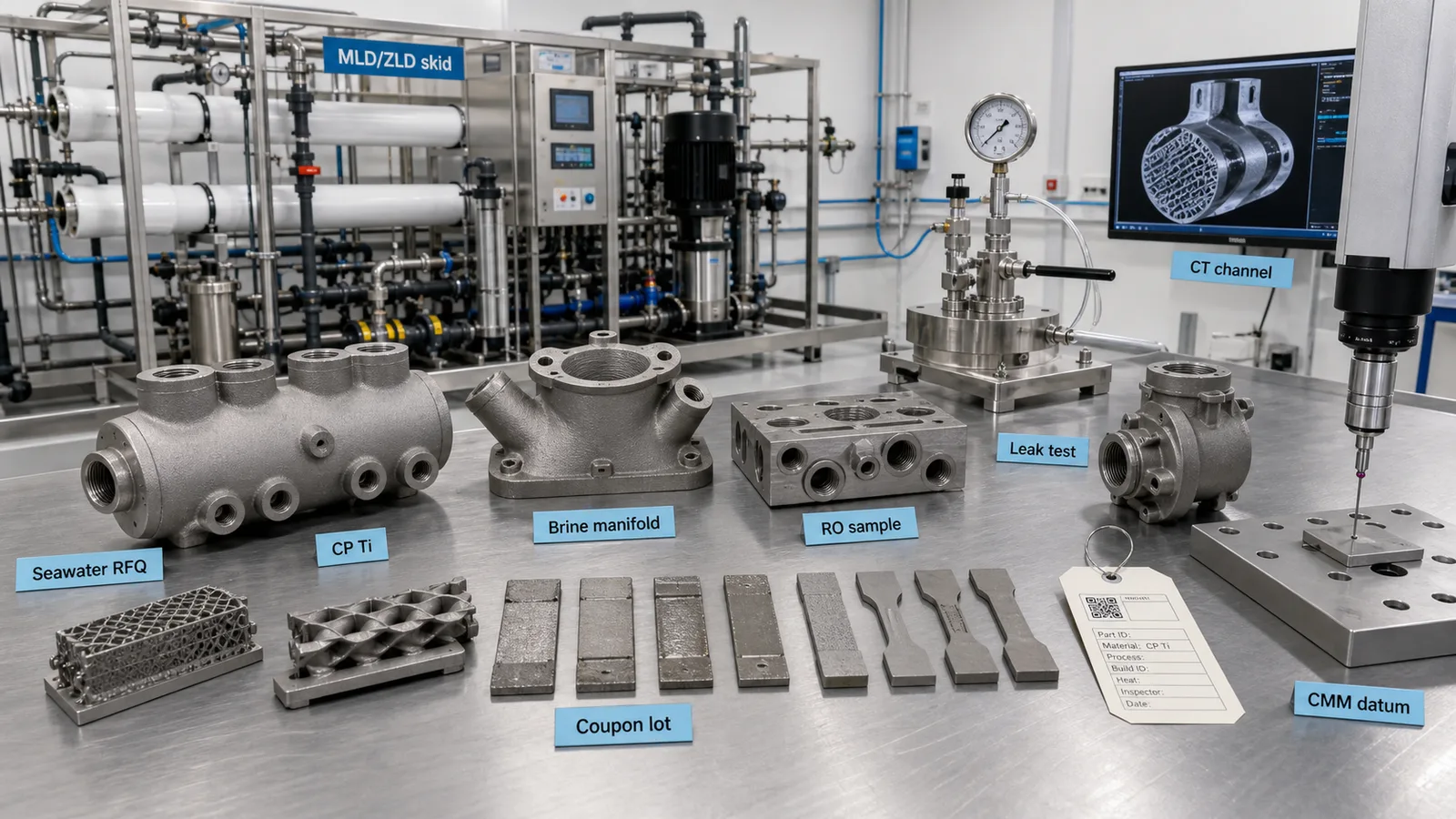
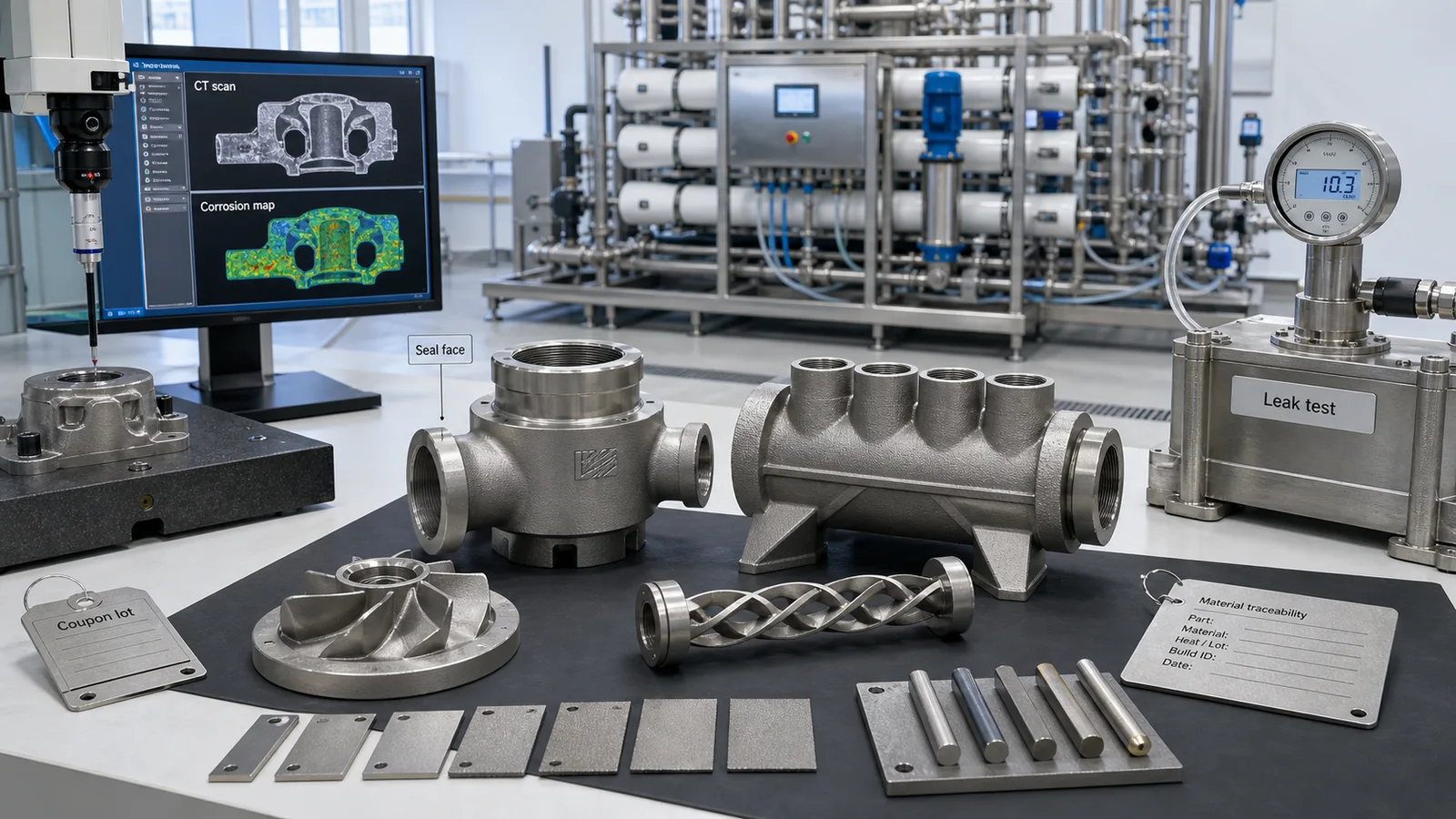
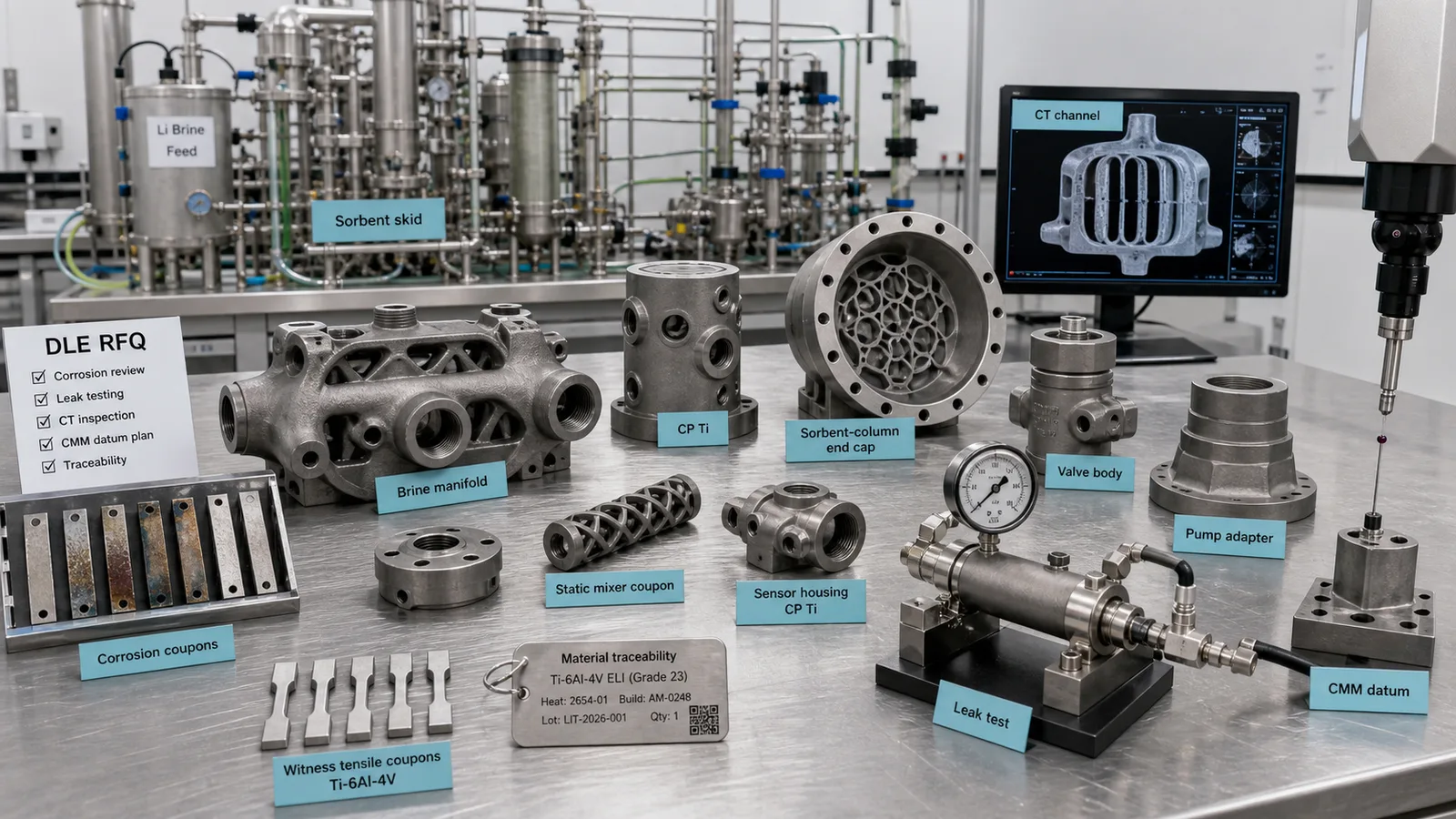
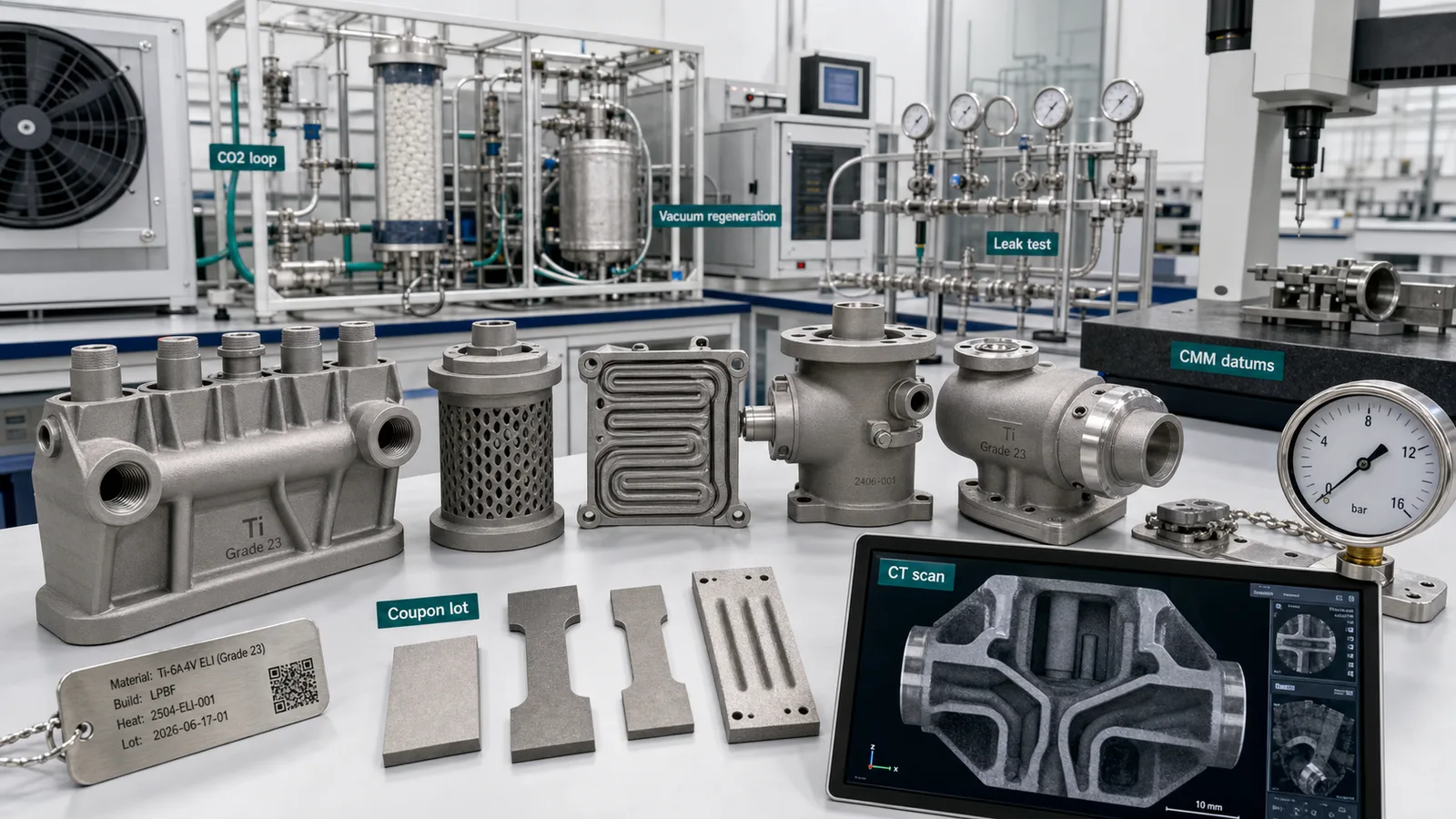
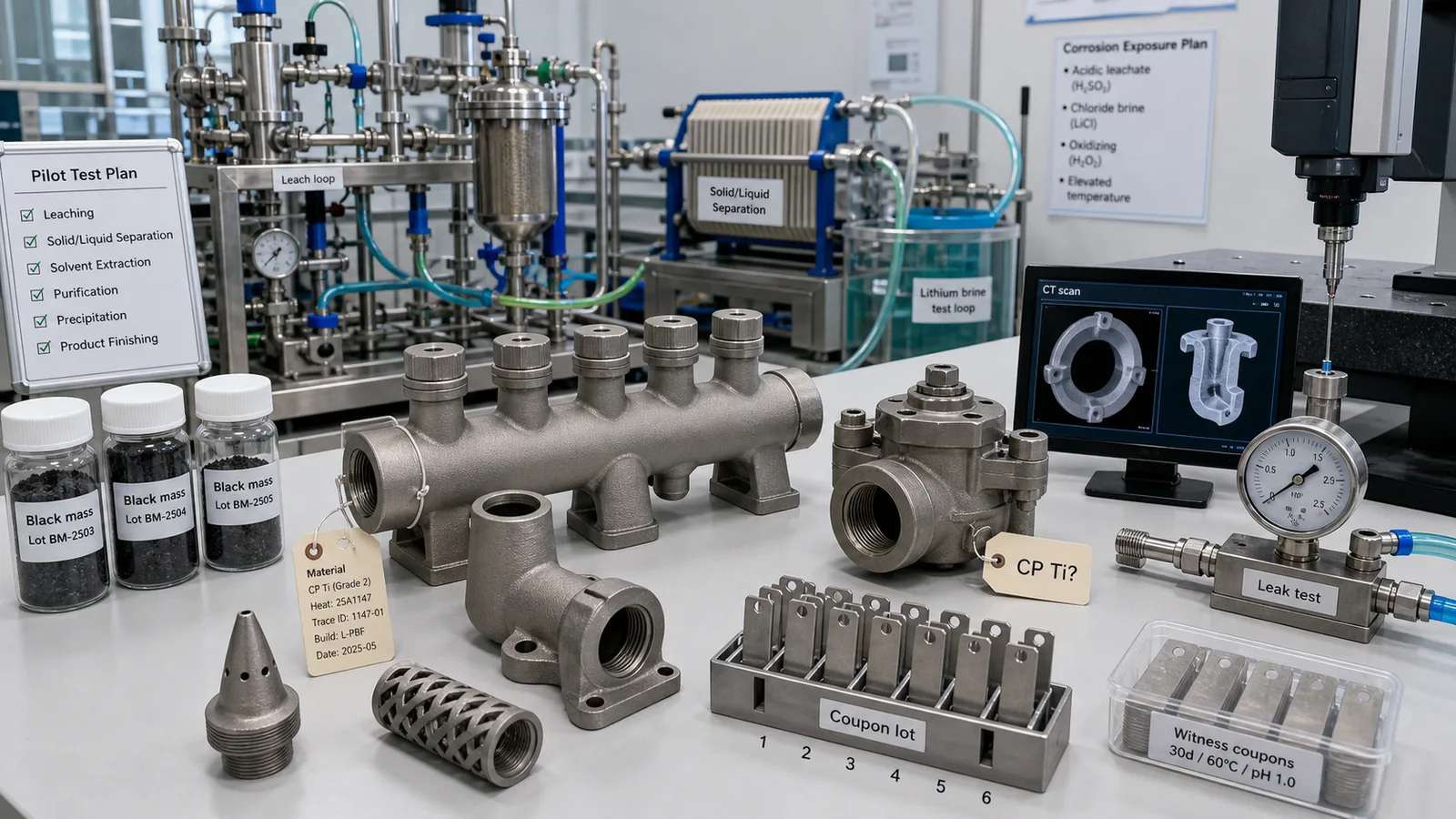
Representative article image; not a customer acceptance record or proof of a qualified manufacturing route. Refer to the cited sources and part-specific inspection records for engineering evidence.
On this page
Titanium 3D printing for seawater desalination and brine concentration hardware is worth reviewing when a compact pilot-plant or low-volume process component needs chloride resistance, fewer leak paths, integrated ports, fast iteration, machined seal faces, CT-verifiable internal passages, or documented traceability. It is not a shortcut around corrosion review, membrane fouling, scale control, pressure testing, cleaning, or plant acceptance.
Desalination hardware sits between water treatment, marine service, chemical processing, thermal management, and industrial water reuse. A printed titanium seawater manifold, RO sample block, pump adapter, valve body, brine concentrator adapter, MLD/ZLD pilot fixture, corrosion coupon rack, sensor housing, or compact heat-transfer coupon can be useful, but only when feed chemistry, brine concentration, antiscalants, cleaning chemicals, seal faces, leak testing, CT, CMM, and material records are defined before quote comparison.
For broader water-treatment hardware, use Titanium 3D Printing for Chemical Processing and Water Treatment Parts. For pump adapters, valve bodies, static mixers, nozzles, and compact flow-control hardware that also appears outside desalination, use Titanium 3D Printing for Industrial Valves, Pump Parts, and Flow Control Hardware. For seawater deployment and galvanic risk, use Titanium 3D Printing for Marine, Subsea, and Offshore Parts. For mineral-processing brines, acid leach, tailings-water, slurry, and hydrometallurgy pilot hardware, use Titanium 3D Printing for Mining, Mineral Processing, and Hydrometallurgy Hardware. This guide focuses specifically on desalination, reverse-osmosis concentrate, brine concentration, and MLD/ZLD pilot hardware.
Quick Answer
Titanium additive manufacturing is a practical candidate for desalination and brine concentration hardware when the part is compact, corrosion-exposed, low-volume, interface-heavy, or functionally improved by internal routing that conventional drilling, welding, or stacked fabrication would make slow or leak-prone.
Good candidates include:
- CP titanium or Ti-6Al-4V seawater manifolds with sample ports, pressure taps, drains, and machined seal faces.
- RO concentrate sample blocks, membrane-test adapters, brine distribution bodies, and instrumentation manifolds.
- Pump adapters, valve bodies, sensor housings, and filter interfaces for chloride-rich pilot skids.
- Static mixer coupons, corrosion coupon racks, and scale-test fixtures for process-development work.
- Compact titanium heat-transfer coupons or heat-exchanger subcores where brine corrosion and internal channels matter.
- MLD/ZLD pilot hardware where brine concentration, cleaning access, and pressure evidence must be documented.
- Low-volume spares for desalination test systems when conventional machining would require many plugs, welds, or fittings.
Weak candidates include large pipe spools, commodity valves, standard membrane housings, tanks, evaporator shells, simple plates, high-volume cast parts, and any pressure or brine-contact part where the RFQ does not define alloy, exposure, cleaning route, seal faces, pressure or leak test, and documentation.
If standard pipe, tube, plate, billet, duplex stainless, nickel alloy, polymer, fluoropolymer-lined hardware, fabricated titanium, or conventional machining meets the requirement with lower risk, use the When Not to Use Titanium Additive Manufacturing screen before requesting production pricing.
Why Desalination and Brine Hardware Is Timely in 2026
Desalination and water reuse are not narrow utility topics in 2026. Water stress, drought resilience, industrial water circularity, inland brackish groundwater, reverse-osmosis concentrate, and brine management are all moving from policy language into pilot skids, test loops, and procurement decisions.
Recent public signals show the context:
- The United Nations World Water Development Report 2026 keeps water access, scarcity, climate pressure, and unequal water burdens in the global policy conversation.
- The World Bank report Scaling Water Reuse says potable and industrial reuse could grow 8-fold by 2040, reaching 430 million cubic meters per day, if investment and regulation support the transition.
- The European Commission’s Blue Economy Observatory page on desalination highlights reverse osmosis, brine management, drought pressure, coastal plants, inland brackish water, and industrial water use.
- The U.S. Bureau of Reclamation’s Brackish Groundwater National Desalination Research Facility exists to develop desalination technologies for brackish and impaired groundwater in inland states.
- In 2026, DOE and NAWI announced USD 9.2 million in federal funding for 12 desalination and water reuse projects, including work on reverse-osmosis concentrate and treatment trains for reuse.
- DOE’s earlier USD 75 million NAWI renewal shows the same direction: lower the cost and energy of water purification technologies and treat alternative water sources.
- A Nature Water analysis of ZLD/MLD desalination treatment trains shows why brine concentration is a real engineering problem: higher water recovery comes with energy, cost, scaling, heat-integration, and system-design trade-offs.
These signals do not mean every desalination or brine part should be printed in titanium. They explain why engineering teams are asking sharper RFQ questions about corrosion-resistant pilot hardware, compact brine routing, fewer leak paths, pressure evidence, internal-channel inspection, and documented material condition.
Where Titanium AM Fits in Desalination Equipment
Titanium is not selected only because it is corrosion resistant. It earns a review when corrosion behavior, strength-to-weight ratio, low magnetic response, heat tolerance, low-volume availability, or additive geometry improves the delivered water-treatment system.
| Part family | Why titanium AM can help | Main RFQ risk | Evidence to define |
|---|---|---|---|
| Seawater or brine manifold | Fewer fittings, shorter paths, integrated drains and taps | Powder removal and leak paths | CT or flow check, pressure test, cleaning route |
| RO sample block | Compact ports for permeate, concentrate, sensors, and drains | Seal faces, threads, and dead legs | CMM, machined ports, leak threshold |
| Pump or valve adapter | Low-volume interface hardware for pilot skids | Seal quality, crevice risk, erosion | Machined seats, roughness, pressure test |
| Brine concentrator adapter | Corrosion-resistant transition between units | Scaling, solids, and cleaning access | Exposure map, flush route, inspection photos |
| Static mixer or dosing body | Internal geometry for antiscalant, acid, or process dosing | Blockage and cleanability | Flow test, depowdering route, accepted roughness |
| Heat-transfer coupon or subcore | Compact thermal geometry in chloride-rich media | Internal roughness and pressure integrity | CT, flow test, leak or pressure test |
| Coupon rack or exposure fixture | Matched titanium exposure hardware for process tests | Over-specifying simple hardware | Alloy, surface condition, coupon lot records |
The strongest cases are not generic “desalination parts.” They are compact wetted components where additive manufacturing reduces leak paths, replaces drilled cross-holes, integrates ports, improves pilot-line iteration, or makes a cleanable flow path possible.
For thermal brine equipment, use Titanium 3D Printed Heat Exchangers. For lithium brines and direct lithium extraction, use Titanium 3D Printing for Direct Lithium Extraction and Brine Processing Hardware. For seawater deployment and offshore maintenance, use Titanium 3D Printing for Marine, Subsea, and Offshore Parts.
Start With the Feedwater, Brine, and Cleaning Map
“Desalination service” is not a material requirement. A seawater intake stream, brackish groundwater stream, RO concentrate, nanofiltration reject, MLD brine, evaporator concentrate, cleaning solution, and antiscalant dosing line can create very different material and cleaning assumptions.
Define:
- Feed source: seawater, brackish groundwater, produced water, industrial wastewater, cooling blowdown, RO concentrate, or synthetic test brine.
- Salinity, chloride level, pH, temperature, dissolved oxygen, hardness, silica, sulfate, carbonate, boron, iron, manganese, organics, PFAS, and biological activity if known.
- Scaling tendency, suspended solids, fouling risk, antiscalants, acids, bases, oxidants, biocides, and cleaning cycles.
- Pressure, temperature, flow rate, stagnation periods, pressure cycling, and duty cycle.
- Whether the part sees continuous wetting, spray, vapor, intermittent testing, drying, or storage after brine exposure.
- Mating materials, fasteners, elastomers, liners, coatings, membranes, electrodes, and electrical contact.
- Whether the part is structural, flow-carrying, pressure-retaining, sensor-adjacent, or only a test fixture.
- Acceptance tests: pressure hold, leak test, flow test, CMM, CT, roughness, cleaning verification, coupon evidence, COA, COC, or build record.
Do not ask for titanium only as a corrosion-resistant label. Ask for the titanium grade, delivered condition, exposed surfaces, mating materials, cleaning route, and evidence package that match the actual water and brine duty.
CP Titanium vs Ti-6Al-4V in Chloride-Rich Water
Ti-6Al-4V is often the first AM quote route because it is widely available in LPBF supply chains and has a strong mechanical-property track record. Ti-6Al-4V ELI may be reviewed when ductility, fracture behavior, or a specific acceptance basis matters.
Commercially pure titanium is a different conversation. CP titanium may be more relevant when corrosion behavior, ductility, or chemical compatibility matters more than high strength. It can also be harder to source through a given additive route, so buyers should review it early instead of asking for a late material substitution after the geometry and price are frozen.
For Grade 2, TA2, TA2G, and CP titanium naming and purchasing boundaries, use the commercially pure titanium 3D printing guide. It separates material-family language, wrought product standards, supplier LPBF feasibility, and AM-specific acceptance evidence.
Material selection should follow:
- Chloride concentration, temperature, oxygen level, pH, cleaning chemistry, and scaling chemistry.
- Mechanical load, pressure boundary, fatigue, vibration, and stiffness requirements.
- Whether the part is a short-duration test coupon fixture, a pilot-plant component, or production-intent hardware.
- Supplier availability for LPBF, EBM, or another route in the requested titanium grade.
- Post-processing, passivation, polishing, machining, or special cleaning requirements.
- Documentation level: COA, COC, powder lot, heat-treatment record, build record, inspection report, and traceability.
The broader alloy framework is in Titanium AM Material Selection: Ti-6Al-4V, ELI, and CP Titanium. The important point for desalination hardware is simple: do not let three suppliers quote three different titanium grades under one brine-risk part number.
Brine Concentration Is a Scaling and Cleaning Problem
RO concentrate and MLD/ZLD brines are not only “saltier water.” As recovery rises, the hardware may see higher ionic strength, scale-forming species, antiscalants, pH adjustment, periodic cleaning, solids, and concentration swings. A printed titanium part can survive the material screen and still fail the system if it creates dead zones or cannot be cleaned.
High-risk features include:
- Blind brine passages with no powder exit or flushing route.
- Dead legs near sample ports, pressure taps, drains, and sensor pockets.
- Small restrictions where scale, solids, or partially sintered powder can accumulate.
- Internal shelves and abrupt expansions that trap cleaning residue or solids.
- Parallel paths with no flow-balance or pressure-drop check.
- Sealed lattice structures connected to wet regions.
- Threaded ports that intersect rough as-built internal channels.
- Geometry that cannot be inspected after a brine concentration campaign.
For brine concentration hardware, the RFQ should define both initial acceptance and maintenance logic. A part may pass leak testing before service but still be unacceptable if scale cannot be removed after the first pilot run.
Manifolds, RO Sample Blocks, and Sensor Housings
Titanium AM can be useful when a desalination skid needs a compact part that would otherwise require multiple drilled blocks, welded bosses, fittings, plugs, and external tubes. The value is not the printed shape. The value is fewer leak paths and a cleaner arrangement of process interfaces.
Strong candidates include:
- RO feed, permeate, and concentrate sample blocks.
- Brine distribution manifolds with integrated pressure taps and drains.
- Instrument bodies for conductivity, pH, pressure, temperature, or flow sensors.
- Pump adapters and valve bodies with nonstandard port geometry.
- Dosing manifolds for antiscalant, acid, base, or cleaning solution.
- Filter, cartridge, membrane-cell, or electrodialysis fixture adapters.
- Coupon racks and corrosion exposure fixtures that keep samples traceable.
Define every functional interface:
- O-ring grooves, gasket lands, flange faces, valve seats, and metal-seal surfaces.
- Pipe threads, tube-fitting seats, bosses, bolt pads, dowel holes, and datum faces.
- Drain points, sample ports, pressure taps, and cleaning ports.
- Surfaces that may remain as-built and surfaces that must be machined, polished, lapped, or finished.
- Assembly access for membranes, electrodes, sensors, tubing, ferrules, gaskets, and fasteners.
Add machining stock where seals, threads, ports, and datums matter. If a port intersects an internal AM channel, define how the transition will be cleaned and inspected.
For drawing strategy, use Titanium 3D Printing Tolerances: Datum Planning and CMM before sending a quote package.
Internal Channels Need Depowdering and CT Logic
Internal geometry is one of the strongest reasons to print desalination hardware. It can replace drilled cross-holes, plugs, welds, stacked plates, and external tubing. It can also trap titanium powder, cleaning media, brine residue, scale, or biological material if the geometry is not designed for acceptance.
Plan the channel around:
- Minimum channel diameter and powder-removal access.
- Branches, bends, transitions, and down-facing internal roofs.
- Drainability after testing and after chemical cleaning.
- Internal roughness and pressure-drop assumptions.
- Whether abrasive flow finishing, chemical finishing, or other internal finishing is realistic.
- Whether CT can resolve the smallest critical feature.
- Whether a flow test or pressure-drop check is more useful than CT for a particular path.
- How plugged temporary access ports will be sealed, machined, inspected, and documented.
Use Titanium 3D Printed Internal Channels: Powder Removal and CT before freezing a printed brine manifold, static mixer, dosing body, sample block, or compact heat-transfer coupon.
Heat-Transfer and Brine Concentrator Hardware
Desalination systems are also thermal systems. Pretreatment, membrane trains, brine concentration, evaporators, condensers, heat recovery, crystallization, and cleaning loops can all involve heat-transfer questions. Titanium AM may create compact thermal coupons or low-volume heat-transfer test bodies, but it should not be used as a generic replacement for conventional heat exchangers.
Review titanium AM when:
- Corrosion resistance and compact channels matter together.
- A pilot program needs a test coupon or subscale thermal body quickly.
- Internal routing reduces external fittings or leak paths.
- A heat-transfer part also carries sensors, sample ports, or mounting structure.
- The geometry can be depowdered, cleaned, pressure tested, and inspected.
Avoid printing a large thermal component when tube, plate, shell-and-tube, plate-and-frame, graphite, polymer, or fabricated titanium hardware meets the duty with lower risk. If the part is a thermal core, the RFQ must define heat load, flow rate, pressure drop, temperature, brine chemistry, cleaning route, pressure test, CT scope, and CMM scope.
For the general thermal framework, use Titanium 3D Printed Heat Exchangers: Thermal Management RFQ Guide.
Pressure, Leak, and Flow Testing
Desalination and brine parts often combine corrosion exposure with pressure or leak requirements. Do not accept a printed titanium flow body only because it looks dense. The test method should match the failure mode and the actual process duty.
Define:
- Working pressure, proof pressure, burst requirement if any, and pressure cycling.
- Test fluid or gas, temperature during test, and compatibility with the finished part.
- Leak-test method, allowable leakage, hold time, port sealing method, and fixture responsibility.
- Whether pressure testing happens before or after machining, finishing, passivation, and final cleaning.
- Whether feed, permeate, concentrate, and cleaning circuits are tested separately.
- Flow rate, pressure drop, and flow-balance requirements if channel openness affects performance.
- Whether test results are development data, shipment acceptance, or qualification evidence.
Weak wording:
Include leak testing.
Better wording:
Quote this titanium AM brine manifold as delivered accepted hardware. The part carries RO concentrate during pilot testing and includes six threaded ports, two sample ports, one drain, and a machined gasket face. Please include final machining of seal faces and threads, cleaning after machining, pressure hold at the agreed proof pressure, leak threshold and hold time, CMM for ports and datums, and CT or flow-test recommendation for the two internal channels.
That wording gives the supplier a real acceptance target instead of a test label.
Surface Finish, Cleaning, and Residue Control
As-built titanium AM texture can be acceptable on noncritical exterior surfaces. It can be wrong for seal faces, gasket lands, threaded ports, fatigue-sensitive edges, sliding interfaces, or wetted regions that must be cleaned repeatedly.
Separate surfaces by function:
- Seal faces, O-ring grooves, gasket lands, valve seats, and lapped interfaces.
- Threaded ports, tube-fitting seats, pressure taps, and membrane-cell interfaces.
- Wetted internal channels where roughness affects residue, scale, pressure drop, or cleaning.
- Pump or nozzle surfaces where erosion, cavitation, or balance matters.
- Fatigue or pressure-cycle surfaces where support scars are unacceptable.
- Datum pads and bolt faces that require CMM control.
- Noncritical exterior areas that may remain as-built or bead blasted.
Post-processing may include stress relief, HIP when justified, support removal, machining, abrasive flow finishing, chemical finishing, blasting, passivation, ultrasonic cleaning, drying, capping, packaging, and inspection photos. The sequence matters because a part can pass a dimensional check and still be unacceptable if powder or residue remains in a hidden brine path.
Use Post-Processing for Titanium 3D Printing when defining delivered condition.
Process Choice: LPBF Usually Leads for Compact Brine Parts
Compare the proposed route against the most demanding operating and cleaning state, not feed seawater alone. Identify concentrated streams, deposit-prone regions, shutdown/stagnation, cleaning chemicals, temperature changes, and surfaces that cannot be reached after assembly. Specify how deposits and cleaning residues will be assessed on representative geometry.
The supplier should explain the finish and verification achievable inside the actual flow path, including any redesign needed for access. Use the process selection guide for general LPBF/EBM/DED trade-offs and the chemical exposure guide for the parent materials decision; this page addresses concentration, scale, and cleaning-cycle constraints.
Inspection Evidence Should Match the Brine Risk
Desalination titanium AM parts can be under-tested or over-tested. A corrosion coupon rack does not need the same evidence as a pressure-retaining brine manifold. A compact RO concentrate block with hidden channels may need CT, pressure testing, and CMM. A low-risk pilot-plant bracket may only need material records and a dimensional check.
Typical evidence includes:
- CMM report for ports, datums, seal faces, bolt patterns, gasket lands, and machined features.
- CT inspection for internal channels, trapped powder, wall thickness, hidden defects, or blockage where risk justifies it.
- Pressure, leak, flow, or pressure-drop test tied to the accepted configuration.
- Surface roughness checks on sealing, fatigue, or wetted-cleanability regions.
- Material certification, COA, COC, heat-treatment record, build record, powder lot, and traceability.
- Inspection photos for support removal, machined features, critical surfaces, and test setup.
- Coupon evidence when the lot, process, corrosion exposure, or acceptance basis requires it.
Use Titanium AM Qualification and Inspection Evidence to select evidence by part risk. A cheap quote with no test scope is often a print-only quote, not a delivered process-hardware quote.
Cost: Compare Delivered Water-Treatment Hardware
Titanium AM can reduce fittings, shorten pilot-plant iteration, consolidate ports, and eliminate difficult drilling. It can also hide cost in post-processing and evidence.
Cost drivers include:
- Build orientation and support strategy.
- Support removal from ports, ribs, mixer elements, and internal openings.
- Stress relief, HIP if justified, and heat treatment.
- Machining of seal faces, valve seats, threads, gasket lands, bores, and datum pads.
- Internal cleaning, flushing, drying, and residue verification.
- Passivation, polishing, abrasive flow finishing, or chemical finishing.
- CT, CMM, leak testing, pressure testing, flow testing, and roughness checks.
- Material records, lot traceability, inspection reports, and packaging.
- Rework if internal channels cannot be cleaned or verified.
Control cost before geometry is frozen. Remove unnecessary sealed cavities, keep brine paths cleanable, machine only functional surfaces, define evidence by risk, and let suppliers suggest DfAM changes before final pricing.
For quote normalization, use Titanium 3D Printing Cost Drivers: How to Reduce RFQ Price and the Titanium AM RFQ and Procurement Guide.
Example RFQ: Desalination Brine Manifold
Weak RFQ:
Please quote this titanium 3D printed desalination manifold.
Better RFQ:
Please review this titanium AM brine manifold for a seawater RO pilot skid. The part carries RO concentrate and periodic cleaning solution, with six threaded ports, two pressure taps, one conductivity sensor pocket, one drain point, and a machined gasket face. Please recommend Ti-6Al-4V, Ti-6Al-4V ELI, or CP titanium based on the exposure notes; identify powder-removal access, support strategy, machining stock, cleaning route, pressure-test method, leak threshold, CMM scope, CT or flow-test recommendation for internal channels, material traceability, and any DfAM changes needed before quotation. Quote the delivered accepted part, not only the printed shape.
That wording helps procurement compare suppliers on the same delivered route: print, stress relieve, depowder, machine, clean, inspect, test, document, and package.
Example RFQ: MLD/ZLD Pilot Fixture
For a brine concentration or MLD/ZLD pilot part, include:
- Process step: RO concentrate handling, nanofiltration, electrodialysis, membrane distillation, evaporator loop, crystallizer feed, cleaning loop, or coupon exposure.
- Process media: seawater, brackish water, RO concentrate, MLD brine, cleaning solution, antiscalant, acid, base, solids, pH, temperature, pressure, and duty cycle.
- Functional surfaces: ports, seal faces, gasket lands, sensor pockets, flow conditioners, drain points, and coupon positions.
- Inspection scope: CMM, CT, leak test, pressure test, flow test, roughness, coupon records, COA, COC, build record, powder lot, and photos.
- Maintenance logic: flushing, scale removal, drying, capping, cleaning access, and whether the part can be opened after a pilot campaign.
For mineral-rich brines and lithium extraction, pair this with Titanium 3D Printing for Direct Lithium Extraction and Brine Processing Hardware.
Choose the Next Engineering Check
Use these pages together when planning a desalination or brine hardware RFQ:
- General process equipment: Titanium 3D Printing for Chemical Processing and Water Treatment Parts
- Seawater and offshore exposure: Titanium 3D Printing for Marine, Subsea, and Offshore Parts
- Thermal and heat-transfer hardware: Titanium 3D Printed Heat Exchangers
- Lithium and critical-minerals brines: Titanium 3D Printing for Direct Lithium Extraction and Brine Processing Hardware
- Alloy choice: Titanium AM Material Selection: Ti-6Al-4V, ELI, and CP Titanium
- Internal channels and CT: Titanium 3D Printed Internal Channels: Powder Removal and CT
- Tolerances and datum planning: Titanium 3D Printing Tolerances: Datum Planning and CMM
- Qualification evidence: Titanium AM Qualification and Inspection Evidence
- Cost normalization: Titanium 3D Printing Cost Drivers: How to Reduce RFQ Price
- RFQ package: Titanium AM RFQ and Procurement Guide
This internal map is also how procurement should avoid duplicate quote requests. Start from the application, then add material, DfAM, inspection, cost, and RFQ evidence only where the risk justifies it.
When Titanium AM Is the Wrong Route
Redesign before quotation when:
- Brine channels have no practical powder exit, flushing path, or drain point.
- Seal faces, gasket lands, valve seats, or threaded ports lack machining stock.
- Internal roughness controls cleaning or pressure drop, but no finishing or flow-test route is defined.
- Scaling risk is high, but the part has dead zones that cannot be cleaned.
- The part mixes incompatible fluids across thin walls with no inspection basis.
- CT cannot resolve the smallest critical internal feature.
- Pressure testing is required but pressure, method, hold time, and leakage limit are vague.
- CP titanium is required but the supplier route only supports Ti-6Al-4V.
- A simple machined or fabricated part would meet the requirement with lower acceptance risk.
Avoid titanium AM when standard polymer, lined steel, duplex stainless, nickel alloy, conventional titanium fabrication, machining, casting, or catalog desalination hardware meets the chemistry, cost, lead-time, and evidence requirements with lower risk.
Bottom Line
Titanium 3D printing can be valuable for seawater desalination and brine concentration hardware when it solves a real hardware problem: corrosion-resistant compact routing, fewer leak paths, low-volume pilot hardware, replacement of difficult drilling, integrated sample and sensor ports, documented test components, or CT-verifiable internal geometry.
The strongest candidates are brine manifolds, RO sample blocks, pump and valve adapters, sensor housings, static mixer coupons, heat-transfer coupons, corrosion coupon racks, and MLD/ZLD pilot fixtures where exposure, sealing, machining, cleaning, and evidence are planned from the start.
If you are reviewing a titanium seawater manifold, RO concentrate block, CP titanium sensor housing, brine concentrator adapter, static mixer coupon, compact heat-transfer body, or corrosion exposure fixture, send the CAD model, target alloy, brine chemistry, temperature, pressure, quantity, and inspection expectations through the TITANIUM 3DP RFQ page. Include the surfaces that need machining, the passages that need CT, and the leak or pressure test required for acceptance.
- Desalination
- Seawater
- Brine concentration
- Water reuse
- Zld
- Mld
- CP titanium
- Heat exchangers
- Leak testing
- RFQ