· Updated - TITANIUM 3DP Engineering - Engineering Guides - 14 min read
Titanium 3D Printing for Direct Lithium Extraction and Brine Processing Hardware
Engineering RFQ guide for titanium 3D printed direct lithium extraction and brine processing hardware, covering brine manifolds, sorbent skids, pump and valve adapters, sensor housings, corrosion coupons, leak testing, CT, CMM, and traceability.
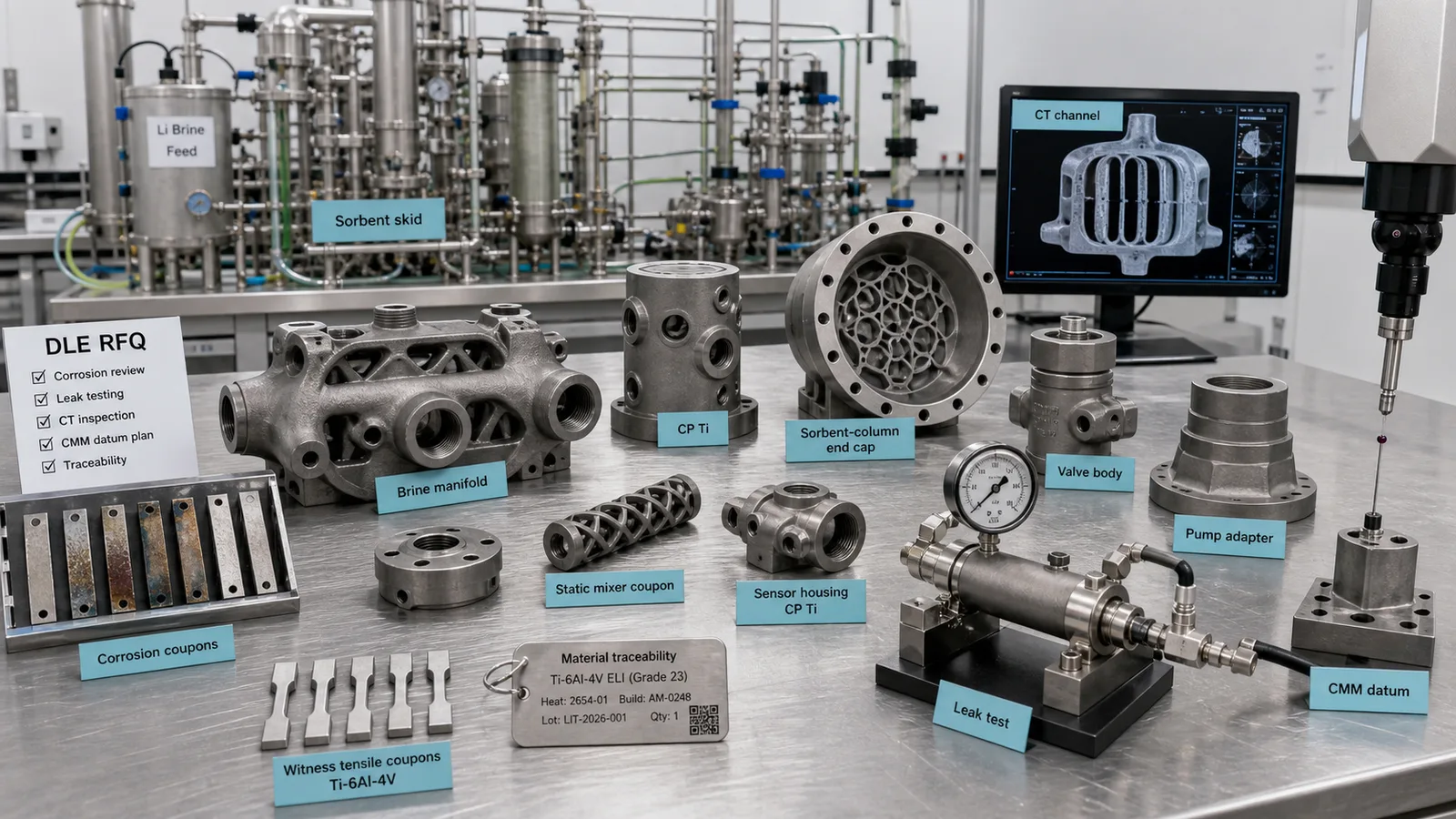
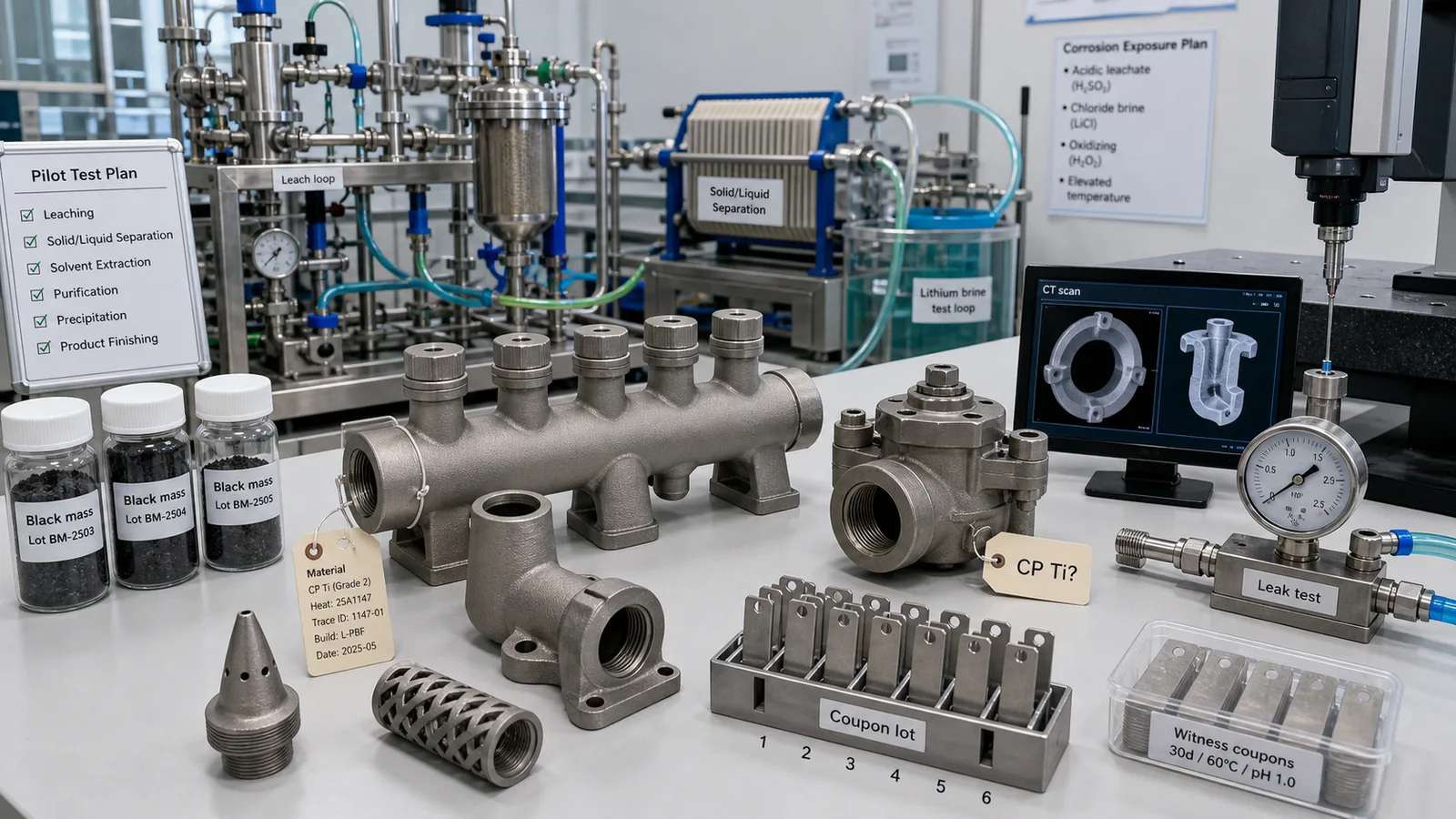
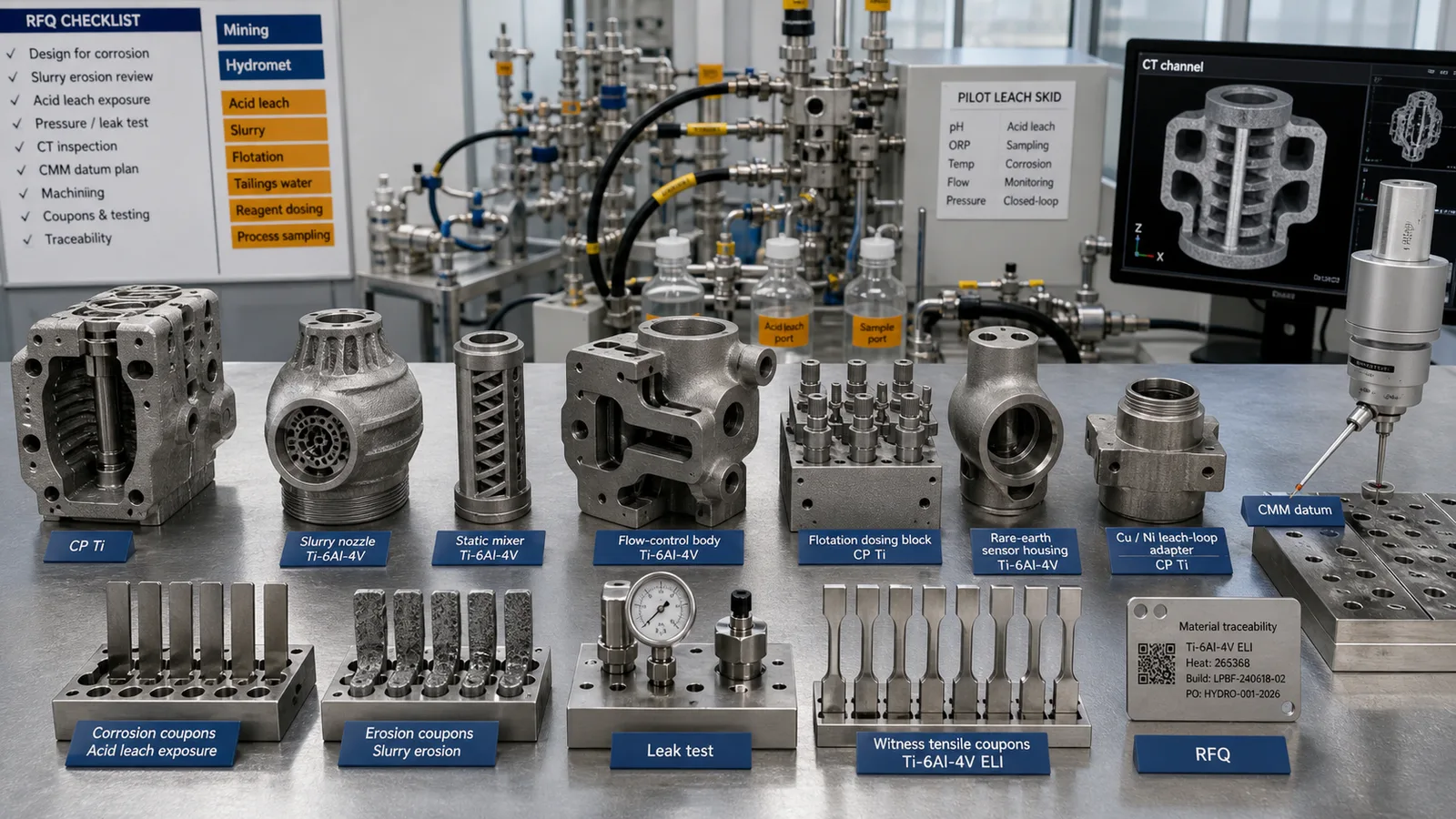
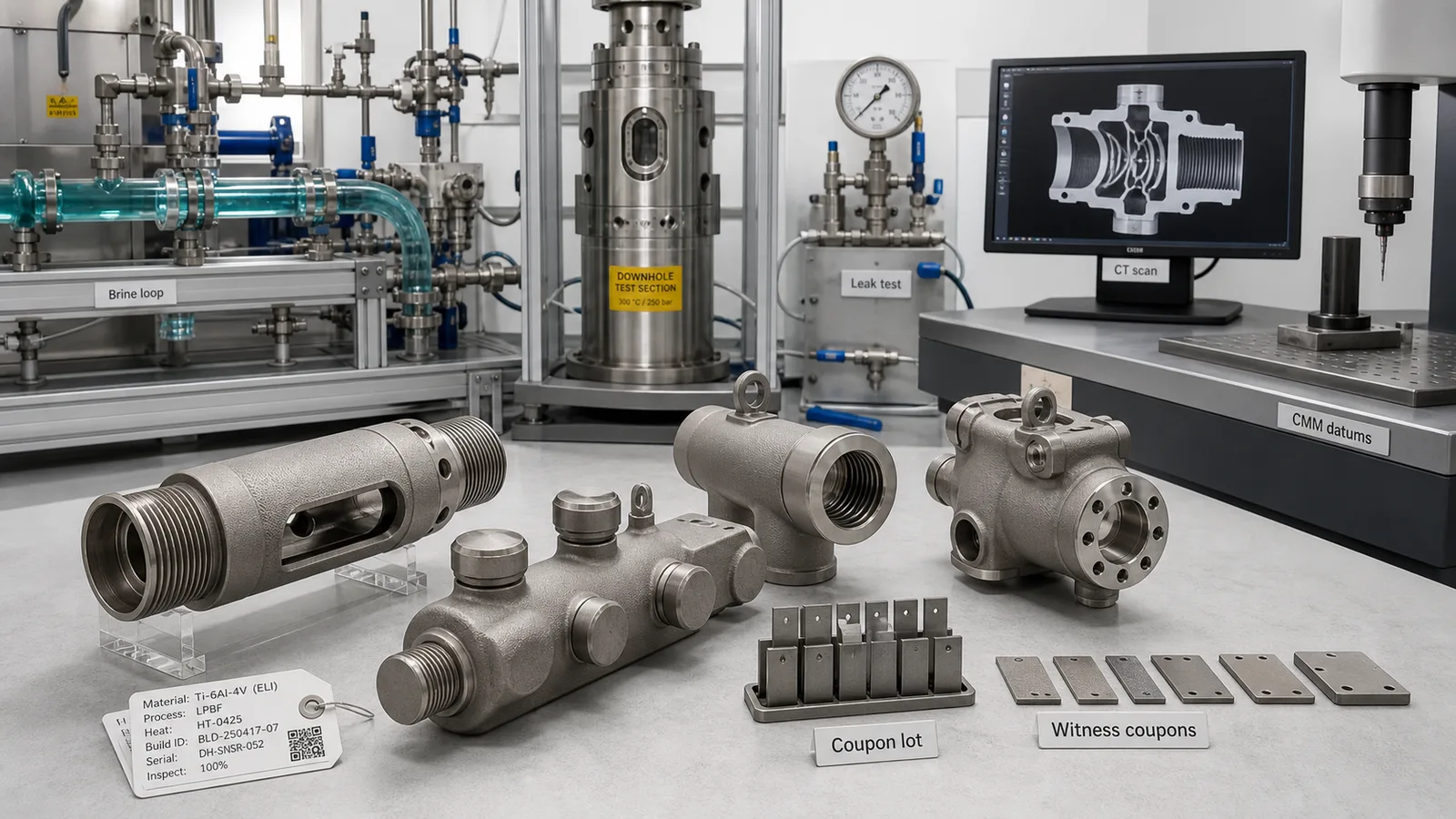
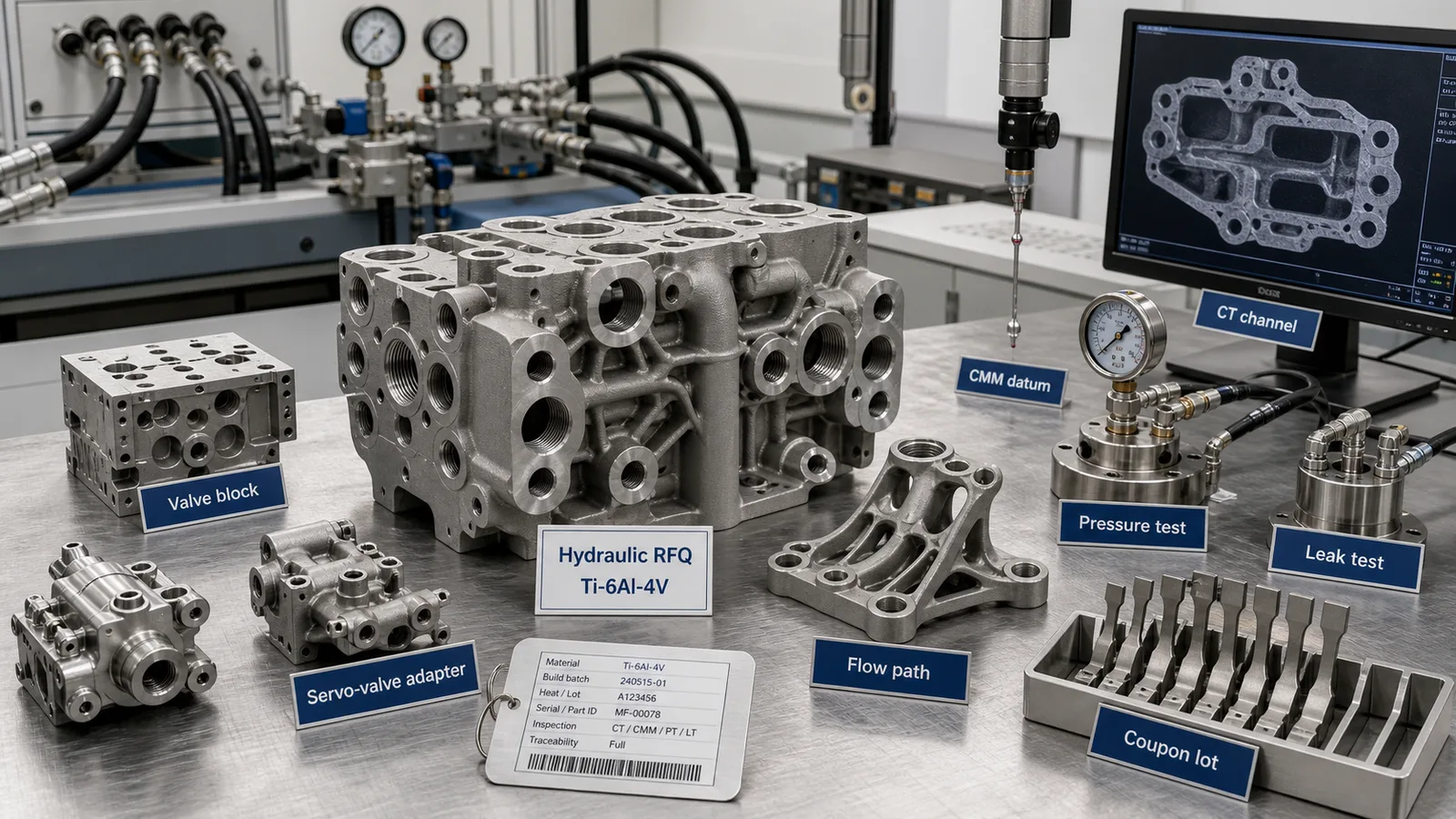
Representative article image; not a customer acceptance record or proof of a qualified manufacturing route. Refer to the cited sources and part-specific inspection records for engineering evidence.
On this page
Titanium 3D printing for direct lithium extraction and brine processing hardware is worth reviewing when a compact pilot-plant or test-loop component needs corrosion resistance, complex port routing, fewer leak paths, fast iteration, machined seal faces, CT-verifiable internal passages, or documented traceability. It is not a generic substitute for pipe spools, tanks, commodity valves, lined vessels, or high-volume process hardware.
Direct lithium extraction hardware sits between geothermal energy, critical-minerals processing, hydrometallurgy, water treatment, and pilot-line chemical equipment. A printed titanium brine manifold, sorbent-column end cap, sample block, pump adapter, valve body, sensor housing, static mixer coupon, corrosion coupon rack, or pressure-test fixture can be useful, but only when brine chemistry, solids, scale, cleaning access, seal faces, leak testing, CT, CMM, and material documentation are defined before quote comparison.
For geothermal and downhole service, use Titanium 3D Printing for Geothermal and Downhole Energy Parts. For non-lithium seawater RO, brine concentration, and MLD/ZLD pilot hardware, use Titanium 3D Printing for Seawater Desalination and Brine Concentration Hardware. For cross-industry pump adapters, valve bodies, static mixers, nozzles, and compact flow-control bodies, use Titanium 3D Printing for Industrial Valves, Pump Parts, and Flow Control Hardware. For black mass and battery-material processing, use Titanium 3D Printing for Battery Recycling and Critical Minerals Processing Parts. For non-lithium mining, mineral processing, acid leach, slurry, flotation, and hydrometallurgy pilot hardware, use Titanium 3D Printing for Mining, Mineral Processing, and Hydrometallurgy Hardware. This guide focuses specifically on lithium brine and DLE pilot hardware.
Quick Answer
Titanium additive manufacturing is a practical candidate for DLE and lithium brine hardware when the part is compact, corrosion-exposed, low-volume, interface-heavy, or functionally improved by internal routing that conventional machining would make slow or expensive.
Good candidates include:
- DLE brine manifolds with integrated sample ports, pressure taps, drain paths, and machined seal faces.
- Sorbent-column end caps, cartridge adapters, and ion-exchange test fixtures where low-volume iteration matters.
- CP titanium sensor housings, probe adapters, and instrument blocks for chloride-rich brine test loops.
- Pump adapters, valve bodies, filter adapters, and bypass blocks for pilot skids.
- Static mixer coupons, flow-distribution coupons, and CT-inspected internal-channel samples.
- Corrosion coupon racks and exposure fixtures for comparing CP titanium, Ti-6Al-4V, stainless, nickel alloys, polymers, and lined hardware.
- Leak-test, pressure-test, cleaning, and traceability fixtures used to qualify a larger brine processing route.
Weak candidates include large tanks, long pipe runs, catalog fittings, commodity valves, large pressure vessels, simple flat plates, high-volume cast components, and any wetted part where the RFQ does not define brine chemistry, temperature, pressure, solids, scale, cleaning route, seal faces, leak threshold, and acceptance evidence.
If a machined block, welded titanium fabrication, lined steel component, polymer part, stainless fabrication, duplex stainless, nickel alloy, or catalog process component meets the chemistry and evidence requirements with lower cost and risk, use the When Not to Use Titanium Additive Manufacturing screen before requesting production pricing.
Why DLE and Brine Hardware Is Timely in 2026
DLE pilot hardware should be specified around the brine and regeneration cycle, not the lithium project label. Identify sorbent-contact surfaces, regenerant chemistry, sampling accuracy, solids carryover, and cleaning access before deciding whether an AM route is worth quoting.
Recent public signals show the context:
- The USGS 2026 lithium summary notes that lithium supply security has become a priority for technology companies and that brine-based lithium sources were in development or exploration in multiple countries, including the United States.
- The IEA Global Critical Minerals Outlook 2025 reported strong lithium demand growth in 2024 and frames lithium, nickel, cobalt, graphite, copper, and rare earths as core energy-transition minerals.
- In April 2026, the IEA reported that battery recycling innovation is surging, reinforcing the broader point that critical-minerals supply is pushing more technical work into processing, recovery, and verification routes.
- DOE’s geothermal lithium page explains why lithium recovery from geothermal brines is being studied and describes DLE as a route with smaller land and water footprint than traditional evaporation-pond approaches.
- DOE’s article on whether geothermal energy can solve the lithium shortfall highlights hot salty geothermal brines as both an energy resource and a potential lithium source.
These sources do not mean every DLE plant component should be printed in titanium. They explain why more engineers and procurement teams are asking practical RFQ questions about chloride brines, compact pilot skids, sensor integration, corrosion coupons, seal faces, leak testing, CT, CMM, and traceable manufacturing.
Where Titanium AM Fits in a DLE Pilot Loop
Direct lithium extraction systems can use adsorption, ion exchange, solvent extraction, membranes, electrochemical approaches, or hybrid process trains. Titanium AM does not determine the extraction chemistry. It may help selected hardware around that chemistry when the part is small enough, valuable enough, and difficult enough to justify the delivered route.
| DLE or brine hardware family | Why titanium AM can help | Main RFQ risk | Evidence to define |
|---|---|---|---|
| Brine manifold | Compact routing, fewer fittings, pressure taps, sample ports | Trapped powder, scale, cleaning access | CT or flow check, leak test, cleaning route |
| Sorbent-column end cap | Custom flow distribution and quick iteration | Seal faces, dead zones, sorbent-media compatibility | Machined faces, CMM, flow or pressure test |
| Sensor housing or probe adapter | Corrosion resistance and integrated datums | Thread quality, seal leakage, galvanic pairing | Machined threads, CMM, leak threshold |
| Pump or valve adapter | Low-volume interface hardware for pilot skids | Seal faces, erosion, solids accumulation | Machining plan, roughness, pressure test |
| Static mixer coupon | Internal geometry for process development | Powder removal and blockage | CT, flow test, cleaning access |
| Corrosion coupon rack | Matched titanium exposure fixture | Over-specifying a simple holder | Alloy, finish, coupon lot traceability |
| Sample block or bypass body | Integrated sampling and drain paths | Dead legs, contamination, residue | Drainability, cleaning, CMM, leak test |
The right candidate is usually a compact, interface-dense part where additive manufacturing reduces external fittings, integrates measurement points, shortens pilot iteration, or creates a cleanable corrosion-resistant path that machining would struggle to produce.
Start With the Brine and Duty Map
“Lithium brine” is not a material requirement. Brines can vary by source, salinity, chloride, sulfate, carbonate, silica, calcium, magnesium, iron, dissolved gases, organic additives, pH, temperature, scaling tendency, solids, and treatment chemistry. A useful titanium AM quote starts with a brine and duty map.
Define:
- Brine source: geothermal brine, salar brine, oilfield brine, synthetic brine, process concentrate, rinse stream, regenerant, eluate, or waste stream.
- Chemistry: chloride, sulfate, carbonate, lithium, sodium, potassium, calcium, magnesium, boron, silica, iron, manganese, H2S, CO2, dissolved oxygen, inhibitors, acid, base, or oxidizer if known.
- Temperature, pressure, flow rate, pressure cycling, thermal cycling, stagnation, and duty cycle.
- Solids, precipitates, scale, entrained sand, filter cake, corrosion products, or sorbent fines.
- Whether the part is lab hardware, pilot skid hardware, field trial hardware, production-intent hardware, or a disposable test coupon.
- Mating materials: stainless, duplex stainless, nickel alloy, carbon steel, polymers, elastomers, graphite, ceramics, lined hardware, or coated surfaces.
- Acceptance tests: CMM, CT, pressure test, leak test, flow test, roughness, coupon evidence, material traceability, cleaning record, or customer-specific qualification.
Do not ask for titanium only as a corrosion-resistant label. Ask for the titanium grade, delivered condition, exposed surfaces, mating materials, and acceptance route that match the brine and duty cycle.
CP Titanium vs Ti-6Al-4V in Brine Hardware
Commercially pure titanium may be relevant for brine and chemical exposure when corrosion behavior is more important than high strength. Ti-6Al-4V is often reviewed for stronger brackets, housings, compact manifolds, test fixtures, and structural hardware. Ti-6Al-4V ELI may be reviewed when ductility, fracture behavior, or a more conservative acceptance basis matters.
The material decision should follow the part’s job:
- Use CP titanium as a first review for corrosion-focused wetted components where high strength is not the main driver.
- Use Ti-6Al-4V for compact structural housings, adapters, and manifolds where strength-to-weight or supplier familiarity matters.
- Review Ti-6Al-4V ELI where ductility or a stricter acceptance route is useful.
- Avoid titanium where lined steel, polymer, nickel alloy, duplex stainless, ceramic, graphite, or conventional titanium fabrication gives the same brine compatibility with lower delivered cost.
For broader alloy screening, use Titanium AM Material Selection: Ti-6Al-4V, Ti-6Al-4V ELI, and CP Titanium.
Corrosion, Scaling, and Solids Are Not the Same Problem
Titanium can be attractive in chloride and brine discussions, but DLE hardware is not only a corrosion problem. Scale, precipitates, solids, sorbent fines, filter cake, erosion, crevice zones, stagnant pockets, and cleaning residue can decide whether a printed part is practical.
High-risk features include:
- Dead legs where precipitates can collect.
- Blind channels that cannot be flushed.
- Crevices near gaskets, threads, ports, and bolted interfaces.
- Internal lattice or weight-reduction voids connected to wetted paths.
- Rough as-built surfaces in solids-bearing regions.
- Thin internal walls between different process circuits.
- Sharp flow transitions that collect scale or damage sorbent media.
The RFQ should define whether solids and scale are expected, whether the part must drain fully, and whether chemical cleaning, backflushing, disassembly, or visual inspection is required. A beautiful internal channel is a weak design if the pilot operator cannot clean it after brine exposure.
Internal Channels Require Powder Removal and CT Logic
Brine manifolds, sample blocks, static mixers, and compact flow bodies are tempting DLE candidates because additive manufacturing can replace cross-drilled holes, plugs, and external fittings. The same geometry can create trapped powder and cleaning risk.
Define:
- Minimum channel diameter and accessible cleaning openings.
- Whether blind channels are allowed.
- Whether all passages must be borescope-visible, CT-visible, or flow-testable.
- Powder removal method and acceptance threshold.
- Whether CT is required before pressure or leak testing.
- Whether surfaces need machining, abrasive flow, polishing, chemical finishing, or a supplier-specific cleaning route.
- Whether the part will be exposed to brine before or after final proof testing.
Use Titanium 3D Printed Internal Channels: Powder Removal and CT before sending a manifold, mixer, purge block, or sample body for quote.
Seal Faces, Threads, and Leak Testing Need Machining Stock
DLE pilot skids often include threaded ports, fittings, O-ring grooves, gasket faces, sample ports, pressure taps, and sensor interfaces. Printed titanium geometry should not be treated as the final sealing surface unless the supplier and buyer explicitly qualify that route.
Define:
- Which faces are sealing faces.
- Fitting type, gasket type, O-ring material, thread type, and port standard if applicable.
- Machining stock on ports, bores, counterbores, grooves, and flange faces.
- Flatness, surface roughness, and bore-position requirements.
- Leak-test method, pressure-test method, fixture assumption, and acceptance threshold.
- Whether testing happens before or after final cleaning.
- Whether test media must match brine, water, nitrogen, helium, air, or another safe development fluid.
Use Titanium 3D Printing Tolerances: Datum Planning and CMM when defining machined datums, seal faces, and inspection reports.
Sorbent Columns and Ion-Exchange Hardware
Sorbent-column adapters, end caps, flow distributors, and cartridge fixtures can be good low-volume AM candidates when a DLE team is testing media, flow distribution, sealing, service access, or regeneration cycles. Titanium AM can integrate ports and support features, but it should not create uncleanable zones near sorbent media.
Define:
- Column diameter, bed height, cartridge interface, and media retention features.
- Flow distribution target and allowable pressure drop.
- Cleaning and media replacement method.
- Whether brine, regenerant, acid, base, or rinse fluid contacts the part.
- Seal faces and gasket interfaces that need machining.
- Whether the part is a lab fixture, pilot fixture, or production-intent component.
- Whether corrosion coupons need the same alloy, finish, and heat treatment as the delivered part.
Do not over-specify a printed titanium end cap when a machined polymer, lined steel, stainless, or conventional titanium part is easier to clean and inspect.
Pump, Valve, Filter, and Sensor Hardware
Pilot plants often need adapters between commercial equipment and custom test hardware. Titanium AM can help with compact pump adapters, valve test bodies, filter housings, sensor blocks, and bypass manifolds, especially when the design changes repeatedly during process development.
Watch for:
- Seal-face finish and flatness.
- Thread and port quality.
- Crevice corrosion near gasket pockets.
- Erosion or solids impingement at flow changes.
- Drains and vents needed for startup, shutdown, and cleaning.
- Galvanic coupling with stainless, carbon steel, nickel alloy, or coated parts.
- CMM datums that let the part be installed repeatably.
For the broader process-equipment screen, use Titanium 3D Printing for Chemical Processing and Water Treatment Parts.
Inspection, Coupons, and Traceability
DLE projects often move through research, pilot, field trial, and scale-up stages. If early hardware lacks records, it becomes harder to compare material behavior across tests or transfer a design into a stricter procurement package.
Useful deliverables include:
- Material certificate or certificate of conformance.
- Powder lot, build lot, and serial-number traceability.
- Heat treatment and HIP records where required.
- CMM report for machined datums, seal faces, bores, and port locations.
- CT report for internal channels and powder-removal checks.
- Pressure, leak, flow, or cleaning verification report.
- Surface finish report on seal faces and wetted areas where needed.
- Corrosion coupon records tied to alloy, finish, heat treatment, exposure time, and brine chemistry.
- Packaging and cleanliness notes before installation.
Use Titanium AM Qualification and Inspection Evidence to align CMM, CT, coupons, and traceability with the quote. Use Titanium AM RFQ and Procurement Guide when writing the purchasing package.
Cost Should Be Compared Against the Pilot Campaign
Titanium AM is not automatically cheaper than machining. It becomes credible when it reduces pilot downtime, removes fittings, shortens redesign loops, consolidates sample ports, makes corrosion coupon testing cleaner, or reduces the time needed to test a new DLE process configuration.
Cost drivers include:
- Build volume and part height.
- Number of ports, threads, and machined seal faces.
- Support-removal access and surface finishing.
- CT, CMM, leak testing, pressure testing, and flow testing.
- Cleaning, packaging, and corrosion-coupon evidence.
- Number of design revisions expected during pilot operation.
- Whether the part is a prototype, field-trial component, or production-intent item.
Use Titanium 3D Printing Cost Drivers before comparing suppliers only on print price.
Example RFQ: DLE Brine Manifold
A practical RFQ might describe a CP titanium or Ti-6Al-4V LPBF brine manifold for a DLE pilot skid. The current assembly uses multiple tees, adapters, and plugged cross-drilled passages. The engineering team wants fewer leak points, integrated sample ports, a drain path, and CT-verifiable channels.
The RFQ should include:
- CAD model and drawing revision.
- Target alloy and reason for the alloy choice.
- Brine source, chemistry summary, temperature, pressure, flow rate, and expected solids or scale.
- Port standards, thread types, fitting assumptions, and gasket or O-ring details.
- Machined seal faces, threads, bores, and datum pads.
- Internal channel diameter, cleaning access, and no-blind-channel rules.
- CT requirement before leak testing.
- Pressure or leak-test method and acceptance threshold.
- Surface finish and cleaning requirements for wetted paths.
- CMM scope for port positions, datums, and seal faces.
- Material certificate, build traceability, and quantity.
This is stronger than asking for a “titanium DLE part” because it lets the supplier quote accepted process hardware rather than only a printed shape.
Example RFQ: Sorbent-Column End Cap and Coupon Rack
A second example is a sorbent-column end cap with a matching corrosion coupon rack. The DLE team wants to compare CP titanium and Ti-6Al-4V in a brine/regenerant cycle while testing flow distribution through a small column.
The RFQ should define:
- Column interface, gasket surface, fastener pattern, and cartridge geometry.
- Flow-distribution objective and allowable pressure drop.
- Whether the end cap contacts brine, regenerant, acid, base, rinse fluid, or only ambient air.
- Machined seal faces and CMM datum plan.
- Coupon dimensions, surface finish, marking, and lot traceability.
- Exposure cycle, cleaning method, and documentation required after testing.
- Whether CT is required for any internal flow feature.
For geothermal brines and downhole-adjacent test hardware, pair this RFQ with Titanium 3D Printing for Geothermal and Downhole Energy Parts.
Choose the Next Engineering Check
Use these related pages to build a complete sourcing decision:
- Geothermal brines and downhole context: Titanium 3D Printing for Geothermal and Downhole Energy Parts
- Battery recycling and critical minerals: Titanium 3D Printing for Battery Recycling and Critical Minerals Processing Parts
- Chemical processing and water treatment: Titanium 3D Printing for Chemical Processing and Water Treatment Parts
- Internal channels and CT: Titanium 3D Printed Internal Channels
- Heat-transfer and flow bodies: Titanium 3D Printed Heat Exchangers
- Materials: Titanium AM Material Selection
- Process choice: Titanium AM Process Selection
- DfAM: Titanium DfAM Rules
- Tolerances and CMM: Titanium 3D Printing Tolerances
- Inspection evidence: Titanium AM Qualification and Inspection
- RFQ wording: Titanium AM RFQ and Procurement Guide
- No-go screen: When Not to Use Titanium Additive Manufacturing
When Titanium AM Is the Wrong Route
Do not use titanium AM for DLE or brine processing hardware when:
- The part is a simple pipe spool, flat plate, commodity fitting, or catalog valve.
- A lined steel, polymer, stainless, nickel alloy, or machined titanium part is easier to clean and inspect.
- Brine chemistry, solids, temperature, pressure, and scale behavior are unknown.
- Internal passages cannot be cleaned, drained, or inspected.
- Seal faces, threads, bores, and gasket lands are expected to remain as-built.
- The buyer cannot define whether the part is lab hardware, pilot hardware, field trial hardware, or production-intent hardware.
- Leak testing, pressure testing, CT, CMM, and cleaning evidence are needed but not budgeted.
Titanium AM should earn its place by improving corrosion-resistant packaging, pilot iteration, integrated sampling, internal routing, leak-path reduction, or documented test evidence. If it does not improve one of those outcomes, a conventional process is probably better.
Bottom Line
Direct lithium extraction and brine processing can create strong titanium AM opportunities, but the best candidates are compact, inspectable, and evidence-backed: brine manifolds, sample blocks, sorbent-column adapters, sensor housings, pump and valve adapters, corrosion coupon racks, and CT-verified flow coupons.
If you are reviewing a titanium DLE brine manifold, sorbent skid adapter, CP titanium sensor housing, pump or valve body, static mixer coupon, or corrosion exposure fixture, send the CAD model, target alloy, brine chemistry, temperature, pressure, quantity, and inspection expectations through the TITANIUM 3DP RFQ page. Include the surfaces that need machining, the passages that need CT, and the leak or pressure test required for acceptance.
- Direct lithium extraction
- Lithium brine
- Brine processing
- Critical minerals
- Geothermal
- Hydrometallurgy
- CP titanium
- Leak testing
- CT
- RFQ