· Updated - TITANIUM 3DP Engineering - Engineering Guides - 16 min read
Titanium 3D Printing for Marine, Subsea, and Offshore Parts
Engineering RFQ guide for titanium 3D printed marine and subsea parts, covering seawater corrosion, ROV and AUV brackets, offshore manifolds, galvanic isolation, pressure testing, CMM, CT, and cost control.
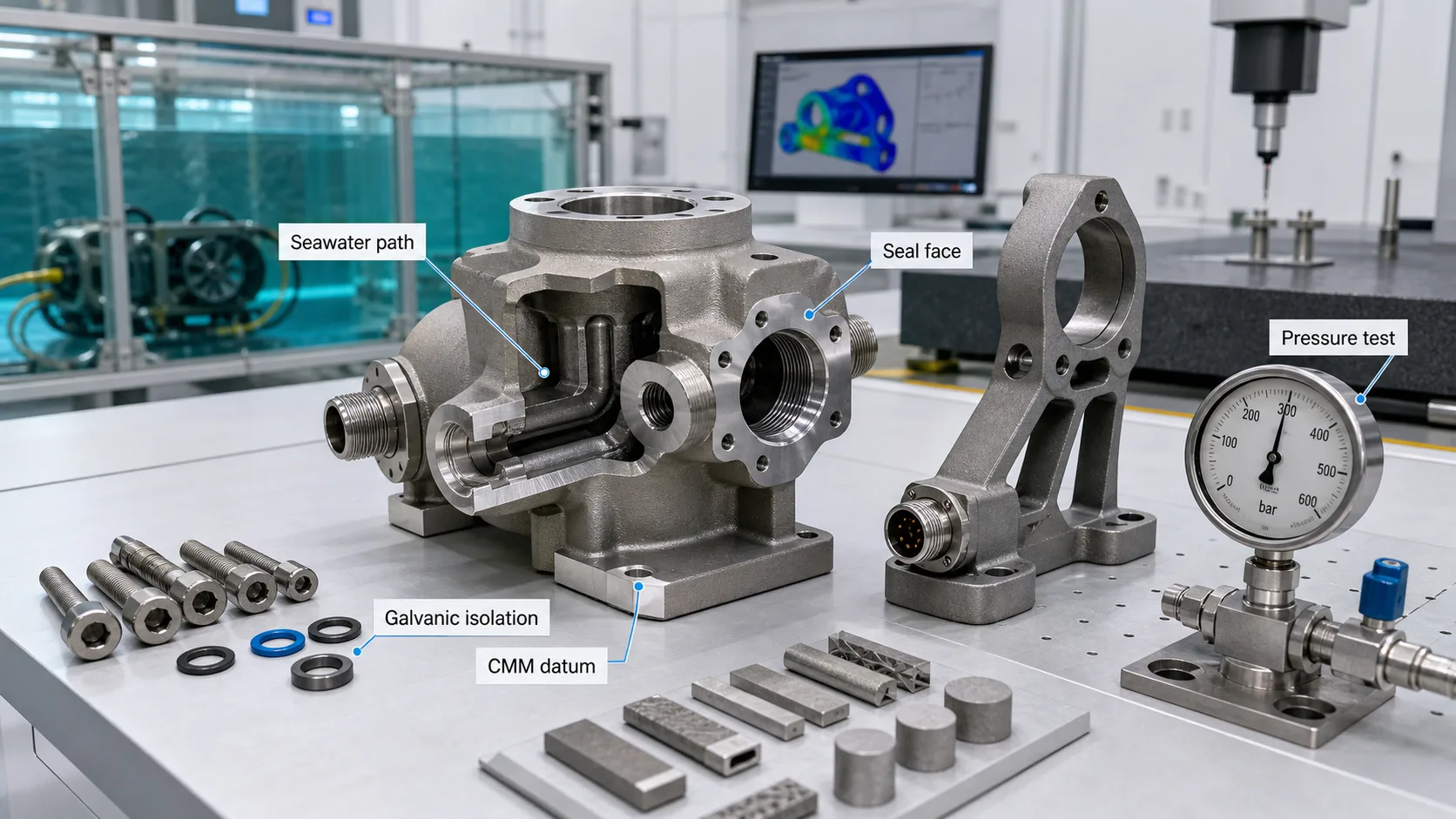
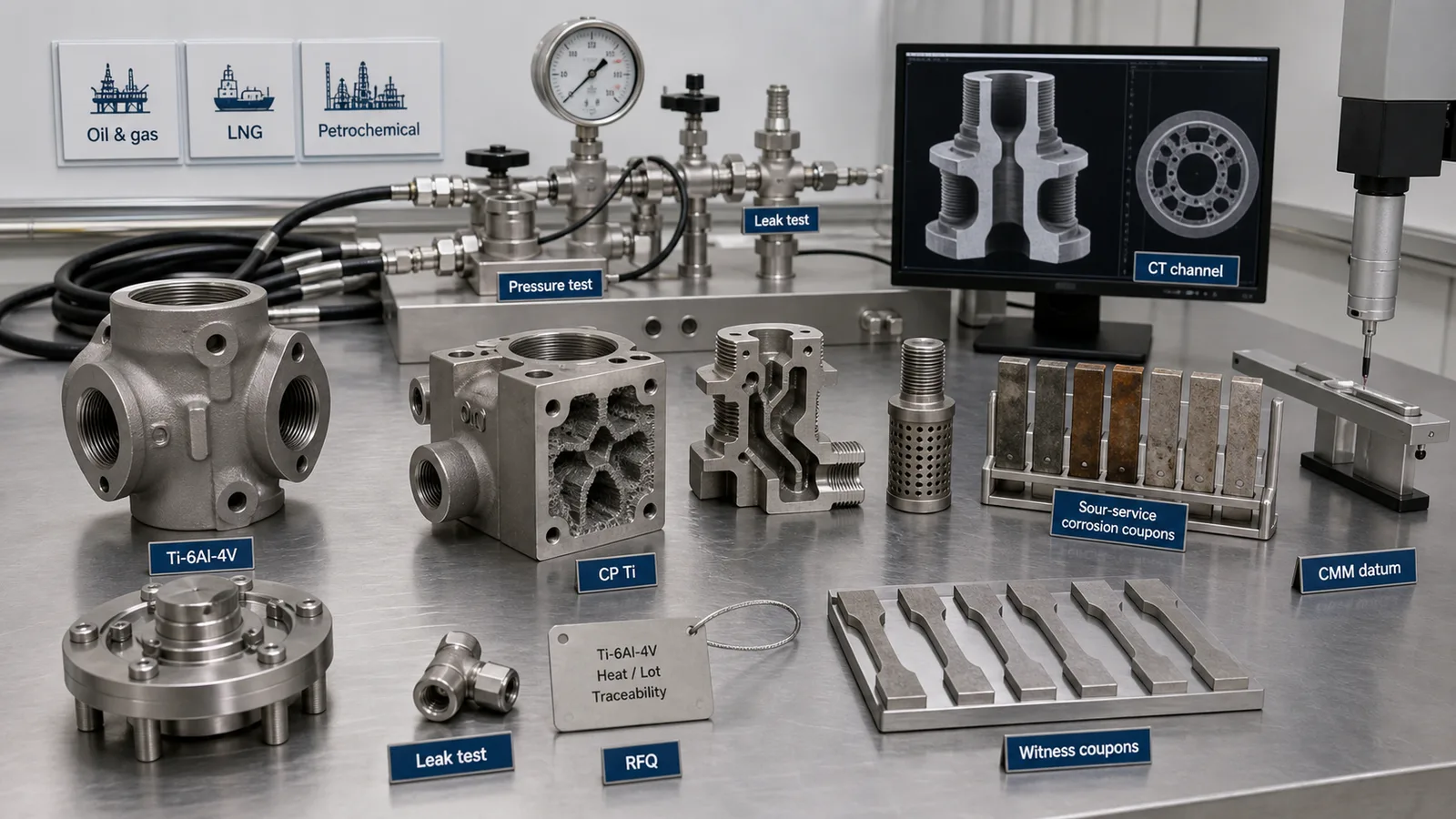
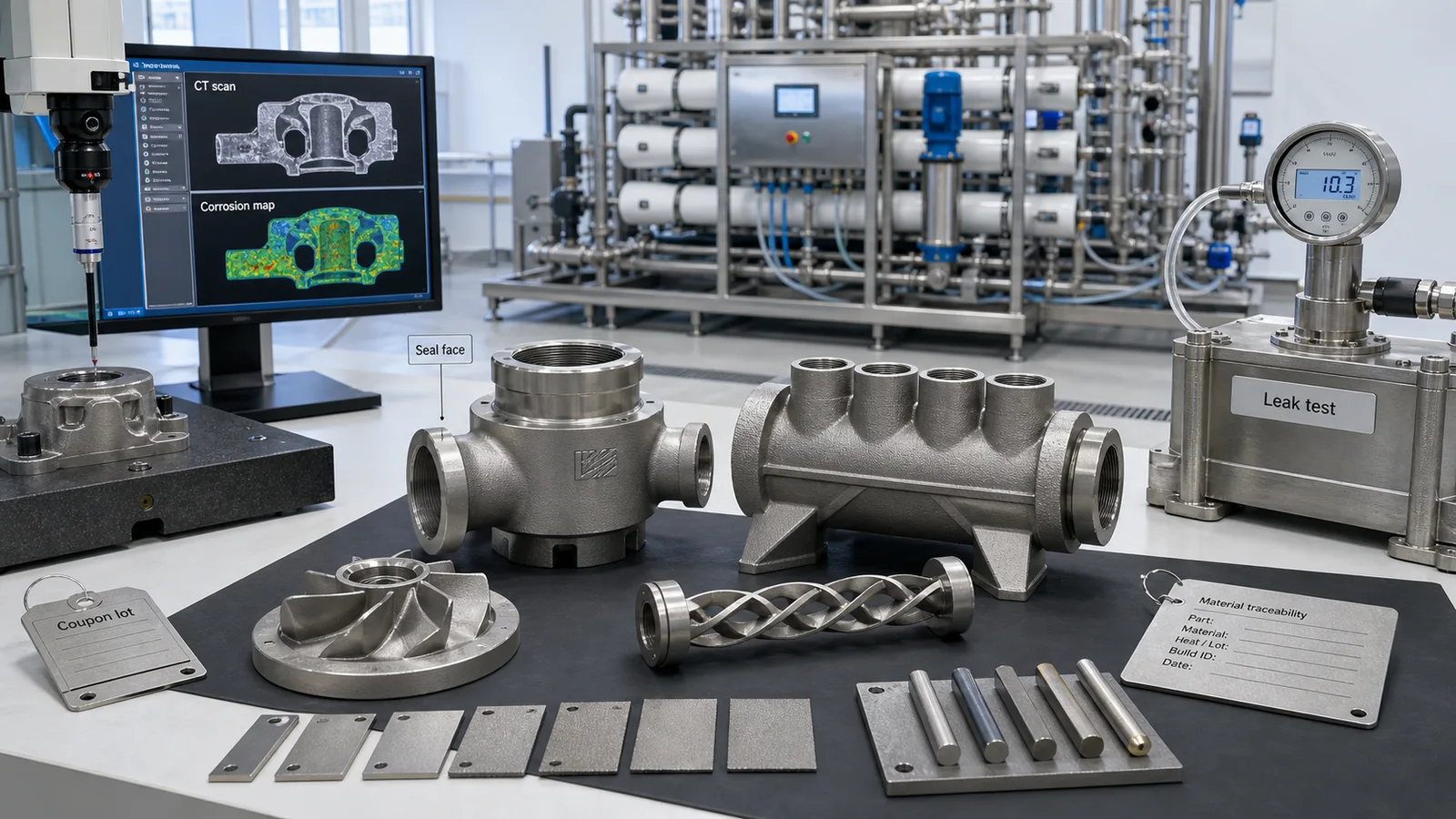
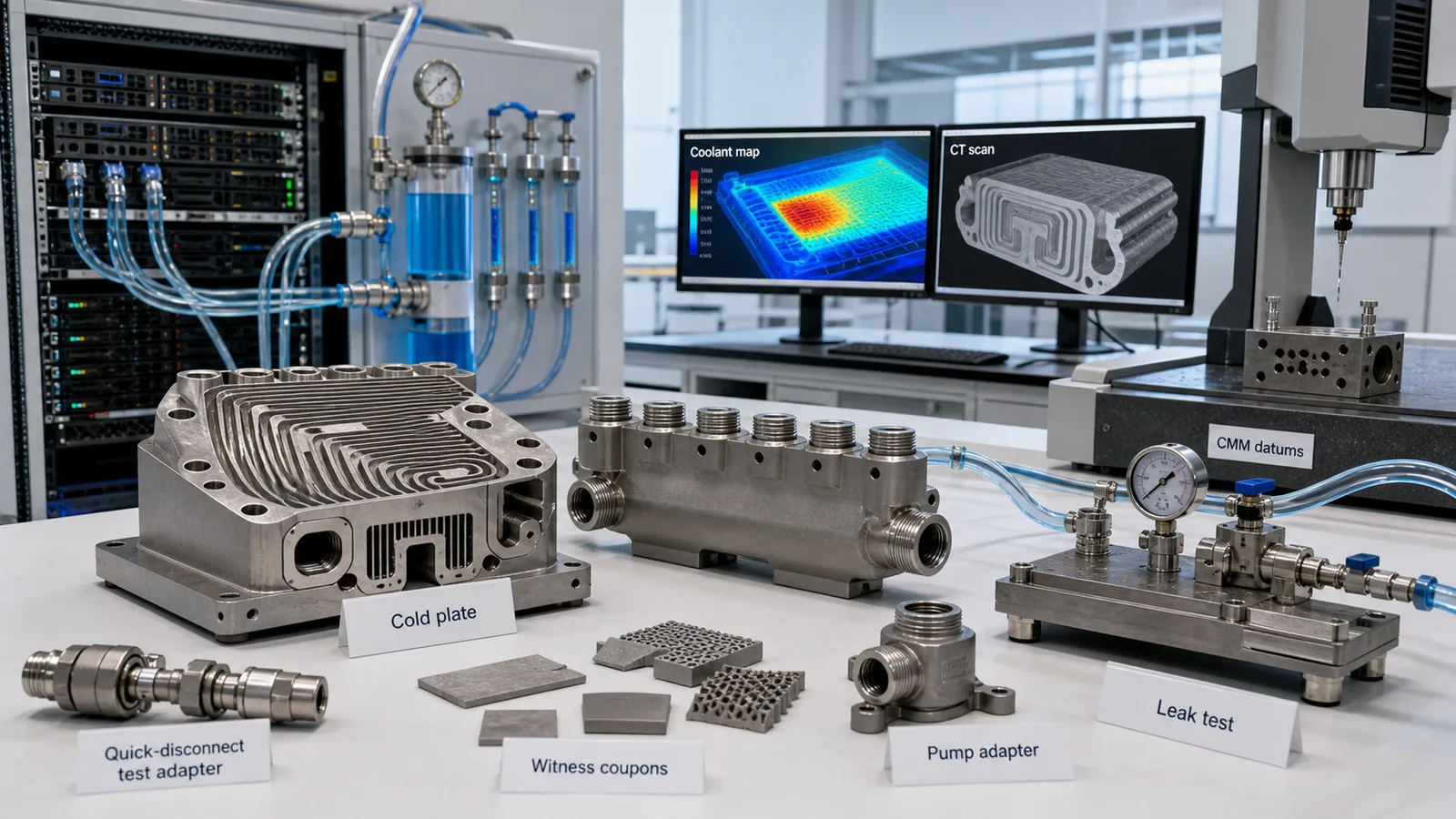
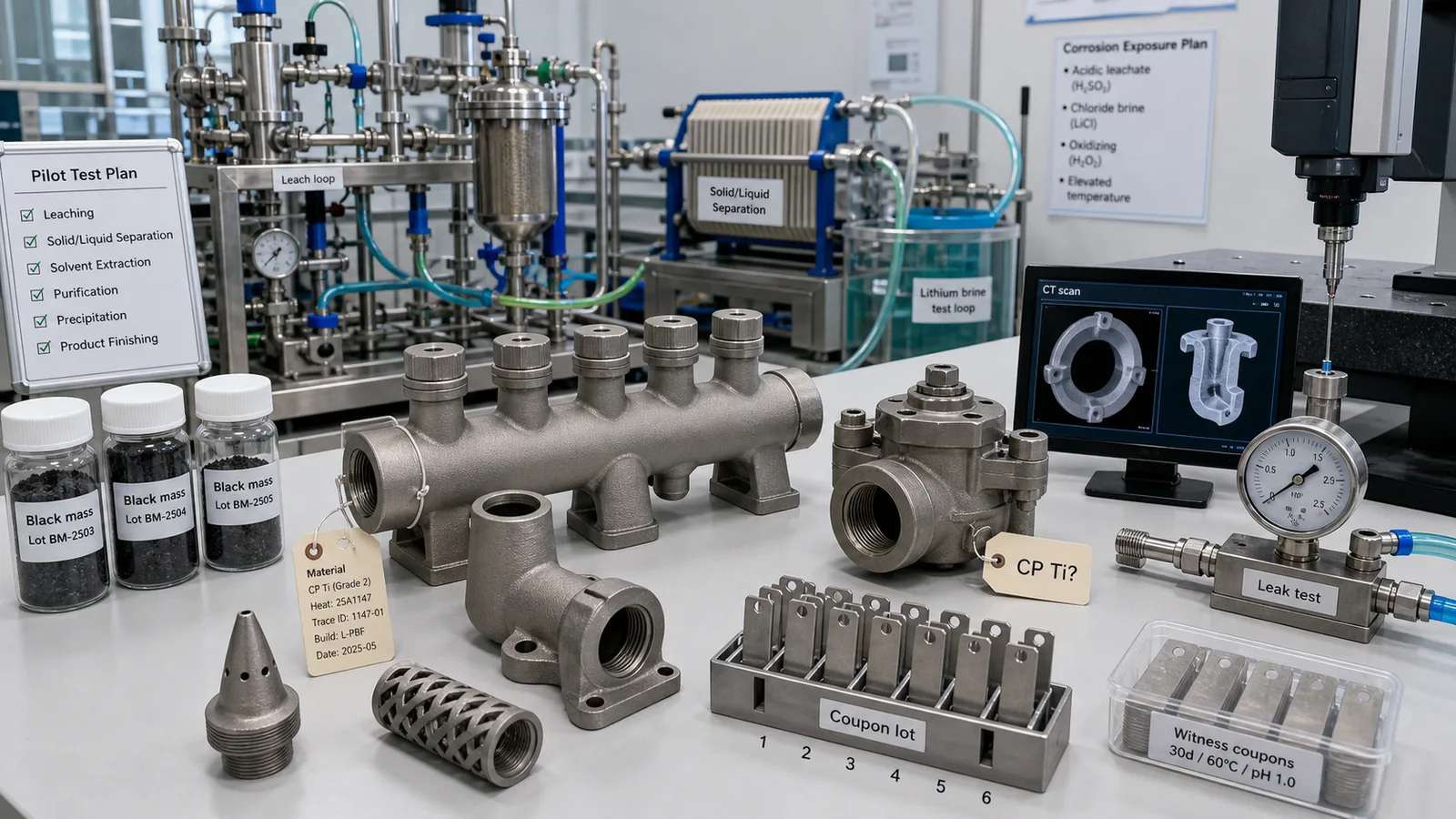
Representative article image; not a customer acceptance record or proof of a qualified manufacturing route. Refer to the cited sources and part-specific inspection records for engineering evidence.
On this page
Titanium 3D printing for marine, subsea, and offshore parts is useful when seawater exposure, compact routing, low-volume replacement, weight reduction, pressure testing, or corrosion-resistant hardware makes a conventional route slow or expensive. It is not valuable simply because a part will be used near the ocean.
Marine hardware is a rough acceptance environment. A printed titanium seawater manifold, ROV bracket, AUV sensor mount, offshore inspection fixture, pump adapter, clamp, or corrosion-resistant test component must handle seals, galvanic isolation, crevice risk, pressure testing, cleaning, CMM, CT if hidden passages matter, and documentation. If those assumptions are left out of the RFQ, the quote may cover a printed shape rather than a deployable marine part.
For a broad application map, start with Titanium 3D Printing Applications and use this guide for seawater and offshore-specific decisions. For seawater RO manifolds, brine concentration hardware, and MLD/ZLD pilot skids, use Titanium 3D Printing for Seawater Desalination and Brine Concentration Hardware. For industrial pump adapters, valve bodies, compact flow blocks, and test-loop components that overlap with marine process systems, use Titanium 3D Printing for Industrial Valves, Pump Parts, and Flow Control Hardware.
For offshore oil and gas, produced-water, LNG, and petrochemical-adjacent hardware where pressure testing, sour-service screening, API 20S, or operator documentation enters the sourcing route, use Titanium 3D Printing for Oil & Gas, LNG, and Petrochemical Hardware.
Quick Answer
Titanium additive manufacturing is worth reviewing for marine and subsea equipment when the part is compact, corrosion-exposed, interface-heavy, low-volume, lead-time-sensitive, or difficult to machine from billet.
Good candidates include:
- Seawater manifolds, valve adapters, and compact routing blocks with fewer fittings.
- ROV and AUV sensor brackets, thruster mounts, payload frames, clamps, and inspection-tool hardware.
- Offshore wind, wave, tidal, and subsea energy fixtures exposed to seawater spray or immersion.
- Pump, filter, heat exchanger, and coolant adapters where titanium compatibility matters.
- Corrosion-resistant spares for marine maintenance programs with low annual quantities.
- Test fixtures for salt-spray, pressure, flow, and immersion validation.
- Lightweight payload hardware where lower mass improves vehicle endurance or handling.
- Parts with integrated cable, hydraulic, or fluid routing when powder removal is feasible.
Weak candidates include simple plates, large noncritical covers, commodity stainless fittings, sacrificial brackets, high-volume cast parts, and any pressure or seawater path where the RFQ does not define alloy, isolation, seal faces, proof test, leak threshold, cleaning, and inspection evidence.
If the part can be made from standard tube, welded fabrication, stainless bar, polymer, composite, or a simple machined block with lower risk, use the When Not to Use Titanium Additive Manufacturing screen before requesting production pricing.
Why Marine and Subsea Hardware Is Timely in 2026
Marine hardware is not a narrow niche in 2026. Floating offshore wind, subsea power and data infrastructure, autonomous surface vessels, AUVs, ROV inspection, naval unmanned systems, offshore energy maintenance, and corrosion-resistant spares are all keeping attention on hardware that must work in seawater, salt spray, pressure, and hard-to-access service locations.
Recent public signals show the context:
- A 2025 review in Nature Reviews Clean Technology noted that floating offshore wind can more than double global offshore wind energy potential and that a floating turbine contains more than 8,000 mechanical and electrical parts.
- DNV’s Energy Transition Outlook for floating offshore wind projects floating offshore wind capacity reaching 331 GW by 2060, with deep-water projects needing long-life marine hardware and inspection strategies.
- The U.S. Navy reported in May 2026 that it selected seven companies for a MUSV at-sea test event, reflecting continued operational interest in unmanned maritime platforms.
- The U.S. Navy also described recent High North unmanned maritime system operations focused on cold, strategically important waters and critical undersea infrastructure.
These trends do not prove that a specific subsea part should be printed in titanium. They explain why engineers are asking better RFQ questions about corrosion resistance, compact design, low-volume spares, inspection evidence, and hardware that can be accepted before it goes offshore.
Where Titanium AM Fits in Marine Equipment
Titanium is not the default answer for marine hardware. Stainless steel, duplex stainless, super duplex, nickel alloys, bronze, aluminum bronze, polymers, composites, and sacrificial designs often make more sense. Titanium earns a review when its corrosion resistance, strength-to-weight ratio, low magnetic signature, compatibility, or additive geometry creates a delivered system benefit.
| Part family | Why titanium AM can help | Main RFQ risk | Evidence to define |
|---|---|---|---|
| Seawater manifold or adapter | Compact routing with fewer plugs and fittings | Powder removal and leak paths | CT or flow check, pressure test, cleaning route |
| ROV or AUV bracket | Lower mass, corrosion resistance, compact sensor geometry | Datum repeatability and fatigue | CMM, machined interfaces, load case |
| Offshore fixture or clamp | Low-volume corrosion-resistant custom hardware | Galvanic contact with other metals | Isolation plan, fasteners, surface condition |
| Pump or filter interface | Integrated ports, mounts, and seal faces | Seal quality and crevice risk | Machined seal faces, pressure test, roughness |
| Marine heat exchanger body | Channels plus corrosion-resistant structure | Internal roughness and pressure integrity | CT, flow test, pressure or leak test |
| Inspection or test tooling | Fast iteration and custom geometry | Overpaying for a noncritical tool | Risk class, finish, documentation level |
The right application is one where titanium AM reduces assembly, shortens replacement lead time, improves corrosion behavior, or makes a compact geometry possible. The wrong application is one where it adds post-processing, inspection, and documentation burden without improving the marine system.
For thermal hardware in seawater or offshore energy systems, see Titanium 3D Printed Heat Exchangers. For robot-adjacent subsea handling or sensor hardware, the motion and datum logic overlaps with Titanium 3D Printing for Robotics and Automation Parts.
Seawater Corrosion Is Not One Requirement
The phrase “seawater corrosion resistant” is too broad for a useful RFQ. A part may see continuous immersion, intermittent splash, warm seawater, stagnant crevices, cathodic protection, biofouling, galvanic contact, cleaning chemicals, erosion, pressure cycling, or offshore storage before deployment. Each condition changes the acceptance route.
Define:
- Continuous immersion, splash zone, deck exposure, lab saltwater test, or temporary deployment.
- Temperature, salinity, oxygen level, flow velocity, and stagnant regions if known.
- Contact with stainless steel, carbon steel, aluminum, copper alloys, composites, elastomers, or coated parts.
- Whether cathodic protection, sacrificial anodes, coatings, or isolation washers are present.
- Whether crevices, gasket interfaces, blind pockets, or trapped fluid regions are acceptable.
- Whether the part is structural, pressure-containing, flow-carrying, or only a support bracket.
- Cleaning route after printing and before marine assembly.
Do not specify titanium only as a material name. Specify the exposure, contact metals, seals, and acceptance test that make titanium the right choice.
Galvanic Isolation Can Decide the Design
Titanium can behave well in seawater, but the assembled system may still fail if dissimilar metals are connected without a plan. A titanium bracket bolted to aluminum or carbon steel, a titanium manifold with stainless fasteners, or a titanium fixture touching copper alloy hardware can create galvanic conditions that matter more than the printed geometry.
RFQs should define:
- Mating materials and fastener materials.
- Isolation washers, sleeves, gaskets, coatings, or sealants.
- Whether electrical continuity is required or must be avoided.
- Cathodic protection assumptions.
- Inspection and maintenance access.
- Surface finish and coating compatibility.
- Whether the supplier is responsible for the isolation stack or only the titanium part.
Weak wording:
Quote this titanium seawater bracket.
Better wording:
Quote this Ti-6Al-4V or CP titanium bracket for intermittent seawater immersion. It bolts to an aluminum frame and uses stainless fasteners. Please include a galvanic isolation recommendation, machined datum faces, fastener-hole finishing assumptions, surface condition, cleaning route, and any changes needed to avoid trapped seawater crevices.
That wording gives the supplier a real engineering target instead of a material label.
Pressure, Seals, and Leak Testing
Subsea and offshore parts often combine corrosion exposure with pressure or leak requirements. A printed titanium manifold, pump adapter, housing, or pressure-test fixture should not be accepted because it looks dense. It needs a test plan tied to the actual function.
Define:
- Working pressure, proof pressure, and pressure cycling.
- Seawater, hydraulic fluid, air, nitrogen, process fluid, coolant, or test fluid.
- Leak-test method, allowable leakage, hold time, and fixture method.
- Whether testing occurs before or after final cleaning and finishing.
- Which faces are machined seal faces and which surfaces may remain as-built.
- O-ring, gasket, metal seal, threaded fitting, flange, or custom interface assumptions.
- Whether CT, pressure test, flow test, or a simpler development check is required.
Do not rely on as-built surfaces for sealing. Add machining stock to seal faces, ports, O-ring grooves, gasket lands, and datum pads. The article on Titanium 3D Printing Tolerances: Datum Planning and CMM covers the drawing and measurement side of that decision.
Internal Seawater Paths and Cleaning
Internal channels can make marine titanium AM attractive. They can replace drilled cross-holes, plugs, welded fittings, external tubes, and bulky manifolds. They can also create powder traps, biofouling traps, pressure-drop uncertainty, and cleaning problems.
High-risk features include:
- Blind seawater channels with no powder exit.
- Small restrictions that partially sintered powder can block.
- Sharp corners where sediment, salt, or biological material can collect.
- Parallel passages with no flow-balance check.
- Thin walls between fluid circuits.
- Sealed lattice or weight-reduction cavities connected to wet regions.
- Threaded ports that intersect rough as-built internal features.
- Drain paths that trap seawater after recovery.
If the channel is functional, define powder removal, accepted internal roughness, flow test, pressure drop, and CT assumptions early. For hidden flow paths, use Titanium 3D Printed Internal Channels: Powder Removal and CT before freezing the geometry.
For marine hydraulic blocks, valve adapters, pressure-tested manifolds, and compact fluid-power bodies, use Titanium 3D Printing for Hydraulic Manifolds and Fluid Power Components to connect sealing, cleaning, CT, CMM, and leak-test requirements.
ROV and AUV Hardware: Weight, Stiffness, and Access
ROV and AUV parts can be good titanium AM candidates when packaging is tight and the annual quantity is low. Sensor brackets, thruster adapters, camera mounts, manipulator fixtures, cable guides, acoustic payload supports, and recovery hardware may benefit from corrosion resistance and lower mass.
The engineering target should be practical:
- Lower vehicle mass or easier handling.
- Better stiffness at a sensor or payload interface.
- Fewer fasteners and fewer trapped-crevice regions.
- Cleaner cable, hydraulic, or fluid routing.
- Machined datum faces for repeatable payload installation.
- Corrosion resistance without painting every local feature.
- Replacement geometry for obsolete or low-volume hardware.
The weak case is a simple bracket where aluminum, polymer, stainless, or composite is already good enough. Titanium AM should earn its place through corrosion, mass, stiffness, packaging, or lead-time value.
For repeated acceleration, vibration, handling impact, or launch-and-recovery loads, pair this section with Titanium 3D Printing Fatigue Design.
Material Selection: Ti-6Al-4V, ELI, or CP Titanium
Ti-6Al-4V is often the first titanium AM review route because it is widely available, strong, and familiar to many LPBF suppliers. Ti-6Al-4V ELI may be considered when ductility, fracture behavior, or a specific acceptance basis matters. CP titanium may be relevant when corrosion behavior, ductility, or chemical compatibility matters more than high strength.
When CP titanium is the target, review Grade 2, TA2, and TA2G commercially pure titanium AM requirements before design freeze. The page explains why a material alias, wrought certificate, or mature Ti-6Al-4V parameter set is not enough to control the printed component.
Material choice should follow:
- Seawater exposure: immersion, splash, stagnant crevice, or lab test.
- Load, pressure, vibration, and fatigue.
- Mating materials and galvanic isolation plan.
- Seal, gasket, and fastener assumptions.
- Whether the part needs coating, passivation, polishing, or special cleaning.
- Supplier process capability and material traceability.
- Required COA, COC, heat-treatment record, build record, and powder lot.
For alloy comparison, use Titanium AM Material Selection: Ti-6Al-4V, ELI, and CP Titanium. Do not let every supplier quote a different titanium grade under the same seawater part number.
Process Choice: LPBF Usually Leads for Compact Parts
LPBF is usually the first process reviewed for compact marine titanium parts because it supports fine geometry, manifolds, brackets, internal channels, and low-volume precision hardware. EBM may be considered when geometry, surface expectations, and supplier capability fit. DED is usually a better conversation for larger near-net shapes, repair, or machining-stock parts rather than small sealed channels.
Process choice affects:
- Minimum channel size and powder-removal feasibility.
- As-built surface texture in wet or seal-adjacent regions.
- Support contact on fatigue, seal, or cosmetic surfaces.
- Distortion near flat datum faces.
- Stress relief, HIP, machining, finishing, and cleaning sequence.
- CT, CMM, leak test, pressure test, coupons, and traceability.
- Cost and lead time.
Use Titanium AM Process Selection: LPBF vs EBM vs DED when the supplier should recommend the route instead of only quoting a process named on the drawing.
DfAM Rules for Marine and Subsea Parts
DfAM for marine hardware should reduce corrosion, pressure, cleaning, and inspection risk. It should not only make the part look optimized.
Useful rules include:
- Keep supports away from seal faces, gasket lands, threads, fatigue surfaces, and machined datums.
- Add machining stock to ports, seal faces, bolt pads, and datum features.
- Avoid blind seawater cavities and internal features that cannot drain or be cleaned.
- Use smooth internal transitions to reduce powder and sediment traps.
- Separate functional flow paths from weight-reduction cavities.
- Avoid unnecessary lattices in wet regions unless they are inspectable and cleanable.
- Plan galvanic isolation features early, not after the first printed lot.
- Keep crevice-prone interfaces accessible for inspection and maintenance.
- Define no-support regions before the supplier selects build orientation.
The broader support, overhang, trapped-powder, and thin-wall rules are covered in Titanium DfAM Rules for LPBF and EBM.
Surface Finish, Post-Processing, and Marine Cleaning
As-built titanium AM surfaces are not equivalent to machined, polished, or cast surfaces. Rough surfaces can trap salt, sediment, biological material, and cleaning residue. They can also affect seal behavior, fatigue, and pressure testing.
Separate surfaces by function:
- Seal faces, O-ring grooves, and gasket lands that need machining.
- Threaded ports and fitting interfaces that need final machining or tapping.
- Wetted internal paths where roughness affects cleaning or pressure drop.
- Fatigue or pressure-cycle surfaces where support scars are unacceptable.
- Datum faces and bolt pads that need CMM control.
- Exterior surfaces that may remain as-built.
- Surfaces that need passivation, coating, polishing, or controlled packaging.
Post-processing may include stress relief, HIP where justified, machining, blasting, polishing, passivation, coating, cleaning, drying, and packaging. The right route depends on exposure and acceptance risk. Use Post-Processing for Titanium 3D Printing when defining delivered condition.
Inspection Evidence: Match the Deployment Risk
Marine titanium AM parts can be over-tested or under-tested. A lab saltwater fixture does not need the same evidence as a pressure-carrying subsea manifold. A simple ROV camera bracket does not need the same CT scope as a hidden multi-circuit seawater path.
Typical evidence includes:
- CMM report for datums, seal faces, ports, bolt patterns, and mounting interfaces.
- CT inspection for internal channels, wall thickness, trapped powder, or hidden defects where risk justifies it.
- Pressure or leak test for flow-carrying or pressure-retaining parts.
- Flow or pressure-drop test where channel openness affects function.
- Surface roughness checks on seal, fatigue, or wet-contact regions.
- Inspection photos for support removal, machined features, and critical surfaces.
- Material certification, COA, COC, heat-treatment record, build record, powder lot, and traceability.
- Saltwater, immersion, or corrosion testing when the project requires its own acceptance basis.
Use Titanium AM Qualification and Inspection Evidence to choose evidence by risk class. A quote that includes no evidence may be cheap because it is incomplete.
Cost: Compare Delivered Offshore Hardware
Titanium AM can reduce assembly count, shorten replacement lead time, and create compact seawater hardware. It can also hide cost in post-processing, testing, and documentation.
Cost drivers include:
- Build orientation and support strategy.
- Support removal from ports, ribs, and internal openings.
- Stress relief, HIP if justified, and heat treatment.
- Machining of seal faces, ports, threads, gasket lands, and datum pads.
- Galvanic isolation hardware and fastener selection.
- Coating, passivation, finishing, cleaning, drying, and packaging.
- CT, CMM, leak testing, pressure testing, flow testing, and roughness checks.
- Rework if powder, salt, or cleaning residue remains in a hidden path.
- Revision iteration during offshore tool integration.
Control cost before geometry is frozen. Remove unnecessary sealed cavities, keep channels cleanable, machine only functional surfaces, define galvanic contact conditions, and request evidence by risk. For quote normalization, use Titanium 3D Printing Cost Drivers: How to Reduce RFQ Price and the Titanium AM RFQ and Procurement Guide.
Better RFQ Wording
Weak RFQ:
Please quote this titanium 3D printed subsea part.
Better RFQ:
Please review this titanium AM component for intermittent seawater immersion on an ROV-mounted inspection tool. The part includes a functional seawater path and machined sensor datums. Critical features are the machined seal face, threaded ports, bolt pattern, galvanic isolation points, and two CMM datum pads. Please identify alloy recommendation, support strategy, machining stock, powder-removal access, cleaning route, pressure-test method, CMM scope, CT or flow-test recommendation for the internal channel, material traceability, and any DfAM changes needed before quotation. Quote the delivered accepted part, not only the printed shape.
That wording helps the supplier price the route that matters: print, stress relieve, depowder, machine, clean, inspect, test, document, and package.
Marine Titanium AM RFQ Checklist
Send the supplier:
- STEP file and drawing with datums, section views, and critical surfaces.
- Target alloy, material condition, and whether substitutions are allowed.
- Quantity, prototype or production intent, and target lead time.
- Exposure: immersion, splash, salt spray, lab seawater, offshore deck, or subsea deployment.
- Mating materials, fasteners, coatings, cathodic protection, and galvanic isolation requirements.
- Working pressure, proof pressure, leak threshold, flow rate, and test method if the part carries fluid.
- Functional interfaces: seal faces, gasket lands, O-ring grooves, ports, threads, bolt holes, sensor datums, and mounting pads.
- Internal channel details: minimum feature size, blind regions, powder-removal access, accepted roughness, and cleaning route.
- Post-processing expectations: stress relief, HIP if justified, machining, coating, finishing, passivation, cleaning, drying, and packaging.
- Inspection scope: CMM, CT, pressure test, leak test, flow test, roughness, coupons, COA, COC, build record, powder lot, and inspection photos.
- Permission for supplier DfAM changes before final pricing.
If the RFQ does not define exposure, contact metals, sealing, pressure, cleanliness, and evidence, suppliers may quote very different products under the same part number.
When to Redesign or Avoid Titanium AM
Redesign before quotation when:
- Seawater channels have no practical powder exit or drain path.
- Seal faces, gasket lands, or threaded ports lack machining stock.
- Mating metals create galvanic risk but no isolation plan exists.
- Internal roughness controls cleaning or pressure drop, but no flow or finishing route is defined.
- CT cannot resolve the smallest critical feature.
- Pressure testing is required but pressure, method, threshold, and port sealing are vague.
- A simple machined or fabricated part would meet the requirement with lower risk.
Avoid titanium AM when standard stainless, duplex, bronze, polymer, composite, welded fabrication, or conventional machining meets the seawater, cost, lead-time, and evidence requirements with lower risk.
Bottom Line
Titanium 3D printing can be valuable for marine, subsea, and offshore parts when it solves a real hardware problem: compact seawater routing, fewer leak paths, corrosion resistance, lower vehicle mass, faster low-volume replacement, or documented test hardware. The strongest candidates are manifolds, ROV and AUV brackets, sensor mounts, pump adapters, marine heat exchanger bodies, inspection tooling, and corrosion-resistant fixtures where exposure, galvanic contact, sealing, machining, cleaning, and evidence are planned from the start.
The weak cases are simple shapes, commodity fittings, sacrificial brackets, high-volume cast parts, and any seawater or pressure path where the RFQ ignores powder removal, surface finish, isolation, leak testing, and traceability.
For an RFQ review, send CAD, drawing, exposure map, mating materials, pressure and leak requirement, target alloy, quantity, post-processing expectations, and inspection scope through the RFQ inputs page or email info@szcomo.com.
- Marine
- Subsea
- Offshore
- Seawater corrosion
- Rov
- Auv
- Leak testing
- RFQ