· Updated - TITANIUM 3DP Engineering - Engineering Guides - 17 min read
Titanium 3D Printing for Carbon Capture and Direct Air Capture Hardware
Engineering RFQ guide for titanium 3D printed carbon capture and direct air capture hardware, covering solvent and sorbent loops, CO2 manifolds, vacuum regeneration, heat-transfer test bodies, leak testing, CT, CMM, and traceability.
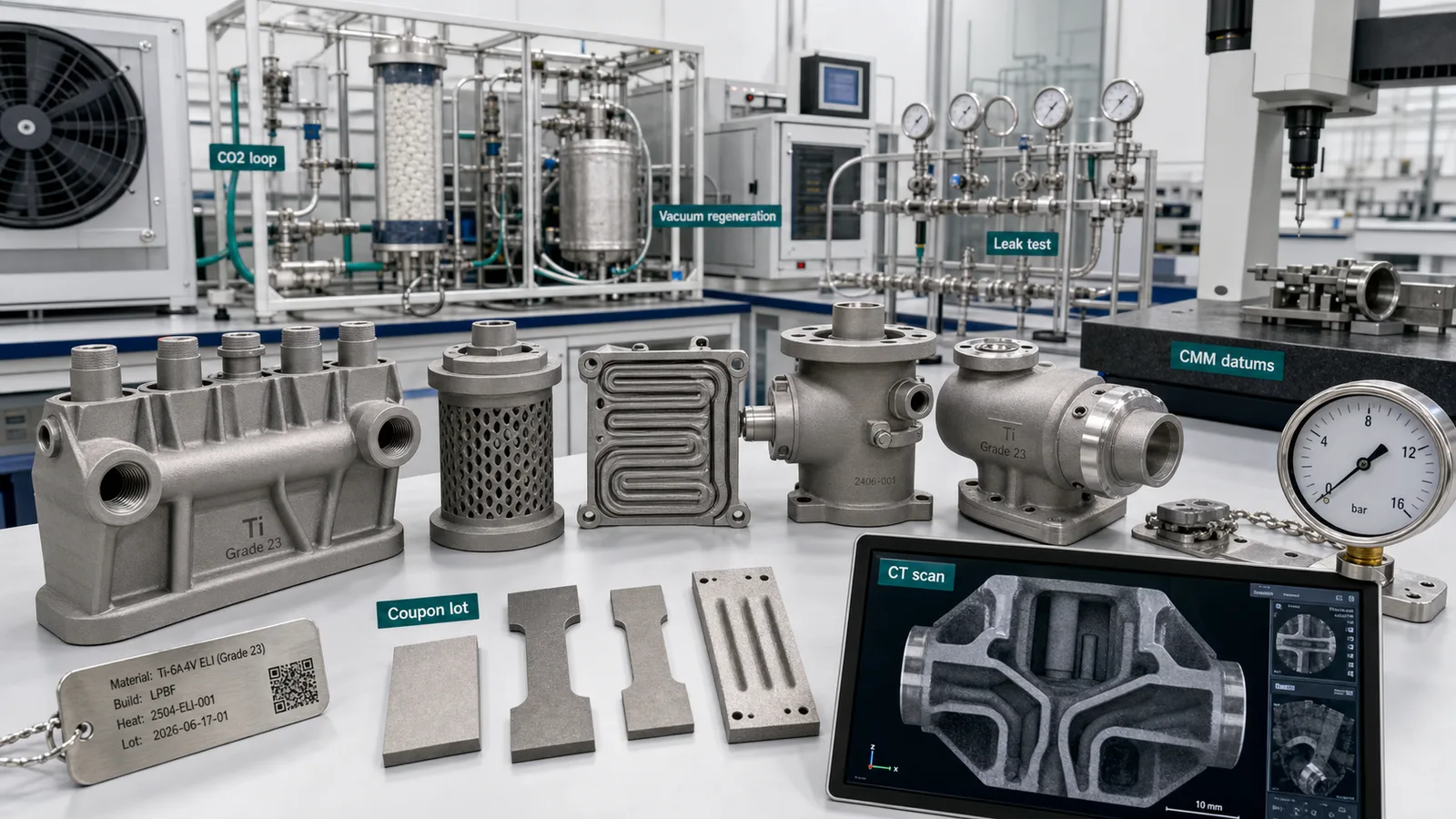
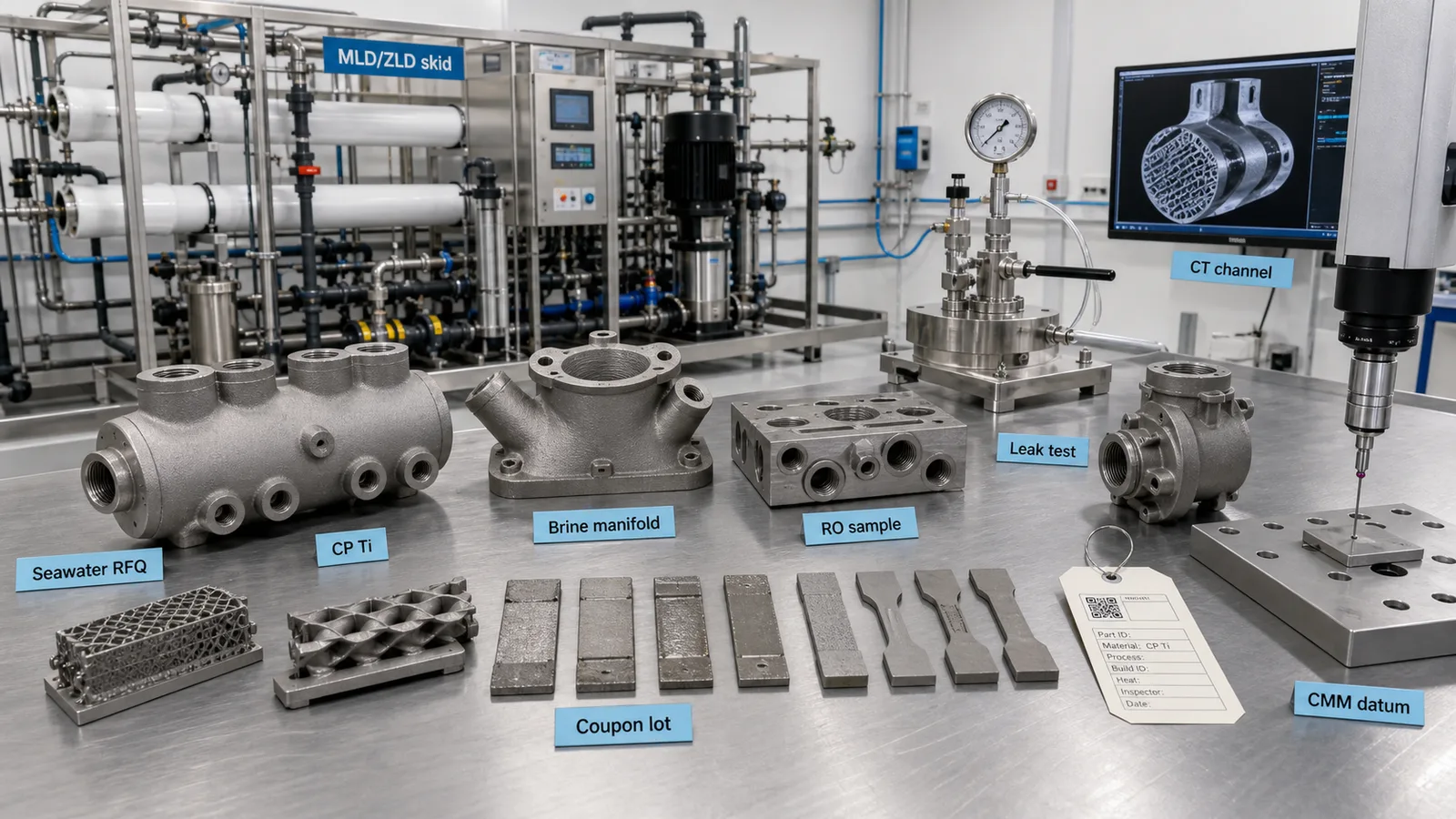
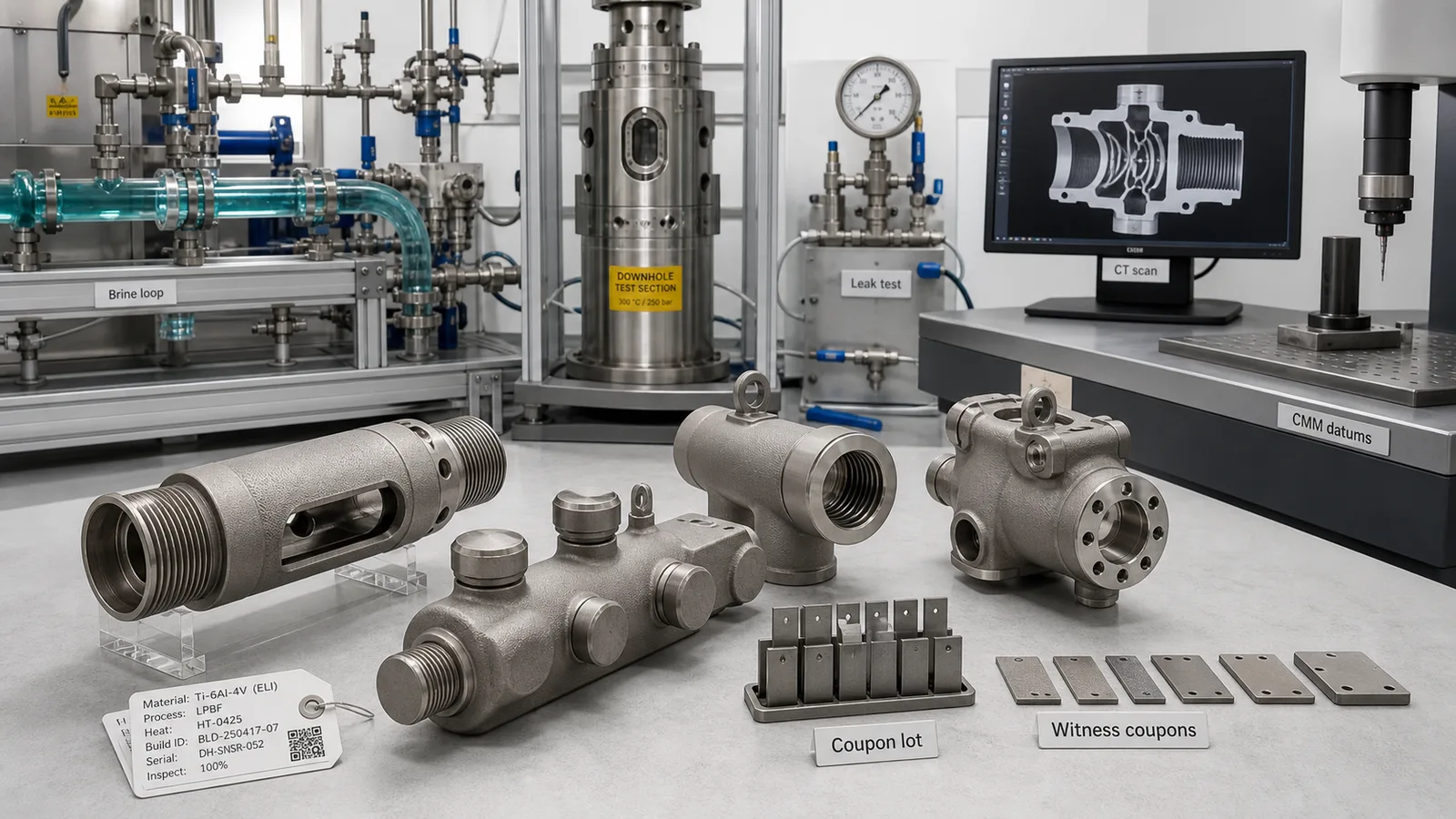
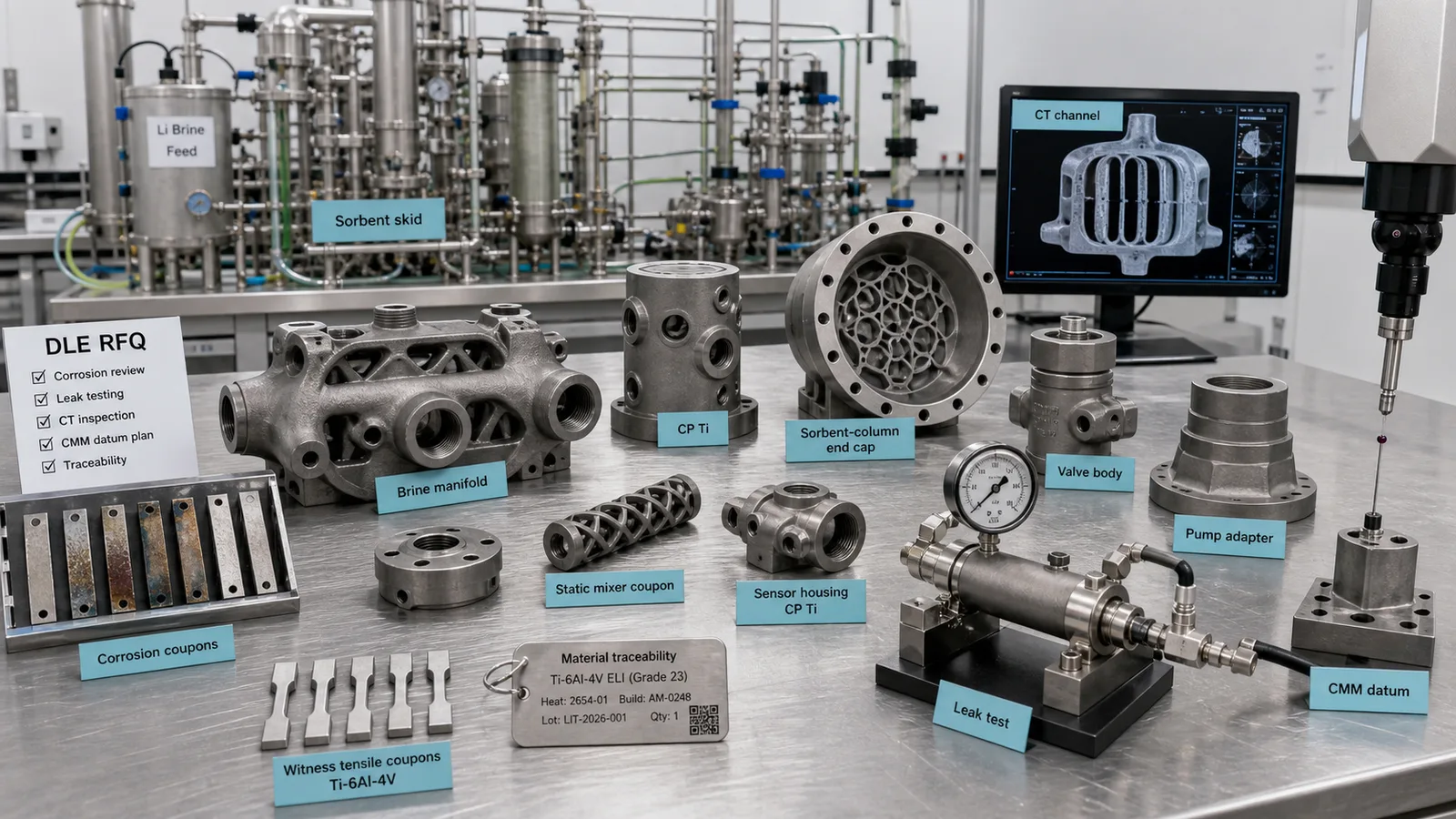
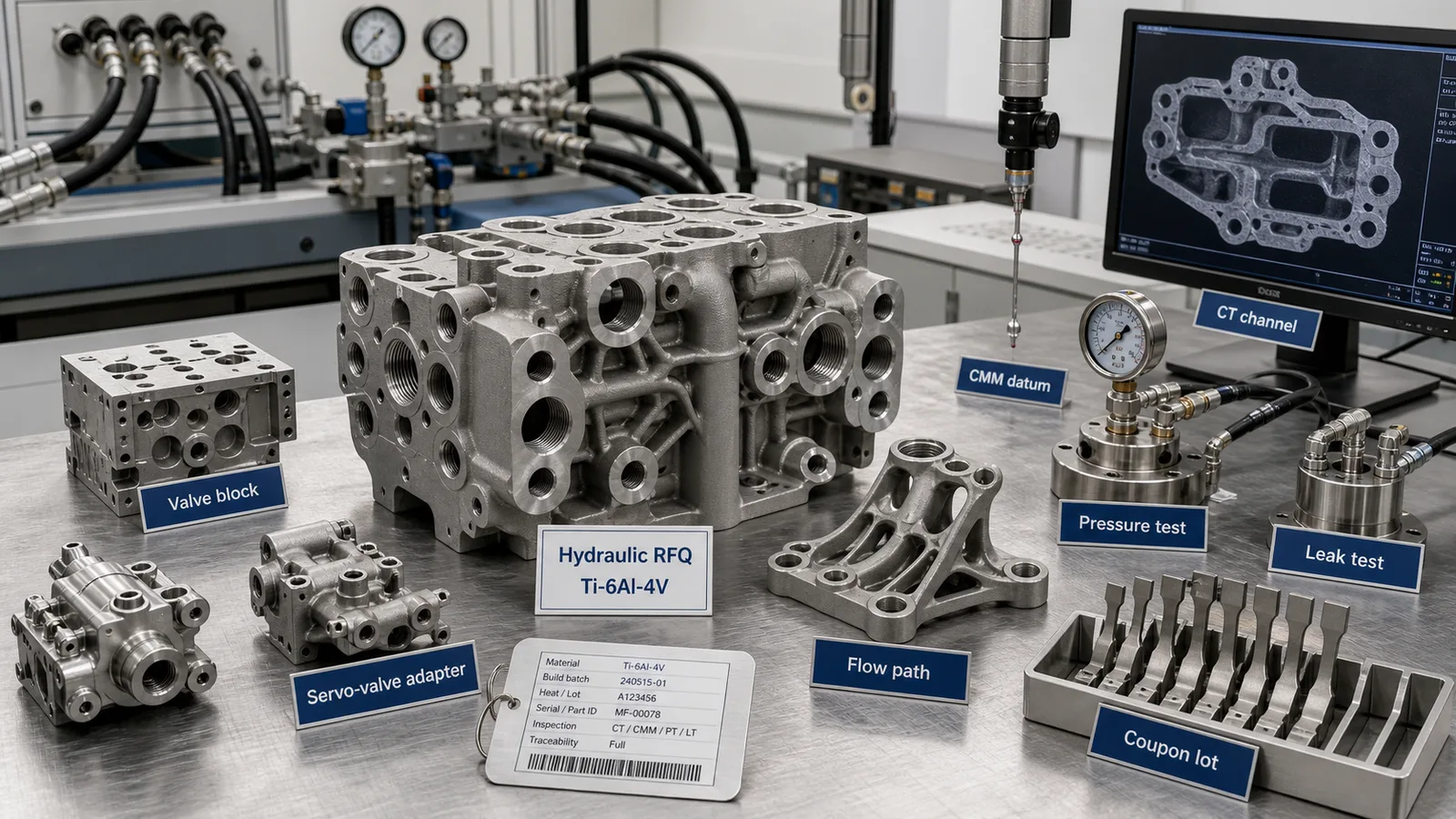
Representative article image; not a customer acceptance record or proof of a qualified manufacturing route. Refer to the cited sources and part-specific inspection records for engineering evidence.
On this page
Titanium 3D printing for carbon capture and direct air capture hardware is worth reviewing when corrosive process media, compact routing, vacuum or pressure cycling, low-volume pilot hardware, fewer leak paths, or difficult heat-transfer geometry creates a real engineering advantage. It is not a default replacement for stainless process equipment, polymer ducting, copper heat spreaders, large vessels, or catalog CO2 handling components.
The strongest RFQs treat a printed titanium solvent manifold, sorbent cartridge adapter, CO2 sample block, vacuum regeneration test body, heat-exchanger coupon, pump adapter, valve body, or corrosion coupon fixture as delivered process hardware. That means the quote must cover media exposure, titanium grade, seal faces, cleaning, pressure or leak testing, CT when hidden channels matter, CMM, material records, and traceability.
For the broader corrosion and process-fluid framework, start with Titanium 3D Printing for Chemical Processing and Water Treatment Parts. For pump adapters, valve bodies, static mixers, nozzles, and flow-control hardware shared across process industries, use Titanium 3D Printing for Industrial Valves, Pump Parts, and Flow Control Hardware. For thermal components, pair this guide with Titanium 3D Printed Heat Exchangers. Use this page for carbon-capture- and direct-air-capture-specific RFQ decisions.
For carbon capture hardware attached to refinery, LNG, gas-processing, or petrochemical systems, also review Titanium 3D Printing for Oil & Gas, LNG, and Petrochemical Hardware before defining pressure, leak, sour-service, and operator documentation requirements.
Quick Answer
Titanium additive manufacturing is a practical candidate for carbon capture and DAC hardware when the part is compact, corrosion-exposed, interface-heavy, prototype-intensive, or improved by cleanable internal routing that conventional machining cannot deliver efficiently.
Good candidates include:
- Solvent-loop manifolds, dosing blocks, sample blocks, and compact CO2 process adapters for pilot systems.
- Sorbent cartridge adapters, vacuum regeneration test bodies, and lab-scale direct air capture fixtures.
- Heat-transfer coupons, compact heat exchanger samples, and thermal-cycle test bodies.
- Pump, valve, filter, separator, and analytical-instrument adapters where custom routing matters.
- Leak-test, pressure-test, and vacuum-test fixtures for carbon capture development programs.
- Corrosion coupon racks and exposure fixtures for comparing CP titanium, Ti-6Al-4V, stainless, nickel alloy, polymers, coatings, or lined hardware.
- Internal-channel demonstrators where CT, flow testing, and cleaning evidence are part of the development plan.
Weak candidates include large absorber columns, broad ductwork, fan housings, commodity pipe spools, simple plates, high-volume molded parts, and any pressure, vacuum, or chemical-contact part where the RFQ does not define media chemistry, temperature, pressure, vacuum level, seal faces, leak threshold, cleaning route, and documentation.
If a machined block, welded fabrication, stainless steel, nickel alloy, lined steel, polymer, ceramic, copper, aluminum, or catalog process component meets the duty with lower cost and clearer acceptance, use the When Not to Use Titanium Additive Manufacturing screen before requesting production pricing.
Why Carbon Capture Hardware Is Timely in 2026
Separate solvent-wetted parts, sorbent interfaces, regeneration hardware, vacuum connections, and non-process fixtures before requesting a quote. The useful output is an exposure and acceptance map for one component, not a general claim that titanium suits every carbon-capture process.
Recent public signals show the context:
- The IEA’s 2026 commentary on CCUS policy and financing momentum says project momentum continued despite delays, with operational and under-construction CO2 capture capacity over 10% higher in 2025 and CO2 storage capacity up about 25%.
- The IEA’s CCUS project database is updated regularly and tracks large-scale capture, transport, storage, and utilization projects worldwide.
- DOE’s Direct Air Capture explainer describes DAC as a way to remove CO2 directly from ambient air using liquid solvents or solid sorbents, then regenerate and concentrate the CO2 stream.
- DOE’s Carbon Negative Shot Strategy keeps a long-term cost and scale target in public view for carbon dioxide removal pathways.
- DOE’s Regional Direct Air Capture Hubs program frames DAC hubs as integrated systems that can capture CO2 from the atmosphere and store or convert it.
- DOE’s Carbon Capture Large-Scale Pilot Projects program focuses on moving carbon capture technologies from lab scale toward pilot and commercial-scale demonstration.
These sources do not mean every CCUS or DAC part should be printed in titanium. They explain why buyers are asking sharper RFQ questions about solvent compatibility, sorbent-loop hardware, heat management, leak testing, vacuum regeneration, internal-channel evidence, and documented material condition.
Where Titanium AM Fits in Carbon Capture Hardware
Carbon capture hardware spans many environments: flue gas pretreatment, solvent absorption, solid sorbent contactors, regeneration, compression, drying, CO2 measurement, heat integration, corrosion testing, pilot skids, and lab fixtures. Titanium AM only fits selected points in that chain.
| Part family | Why titanium AM can help | Main RFQ risk | Evidence to define |
|---|---|---|---|
| Solvent manifold or dosing block | Compact routing, fewer fittings, sensor ports | Chemistry and residue control | Exposure map, cleaning route, leak test |
| DAC sorbent cartridge adapter | Low-volume geometry and integrated ports | Seal leakage and vacuum cycling | Machined seals, leak test, CMM |
| Vacuum regeneration body | Compact test hardware and thermal routing | Leak rate, distortion, and cleaning | Vacuum/leak test, CMM, surface condition |
| Heat-transfer coupon or thermal block | Internal channels and test iteration | Powder removal and thermal duty | CT, flow test, pressure or leak test |
| Pump or valve adapter | Custom pilot-skid interfaces | Seal faces, threads, and corrosion | Machining plan, roughness, CMM |
| Analytical sample block | Integrated taps and short flow paths | Dead legs and contamination | Cleaning route, material records, inspection photos |
| Coupon rack or exposure fixture | Matched titanium exposure hardware | Over-specifying a simple holder | Alloy, finish, coupon lot traceability |
The best candidates are not generic “carbon capture parts.” They are compact process components where additive geometry reduces leak paths, integrates sampling or sensor features, shortens pilot-line iteration, or makes a cleanable corrosion-resistant flow path practical.
For hydrogen production sites that include CO2 capture, see Titanium 3D Printing for Hydrogen Electrolyzer and Fuel Cell Parts. For coolant or facility water loops around capture skids, use the water-treatment and AI data center liquid-cooling hardware guides as adjacent coolant-compatibility references.
Start With the Media and Duty Map
“Carbon capture service” is not a material requirement. A useful quote needs the process media, duty cycle, and acceptance basis. Solvent capture, solid sorbent DAC, carbonate chemistry, amine systems, humid CO2, dry CO2, oxygen, acid gas impurities, water wash, vacuum regeneration, and thermal cycling can create different material and cleaning assumptions.
Define:
- Capture route: post-combustion solvent, DAC solvent, DAC sorbent, membrane test, mineralization test, CO2 compression support, lab fixture, or pilot-skid hardware.
- Media chemistry: amine, carbonate, hydroxide, water, inhibitor, degradation product, acid gas impurity, oxygen, chloride, solvent, rinse water, or CO2 stream if known.
- Fluid state: gas, vapor, condensate, liquid, slurry, wet solid sorbent, dry sorbent, or mixed phase.
- Temperature, pressure, vacuum level, thermal cycling, pressure cycling, flow rate, and duty cycle.
- Cleaning chemistry, drying route, drainability, stagnation, and residue tolerance.
- Mating materials: stainless, nickel alloy, copper, aluminum, polymer, elastomer, gasket, coating, liner, sorbent media, or instrument tubing.
- Acceptance tests: leak, pressure hold, vacuum hold, flow, cleaning verification, roughness, CMM, CT, coupon evidence, or project-specific qualification.
Do not ask for titanium only as a corrosion-resistant material label. Ask for the titanium grade, delivered condition, exposed surfaces, cleaning route, and evidence package that match the process duty.
Solvent and Sorbent Systems Need Different Designs
Liquid-solvent capture hardware and solid-sorbent DAC hardware can look similar in CAD, but their failure modes are different. A solvent manifold may be controlled by corrosion, liquid leakage, residue, and cleaning. A sorbent adapter may be controlled by vacuum leakage, sealing, cartridge alignment, thermal cycling, and particulate containment.
For solvent-loop parts, define:
- Liquid chemistry, concentration, degradation products, inhibitors, oxygen, temperature, and cleaning media.
- Seal face condition, gasket compatibility, threaded ports, drain points, and dead legs.
- Pressure, leak threshold, flow rate, pressure drop, and cleaning acceptance.
- Whether internal roughness can trap residue, salts, or degradation products.
For sorbent-loop or DAC regeneration parts, define:
- Vacuum level, leak-rate expectation, regeneration temperature, airflow, purge gas, steam, or humidity.
- Sorbent cartridge geometry, filter screens, particulate control, and access for service.
- Machined seal faces, flatness, bolt patterns, connector datums, and CMM scope.
- Thermal cycling and distortion assumptions near seal or datum features.
One RFQ should not let a supplier guess whether the part is a wet solvent component, a dry sorbent fixture, a vacuum test body, or a general lab bracket.
Titanium Value and Limits
Titanium’s value in carbon capture hardware is not universal. It earns a review when corrosion behavior, strength-to-weight ratio, nonmagnetic behavior, low-volume manufacturability, heat tolerance, or additive geometry improves the delivered hardware.
Titanium may help when:
- A compact pilot part needs many ports, drains, sample taps, or sensor bosses.
- A solvent or wash fluid creates a credible corrosion or compatibility concern.
- A vacuum or pressure path benefits from fewer fittings and fewer joints.
- Internal channels are useful and can be cleaned, flow-tested, or CT-inspected.
- Low-volume iteration is more important than commodity material cost.
- The delivered part needs material records, inspection evidence, and traceability.
Titanium may be the wrong answer when:
- Copper or aluminum is needed for heat spreading.
- Stainless, nickel alloy, lined steel, polymer, or ceramic has a better compatibility basis.
- A large duct, absorber section, fan housing, or simple vessel would be cheaper by conventional fabrication.
- The customer cannot define media chemistry, leak requirement, cleaning route, or acceptance evidence.
- The part is regulated, pressure-boundary, or safety-critical and the AM route is not qualified for that use.
The broader alloy framework is covered in Titanium AM Material Selection: Ti-6Al-4V, ELI, and CP Titanium.
CO2 Manifolds, Vacuum Regeneration, and Leak Testing
Carbon capture pilot hardware often combines CO2 flow, solvent or sorbent exposure, vacuum regeneration, pressure taps, sample lines, and instrumentation. A printed titanium manifold may reduce fittings and assembly joints, but only if the sealing and leak-test plan is clear.
Define:
- Working pressure, proof pressure, vacuum level, pressure cycling, and thermal cycling.
- CO2 stream condition: dry, wet, humid, oxygen-containing, impurity-containing, or solvent-contaminated.
- Leak-test method, allowable leakage, hold time, port sealing method, and fixture responsibility.
- Whether testing happens before or after final machining, cleaning, passivation, or packaging.
- Which faces are machined seal faces and which surfaces may remain as-built.
- Whether each circuit is tested separately or the final assembly is tested as one part.
Do not rely on as-built AM surfaces for seals. Add machining stock to O-ring grooves, gasket lands, threaded ports, tube fitting seats, vacuum faces, datum pads, and any surface that controls leakage or assembly.
Use Titanium 3D Printing Tolerances: Datum Planning and CMM before sending a compact manifold or cartridge adapter for quotation.
Heat Transfer and Thermal Cycling Need Evidence
Carbon capture and DAC systems are thermal systems. Solvents are heated and cooled. Sorbents regenerate. CO2 streams may be dried, compressed, cooled, or routed through test heat exchangers. Titanium AM can create compact heat-transfer geometry, but the RFQ must separate thermal value from manufacturing risk.
High-risk features include:
- Fine channels with no powder exit or flushing route.
- Internal roughness that changes pressure drop, heat transfer, or cleaning.
- Thin walls between hot and cold circuits with no inspection basis.
- Flat seal faces near thick printed sections that may distort.
- Thermal-cycle regions with support scars, notches, or poor surface finish.
- Heat-transfer coupons where the test result is meaningless unless surface condition is controlled.
If the channel controls thermal performance, include depowdering, internal roughness, accepted pressure drop, flow test, leak test, CT scope, and delivered surface condition in the RFQ.
Use Titanium 3D Printed Internal Channels: Powder Removal and CT before freezing a printed CO2 manifold, heat-transfer coupon, or compact regeneration body.
Material Choice: Ti-6Al-4V, ELI, or CP Titanium
Ti-6Al-4V is often the first AM quote route because it is widely available in LPBF supply chains, strong, and familiar to suppliers. Ti-6Al-4V ELI may be reviewed when ductility, fracture behavior, or a tighter acceptance basis matters. CP titanium may be relevant when corrosion behavior, ductility, or chemical compatibility matters more than high strength.
For carbon capture hardware, the alloy decision should follow the media map. A supplier who can print Ti-6Al-4V may not have a mature CP titanium route. A buyer who needs CP titanium for corrosion exposure testing should not accept a Ti-6Al-4V price as equivalent without review.
Choose the material based on:
- Solvent, sorbent, wash fluid, CO2 stream, impurity, oxygen, water, chloride, temperature, and cleaning chemistry.
- Whether the part is structural, flow-carrying, pressure-retaining, vacuum-facing, thermal, or only a coupon holder.
- Strength, ductility, fatigue, fracture, and corrosion requirements.
- Supplier availability for LPBF, EBM, or another route in the requested grade.
- Post-processing, passivation, machining, coating, or finishing requirements.
- Documentation level: COA, COC, powder lot, heat-treatment record, build record, inspection report, and traceability.
Do not let every supplier quote a different titanium grade under the same carbon-capture part number.
Process Choice: LPBF Usually Leads for Compact Pilot Hardware
LPBF is usually the first process reviewed for compact titanium carbon capture hardware because it supports fine channels, small manifolds, cartridge adapters, sensor bodies, ports, and low-volume precision parts. EBM may be considered when the supplier route and geometry fit. DED is usually better for larger near-net shapes, repair, cladding, or machining-stock parts, not fine clean internal channels.
Process choice affects:
- Minimum channel size and powder-removal feasibility.
- Internal roof quality, roughness, and residue-retention risk.
- Support contact on seal faces, fatigue surfaces, datums, and machined pads.
- Distortion near flat gasket faces, vacuum faces, and bolt patterns.
- Stress relief, HIP, machining, finishing, cleaning, and passivation sequence.
- CT, CMM, pressure test, leak test, vacuum test, flow test, coupons, and traceability scope.
- Cost and lead time.
Use Titanium AM Process Selection: LPBF vs EBM vs DED when the supplier should recommend the route instead of only quoting a process named in the drawing.
Post-Processing and Cleaning Decide Acceptance
As-built titanium AM surfaces are not equivalent to machined, polished, chemically finished, or conventionally wrought surfaces. In carbon capture hardware, roughness can trap powder, solvent residue, salts, sorbent particles, corrosion products, rinse water, or cleaning chemistry. In vacuum-facing parts, roughness and trapped residue can affect leak testing and contamination control.
Separate surfaces by function:
- Seal faces, O-ring grooves, gasket lands, vacuum faces, threaded shoulders, and tube fitting seats.
- Wetted channels where roughness affects residue, pressure drop, or cleanability.
- Sorbent cartridge interfaces, filter seats, screens, and particulate-sensitive regions.
- Thermal-cycle or fatigue surfaces where support scars are unacceptable.
- Datum pads, bolt faces, bores, and inspection surfaces that require CMM control.
- Noncritical exterior surfaces that may remain as-built or bead blasted.
Post-processing may include stress relief, HIP when justified, support removal, machining, abrasive flow finishing, chemical finishing, blasting, passivation, ultrasonic cleaning, drying, capping, packaging, and inspection photos. The sequence matters because a part can pass a dimensional check and still be unacceptable if powder or solvent residue remains in a hidden flow path.
Use Post-Processing for Titanium 3D Printing when defining delivered condition.
Inspection Evidence Should Match the Risk
Carbon capture titanium AM parts can be over-tested or under-tested. A coupon rack does not need the same evidence as a vacuum regeneration body. A solvent manifold with hidden channels may need CMM, CT, leak testing, cleaning evidence, and material traceability.
Typical evidence includes:
- CMM report for ports, datums, seal faces, vacuum faces, bolt patterns, gasket lands, and machined features.
- CT inspection for internal channels, trapped powder, wall thickness, hidden defects, or blockage where risk justifies it.
- Pressure, leak, vacuum hold, flow, pressure-drop, drainability, or thermal-cycle test tied to the accepted configuration.
- Surface roughness checks on sealing, fatigue, wetted-cleanability, or vacuum regions.
- Material certification, COA, COC, heat-treatment record, build record, powder lot, and traceability.
- Inspection photos for support removal, machined features, critical surfaces, and test setup.
- Witness coupons or tensile coupons when the lot, process, or acceptance basis requires them.
Use Titanium AM Qualification and Inspection Evidence to choose evidence by risk. A low quote with no CT, no leak test, no CMM, and no material records may simply be quoting a printed shape, not accepted carbon capture hardware.
Cost: Compare Delivered Process Hardware
Titanium AM can reduce fittings, shorten pilot-loop iteration, integrate ports, and replace difficult drilling. It can also hide cost in post-processing, testing, and documentation.
Cost drivers include:
- Manufacturability review and media exposure review.
- Build orientation and support strategy.
- Support removal from ports, ribs, channels, cartridge features, and sensor pockets.
- Stress relief, HIP if justified, and heat treatment.
- Machining of seals, threads, gasket lands, vacuum faces, bores, and datum pads.
- Internal cleaning, flushing, drying, and residue verification.
- Passivation, polishing, abrasive flow finishing, or chemical finishing.
- CT, CMM, leak testing, vacuum testing, pressure testing, flow testing, roughness checks, and thermal-cycle testing.
- Material records, lot traceability, inspection reports, customer forms, and packaging.
- Rework if internal channels cannot be cleaned, measured, or verified.
Control cost before geometry is frozen. Remove unnecessary sealed cavities, keep CO2 and solvent paths cleanable, machine only functional surfaces, define evidence by risk, and let suppliers propose DfAM changes before final pricing.
For quote normalization, use Titanium 3D Printing Cost Drivers: How to Reduce RFQ Price and the Titanium AM RFQ and Procurement Guide.
Better RFQ Wording
Weak RFQ:
Please quote this titanium 3D printed carbon capture part.
Better RFQ:
Please review this titanium AM solvent-loop manifold for a carbon capture pilot skid. The part carries a test solvent with intermittent CO2 exposure and includes six threaded ports, two sample taps, one drain, one sensor pocket, and a machined gasket face. Please recommend Ti-6Al-4V, Ti-6Al-4V ELI, or CP titanium based on the exposure notes; identify powder-removal access, support strategy, machining stock, cleaning route, pressure or leak-test method, leak threshold, CMM scope, CT or flow-test recommendation for internal channels, material traceability, and any DfAM changes needed before quotation. Quote the delivered accepted part, not only the printed shape.
That wording helps procurement compare suppliers on the same route: print, stress relieve, depowder, machine, clean, inspect, test, document, and package.
Carbon Capture Titanium AM RFQ Checklist
Send the supplier:
- STEP file and drawing with datums, section views, critical surfaces, and pressure or vacuum boundaries.
- Target alloy, material condition, and whether substitutions are allowed.
- Quantity, prototype or production intent, lot definition, and target lead time.
- Capture route: solvent capture, DAC solvent, DAC sorbent, membrane test, mineralization test, CO2 compression support, lab fixture, or pilot-skid hardware.
- Media chemistry: solvent, sorbent, water, rinse fluid, inhibitor, impurity, oxygen, chloride, acid gas, CO2 stream condition, and cleaning fluid.
- Temperature, pressure, vacuum level, pressure cycling, thermal cycling, leak threshold, flow rate, pressure drop, and test method.
- Functional interfaces: seal faces, O-ring grooves, gasket lands, vacuum faces, threads, ports, cartridge datums, sensor interfaces, cable paths, and mounting pads.
- Internal channel details: minimum feature size, blind regions, powder-removal access, accepted roughness, flushing route, drainability, and CT scope.
- Mating materials, elastomers, coatings, sorbent media, fasteners, isolation requirements, and compatibility assumptions.
- Post-processing expectations: stress relief, HIP if justified, machining, finishing, passivation, cleaning, drying, capping, and packaging.
- Inspection scope: CMM, CT, pressure test, leak test, vacuum test, flow test, roughness, coupons, COA, COC, build record, powder lot, and inspection photos.
- Permission for supplier DfAM changes before final pricing.
If the RFQ does not define exposure, sealing, pressure or vacuum, cleaning, inspection, and traceability, suppliers may quote very different products under the same part number.
When to Redesign or Avoid Titanium AM
Redesign before quotation when:
- CO2, solvent, or wash-fluid channels have no practical powder exit, flushing path, or drain point.
- Solvent residue, sorbent dust, salts, corrosion products, or cleaning media can collect in inaccessible dead zones.
- Seal faces, gasket lands, O-ring grooves, vacuum faces, threaded ports, or tube fitting seats lack machining stock.
- Media chemistry, temperature, pressure, vacuum level, leak threshold, or cleaning route is unknown.
- Internal roughness controls pressure drop, residue retention, thermal performance, or cleaning, but no finishing or flow-test route is defined.
- The part mixes incompatible fluids or process and instrument cavities across thin walls with no inspection basis.
- CT cannot resolve the smallest critical internal feature.
- Pressure or leak testing is required but pressure, method, hold time, port sealing, and leakage limit are vague.
- CP titanium is required but the supplier route only supports Ti-6Al-4V.
- A simple machined, fabricated, lined, polymer, stainless, nickel alloy, copper, aluminum, ceramic, or catalog route would meet the requirement with lower acceptance risk.
Avoid titanium AM when conventional manufacturing meets the corrosion, thermal, pressure, vacuum, lead-time, and evidence requirements with lower risk. Titanium AM should earn its place through compact routing, fewer leak paths, documented internal geometry, low-volume iteration, corrosion-exposed test hardware, or a real delivered-system advantage.
Bottom Line
Titanium 3D printing can be valuable for carbon capture and direct air capture hardware when it solves a real engineering problem: compact solvent routing, sorbent cartridge interfaces, fewer fittings, low-volume pilot hardware, vacuum regeneration test bodies, heat-transfer coupons, pressure/leak evidence, or documented internal channels. The strongest candidates are solvent manifolds, DAC cartridge adapters, sample blocks, flow adapters, pump and valve adapters, thermal test bodies, leak-test fixtures, and coupon racks where exposure, sealing, machining, cleaning, and evidence are planned from the start.
The weak cases are simple shapes, commodity fittings, large fabricated equipment, high-volume standard parts, and any pressure, vacuum, solvent, or CO2 path where the RFQ ignores alloy selection, powder removal, surface finish, cleaning, leak testing, and traceability.
For an RFQ review, send CAD, drawing, media exposure map, pressure or vacuum requirement, leak threshold, target alloy, quantity, post-processing expectations, and inspection scope through the RFQ inputs page or email info@szcomo.com.
- Carbon capture
- Direct air capture
- Ccus
- Dac
- Carbon management
- Solvent loops
- Sorbents
- Heat exchangers
- Leak testing
- RFQ